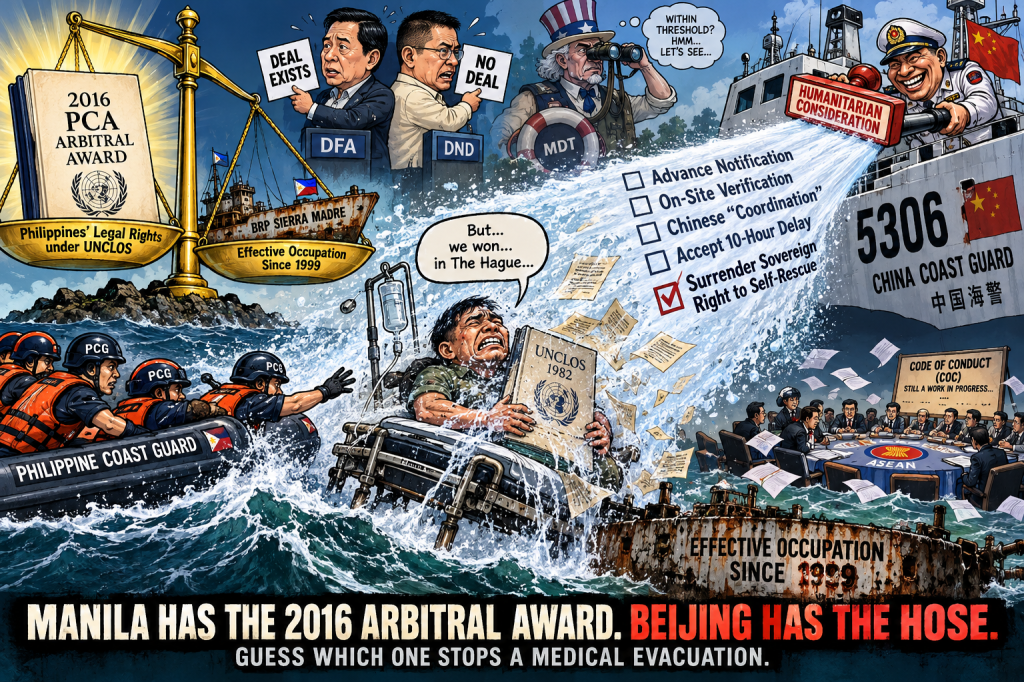
Manila Has the 2016 Arbitral Award. Beijing Has the Hose. Guess Which One Stops a Medical Evacuation.
By Louis “Barok” C. Biraogo | October 16, 2026
THE story Manila wants you to hear is simple: on October 8, a Filipino sailor needed a doctor. China’s Coast Guard sprayed a water cannon at the rescue boat, blocked it for ten hours, and only relented when the soldier’s own small rubber boat was finally allowed through. “When a life is at stake,” declared PCG Commandant Ronnie Gil Gavan, “there should be no water cannon, no obstruction, and no delay.” It is a clean narrative. Too clean, perhaps, for a maritime dispute where nothing is ever quite what it seems.
The story Beijing wants you to hear is equally tidy: the Philippines, under the humanitarian cover of a medical evacuation, tried to sneak a resupply vessel into waters China claims as its own. The Chinese Coast Guard, acting “legally and professionally,” allowed the transfer out of the goodness of its heart—but only after Manila delayed the operation repeatedly with excuses about “fuel shortages” and “broken engines.” “The Philippine side’s statements disregard facts and reverse black and white,” said CCG spokesman Jiang Lue. The Filipinos, in other words, were the ones playing games with a sick man’s life.
Somewhere between these two narratives lies a truth that neither side wants to admit: the October 8 incident is not really about a water cannon. It is about a permission slip. It is about who gets to decide when a sovereign nation may move its own personnel in waters it believes belong to it. And it is about the uncomfortable reality that the Philippines has spent two years convincing itself it is winning a legal war while losing the operational peace.
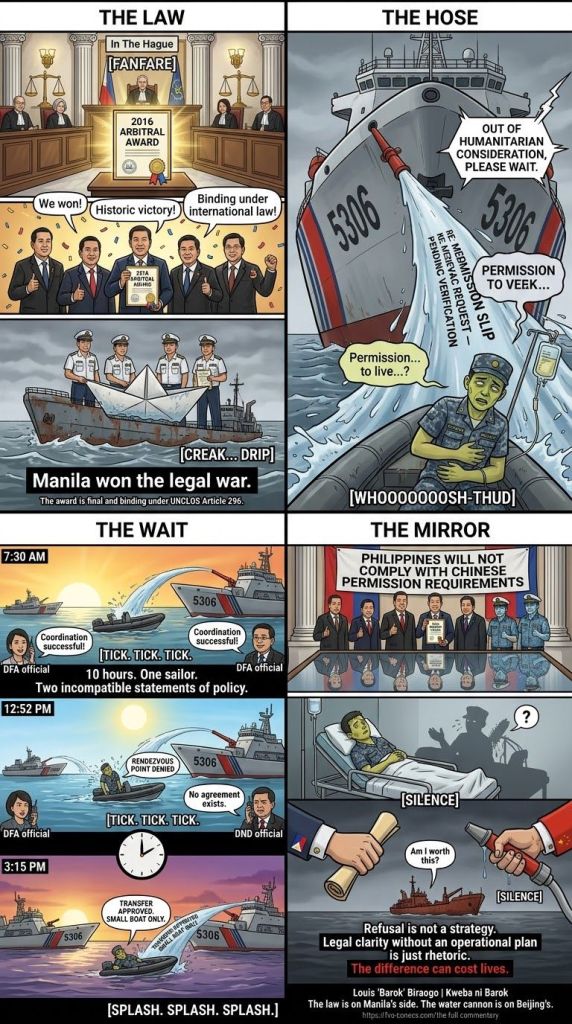
The Legal High Ground Is Real—and Insufficient
Let us begin with what is legally clear. The 2016 Arbitral Award found that Ayungin Shoal—Second Thomas Shoal—is a low-tide elevation within the Philippines’ exclusive economic zone (EEZ). The tribunal rejected China’s claim to historic rights within the nine-dash line insofar as those rights exceed United Nations Convention on the Law of the Sea (UNCLOS) entitlements. UNCLOS Article 56 gives the Philippines sovereign rights over resources in that EEZ. The BRP Sierra Madre, a commissioned Philippine Navy vessel grounded since 1999, sits there as a physical assertion of Philippine presence. The legal case is strong.
But here is what the legal case cannot do: it cannot make a water cannon stop spraying. It cannot make a Chinese Coast Guard captain read the arbitral award and have a change of heart. The Philippines holds the legal high ground, and China holds the hose.
This is the central paradox of Philippine maritime policy since 2016. Manila won a landmark arbitration, celebrated it, waved it in every international forum, and then discovered that enforcement is a different animal entirely. The award is final and binding under UNCLOS Article 296. China rejected it, and rejection, as it turns out, is a strategy. When you reject a ruling and then deploy coast guard vessels to prevent the other side from exercising the rights that ruling confirmed, you have effectively created a new status quo that the law does not reach.
President Marcos Jr., to his credit, seems to understand this. His statement that the Philippines will not comply with China’s “stated requirements for permission” is legally correct: China cannot unilaterally convert a disputed maritime encounter into a licensing regime for Philippine operations. Under UNCLOS Article 300, states must exercise their rights without abuse of right. Under Article 301, they must refrain from threats or uses of force against another state’s political independence. A Chinese demand that the Philippines seek permission before evacuating its own wounded soldier from its own vessel in its own claimed EEZ is precisely the kind of unilateral assertion that these provisions were designed to constrain.
But Marcos’s rhetoric has a problem. “In my own property,” he asked, “you’re going to tell me what I’m allowed to do?” The line lands well politically. It is legally sloppy. Ayungin is not “property” in the sense of territorial sovereignty. It is a low-tide elevation that cannot be appropriated under UNCLOS Article 13. The Philippines has sovereign rights and jurisdiction there, not sovereignty over the feature itself. The stronger legal hook is not property law but maritime law: the Sierra Madre is a warship entitled to sovereign immunity under Articles 29 and 95, and the Philippines has jurisdiction over installations in its EEZ under Article 60. Precision matters. Careless “territory” rhetoric gives Beijing an opening to portray Manila as the one overreaching.
The Permission Slip Problem
Here is where the story gets genuinely intriguing—and genuinely troubling.
The 2024 Provisional Understanding between Manila and Beijing was supposed to be a de-escalation mechanism. After the June 2024 boarding incident, in which Chinese forces injured a Philippine sailor and confiscated firearms, the two sides agreed on a “living document” that would allow resupply missions to the Sierra Madre without dangerous confrontations. The Department of Foreign Affairs (DFA) insisted the arrangement was purely humanitarian and recognized no Chinese jurisdiction. China, for its part, described it as requiring advance notification and on-site verification.
Notice the gap. One side says “coordination.” The other says “permission.” The text of the arrangement has never been made public. Senator Risa Hontiveros has filed a resolution demanding its disclosure under the constitutional right to information. Former Supreme Court Justice Antonio Carpio warns it may amount to acquiescence in China’s claims. Defense Secretary Gilberto Teodoro says the deal “does not exist.” The DFA says it does. The Department of National Defense (DND) says it doesn’t. The President’s own sister, Imee Marcos, has defended it as “practical.”
This is not mere bureaucratic confusion. It is a deliberate strategy of ambiguity—and it is unraveling. China has now interpreted the arrangement as establishing a permission-and-verification norm. The October 8 medevac obstruction is the logical endpoint: if Manila accepted Chinese “management” of resupply missions, why wouldn’t China also claim the right to manage medical evacuations? The permission slip, once accepted for groceries, becomes the template for everything.
This is the danger Carpio identified. Under international law, acquiescence—failure to protest against a practice that infringes your rights—can, over time, crystallize into a binding legal constraint. The cases of Preah Vihear and Pedra Branca are the classic warnings. If the Philippines routinely notifies Beijing before conducting operations at Ayungin and routinely waits for Chinese “verification,” it is not merely coordinating for safety. It is building a record of Chinese administrative authority.
The Internal Contradiction
The most revealing detail in this entire affair is not the water cannon. It is the contradiction between the DFA and the DND.
The DFA says the Provisional Understanding exists and is being implemented. The DND says it does not exist and that resupply will continue “regardless” of Chinese demands. These are not minor disagreements about tactics. They are fundamentally incompatible statements about Philippine policy, issued by two departments of the same government.
Chinese analysts have noticed. Ding Duo of the National Institute for South China Sea Studies describes the split as a “path divergence”: the DFA prefers quiet diplomatic management, while the military and coast guard prefer public confrontation that generates budget increases, equipment transfers, and political capital. “The more tense the South China Sea becomes,” Ding writes, “the easier it is for the military to get funding approved.” The 2027 Philippine defense budget plans a 6.3% increase, with modernization funding up 25%. The “transparency initiative” produces dramatic footage that plays well domestically and abroad. Confrontation has become a business model.
This is not to say that Chinese pressure is imaginary or that the Philippines has no legitimate grievances. The July 20 baton attack, the September 24 resupply obstruction involving People’s Liberation Army (PLA) Navy vessels, the October 8 water cannon—these are real. But the Philippine response has become entangled with institutional incentives that make de-escalation politically costly for the very agencies responsible for managing it. The DFA wants to negotiate. The DND and Philippine Coast Guard (PCG) want to document and publicize. Both cannot be right.
The Humanitarian Trap
Perhaps the most cynical element of the October 8 incident is how both sides weaponized a sick man.
China’s account is that the Philippines repeatedly delayed the transfer with “excuses” about fuel and engine problems, suggesting the medical emergency was a pretext for attempting a resupply run. Philippine accounts emphasize the ten-hour delay and the water cannon, suggesting China deliberately endangered a serviceman’s life to enforce an unsupported permission requirement.
Neither version can be independently verified from the public record. What we know is that a sailor needed medical attention, that the transfer eventually happened, and that both governments emerged from the episode claiming the moral high ground. The Philippines says China obstructed humanitarian access. China says the Philippines exploited humanitarian access. The sailor, presumably, got the worst of both narratives.
This is the dark logic of gray-zone coercion. China’s October 8 operation was not an armed attack. It did not trigger the Mutual Defense Treaty (MDT). It was a deliberately sub-threshold act—coercion by deprivation rather than violence. It imposed reputational costs on China while remaining difficult to answer with force. As one analyst put it, the ladder runs from protest to shadowing to blocking to water cannon to physical assault to denial of medical care to total interdiction of resupply. The October 8 incident sits at the penultimate rung.
The Code of Conduct Mirage
Marcos has said the incident will be raised in Code of Conduct (COC) negotiations. This is diplomatically sensible and strategically dubious.
The COC process has been grinding forward for years. In August 2026, the 57th Association of Southeast Asian Nations (ASEAN)-China Joint Working Group meeting was held in Manila to advance consultations. In January, senior officials adopted a roadmap and agreed to “accelerate the consultation process.” China’s Foreign Minister Wang Yi has declared that peace, cooperation, and friendship should be “the new narrative of the South China Sea.”
But Chatham House has judged a 2026 conclusion “unlikely” under a Philippine chairmanship. Beijing opposes a legally binding code. The gap between “coordination” and “authorization” that bedevils the Provisional Understanding would be replicated at regional scale. A COC that requires “notification” and “verification” for humanitarian operations would entrench Chinese leverage, not constrain it. A COC without enforcement mechanisms would be a press release dressed as a treaty.
The most practical ask—a humanitarian-access clause—is also the hardest to secure. It is difficult for Beijing to oppose openly, but also difficult to define in a way that does not legitimate the permission slip logic. The Philippines should push for it. But it should not pretend that a COC will solve the problem that a water cannon created.
What Marcos Is Not Saying
The President’s public statements have been firm, legally defensible, and strategically incomplete.
He says the Philippines will not comply with Chinese permission requirements. He does not say what the Philippines will do when a water cannon is aimed at the next medical evacuation. He says the incident will be raised in COC talks. He does not say what happens if the talks fail. He acknowledges allied support. He does not specify what that support will look like if a sailor dies.
This is the operational gap. Legal clarity without an operational plan is just rhetoric. The Philippine Coast Guard needs clear rules of engagement for medical evacuations under coercion: When do you proceed? When do you turn back? When do you call for naval escort? When do you accept that the risk to personnel outweighs the symbolic value of the mission?
There is also the question no one wants to ask: Is the BRP Sierra Madre worth the risk? It is a rusting hull with minimal military value. It has become a lightning rod for confrontation. Abandoning it would be politically impossible, but maintaining it requires putting Filipino sailors in harm’s way for a ship that cannot move, shoot, or defend itself. The “effective occupation” argument it supports is legally marginal. The human cost is not.
The Allies and the Ambiguity
The Mutual Defense Treaty with the United States is the ultimate escalation threshold. Article V defines an “armed attack” to include attacks on public vessels. A water cannon at a PCG vessel is likely below that threshold. A ramming that causes serious injury might cross it. A death would almost certainly trigger consultations.
But the treaty’s ambiguity cuts both ways. Washington has consistently maintained strategic ambiguity about automatic intervention. The Philippines should not assume that a water cannon incident—even one that delays a medical evacuation by ten hours—will bring American warships to Ayungin. The allies will provide intelligence, surveillance, and diplomatic support. They will not fight for a rusting hulk unless the stakes are unmistakable.
The Real Scandal
The October 8 incident is not a scandal because China sprayed water at a Philippine boat. That has happened before and will happen again. It is a scandal because it exposes the gap between the Philippines’ legal position and its operational capacity, between its public resolve and its private uncertainty, between what Manila says it will not accept and what it can actually prevent.
China has learned that it can obstruct medical evacuations, delay resupply missions, and swarm a Philippine island with militia sampans—all while staying below the threshold that would trigger a military response or a decisive international backlash. It has learned that the Philippine government will issue strongly worded statements, that the PCG will release dramatic footage, that the Senate will hold hearings, and that the COC talks will continue. It has learned that the permission slip, once accepted, becomes the template.
Marcos’s refusal to comply with Chinese demands is correct. But refusal is not a strategy. The Philippines needs a plan for what happens the next time a sailor gets sick, the next time a water cannon sprays, the next time China decides to test whether “no permission” really means no permission.
The law is on Manila’s side. The water cannon is on Beijing’s. Between those two facts lies the uncomfortable truth that the Philippines has spent years winning arguments it cannot enforce. The October 8 incident is not an escalation. It is a mirror. And what it reflects is a government that has confused legal victory with operational reality—and a nation that may soon discover that the difference can cost lives.
Louis “Barok” C. Biraogo is the author of the Kweba ni Barok blog, where he writes on Philippine politics, law, and the uncomfortable truths that official narratives prefer to bury.
Key Citations
A. Legal & Official Sources
- Permanent Court of Arbitration. The South China Sea Arbitration (The Republic of the Philippines v. The People’s Republic of China). 12 July 2016. https://pca-cpa.org/en/cases/7/
- United Nations. United Nations Convention on the Law of the Sea. 1982. https://www.un.org/depts/los/convention_agreements/texts/unclos/unclos_e.pdf
- Republic of the Philippines. Mutual Defense Treaty between the Republic of the Philippines and the United States of America. 30 Aug. 1951. https://www.officialgazette.gov.ph/1951/08/30/mutual-defense-treaty-between-the-republic-of-the-philippines-and-the-united-states-of-america-august-30-1951/
- Asia Maritime Transparency Initiative. “Judgment Day: The South China Sea Tribunal Issues Its Ruling.” CSIS, 11 July 2016. https://amti.csis.org/arbitration-ruling-analysis/
- Chatham House. “With the Philippines as ASEAN Chair, a South China Sea Agreement Is Unlikely to Be Concluded in 2026.” 9 Dec. 2025. https://www.chathamhouse.org/2025/12/philippines-asean-chair-south-china-sea-agreement-unlikely-be-concluded-2026
- Ministry of Foreign Affairs of the People’s Republic of China. “The 57th Meeting of the ASEAN-China Joint Working Group on the Implementation of the Declaration on the Conduct of Parties in the South China Sea Held in Manila.” 21 Aug. 2026. https://www.fmprc.gov.cn/eng/wjb/zzjg_663340/bianhaisi_eng_665278/bianhaixiangguanxinwen_665280/202608/t20260822_12008584.html
B. News Articles
- “China Coast Guard Harasses Ayungin Medical Evacuation.” The Manila Times, 10 Oct. 2026. https://www.manilatimes.net/2026/10/10/news/national/china-coast-guard-harasses-ayungin-medical-evacuation/2442810
- “PCG: China Coast Guard Delays PH Navy Personnel’s Medical Evacuation from Ayungin Shoal.” GMA News Online, 9 Oct. 2026. https://www.gmanetwork.com/news/topstories/nation/1005334/pcg-china-coast-guard-delays-ph-navy-personnel-s-medical-evacuation-from-ayungin-shoal/story/
- Romero, Alexis. “President Marcos Admits Escalation of Tensions in Ayungin.” The Philippine Star, 12 Oct. 2026. https://www.philstar.com/headlines/2026/10/12/2562551/president-marcos-admits-escalation-tensions-ayungin
- “Hontiveros Seeks Senate Scrutiny of PH-China Ayungin Deal.” Philippine News Agency, 11 Aug. 2026. https://www.pna.gov.ph/articles/1281560
- “‘Dumber Than Dumb’: Carpio Slams Ayungin Deal.” OneNews.PH, 25 July 2026. https://www.onenews.ph/dumber-than-dumb-carpio-slams-ayungin-deal
- “Philippines Accuses Chinese Coast Guard of Injuring Filipino Sailor in Disputed Shoal.” Associated Press, 20 July 2026. https://apnews.com/article/philippines-south-china-sea-second-thomas-shoal-16650e191aaf373471720dbcba88b819
- Ministry of Foreign Affairs of the People’s Republic of China. “Wang Yi: Peace, Cooperation and Friendship Should Be the New Narrative of the South China Sea.” 8 Mar. 2026. https://www.fmprc.gov.cn/eng/wjbzhd/202603/t20260308_11870562.html
- “Ang Hirap Maging Mahirap”: The PAO Scandal That Proves Government Contempt Is Nothing New

- “Far-Off” My Axx: Malacañang’s Claire Castro Drowns in Her Own Legal Gaslighting
- “Forthwith” to Farce: How the Senate is Killing Impeachment—And Why Enrile’s Right (Even If You Can’t Trust Him)
- “HINDI AKO NAG-RESIGN!”

- “I Know Nothing”: Baste Duterte’s Amnesia Defense Meets ₱33M in GenCorp Contracts

- “I’m calling you from my new Globe SIM. Send load!”

- “Mahiya Naman Kayo!” Marcos’ Anti-Corruption Vow Faces a Flood of Doubt

- “Manageable” Debt, Unmanageable Lies: DBM’s ₱21 Trillion Fairy Tale
- “Meow, I’m calling you from my new Globe SIM!”

- “Natrabaho”: One Word, One Ombudsman, and a Judiciary on Trial
- “No Special Jail for Crooks!” Boying Remulla Slams VIP Perks for Flood Scammers
- “Philippine-Controlled” or Yankee Gas Station? The Davao Fuel Depot Farce Exposed




Leave a Reply