Three Articles, Kept the Prejudice, and Called the Defense’s Rebuttal “a Waste of Time”
By Louis ‘Barok’ C. Biraogo | October 17, 2026
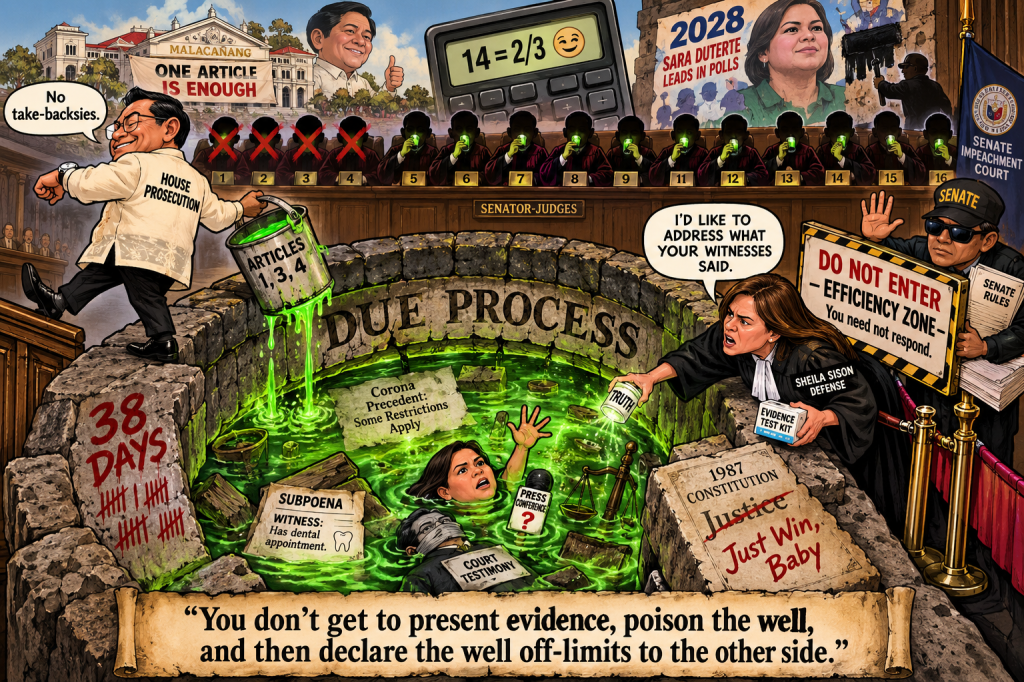
THE House prosecution panel, in a move of breathtaking legal strategy that would make a first-year law student blush, has withdrawn three of the four Articles of Impeachment against Vice President Sara Duterte. The charge that remains? Unexplained wealth. The charge that vanished into the ether? Misuse of confidential funds, bribery, and—wait for it—alleged assassination threats against the President.
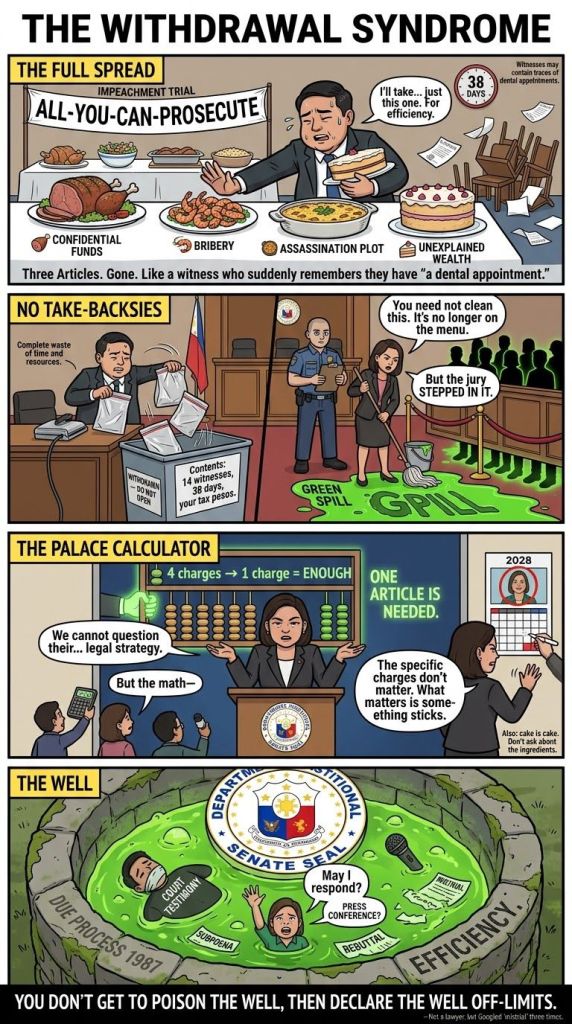
Three charges. Gone. Like a witness who suddenly remembers they have “a dental appointment” when the subpoena arrives.
The prosecution’s explanation, delivered with the straight-faced solemnity of a used car salesman explaining why the odometer is “just a number,” is that this move will “expedite the proceedings.” The Senate impeachment court, through Presiding Officer Chiz Escudero, dutifully accepted the withdrawal, ruled that the defense no longer needs to present evidence on the dropped articles, and lifted the sub judice rule to allow both sides to discuss the abandoned allegations publicly.
And here’s where the plot thickens. Or rather, where the plot spontaneously combusts.
The Defense Wants to Actually Defend. How Quaint.
Lead defense counsel Sheila Sison—who, unlike apparently everyone else in this clown show, remembers that trials are supposed to involve both sides presenting evidence—argued that the defense intends to present its case regardless of the prosecution’s strategic retreat. The withdrawal should not determine how Duterte’s lawyers respond to allegations that were already presented, already aired publicly, and already absorbed into the senator-judges’ collective consciousness.
The prosecution’s response? Defense spokesperson Benjamin Tolosa called rebutting the dropped articles “a complete waste of time and resources.” Because apparently, the only thing more wasteful than spending months presenting evidence on charges you eventually abandon is letting the other side respond to that evidence.
Let that sink in for a moment. The prosecution spent weeks—by some accounts, 38 days—parading witnesses, submitting documents, and painting a narrative of corruption and misconduct. Then they decided, “Actually, never mind on three of those.” And when the defense said, “We’d like to address what your witnesses said,” the prosecution responded with the legal equivalent of “No take-backsies.”
The Corona Precedent: A Distinction With a Difference
The prosecution has leaned heavily on the 2012 impeachment of Chief Justice Renato Corona, where the House prosecution dropped five of eight articles, and the trial proceeded on the remaining three. Precedent set, right?
Not so fast.
The Corona case involved minimal evidence presentation on the dropped articles. The Duterte case? Fourteen witnesses testified on the confidential funds and grave threats charges alone. Thirty-eight days of trial. The evidentiary record on those abandoned articles is not a footnote—it’s a volume.
As defense spokesperson Michael Poa pointed out, witnesses the defense wanted to subpoena “are not necessarily aligned with us” and cannot simply be summoned to a press conference. The court’s lifting of the sub judice rule allows Duterte to speak publicly about the dropped allegations, but as Poa noted, defending charges at a press conference is not the same as defending them in court.
Escudero, to his credit, seemed to recognize the fairness problem. “The last thing I want anyone to say when they leave this courtroom is, ‘She was not allowed to respond in court, and now she is not even allowed to respond outside it,’” he said. It’s a noble sentiment. But allowing someone to defend themselves in the media rather than in the tribunal where the accusations were made is not due process. It’s damage control.
The Palace’s Remarkable Non-Statement Statement
Malacañang, when asked about the withdrawal, offered a response that can only be described as aggressively indifferent. Palace Press Officer Claire Castro said the Palace “cannot question” the prosecution’s decision, calling it part of their “legal strategy.”
But here’s the kicker: Castro also said that “one article would be needed” to establish that Duterte should be impeached. One article. Any article. The specific charges apparently don’t matter—what matters is that something sticks.
This is the kind of logic that would be funny if it weren’t so chilling. The prosecution spent months building a case on four articles of impeachment, then abandoned three, and the executive branch’s response is essentially, “Well, one is probably enough.” It’s not an endorsement of the remaining charge. It’s an endorsement of the outcome.
The Real Question Nobody’s Asking
Here’s what’s conspicuously absent from the prosecution’s explanation: Why drop the articles now?
The prosecution says it wants to “expedite” the proceedings. But the trial was already underway. Evidence had been presented. Witnesses had testified. The expedited option would have been to, you know, finish the trial.
The more plausible explanation—and the one the defense has hinted at—is that the prosecution realized the evidence on those three articles was weaker than advertised. Or worse, that pursuing them risked exposing uncomfortable truths about people other than Sara Duterte.
Progressive groups wasted no time pointing this out. Former Bayan Muna Rep. Carlos Isagani Zarate accused the prosecution of choosing “political convenience over true accountability.” Former ACT Teachers Rep. France Castro asked the question that should be on every journalist’s lips: “Are they worried that this issue would boomerang to President Marcos?”
The confidential funds charge, after all, involved P125 million approved by the Office of the President for the Office of the Vice President. If the prosecution had continued, they would have had to explain why the same office that approved those funds is now investigating their misuse.
But sure. Let’s pretend this is about efficiency.
The Mistrial That Nobody Wants to Name
Retired Supreme Court Associate Justice Noel Tijam—who, unlike the current Senate impeachment court, seems to remember what due process means—warned that the court’s refusal to let the defense rebut evidence tied to the withdrawn articles “could raise due process concerns” and “could be grounds for a mistrial.”
Tijam offered two options: allow the defense to present counter-evidence, or remove the prosecution’s evidence from the record entirely. The Senate chose neither. They simply told the defense to move on.
This is not how adversarial proceedings work. You don’t get to present evidence, poison the well, and then declare the well off-limits to the other side.
The Political Calculus: Conviction by Subtraction
Let’s be clear about what’s happening here. The prosecution didn’t drop three articles because they suddenly remembered they had somewhere else to be. They dropped them because the math changed.
The Senate impeachment court earlier ruled that the two-thirds conviction threshold would be calculated based on senators actually able to participate—14 votes instead of 16. With four senators unable to participate, the bar for conviction dropped.
Sara Duterte remains the leading presidential candidate for 2028, with poll numbers that would make any opposition strategist weep. Convicting her on a single charge—unexplained wealth—is cleaner, faster, and less likely to generate public sympathy than a prolonged trial on multiple fronts.
The withdrawal is not a strategic retreat. It’s a strategic refocus. The prosecution is betting that one conviction is better than four failed ones.
And the defense? They’re left arguing for the right to defend themselves against charges that the prosecution has already decided they can’t win. Which is either the most principled position in this entire saga or a masterclass in political jiu-jitsu. Probably both.
The Verdict on the Verdict
Sheila Sison is right. The prosecution cannot have it both ways—presenting evidence on charges, then withdrawing those charges to avoid having that evidence tested. The senator-judges have heard testimony about confidential funds and threats. That testimony doesn’t evaporate because the prosecution changed its mind.
The Senate’s ruling that the defense “need not” present evidence on the withdrawn articles is technically correct. The defense need not. But “need not” is not the same as “may not.” And if the defense believes it must address those allegations to ensure a fair verdict on the remaining charge, the court’s refusal to allow that is not efficiency. It’s expedience.
Escudero said he didn’t want Duterte to leave the courtroom saying she wasn’t allowed to respond. But that’s exactly what will happen if the defense is barred from presenting evidence on charges that were already litigated in open court.
The Senate can call it streamlining. The prosecution can call it strategy. But the defense—and anyone who cares about the integrity of these proceedings—will call it what it is: a trial where one side gets to present its case and the other side gets to take notes.
And in a country where impeachment is supposed to be the ultimate accountability mechanism, that’s not just unfair. It’s a mockery.
Louis ‘Barok’ C. Biraogo is not a lawyer, which apparently makes him uniquely qualified to explain why the Senate’s ruling is legally dubious. He writes at Kweba ni Barok, where he chronicles the absurdities of Philippine governance with the weary resignation of someone who Googled “what is a mistrial” three times while writing this piece and still got it right.
Key Citations
A. Legal & Official Sources
- The 1987 Constitution of the Republic of the Philippines. Official Gazette of the Republic of the Philippines, 1987, http://www.officialgazette.gov.ph/constitutions/1987-constitution/.
B. News Reports
- “EXPLAINER: What Is a Mistrial?” GMA News Online, GMA Network, 13 Oct. 2026, http://www.gmanetwork.com/news/topstories/nation/1005765/explainer-what-is-a-mistrial/story/.
- “Duterte Defense: Dropping Charges Cannot Silence Rebuttal.” Daily Tribune, 13 Oct. 2026, tribune.net.ph/2026/10/13/duterte-defense-dropping-charges-cannot-silence-rebuttal.
- “Impeachment Court Lifts Sub Judice Rule on Articles Withdrawn by Prosecutors.” GMA News Online, GMA Network, 13 Oct. 2026, http://www.gmanetwork.com/news/topstories/nation/1005783/impeachment-court-lifts-sub-judice-rule-on-articles-withdrawn-by-prosecutors/story.
- “Tolosa: Rebutting dropped VP charges ‘waste of time and resources’.” Inquirer.net, 14 Oct. 2026, https://newsinfo.inquirer.net/2324504/tolosa-rebutting-dropped-vp-charges-waste-of-time-and-resources.
- “Mistrial Possible If Sara Cannot Rebut Dropped Charges—Retired SC Justice.” Daily Tribune, 14 Oct. 2026, tribune.net.ph/2026/10/14/mistrial-possible-if-sara-cannot-rebut-dropped-charges-retired-sc-justice.
- “[ANALYSIS] VP Sara at a Crossroads: Quantum of Evidence or Quantum of Lies?” Philstar Life, Philstar Global, 13 Oct. 2026, philstarlife.com/news-and-views/916893-analysis-duterte-impeachment-trial-day-39.
- “Senate Court Allows Prosecution to Drop 3 Impeachment Articles vs. Sara Duterte.” GMA News Online, GMA Network, 13 Oct. 2026, http://www.gmanetwork.com/news/topstories/nation/1005756/senate-court-allows-prosecution-to-drop-3-impeachment-articles-vs-sara-duterte/story/.
- ₱9 Billion in ‘Savings’? DILG’s Fire Truck Deal Smells Like Smoke

- ₱8B BBM Pork: CCTV for Every Captain’s Kumpare?

- ₱8.9 Billion, 331 Ghost Police Stations: The TIKAS Scandal Explained

- ₱8.4 Billion, 42,000 Barangays, 1 Election: The “Bawat Barangay Makikinabang” Vote-Buying Masterclass

- ₱75 Million Heist: Cops Gone Full Bandit

- ₱6.77B Ghost Haunts Duterte: RTC Dismisses Mans Carpio’s Desperate Plea

- ₱6.77 Billion and Zero Cash: The Sara Duterte SALN Math That Doesn’t Add Up

- ₱6.7-Trillion Temptation: The Great Pork Zombie Revival and the “Collegial” Vote-Buying Circus

- ₱58.53B, Zero Receipts: The LGSF Pork Barrel Nobody Wants to Name

- ₱53 Million Man Tells ₱695-a-Day Workers to Stop Being ‘Mayabang’: The Audacity of BSP’s Remolona

- ₱4.4 Billion and a Witness Who Can’t Explain It: The Duterte Impeachment’s Most Expensive Non-Answer
- ₱3.06 Billion for Evacuation Centers—But Nobody Knows Where They’ll Stand (Or If They’ll Exist)







Leave a Reply