Sermon on the Mount vs. Math on the Floor: Who Really Decides Duterte’s 2028 Fate?
By Louis ‘Barok‘ C. Biraogo — October 18, 2026
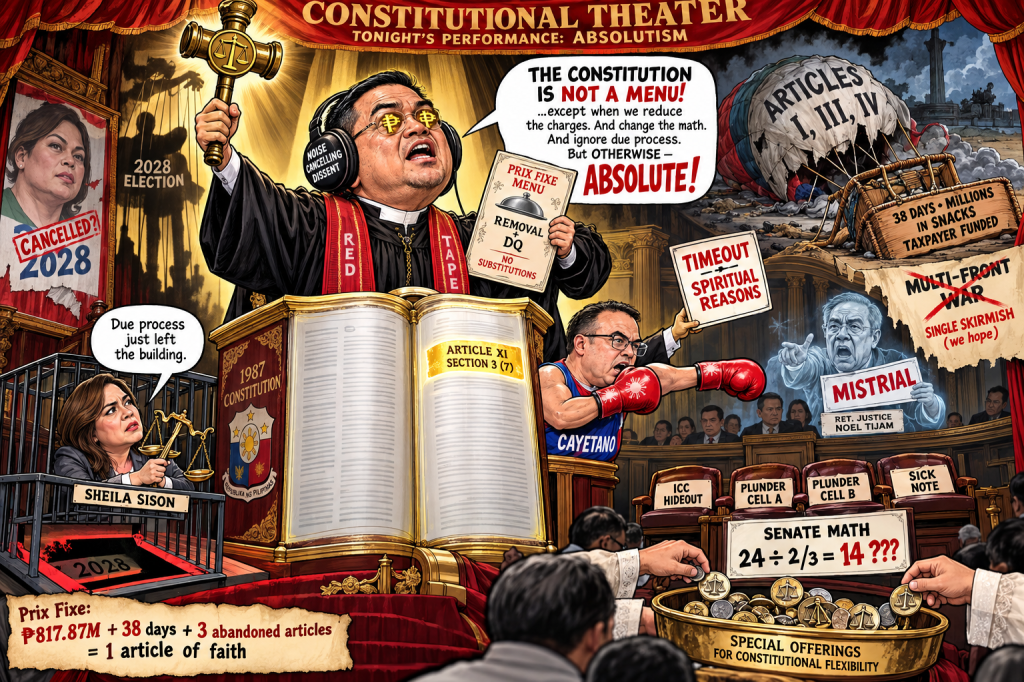
LET US gather, children of the impeachment gallery, and give thanks for Atty. Benjamin “Jay” Tolosa Jr., the House prosecution’s legal spokesperson and a man who has discovered that the Constitution is not merely a document but a weapon of rhetorical mass destruction. This week, Tolosa stood before the microphones and delivered a homily on the sanctity of Article XI, Section 3(7) of the 1987 Constitution of the Republic of the Philippines, rejecting with righteous indignation any suggestion that Vice President Sara Duterte could be convicted in the Senate and yet—gasp—remain eligible to run for president in 2028.
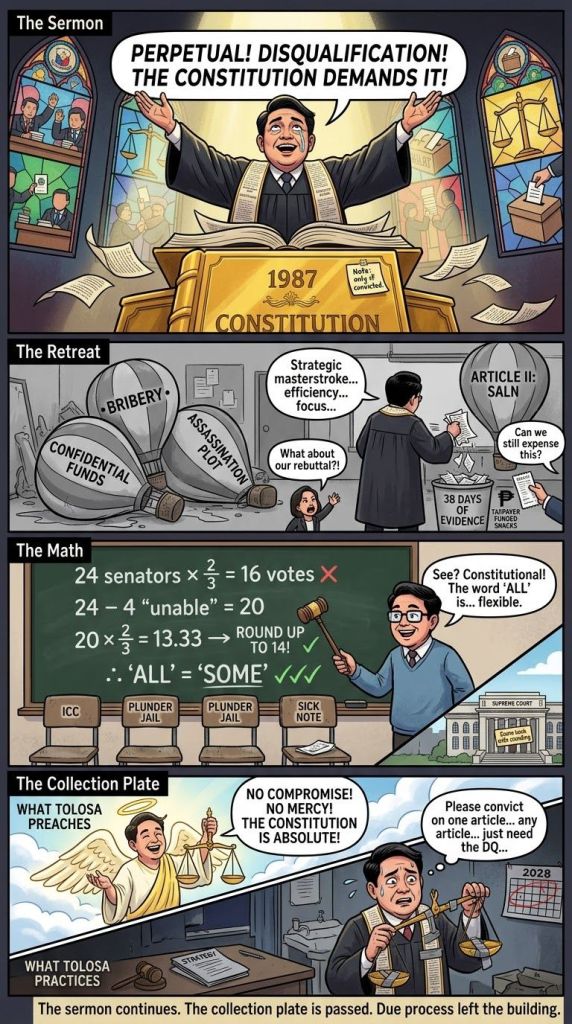
“That has no basis,” Tolosa thundered, “and it’s inconsistent with the provisions of the Constitution.” Perpetual disqualification, he insisted, is the inevitable handmaiden of removal. One article or four, the penalty is the same. The Constitution, you see, is not a menu. It is a prix fixe.
How stirring. How pure. How utterly convenient that this constitutional absolutism emerged precisely at the moment the prosecution’s case began to resemble a punctured balloon.
#SaraDuterteImpeachment #PhilippinePolitics #ConstitutionalTheater
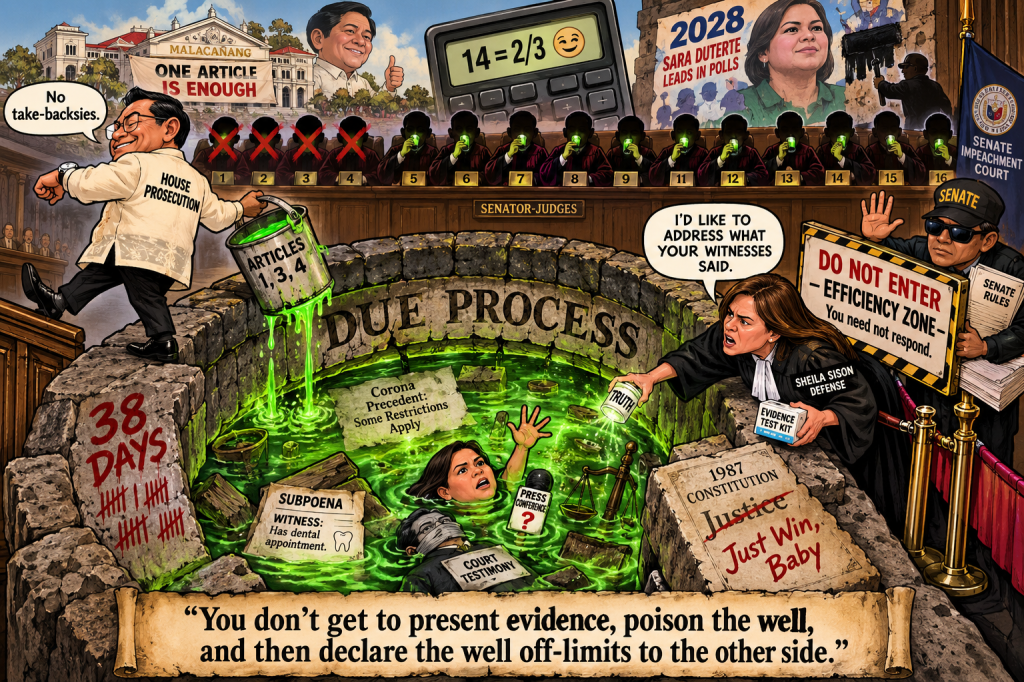
Let us rewind, as any good investigator would, to the scene of the crime against logic. On October 13, after thirty-eight days of trial and untold millions in taxpayer-funded snacks, the House prosecution abruptly withdrew three of its four impeachment articles. Gone: the confidential funds allegation. Gone: the bribery charge. Gone: the grave threats article involving an alleged assassination plot against the President.
What remained was Article II—unexplained wealth, inaccurate Statement of Assets, Liabilities and Net Worth (SALN), business interests—a charge that, while serious, now carries the entire weight of a prosecution that once promised a multi-front war and settled for a single skirmish.
The defense, predictably, cried foul. Lead counsel Sheila Sison argued that presenting evidence on charges and then abandoning them without allowing rebuttal was a denial of due process, a “mistrial” in the making. Senator-judge Alan Peter Cayetano offered the most vivid analogy: “In a fistfight, you punch the defense, then say, ‘To save time, don’t hit back’.” Even retired Supreme Court Justice Noel Tijam warned of a potential mistrial.
Tolosa’s response? The defense had no evidence anyway. They were just stalling. The withdrawal was a strategic masterstroke, not a retreat. And anyway, one article is enough to secure the constitutional penalties.
This is where the constitutional sermon becomes suspicious. If one article is truly sufficient, and if the penalty is truly automatic, why did the prosecution need thirty-eight days and three additional articles to reach this revelation? Why present evidence on confidential funds and grave threats if the legal theory was always that Article II alone would trigger removal and perpetual disqualification?
The answer, of course, is that the withdrawal was not a legal strategy. It was a political calculation dressed in procedural robes. The prosecution, sensing that its broader case was either weak or politically inconvenient, retreated to the charge it believed most likely to yield a conviction—and then wrapped that retreat in the flag of constitutional fidelity.
But let us not be uncharitable. Perhaps Tolosa genuinely believes every word. Perhaps he lies awake at night, tormented by the possibility that the Senate might convict Duterte on Article II and then—horror of horrors—allow her to seek office. The Constitution, after all, does say that judgment “shall not extend further than removal from office and disqualification”. Note the phrase “shall not extend further than.” This is a ceiling, not a floor. It limits what the Senate may impose. It does not, by its plain text, command that every conviction must include disqualification.
Tolosa’s reading—that removal and disqualification are an inseparable package—is plausible. It is also debatable. Constitutional Commission records may support it; some scholars disagree. A serious prosecutor would acknowledge this interpretive uncertainty. Tolosa, instead, declared the compromise “has no basis” and “inconsistent with the Constitution,” as if the matter were settled beyond cavil.
This is not constitutional lawyering. This is constitutional theater.
And what a stage it is. The Senate, meanwhile, has already performed its own act of mathematical creativity, lowering the conviction threshold from sixteen votes to fourteen by ruling that only senators “able to participate” count toward the two-thirds requirement. Four senators are unable to participate: one hiding from the International Criminal Court (ICC), two detained on plunder charges, one on medical leave.
The Constitution says “two-thirds of all the Members of the Senate.” The Senate says: all means some, depending on who shows up. Petitions have been filed. The Supreme Court has dismissed some on procedural grounds. The math is contested. The legitimacy is contested. And into this maelstrom steps Tolosa, lecturing the nation on constitutional purity.
There is a word for this, and the word is not “principle.” It is “convenience.”
Consider the timing. The compromise was floated, according to Tolosa, as a way to convict Duterte but preserve her 2028 eligibility. This is precisely the outcome that moderate senators—those who wish to appear “judicious” by convicting on the facts while avoiding the political fallout of disqualifying the country’s most popular presidential contender—might find attractive.
Tolosa’s rejection of this compromise serves two purposes. First, it maintains maximum pressure on the Senate: no easy off-ramp, no split-the-difference verdict. Second, it positions the prosecution as the guardian of constitutional integrity, even as its case shrinks to a single article and its evidence remains untested by the defense.
The irony is exquisite. The prosecution withdrew three articles without allowing rebuttal, a move the defense calls a due process violation. Then the prosecution’s spokesman declares that any compromise on penalties would be unconstitutional. So: withdrawing charges mid-trial is strategy, but negotiating penalties is heresy. Presenting evidence and then abandoning it is efficiency, but suggesting that disqualification might be discretionary is sacrilege.
The prosecution, it seems, has a very flexible relationship with procedural propriety—rigid where it suits them, expedient where it doesn’t.
Let us also note what Tolosa’s constitutional absolutism conveniently ignores: the political context that makes the disqualification question so fraught. Duterte leads in presidential preference polls. Her father is facing ICC proceedings. The Marcos-Duterte alliance has collapsed into open warfare. A conviction with disqualification would not merely remove a vice president; it would eliminate the strongest challenger to the administration’s preferred successor.
Tolosa insists that the Constitution does not care about 2028. Perhaps. But the timing of his intervention—precisely when a compromise might have resolved the trial without determining the next election—suggests that someone cares very much indeed.
The most charitable reading of Tolosa is that he is a true believer, a lawyer who genuinely thinks the Constitution requires what he says it requires, and who refuses to let politics dilute legal principle. The less charitable reading is that he is a skilled advocate doing exactly what advocates do: framing his client’s interests as the commands of higher law. The least charitable reading—and the one most consistent with the evidence—is that he is providing constitutional cover for a prosecution that has already retreated on three fronts and now needs to justify its remaining case by promising that the prize at the end is absolute.
Meanwhile, the actual evidence against Duterte on Article II—the ₱817.87 million in alleged unexplained wealth, the SALN discrepancies, the business interests—remains contested. Forensic analyst Alexander Cabrera presented computations. The defense will challenge attribution, methodology, and the distinction between transaction flows and net worth. The Senate will decide. And Tolosa will continue to sermonize about perpetual disqualification as if the outcome were preordained.
Here is the uncomfortable question that no one in the prosecution seems willing to answer: If the constitutional penalties are automatic, and if one article suffices, and if the evidence is compelling, why did you need thirty-eight days and four articles to get here? Why not present Article II, rest your case, and let the Constitution do its work?
The answer is that impeachment is not a legal seminar. It is a political trial. And political trials require political strategies. Withdrawing weak charges is a political strategy. Rejecting a compromise that might let the respondent live to fight another day is a political strategy. Invoking the Constitution as if it were a thunderbolt from Mount Olympus is a political strategy.
Tolosa is not wrong that the Senate cannot simply invent penalties. He is not wrong that a political bargain cannot override constitutional text. But he is wrong—or at least disingenuous—to present the disqualification question as settled. It is not settled. It is contested. And the contest matters precisely because the stakes are so high.
In the end, the Gospel According to Tolosa offers a simple creed: conviction means removal and disqualification, no exceptions, no compromises, no mercy. It is a creed that serves the prosecution’s interests admirably. Whether it serves the Constitution—or the truth—is a question the senator-judges, and perhaps the Supreme Court, will have to answer. In the meantime, the sermon continues. The collection plate is being passed. And somewhere in the gallery, a defense lawyer is muttering that due process just left the building.
Key Citations
A. Legal & Official Sources
- The 1987 Constitution of the Republic of the Philippines. Official Gazette of the Republic of the Philippines, 1987, http://www.officialgazette.gov.ph/constitutions/1987-constitution/.
B. News Reports
- Escosio, Jan. “House Prosecution Rejects Sara Duterte Trial ‘Compromise’.” INQUIRER.net, 16 Oct. 2026, newsinfo.inquirer.net/2325336/house-prosecution-rejects-sara-duterte-trial-compromise/.
- Panti, Llanesca T. “Prosecution Drops 3 Articles, Retains Article II in Sara Duterte Impeachment Trial.” GMA News Online, GMA Network, 13 Oct. 2026, http://www.gmanetwork.com/news/topstories/nation/1005740/prosecution-drops-3-articles-retains-article-ii-in-sara-duterte-impeachment-trial/story/.
- Villanueva, Brooke. “Prosecution Withdraws 3 Impeachment Articles vs Sara Duterte.” Philstar Life, Philstar Global, 13 October 2026, philstarlife.com/amp/article/782399-prosecution-withdraws-articles-impeachment-trial-duterte.
- Santos,Tina G. “Senate Court Allows Reduced Charges against Philippine Vice President Sara Duterte.” Asia News Network, 14 October 2026, asianews.network/?p=307725.
- ₱9 Billion in ‘Savings’? DILG’s Fire Truck Deal Smells Like Smoke

- ₱8B BBM Pork: CCTV for Every Captain’s Kumpare?

- ₱8.9 Billion, 331 Ghost Police Stations: The TIKAS Scandal Explained

- ₱8.4 Billion, 42,000 Barangays, 1 Election: The “Bawat Barangay Makikinabang” Vote-Buying Masterclass

- ₱75 Million Heist: Cops Gone Full Bandit

- ₱6.77B Ghost Haunts Duterte: RTC Dismisses Mans Carpio’s Desperate Plea
- ₱6.77 Billion and Zero Cash: The Sara Duterte SALN Math That Doesn’t Add Up

- ₱6.7-Trillion Temptation: The Great Pork Zombie Revival and the “Collegial” Vote-Buying Circus

- ₱58.53B, Zero Receipts: The LGSF Pork Barrel Nobody Wants to Name
- ₱53 Million Man Tells ₱695-a-Day Workers to Stop Being ‘Mayabang’: The Audacity of BSP’s Remolona
- ₱4.4 Billion and a Witness Who Can’t Explain It: The Duterte Impeachment’s Most Expensive Non-Answer
- ₱3.06 Billion for Evacuation Centers—But Nobody Knows Where They’ll Stand (Or If They’ll Exist)





Leave a Reply