How Washington’s “Deterrence” Package Transforms Palawan from Paradise to Powder Keg
By Louis “Barok” C. Biraogo — July 30, 2026
I. Nine Million Dollars for a Pier, One Hundred Million for a Headache
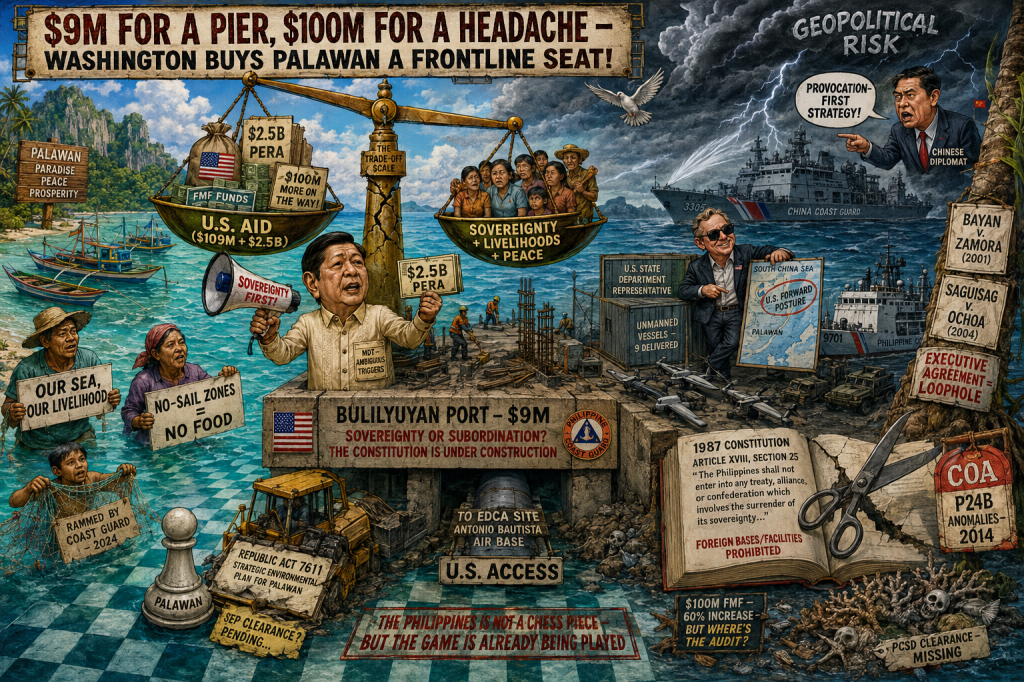
On July 22, 2026, the U.S. State Department released a fact sheet—you know, the kind of glossy document that makes a strategic encirclement look like a charitable donation—earmarking up to $9 million for a Philippine Coast Guard pier expansion in Palawan. That’s “Buliluyan Port,” to be precise—a quiet fishing outpost about to become the belle of the geopolitical ball.
Accompanying this modest dock upgrade is a $100 million increase in Foreign Military Financing (FMF), a $60 million jump over historical annual levels. Read the fine print: by the end of Fiscal Year 2026, Uncle Sam is writing a check for $100 million for Manila to procure military equipment and services. Throw in the Philippine Enhanced Resilience Act (PERA), authorizing $2.5 billion through 2030, and you’ve got what Washington calls “deterrence” and Beijing calls a “forward hub.”
But here’s the question that keeps me up at night, and it’s not whether Chinese coast guard vessels are any good at water cannons. It’s this: is $9 million for a pier, and $100 million for guns, a partnership, or is this a classic case of Washington betting with Manila’s chips—wagering Filipino lives, territory, and sovereignty on a poker game the U.S. never has to lose?
II. Legal Validity: The Saguisag Doctrine and the Executive-Agreement Loophole
Let’s start with the Constitution, because in the Philippines, that’s where sovereignty lives—or at least, where it’s supposed to.
Article XVIII, Section 25 of the 1987 Constitution is clear: “foreign military bases, troops, or facilities” may be allowed in the Philippines only by virtue of a treaty duly concurred in by the Senate—and if Congress so requires, ratified in a national referendum. This provision was written in direct reaction to the Subic-Clark era, when the U.S. military presence was, shall we say, inconveniently close to being permanent.
The Supreme Court, bless their black robes, has already made life interesting for constitutional purists. In Bayan v. Zamora (2000), the Court held that Section 25 draws “no distinction between transient and permanent” foreign presence. Read that again: no distinction. A temporary deployment of U.S. troops? Subject to Section 25. A “rotational” presence? Subject to Section 25. A pier expansion funded by the Pentagon? You’d think so, right?
But then came Saguisag v. Ochoa (2016), and the Court upheld the Enhanced Defense Cooperation Agreement (EDCA) as an executive agreement—not a treaty requiring Senate concurrence. The logic? EDCA doesn’t establish permanent U.S. bases but authorizes “rotational presence and construction of storage, fuel, and logistics facilities within Philippine-controlled ‘Agreed Locations’.” The Court found this consistent with prior treaty obligations, not an expansion of them.
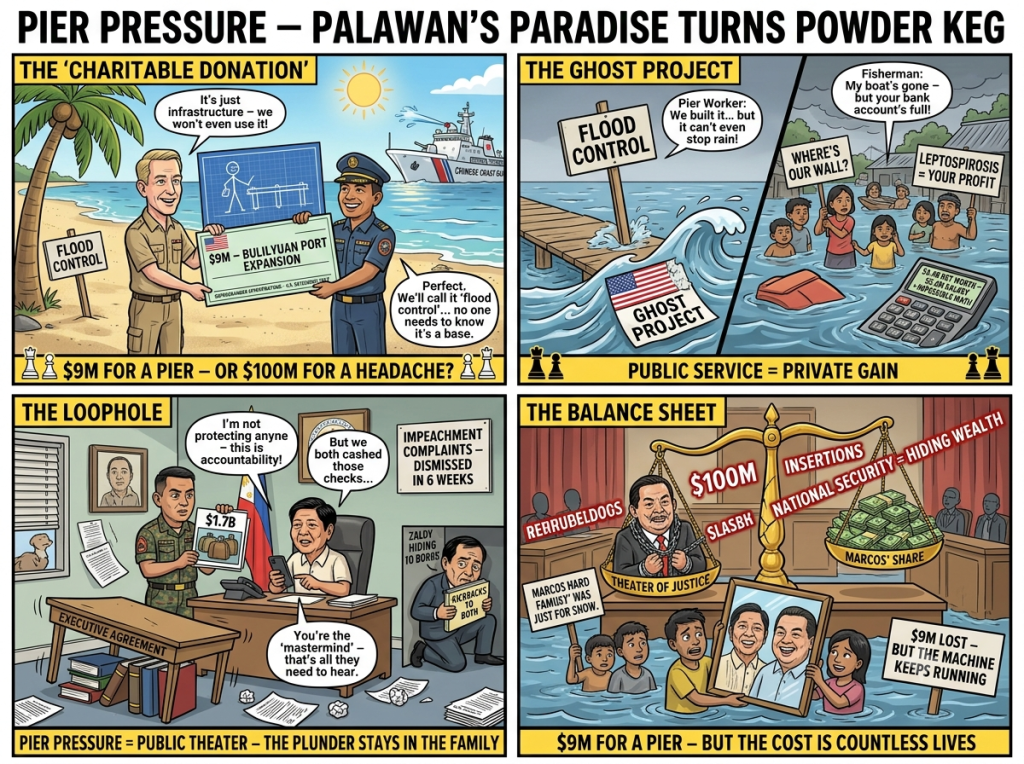
Here’s where the Buliluyan pier gets slippery. The $9 million is FMF—an American grant for a facility the Philippine Coast Guard will ostensibly own and operate. On the Saguisag logic, that’s perfectly kosher: no foreign base, no foreign troops, just a Filipino asset built with borrowed money.
But Buliluyan does not exist in isolation. It exists to feed operations from Antonio Bautista Air Base—an actual EDCA Agreed Location a short distance away. The Pentagon’s own solicitations describe Buliluyan as part of a network coordinated with U.S. command-and-control interests. The functional integration—a U.S.-funded pier supporting operations from a U.S.-accessible base—raises a question the Court has never squarely tested: does a nominally Filipino-owned asset, embedded in a U.S.-orchestrated network, constitute a “foreign facility” under Section 25?
The Court’s own language in Saguisag is instructive: “When no distinction is made by law, the Court should not distinguish—Ubi lex non distinguit nec nos distinguire debemos.” But here, the executive branch is making a distinction: between a treaty-authorized base and an executive-agreement-funded pier. And the Court, so far, has let it slide.
There’s another legal loose end. Palawan is governed by Republic Act No. 7611, the Strategic Environmental Plan (SEP) for Palawan Act, which created the Palawan Council for Sustainable Development (PCSD) and requires an SEP Clearance—grounded in ECAN zoning—before any project proceeds. PCSD Administrative Order No. 6 explicitly extends this requirement to “all government instrumentalities.” No PCSD ruling has squarely addressed whether national security infrastructure enjoys an implicit exemption. No public record confirms SEP Clearance has been obtained for Buliluyan. That’s a transparency gap that would make a seasoned COA auditor weep.
III. Strategic Motives: The “Forward Risk Absorber” Thesis
This is where we pull back the curtain—and find the wizard is a fool. Because the U.S. funding isn’t just about a pier. It’s about a posture.
On May 20, 2026, the Pentagon released notices for “upcoming projects at key facilities in Palawan.” The list includes an intermediate logistics maintenance center at Buliluyan Port and a fuel depot refurbishment at Antonio Bautista Air Base. The latter is an EDCA site, one of nine that a July 2026 report by Beijing’s South China Sea Strategic Situation Probing Initiative (SCSPI) described as forming a posture that “locks the Taiwan Strait from the north and controls the South China Sea from the south.”
The SCSPI report noted that physical construction has proceeded more slowly than Chinese analysts expected—a useful corrective against American triumphalism. But the strategic logic is clear: Palawan is being transformed from a strategic rear into a “forward hub” for operations against China.
The U.S. position, articulated in official strategy documents, is that this is about “deterrence,” not war. The 2023 Bilateral Defense Guidelines state that an armed attack on either country’s coast guard—anywhere in the South China Sea—would invoke the Mutual Defense Treaty (MDT). Secretary of Defense Pete Hegseth reaffirmed this commitment during his March 2025 visit to Manila.
But here’s the rub: the MDT’s “constitutional processes” clause means the U.S. retains full discretion over whether and how to respond. Manila carries the frontline risk—the proximity to Chinese cutters, the domestic backlash, the potential for casualties—while Washington holds the option of intervention. This is the core of the “forward risk absorber” thesis: the Philippines accepts the full brunt of proximity tensions so the United States can secure strategic advantage without endangering its own territory or population.
In 2024, when a Filipino sailor lost a thumb to a Chinese Coast Guard ramming, Manila chose not to invoke the MDT. The legal trigger was clearer after the 2023 guidelines, but the political decision to pull it was not.
IV. Escalation Dynamics and Governance Implications
This funding doesn’t just change Palawan’s infrastructure; it changes Palawan’s—and the Philippines’—risk calculus.
The U.S. has already transferred at least nine unmanned surface vessels (USVs) to the Philippine Navy since 2024. Additional American drones for the Philippine Marine Corps and Philippine Army are in the pipeline. The U.S. will begin transfers of armed drones to the Philippines by 2027. The expansion of Buliluyan Port will enhance PCG force projection capabilities, allowing for “more sustainable and frequent PCG operations in the South China Sea.”
From a purely military standpoint, this addresses a real capability gap: Manila’s fleet of 13 ocean-capable cutters has struggled to maintain a presence in the disputed waters, lacking forward basing and infrastructure, forcing PCG vessels to compete with civilian bulk carriers for space. The French and Japanese cutters arriving in the coming years will help, but the infrastructure gap remains.
But the governance implications are staggering. Secretary Teodoro has publicly pushed for defense spending to rise toward 4 percent of GDP, up from the current 1.3–1.4 percent. That would require billions in counterpart funding for base maintenance, personnel, and infrastructure that follow U.S.-funded projects. Every peso allocated to defense competes with the same fiscal space as flood control, health, and social protection programs—already under public scrutiny for accountability failures.
The AFP’s procurement history isn’t reassuring. COA flagged approximately P24 billion in anomalous procurement under the AFP Modernization Program in 2014, including non-bidding on 19 of 25 projects, and flagged billions more in delayed or undelivered contracts through 2020-2021. More recent assessments suggest tightened oversight has genuinely curbed the worst graft patterns, but the history argues for continued audit attention—not automatic trust—for how the $100 million FMF increase is actually spent.
V. Geopolitical Trade-offs and Long-Term Risks
The U.S. is spending $100 million in FMF—a 60% increase over historical levels—and $2.5 billion over five years under PERA. That’s a lot of money. But what is it buying?
For Washington: a forward staging ground that complicates any Chinese move on Taiwan, protects the global semiconductor supply chain concentrated there, and signals to every treaty ally in the Indo-Pacific that U.S. guarantees are still worth something. The U.S. Coast Guard has redeployed a squadron of cutters from Bahrain to Subic Bay and Singapore, ending a 20-year Middle East mission. This is not about “freedom of navigation”—it’s about establishing a forward posture that the Pentagon can sustain without permanently stationing troops on Philippine soil.
For Beijing: a justification for their own posture. The Chinese narrative, articulated in China Daily, frames the 2016 Arbitral Award as “illegal” and “null and void,” and accuses Manila of “hijacking” Code of Conduct negotiations. The Chinese Foreign Ministry has stated that “hyping up the illegal ‘arbitral award’ will only undermine stability in the South China Sea.” More pointedly, a July 2026 China Daily editorial accused the Marcos government of a “provocation-first, reconciliation-second” strategy, noting that the Philippines risks being “used as a geopolitical tool by the US.”
For Manila: the administration gains a tangible, popular deliverable on West Philippine Sea assertiveness—a nationalist windfall during a period of governance strain. But the administration also inherits an entanglement-risk critique that extends well beyond the traditional nationalist left. The Makabayan bloc’s critique is not pro-Beijing; it’s an argument for an independent foreign policy that treats both great powers as external actors pursuing their own interests at Philippine expense.
For the Filipino people: the long-term risk is being caught in the crossfire. The SCSPI report’s “forward hub” framing is not alarmist; it’s descriptive. Palawan is being transformed into a platform for U.S. power projection, and the people who live there—the fisherfolk, the farmers, the communities that depend on a stable maritime environment—are the ones who will bear the cost of live-fire drills, no-sail zones, and construction disruptions.
VI. The Great Geopolitical Lottery: Winners, Losers, and the Filipino at the Bottom
Marcos Administration, DND, and PCG: Proceed with full public disclosure of SEP Clearance and procurement compliance—or proceed on the current low-disclosure pattern, accepting continued advocacy-group scrutiny as a cost of doing business. Press for further clarification of MDT/gray-zone triggers to reduce ambiguity before the next serious incident.
The United States: Continue the current incremental EDCA/FMF build-out, accelerate toward more explicit prepositioning, or scale back if domestic political currents redirect resources elsewhere. Issue further guideline clarifications narrowing the gray-zone ambiguity.
China: Continue calibrated coercion below the armed-attack threshold, apply diplomatic and economic pressure bilaterally, and test resolve through deliberate escalation at a flashpoint like Second Thomas Shoal or Scarborough.
The Philippine Senate and Congress: Hold hearings demanding disclosure of FMF-funded project details and SEP Clearance status. Assert an oversight role even though Saguisag limits formal concurrence requirements.
BAYAN, Makabayan, and the Left-Nationalist Bloc: Pursue litigation modeled on earlier EDCA challenges, this time targeting FMF-funded, non-EDCA-site construction. Continue public mobilization for an independent foreign policy resolution.
Palawan LGUs, the PCSD, and Fisherfolk: Invoke PCSD SEP Clearance requirements to force formal environmental review and public disclosure. Negotiate explicit consultation and benefit-sharing arrangements tied to the project.
Taiwan: Maintain quiet, informal coordination through track-two channels. Avoid public statements that could inflame the Beijing-Manila-Washington dynamic around Palawan.
VII. Recommendations: The Rule of Law Must Reach the Pier
First: Demand Full Transparency. The $9 million pier and the $100 million FMF increase must be subject to the same procurement, audit, and environmental review standards as any public project. The PCSD must confirm SEP Clearance status. The COA must track spending. The Senate must hold hearings.
Second: Maintain Absolute Sovereignty and Command. The U.S. funding is a partnership, not a favor. Operational command over any facility, equipment, or operation must remain in Philippine hands. The U.S. is a strategic partner, not a commanding officer.
Third: Never Trade Autonomy for Aid. Accept only what serves the national interest. The Philippines is not a chess piece. It is a sovereign nation with the right to chart its own foreign policy course.
Fourth: Demand Clarification of Gray-Zone Triggers. The 2023 guidelines were a step forward, but ambiguity remains. Manila must press for clearer definitions of what constitutes an “armed attack” that would trigger the MDT. The 2024 thumb-loss incident demonstrated that the political decision to invoke the treaty is harder than the legal promise.
Fifth: Continue Diversifying. The French and Japanese cutter transfers are a hedge against U.S. policy volatility. The Philippines should continue to diversify its sources of defense equipment and training.
VIII. Pangwakas: The Tunay na Tanong
The debate over this pier is too often flattened into a binary—pro-American or pro-Chinese, patriot or puppet—that obscures the two questions actually worth asking.
The first is external: does deepening interoperability with Washington reduce the risk of Chinese coercion, or does it raise the odds of being dragged into a conflict over Taiwan that Manila did not choose? Reasonable people, including voices well outside the nationalist left, disagree in good faith.
The second question is internal, and less contested: whatever one’s answer to the first, does the money get spent lawfully, transparently, and for the benefit it claims—through the SEP Clearance process Palawan’s own charter demands, through the public bidding R.A. 9184 requires, and under the audit trail the Commission on Audit is entitled to follow?
That second question does not depend on which great power one trusts more. It depends only on whether the rule of law is allowed to reach a pier as easily as it reaches a barangay.
The U.S. funding is not a gift. It is a transaction—a strategic investment in a forward posture that serves American interests. The Philippines must treat it accordingly: with clear eyes, with sovereign pride, and with the absolute conviction that no foreign funding, however generous, justifies trading autonomy for aid.
May the rule of law rise on the third day. 🪨
Key Citations
A. Reports & Studies
- South China Sea Strategic Situation Probing Initiative. “U.S. Military Base Expansion and Force Posture Enhancement in the Philippines.” SCSPI, 2 July 2026, https://www.scspi.org/en/yjbg/us-military-base-expansion-and-force-posture-enhancement-philippines.
- United States and the Republic of the Philippines. The United States and the Republic of the Philippines Bilateral Defense Guidelines. 3 May 2023, https://media.defense.gov/2023/May/03/2003214357/-1/-1/0/THE-UNITED-STATES-AND-THE-REPUBLIC-OF-THE-PHILIPPINES-BILATERAL-DEFENSE-GUIDELINES.PDF.
B. News Articles
- “U.S. to Fund Philippine Coast Guard Base Expansion Near South China Sea.” USNI News, 28 July 2026, https://news.usni.org/2026/07/28/u-s-to-fund-philippine-coast-guard-base-expansion-near-south-china-sea.
- “Philippines Could Receive $2.5 Billion in Security Aid from U.S. Defense Bill.” USNI News, 18 Dec. 2025, https://news.usni.org/2025/12/18/philippines-could-receive-2-5-billion-in-security-aid-from-u-s-defense-bill.
- “Coast Guard Ends Middle East Mission, Moves Cutter Squadron to Western Pacific.” USNI News, 16 July 2026, https://news.usni.org/2026/07/16/coast-guard-ends-middle-east-mission-moves-cutter-squadron-to-western-pacific.
- “Manila Playing Dangerous Double Game.” China Daily, 26 July 2026, https://www.chinadaily.com.cn/a/202607/26/WS6a66070ca310986e2b467553.html.
- “Philippines Accuses Chinese Coastguards of Piracy after Clash.” The Guardian, 19 June 2024, https://www.theguardian.com/world/article/2024/jun/19/philippines-china-clash-south-sea-navy-injuries-coast-guard-second-thomas-shoal-severe-thumb.
- “U.S. Defense Secretary Reaffirms Ironclad Commitment to Philippines.” Reuters, 28 Mar. 2025, https://www.reuters.com/world/us-defense-secretary-reaffirms-ironclad-commitment-philippines-2025-03-28/.
- “COA Questions P24 Billion Worth of Military Procurement.” Rappler, 10 Nov. 2015, https://www.rappler.com/philippines/112372-coa-questions-afp-modernization-procurement/.
C. Official Documents & Court Decisions
- Office of the Spokesperson. “Advancing American Safety, Strength, and Prosperity in Southeast Asia.” U.S. Department of State, 22 July 2026, http://www.state.gov/releases/office-of-the-spokesperson/2026/07/advancing-american-safety-strength-and-prosperity-in-southeast-asia.
- Bayan v. Zamora. G.R. No. 138570, 10 Oct. 2000, Supreme Court of the Philippines, https://lawphil.net/judjuris/juri2000/oct2000/gr_138570_2000.html.
- Saguisag v. Ochoa. G.R. No. 212426, 12 Jan. 2016, Supreme Court of the Philippines, https://lawphil.net/judjuris/juri2016/jan2016/gr_212426_2016.html.
- Republic Act No. 7611. Strategic Environmental Plan for Palawan Act, 19 June 1992, https://lawphil.net/statutes/repacts/ra1992/ra_7611_1992.html.
- 1987 Constitution of the Republic of the Philippines. Art. XVIII, Sec. 25, https://lawphil.net/consti/cons1987.html.

- ₱9 Billion in ‘Savings’? DILG’s Fire Truck Deal Smells Like Smoke

- ₱8B BBM Pork: CCTV for Every Captain’s Kumpare?

- ₱8.9 Billion, 331 Ghost Police Stations: The TIKAS Scandal Explained

- ₱8.4 Billion, 42,000 Barangays, 1 Election: The “Bawat Barangay Makikinabang” Vote-Buying Masterclass

- ₱75 Million Heist: Cops Gone Full Bandit

- ₱6.77B Ghost Haunts Duterte: RTC Dismisses Mans Carpio’s Desperate Plea

- ₱6.77 Billion and Zero Cash: The Sara Duterte SALN Math That Doesn’t Add Up

- ₱6.7-Trillion Temptation: The Great Pork Zombie Revival and the “Collegial” Vote-Buying Circus

- ₱58.53B, Zero Receipts: The LGSF Pork Barrel Nobody Wants to Name
- ₱53 Million Man Tells ₱695-a-Day Workers to Stop Being ‘Mayabang’: The Audacity of BSP’s Remolona

- ₱4.4 Billion and a Witness Who Can’t Explain It: The Duterte Impeachment’s Most Expensive Non-Answer
- ₱3.06 Billion for Evacuation Centers—But Nobody Knows Where They’ll Stand (Or If They’ll Exist)







Leave a Reply