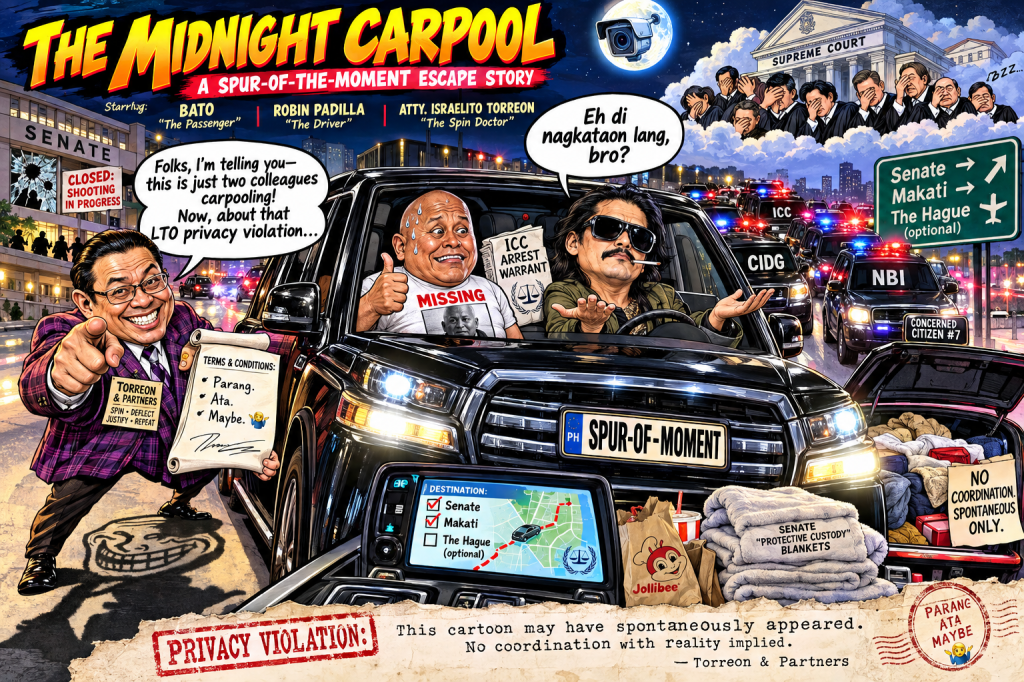
Starring Bato as the Passenger, Robin as the Driver, and the CIDG as the Unwitting Comedy Critics
By Louis ‘Barok’ C. Biraogo — September 28, 2026
LET’S set aside the spin for a moment and consult reality: I don’t know if Senator Robin Padilla committed obstruction of justice under Presidential Decree No. 1829 when he allegedly gave Senator Bato dela Rosa a ride out of the Senate at 2:30 in the morning after a shooting incident.
What I do know is that Atty. Israelito Torreon wants you to believe that the most investigated midnight SUV ride in Philippine political history was essentially the equivalent of two colleagues carpooling after a long day at the office. You know, just a couple of senators, one of whom is the subject of an International Criminal Court (ICC) arrest warrant for crimes against humanity, casually bumping into each other on the fourth floor and saying, “Hey, bro, pwede ba makisabay?”
Sure. And I’m sure the second vehicle trailing them was just a concerned citizen who happened to be going the same way.
Torreon’s media offensive—most recently on Bilyonaryo’s “Politiko Talks” with Atty. Jimmy Bondoc—deserves a special place in the Hall of Fame for Creative Lawyering. It’s not every day you see a legal defense that simultaneously asks us to believe that
- (a) nothing happened,
- (b) if it did happen, it was spontaneous, and
- (c) even if it wasn’t spontaneous, the government violated the privacy of a car owner.
Let’s unpack this masterpiece of misdirection, shall we?
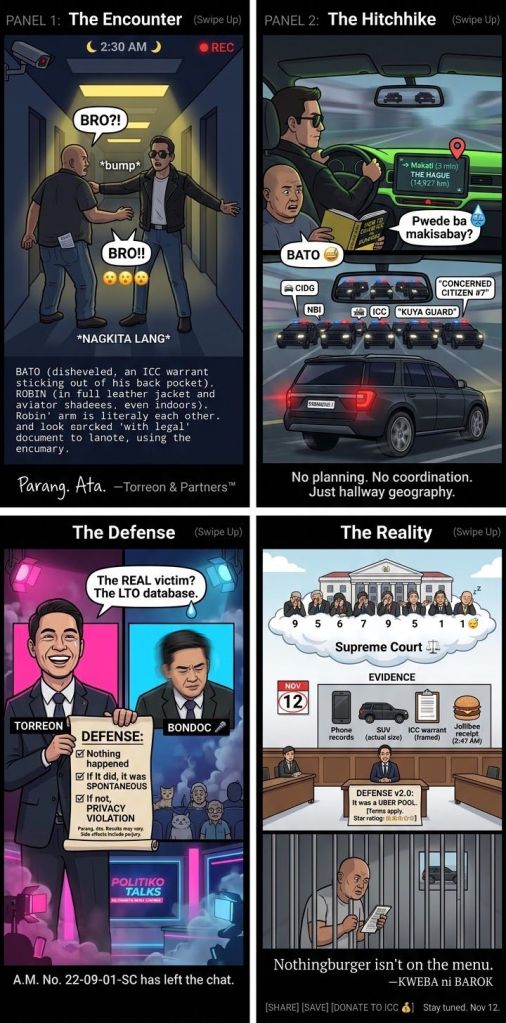
The “Spur-of-the-Moment” Defense: A Legal Theory That Insults Your Intelligence
Torreon’s central claim is that Dela Rosa simply ran into Padilla and asked for a ride. No planning. No coordination. Just two senators engaging in the kind of casual interaction that totally explains why one of them had been effectively in hiding since November 2025 and the other happened to be driving a vehicle that would become the centerpiece of a Department of Justice (DOJ) investigation.
“Nagkita lang sila dun sa parang fourth floor ata yun,” Torreon says. Parang. Ata. These are the qualifiers of a man who either wasn’t paying attention or is hoping you weren’t either.
Here’s the problem with the “spontaneous hitchhike” theory: it requires you to believe that Dela Rosa, a man who had been evading authorities for months, who had just experienced a dramatic confrontation with National Bureau of Investigation (NBI) agents at the Senate, who was the subject of an unsealed ICC warrant, and who had been placed under “protective custody” by Senate leadership , decided to casually ask a colleague for a lift at 2:30 in the morning—and that this colleague, without any knowledge of the significance of the moment, said “sure, hop in.”
That’s not a legal defense. That’s a screenplay for a buddy comedy.
Padilla himself has been more candid, admitting the ride happened and saying, “There was no escape. He simply got into my vehicle and hitched a ride. The CCTV footage wouldn’t lie.” But here’s the thing about CCTV footage: it shows what happened, not why. And the “why” is precisely what the Criminal Investigation and Detection Group (CIDG) is investigating when it describes the departure as a “highly coordinated, pre-planned logistical maneuver.”
Torreon’s response to this? Essentially: Nuh-uh.
The Privacy Gambit: When Lawyering Becomes Trolling
This is where Torreon’s argument enters the realm of the absurd.
The registered owner of the vehicle—a relative of Padilla, according to Torreon—has allegedly had his privacy violated by being named in the complaint. Torreon decries this as a “huge intrusion” into the privacy of someone who “has nothing to do with it at all.”
Let me get this straight: the CIDG is investigating whether a senator facilitated the escape of a man wanted by the ICC for crimes against humanity. A vehicle is used in that alleged escape. Investigators identify the vehicle’s registered owner. And Torreon wants us to believe that the real victim here is… the guy whose name is on the Land Transportation Office (LTO) registration?
This isn’t a privacy argument. This is a distraction. And it’s a pretty transparent one.
Yes, Republic Act No. 10173 (Data Privacy Act of 2012) exists. Yes, proportionality matters. But being named in a criminal complaint because your vehicle was allegedly used in a suspected crime isn’t a violation of your privacy rights—it’s called being a witness or a person of interest. If you lend your car to someone who then allegedly uses it to facilitate an escape, you don’t get immunity from being mentioned in the investigation because your feelings might get hurt.
Bondoc’s claim that “the registered owner was in Senate premises that night wasn’t true” is doing a lot of work here. Okay, so the owner wasn’t there. Great. That means he probably lent the vehicle to someone. Who? That’s the question that matters. And that question is not answered by shouting “privacy violation.”
The ICC Elephant in the Room
Here’s what Torreon’s entire defense conveniently sidesteps: the Supreme Court, voting 9-5-1, denied Dela Rosa’s request for a temporary restraining order (TRO) against the ICC warrant in Duterte and Dela Rosa v. Bersamin (G.R. No. 278747). The Court explicitly rejected the notion that Dela Rosa’s constitutional rights were being unlawfully invaded.
This matters enormously. If the Supreme Court had granted the TRO, Torreon’s argument would be much stronger. He could say: “See? There was no valid legal basis for the arrest, so how could there be obstruction?” But the Court didn’t grant it. It said the arrest wasn’t unlawful. It said the right to liberty is not absolute.
So Torreon’s fallback position is: Well, the main case is still pending. The constitutional merits haven’t been resolved.
Fine. But that cuts both ways. If the legality of the ICC warrant’s domestic enforcement is still unresolved, then Torreon can’t claim with certainty that Dela Rosa had no obligation to submit to arrest. He’s arguing from uncertainty—and hoping you don’t notice.
The “Politiko Talks” Problem: Advocacy as Performance Art
Torreon’s choice of venue matters. This isn’t a court filing. This isn’t a legal brief. It’s “Politiko Talks” on Bilyonaryo News Channel, sitting next to Jimmy Bondoc—another lawyer with deep political ties to the Duterte alliance.
This is not a neutral forum. This is a media platform designed to shape public opinion, not to test legal propositions. And Torreon knows this.
A.M. No. 22-09-01-SC (Code of Professional Responsibility and Accountability) requires lawyers to avoid misleading the public and to refrain from asserting as fact things that haven’t been proven. Torreon’s assertions about the “spur-of-the-moment” ride are carefully hedged with parang and ata—qualifiers that give him plausible deniability while still planting a narrative in the public consciousness.
It’s clever. It’s also transparent.
What Torreon Isn’t Saying
Notice what’s absent from Torreon’s defense:
- Where was Dela Rosa going? Torreon says Padilla dropped him off in Makati. But why Makati? Who was waiting there? This is a man subject to an ICC warrant. Where did he go after he got out of the SUV?
- What did Padilla know? Torreon’s defense requires Padilla to be almost comically uninformed. He didn’t know about the ICC warrant. He didn’t know law enforcement was trying to arrest Dela Rosa. He didn’t know why Dela Rosa was asking for a ride at 2:30 in the morning after a shooting. He was just… being a good colleague.
- What was the second vehicle doing? The CIDG alleges a second vehicle followed Padilla’s SUV as a security escort. Torreon’s response is essentially that this is unproven. Fair enough. But if the CIDG has evidence of coordinated movement, Torreon’s “spontaneous” theory collapses.
The Bottom Line
Torreon is doing what defense lawyers do: he’s advocating for his client and constructing a narrative favorable to the defense. That’s his job. But let’s not mistake advocacy for truth.
The “spur-of-the-moment hitchhike” theory is legally viable but factually thin. It requires you to believe that the most dramatic midnight departure in recent Senate history—following a shooting, during an active ICC enforcement effort—was essentially an accident of hallway geography.
Maybe it was. Maybe Torreon is telling the truth and the CIDG is overreaching.
But Torreon’s performance on “Politiko Talks” wasn’t designed to persuade a prosecutor. It was designed to persuade you. And the measure of its success isn’t whether it’s legally sound—it’s whether it makes you doubt the prosecution’s narrative enough to tune out.
Don’t tune out. The DOJ preliminary investigation is ongoing. The Supreme Court’s main ruling on the ICC warrant’s constitutionality is still pending. The facts are still developing.
Torreon wants you to believe this is all a misunderstanding. A car ride. A favor. A nothingburger.
But when the person asking for the ride is wanted by the ICC for crimes against humanity, and the person giving the ride is a senator who should know better, “nothingburger” isn’t on the menu.
Stay tuned. The November 12 hearing should be interesting.
And Torreon? He’ll be there. Probably telling us all that the real crime here is that someone checked the LTO database.
Key Citations
A. Legal & Official Sources
- The 1987 Constitution of the Republic of the Philippines. Official Gazette of the Republic of the Philippines, 1987, http://www.officialgazette.gov.ph/constitutions/1987-constitution/.
- The 1987 Constitution of the Republic of the Philippines, Article III (Bill of Rights). Official Gazette of the Republic of the Philippines, http://www.officialgazette.gov.ph/constitutions/the-1987-constitution-of-the-republic-of-the-philippines/the-1987-constitution-of-the-republic-of-the-philippines-article-iii/.
- Presidential Decree No. 1829. Penalizing Obstruction of Apprehension and Prosecution of Criminal Offenders. 16 Jan. 1981, lawphil.net/statutes/presdecs/pd1981/pd_1829_1981.html.
- Republic Act No. 10173. An Act Protecting Individual Personal Information in Information and Communications Systems in the Government and the Private Sector, Creating for This Purpose a National Privacy Commission, and for Other Purposes (Data Privacy Act of 2012). 15 Aug. 2012, http://www.officialgazette.gov.ph/2012/08/15/republic-act-no-10173/.
- A.M. No. 22-09-01-SC. Code of Professional Responsibility and Accountability. Supreme Court of the Philippines, 11 Apr. 2023, sc.judiciary.gov.ph/wp-content/uploads/2023/05/22-09-01-SC.pdf.
- Duterte and Dela Rosa v. Bersamin, et al. G.R. No. 278747. Supreme Court of the Philippines, 20 May 2026, sc.judiciary.gov.ph/wp-content/uploads/2026/05/278747-1.pdf.
- Press Briefer, May 20, 2026. Supreme Court of the Philippines, sc.judiciary.gov.ph/press-briefer-may-20-2026/.
- Rome Statute of the International Criminal Court. International Criminal Court, 17 July 1998, http://www.icc-cpi.int/publications/core-legal-texts/rome-statute-international-criminal-court.
- Warrant of Arrest for Mr Ronald Marapon Dela Rosa. ICC-01/21-89, Pre-Trial Chamber I, 6 Nov. 2025, http://www.icc-cpi.int/court-record/icc-01/21-89.
B. News Reports
- “Robin Padilla Faces Obstruction of Justice Complaint over Bato’s Escape.” Rappler, 28 May 2026, http://www.rappler.com/philippines/robin-padilla-obstruction-justice-complaint-bato-dela-rosa-escape/.
- “Padilla: Bato Only Hitched a Ride.” Philstar.com, 23 May 2026, http://www.philstar.com/headlines/2026/05/23/2529864/padilla-bato-only-hitched-ride.
- Umali, Mariz. “SC Denies Bato dela Rosa’s Bid for TRO vs. ICC Arrest Warrant.” GMA News Online, 20 May 2026, http://www.gmanetwork.com/news/topstories/nation/988312/sc-denies-bato-dela-rosa-s-plea-for-tro-vs-icc-arrest-warrant/story/.
- Laqui, Ian. “Robin Appears at DOJ, Yet to Answer Obstruction Rap over Bato’s Escape.” Philstar.com, 25 Sept. 2026, http://www.philstar.com/headlines/2026/09/25/2558853/padilla-appears-doj-yet-answer-obstruction-rap-over-dela-rosas-escape.
- “ICC Office of the Prosecutor Welcomes Unsealing of Arrest Warrant for Ronald Dela Rosa in the Situation in the Philippines.” International Criminal Court, 11 May 2026, http://www.icc-cpi.int/news/icc-office-prosecutor-welcomes-unsealing-arrest-warrant-ronald-dela-rosa-situation-philippines.
- “Atty. Israelito Torreon on Impeachment Vote, VP Sara & Public Officials’ Wealth | Politiko Talks.” Bilyonaryo News Channel, YouTube, 25 Sept. 2026, http://www.youtube.com/watch?v=gyUeuLq9__0.
- ₱8B BBM Pork: CCTV for Every Captain’s Kumpare?
- ₱8.9 Billion, 331 Ghost Police Stations: The TIKAS Scandal Explained

- ₱8.4 Billion, 42,000 Barangays, 1 Election: The “Bawat Barangay Makikinabang” Vote-Buying Masterclass

- ₱75 Million Heist: Cops Gone Full Bandit

- ₱6.77B Ghost Haunts Duterte: RTC Dismisses Mans Carpio’s Desperate Plea
- ₱6.7-Trillion Temptation: The Great Pork Zombie Revival and the “Collegial” Vote-Buying Circus

- ₱53 Million Man Tells ₱695-a-Day Workers to Stop Being ‘Mayabang’: The Audacity of BSP’s Remolona
- ₱3.06 Billion for Evacuation Centers—But Nobody Knows Where They’ll Stand (Or If They’ll Exist)
- ₱10B Ghost in New Clark City: Matibag’s Haunted Séance for Cayetano

- ₱1.9 Billion for 382 Units and a Rooftop Pool: Poverty Solved, Next Problem Please

- ₱1.35 Trillion for Education: Bigger Budget, Same Old Thieves’ Banquet

- ₱1 Billion Congressional Seat? Sorry, Sold Out Na Raw — Si Bello Raw Ang Hindi Bumili





Leave a comment