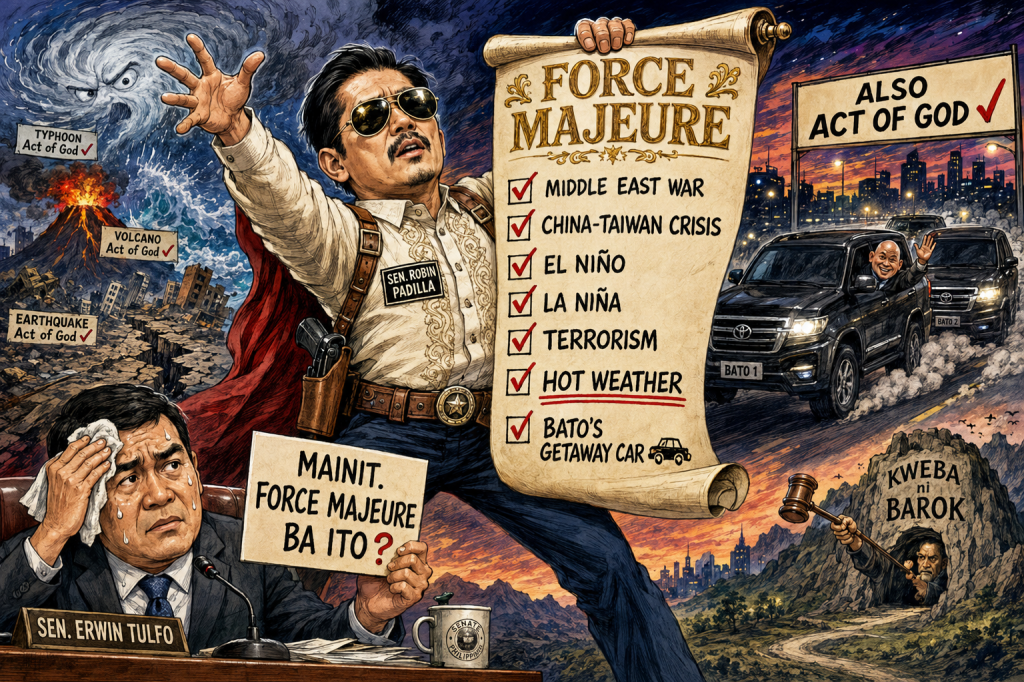
Padilla’s Force Majeure Fantasy: Everything is an Act of God Except His Own Getaway Car
By Louis ‘Barok‘ C. Biraogo — May 29, 2026
The Great Fugitive Extraction: Motorcade Mayhem at Dawn
Let’s begin with the facts, because in this circus the facts are the only things not wearing clown makeup. Between May 11 and 13, 2026, Senator Ronald “Bato” dela Rosa — fresh from an International Criminal Court (ICC) arrest warrant for crimes against humanity tied to the drug war — suddenly resurfaced in the Senate to cast the decisive vote installing Alan Peter Cayetano as Senate President. What followed was pure Philippine political theater with live ammunition: NBI agents entered the chamber to serve the warrant, a shooting incident erupted, and dela Rosa pulled a pre-dawn disappearing act on May 14.
He didn’t hitch a casual ride. According to the CIDG investigation, Senator Robin Padilla’s vehicle was part of a “highly coordinated, pre-planned logistical maneuver” complete with a backup escort car tailing behind for security. Dela Rosa didn’t just leave; he was extracted. RAPPLER reported the details with the clinical precision the Senate itself lacks. Hours later — not days, hours — Rep. Rodante Marcoleta (yes, the same one) filed a motion to amend Senate rules for remote voting under “justifiable circumstances.” The temporal proximity is not coincidence; it is the smoking gun of premeditation. Wikipedia already reads like a plot summary for a bad action movie starring Padilla.
That escape hatch now wears the legal disguise of “force majeure” — the very term the majority is twisting to justify remote voting for those who choose to run rather than face accountability.
Force Majeure Unmasked: What the Civil Code Actually Means (No Clowning Allowed)
Time for a reality check, delivered via Article 1174 of the Civil Code of the Philippines (Republic Act No. 386):
“No person shall be responsible for those events which could not be foreseen, or which, though foreseen, were inevitable.”
The Supreme Court in Nakpil v. Court of Appeals (G.R. No. L-47851, 1986) made it crystal clear — the party invoking force majeure must have clean hands. They cannot have contributed to the event. No self-inflicted wounds allowed.
Existing Senate rules already permit remote participation, but only during actual force majeure or declared national emergencies. Not “feels” or “what ifs.” The killer precedent? In June 2020, a Muntinlupa court denied detained former Senator Leila de Lima’s request for remote participation, ruling that her detention did not qualify as force majeure under the very same rules. Philstar/Interaksyon laid this out plainly. De Lima was physically locked up on what many called trumped-up charges, yet the court said “no.” Now the majority wants to hand remote-voting privileges to a fugitive who chose to run. Equal protection, anyone? Or are we just making a mockery of the rule of law while wearing barong tagalog?
Kiko Pangilinan Delivers the Legal Hammer: Precision Over Populist Nonsense
Senator Francis “Kiko” Pangilinan delivered the legal equivalent of a calm, precise surgical strike. Force majeure, he explained, refers to natural calamities or acts of God — typhoons, earthquakes, that sort of thing — not man-made debacles like Senate shootouts or pre-dawn extractions. INQUIRER.net captured his explanation perfectly: these are not “superior forces” beyond control; they are the direct results of human choices.
His position is legally unassailable because (1) the event must actually exist and currently render performance impossible, not be some speculative geopolitical boogeyman; (2) the clean-hands doctrine obliterates anyone who helped create the crisis; and (3) the distinction between act-of-God and act-of-man is black-letter doctrine, not optional flavor text. Senator Risa Hontiveros drove the point home beautifully on GMA News Online: if the world is so unstable, senators should be more present, not less. Pangilinan’s precision can be caricatured as elitist legalese by the Facebook warriors, but that’s irrelevant. The law doesn’t care about your viral clapbacks.
Padilla’s Global Anxiety List: Forensic Demolition of the “Everything Is Force Majeure” Defense
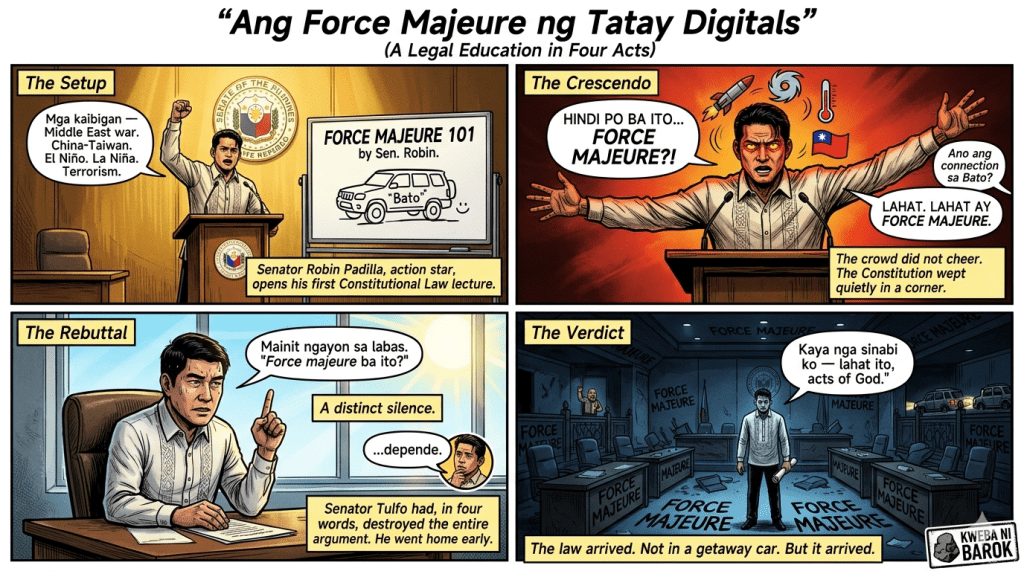
Senator Robin Padilla — action star turned constitutional scholar — offered a greatest-hits list of global anxieties: Middle East wars, China-Taiwan tensions, terrorism, El Niño, La Niña. “Hindi po ba ito force majeure?” he asked on Politiko. Cute. Let’s autopsy this.
- Speculative, non-affecting events. None of these currently prevent any senator from walking into the session hall. Force majeure is not a crystal ball; it requires an existing, unavoidable impossibility.
- Lacson’s “unforced error” correction. Wars are human decisions, not acts of God. As Senator Panfilo Lacson dryly noted, this is the opposite of force majeure.
- Self-inflicted emergency. Dela Rosa’s absence stems from his own decision to flee — a flight Padilla personally facilitated with the coordinated motorcade. Clean hands? Padilla’s are covered in tire marks.
- The Tulfo test. Senator Erwin Tulfo’s deadpan question about “hot weather” as force majeure exposed the reductio ad absurdum. If everything is force majeure, nothing is.
- The ICC dimension. Lawyer Kristina Conti told the Daily Tribune that Padilla’s actions may violate Article 70 of the Rome Statute of the International Criminal Court. Justice Secretary Fredderick Vida confirmed to BusinessWorld that prosecutors are reviewing Padilla’s own admissions. His force majeure lecture isn’t legal analysis — it’s a transparent attempt to provide political cover for potential criminal exposure.
Padilla’s argument isn’t just weak; it’s legally indefensible and comically desperate.
The Procedural Heist: How the Majority Tried to Railroad Democracy’s Rulebook
While everyone argues weather and wars, the real crime is procedural railroading. Marcoleta and the majority bloc tried to bypass the mandatory committee deliberation by invoking Section 136 of the Rules of the Senate (Senate Rules on Amendments to, or Revision of, the Rules) (INQUIRER.net), which they claimed empowers the plenary itself to determine, by a simple majority vote of senators present, whether to immediately consider and vote on a proposed amendment even without prior referral to or endorsement by the Committee on Rules. Pangilinan correctly countered that all 48 previous rule amendments went through proper resolutions under Section 24. The minority walked out, breaking quorum. Former Senate President Franklin Drilon called it “tyranny of the majority” in the Daily Guardian, while the Manila Times reported the minority is already eyeing a Supreme Court petition.
This isn’t a technicality. It is an assault on the Senate’s deliberative soul. Rules exist to constrain power, not to be rewritten mid-escape.
The Desperation Table: Mapping Every Senator’s Self-Serving Agenda
| Actor | Motivation | Endgame |
|---|---|---|
| Robin Padilla | Loyalty signaling + self-preservation from ICC Article 70 liability | Protect Dela Rosa, shield own exposure |
| Alan Peter Cayetano | Repay Dela Rosa for delivering Senate presidency | Secure majority control pre-impeachment |
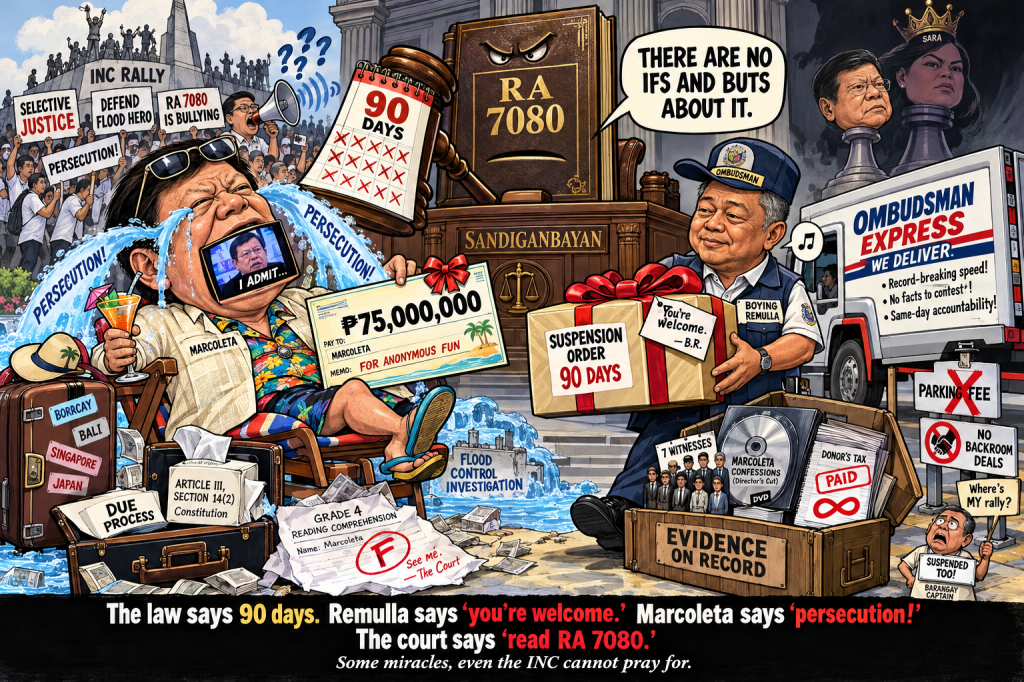
| Rodante Marcoleta | Enable own remote participation if detained for plunder | Survive Sandiganbayan hold departure order |
| Escudero, Estrada, Villanueva | Political survival amid pending plunder charges | Retain votes for Sara Duterte trial |
| Minority bloc | Institutional integrity + rule-of-law optics | Block fugitive voting, preserve Senate credibility |
MindaNews analysis is blunt: once detained senators are removed and Dela Rosa stays hidden, the majority collapses to 6-8 votes. Remote voting isn’t modernization — it’s arithmetic to protect Sara Duterte in July 2026.
Blueprint for Sanity: Actionable Steps to Rescue the Rule of Law
To the Senate Minority: File that Supreme Court petition immediately (Manila Times). Maintain quorum discipline. Brief ICC prosecutors and diplomatic missions. Frame it publicly as “fugitive voting rights vs. rule of law.”
To the Supreme Court (if petitioned): Apply the De Lima precedent consistently. Recognize the ICC obstruction angle. Strike down the procedural bypass as violative of Senate rules and due process.
To the Philippine Public: Demand the Senate address actual governance instead of inventing legal loopholes for fugitives. Remember these votes in 2028.
To Senator Padilla: Retain competent counsel. Stop posting on Facebook (Politiko readers thank you in advance). Consider cooperation with authorities. And for the love of all that is holy, take a basic Civil Code course.
Barok’s Verdict: The Law Doesn’t Arrive in a Getaway Car
The force majeure argument is not law — it is a conjuring trick, wrapping political rescue in Latin to make it smell like jurisprudence. Pangilinan is correct: force majeure is for typhoons, not for senators who choose to run. The law is patient. It will not be suspended by parliamentary sleight-of-hand. It arrives — not in a pre-dawn motorcade with backup vehicles — but in the form of Supreme Court rulings, ICC proceedings, and the electoral judgment of the people.
🪨 May the rule of law rise on the third day. And may someone please buy Senator Padilla a Civil Code.
Key Citations
A. Legal & Official Sources
- Philippines, Congress. Republic Act No. 386: Civil Code of the Philippines. 18 June 1949, lawphil.net/statutes/repacts/ra1949/ra_386_1949.html.
- Senate of the Philippines. Rules of the Senate. Legislative Publications Service, July 2025, legacy.senate.gov.ph/rules%20of%20the%20senate-july%202025.pdf. Section 136.
- Philippines, Supreme Court. Nakpil v. Court of Appeals. G.R. No. L-47851, 25 Aug. 1986, https://lawphil.net/judjuris/juri1986/oct1986/gr_l-47851_1986.html.
- United Nations. Rome Statute of the International Criminal Court. 17 July 1998, www.icc-cpi.int/sites/default/files/RS-Eng.pdf.
B. News Reports
- “Pangilinan Explains Force Majeure Refers to Natural Calamities.” Inquirer.net, 28 May 2026, newsinfo.inquirer.net/2236145/pangilinan-explains-force-majeure-refers-to-natural-calamities.
- “Bato Dela Rosa Left Senate, Evades ICC Arrest.” Rappler, 14 May 2026, www.rappler.com/philippines/bato-dela-rosa-left-senate-evades-icc-arrest-may-14-2026/.
- “Force Majeure Senate Remote Participation Proposal.” Interaksyon / Philstar, 28 May 2026, interaksyon.philstar.com/politics-issues/2026/05/28/314150/force-majeure-senate-remote-participation-proposal/.
- “Force Majeure: Robin Padilla vs Risa Hontiveros.” GMA News Online, 28 May 2026, www.gmanetwork.com/news/topstories/nation/989261/force-majeure-robin-padilla-risa-hontiveros/story/.
- “Hindi Po Ba Ito Force Majeure?” Politiko, 28 May 2026, politiko.com.ph/2026/05/28/hindi-po-ba-ito-force-majeure-robin-padilla-raises-middle-east-war-taiwan-china-conflict-el-nino-to-justify-senate-remote-voting/snitch-network/.
- “Sen. Padilla May Face ICC Liability Over Bato Escape – Lawyer.” Daily Tribune, 24 May 2026, tribune.net.ph/2026/05/24/sen-padilla-may-face-icc-liability-over-bato-escape-lawyer.
- “CIDG to File Obstruction Complaint vs Padilla Over Dela Rosa Escape.” BusinessWorld, 27 May 2026, www.bworldonline.com/the-nation/2026/05/27/752614/cidg-to-file-obstruction-complaint-vs-padilla-over-dela-rosa-escape/.
- “Minority Bloc Senators May Ask Supreme Court to Intervene on Rules Change.” Manila Times, 28 May 2026, www.manilatimes.net/2026/05/28/news/national/minority-bloc-senators-may-ask-supreme-court-to-intervene-on-rules-change/2352869.
- “Drilon Hits ‘Bastusan’ in Remote Voting Push.” Daily Guardian, 28 May 2026, www.dailyguardian.com.ph/blog/drilon-hits-bastusan-in-remote-voting-push.
- “Turning Point: The Senate to the Drain.” MindaNews, 28 May 2026, mindanews.com/mindaviews/2026/05/turning-point-the-senate-to-the-drain/.




Leave a Reply