Private Viber Deals for Plunderers While Ordinary Filipinos Face the Full Force of the Law
By Louis ‘Barok‘ C. Biraogo — May 29, 2026
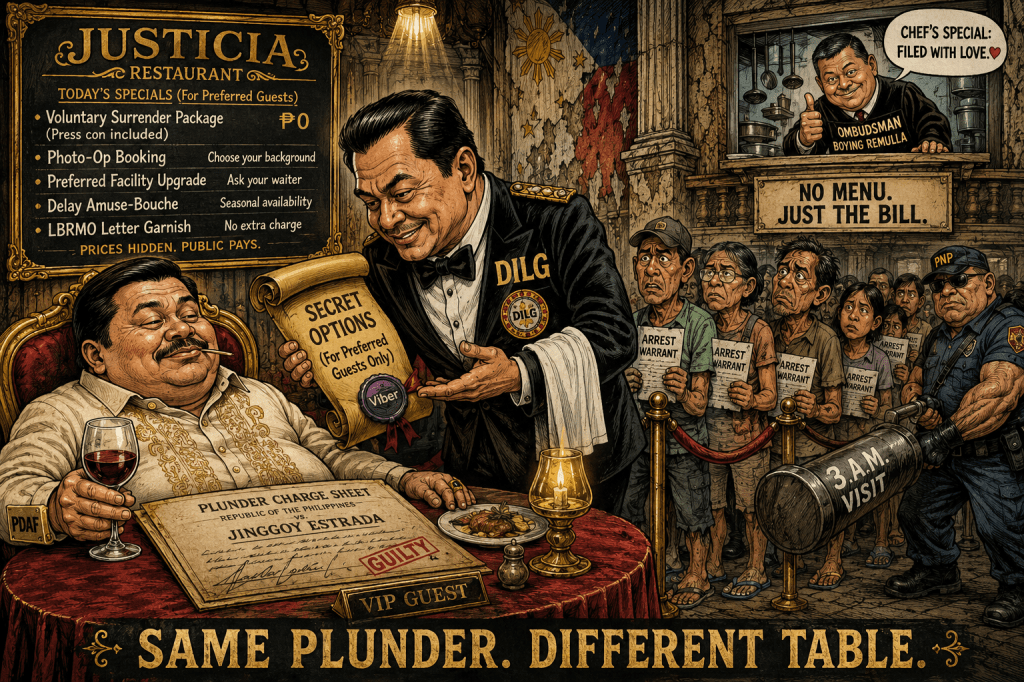
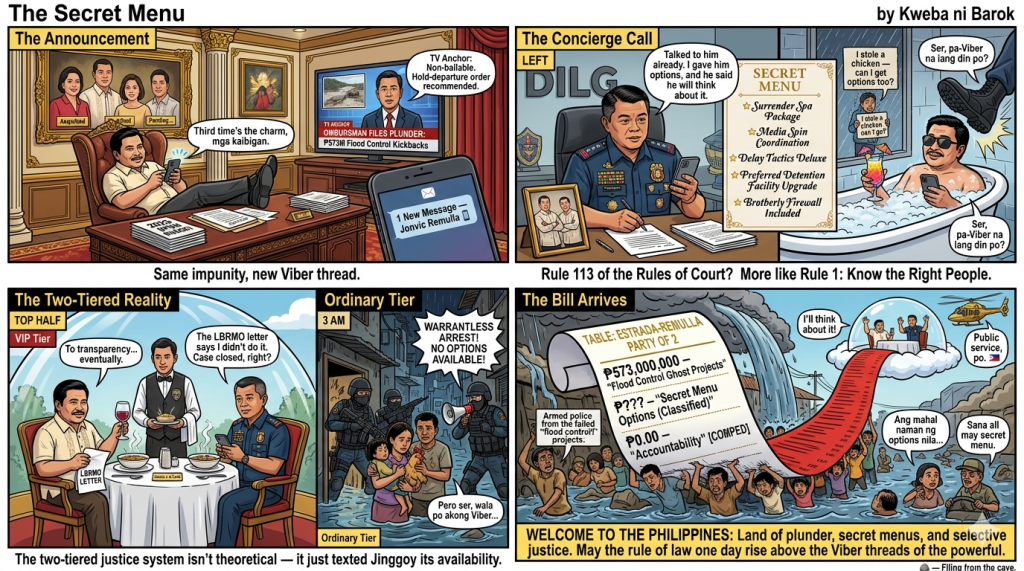
WELCOME to the Philippines: land of plunder, secret menus, and selective justice. Where flood control projects drown in kickbacks, and the only thing that actually gets “controlled” is the narrative of accountability. Yesterday the Office of the Ombudsman dropped plunder and graft charges against Senator Jinggoy Estrada over an alleged ₱573 million in systematic commissions funneled from DPWH flood-control insertions in the 2025 national budget. Non-bailable. Hold-departure order recommended. The usual theater. But the real showstopper wasn’t the ₱573 million ghost money—it was Interior Secretary Jonvic Remulla casually admitting, in that tone-deaf text-message bravado only a Jonvic Remulla can muster: “Talked to him already. I gave him options, and he said he will think about it.” And those options? Classified. Top secret. For Jinggoy’s eyes only until he accepts or rejects them.
Welcome to Philippine justice, 2026 edition: same impunity, new Viber thread.
Let us not pretend this is mere “administrative coordination.” This is the central scandal inside the scandal. A Cabinet secretary who oversees the Philippine National Police (PNP) privately negotiating surrender logistics—or whatever euphemism they’re using this week—with a sitting senator facing non-bailable plunder. The same senator whose family name has been synonymous with plunder charges for a quarter-century. The sheer audacity is almost admirable, if it weren’t so nauseating.
Jinggoy’s Third Plunder Rodeo: Recidivist on Repeat
This is Jinggoy’s third major plunder rodeo in 25 years. Jueteng money. PDAF kickbacks. Now flood-control ghost projects. The man treats Republic Act No. 7080 (The Plunder Law) the way some people treat subscription services—sign up, get charged, acquit, repeat. He leans on a letter from the Senate Legislative Budget Research and Monitoring Office (LBRMO) like it’s a get-out-of-jail-free card, solemnly declaring “no record” of him inserting projects.
Naman, naman, naman. As if sophisticated budget operators leave neat paper trails in the official ledger for the Ombudsman to photocopy. The Ombudsman has already countered that insertions happen through layered, informal channels—verbal nods, intermediaries, the classic Philippine “usap-usapan” that never makes it into the minutes. Under the Plunder Law, the prosecution need not prove every predicate act with surgical precision; a combination or series of overt criminal acts that amass ill-gotten wealth of at least ₱50 million suffices. The Supreme Court said so itself in Estrada v. Sandiganbayan (G.R. No. 148560, 2001)—the very case involving Jinggoy’s own father. The historical irony is so thick you could spread it on pandesal.
Section 3(e) and 3(a) of Republic Act No. 3019 (Anti-Graft and Corrupt Practices Act) complete the picture: manifest partiality, evident bad faith, or gross inexcusable negligence causing undue injury to the government while giving unwarranted benefits to private parties. Funneling public funds into designated projects in exchange for predetermined commissions fits like a bespoke barong. Yet Jinggoy’s defense remains the same recycled script: due process violations, procedural irregularities, and the sacred LBRMO letter. The man has been through this dance twice before and emerged acquitted. Third time’s the charm? Or third time’s the pattern?
Jonvic’s Brotherly Concierge Service: Secret Options for the Elite
But let us return to the real outrage: Jonvic Remulla’s secret “options.” This is not law enforcement; this is concierge service for the politically connected. Rule 113 of the Rules of Court makes arrest warrant execution ministerial. Once the Sandiganbayan issues it, the PNP’s duty is to serve—not to offer a secret menu of surrender packages, photo-op bookings, or whatever discreet arrangements Remulla is cooking up via Viber. The secrecy itself is the poison. The public has no idea whether these “options” include delay, preferred facilities, coordinated media spin, or other courtesies unavailable to the ordinary mortal accused of stealing a chicken.
This directly implicates Republic Act No. 6713 (The Code of Conduct and Ethical Standards for Public Officials and Employees). Section 4 demands the highest degree of integrity, loyalty, and efficiency, and the avoidance of even the appearance of impropriety. Secret negotiations between the DILG chief and an accused plunderer fail that test spectacularly. Worse, Section 3(a) of Republic Act No. 3019 prohibits public officers from persuading or influencing another public officer to violate rules. When the DILG Secretary—who supervises the very agency that will physically arrest the accused—offers undisclosed “options,” the entire process reeks of preferential treatment.
And let us not forget the fraternal dimension. Ombudsman Boying Remulla files the case. Brother Jonvic negotiates the surrender. Two brothers, one prosecutorial-enforcement pincer movement. Even if both act in perfect good faith, the structure is constitutionally grotesque. No firewall. No disclosure. Just family chat and public funds.
Compare this to how ordinary Filipinos experience arrest. No phone call. No options. Just the bang on the door at 3 a.m. The two-tiered justice system isn’t theoretical—it just texted Jinggoy its availability.
Estrada’s Call to Duty: Walk the Rule-of-Law Talk
Senator Estrada, if you are reading this from whatever gilded corner of the Senate you currently occupy: enough. For once in your long, colorful career, uphold the rule of law you so loudly demand for yourself. Cooperate with the proceedings. Surrender with dignity instead of milking every procedural delay. Stop misusing your office to launch partisan broadsides at the prosecutors. Respect the due process you insist upon while simultaneously complaining it was denied to you. Let the evidence, not backroom influence or familial Viber diplomacy, decide your fate.
To Secretary Remulla: disclose the options. Now. The constitutional right to information (Article III, Section 7 of the 1987 Constitution) and the principle that public office is a public trust (Article XI, Section 1 of the 1987 Constitution) demand nothing less. Chavez v. Public Estates Authority (G.R. No. 133250, 2002) is clear—transactions involving public funds and public liberty cannot be managed through private chats between powerful brothers and the accused. The public whose taxes allegedly became Jinggoy’s kickbacks has a right to know what special arrangements their government is offering him.
Strategic Satire Served Hot: What Must Happen Now
- Remulla must recuse or disclose. Step away from any further involvement in the flood-control docket or publish the full transcript of those “options.” Anything less confirms the two-tiered system.
- Estrada should surrender cleanly. Follow the Revilla template without the drama. File your motions, argue your LBRMO letter, invoke Enrile v. Sandiganbayan (G.R. No. 213847, 2015) for bail on humanitarian grounds if you must—but stop treating the Sandiganbayan like a political arena.
- The Ombudsman must pursue the upcoming plunder case against Senator Joel Villanueva with equal ferocity. The credibility of this flood-control “cleanup” rests on whether the next senator in line gets the same no-bail, no-options treatment as Jinggoy — or whether secret menus and special courtesies suddenly become available again.
- Congress and the Supreme Court should examine the Remulla brothers’ structural conflict. This family concentration of prosecutorial and enforcement power is an accident waiting to become precedent.
Final Verdict: The True Measure of Rule of Law
The ultimate measure of the rule of law in these islands is not who gets arrested. It is who gets a private call with a secret menu of “options” beforehand—while the rest of the country drowns in the flood of unaccountable elite impunity.
May the rule of law one day rise above the Viber threads of the powerful.
🪨 — Barok, filing from the cave.
This dispatch reflects the independent, unsparing analysis of the Kweba ni Barok blog. All accused are presumed innocent until convicted by final judgment. But some are presumed to have better lawyers, better connections, and better “options.”
Key Citations
A. Legal & Official Sources
- The 1987 Constitution of the Republic of the Philippines. Official Gazette of the Republic of the Philippines, 1987, https://www.officialgazette.gov.ph/constitutions/1987-constitution/.
- Republic Act No. 7080. An Act Defining and Penalizing the Crime of Plunder. 1991, https://lawphil.net/statutes/repacts/ra1991/ra_7080_1991.html.
- Republic Act No. 3019. Anti-Graft and Corrupt Practices Act. 1960, https://lawphil.net/statutes/repacts/ra1960/ra_3019_1960.html.
- Supreme Court of the Philippines. “Rule 113: Arrest.” The Revised Rules of Criminal Procedure (Rules of Court), effective 1 Dec. 2000, lawphil.net/courts/rules/rc_110-127_crim.html.
- Republic Act No. 6713. An Act Establishing a Code of Conduct and Ethical Standards for Public Officials and Employees. 1989, https://lawphil.net/statutes/repacts/ra1989/ra_6713_1989.html.
- Estrada v. Sandiganbayan, G.R. No. 148560 (Supreme Court of the Philippines, Nov. 19, 2001), https://lawphil.net/judjuris/juri2001/nov2001/gr_148560_2001.html.
- Enrile v. Sandiganbayan, G.R. No. 213847 (Supreme Court of the Philippines, Aug. 18, 2015), https://lawphil.net/judjuris/juri2015/aug2015/gr_213847_2015.html.
- Chavez v. Public Estates Authority, G.R. No. 133250 (Supreme Court of the Philippines, Jul. 9, 2002), https://lawphil.net/judjuris/juri2002/jul2002/gr_133250_2002.html.
B. News Reports
- GMA News. “Jonvic Remulla Says He Gave Jinggoy Estrada Options Amid Senator’s Expected Arrest.” GMA News Online, 28 May 2026, http://www.gmanetwork.com/news/topstories/nation/989378/jonvic-remulla-and-jinggoy-estrada-discuss-options-amid-expected-arrest-for-flood-control-projects-scan/story/.
- ABOGADO.COM.PH Staff. “Senate Office: No Official Record of Jinggoy’s Insertions or Amendments in 2025 Budget.” Abogado.com.ph, 28 Apr. 2026, abogado.com.ph/senate-office-no-official-record-of-jinggoys-insertions-or-amendments-in-2025-budget/.





Leave a Reply