A Budget of Blanks: The Art of Punishing Millions Without Saying a Word
By Louis ‘Barok‘ C. Biraogo — August 18, 2026
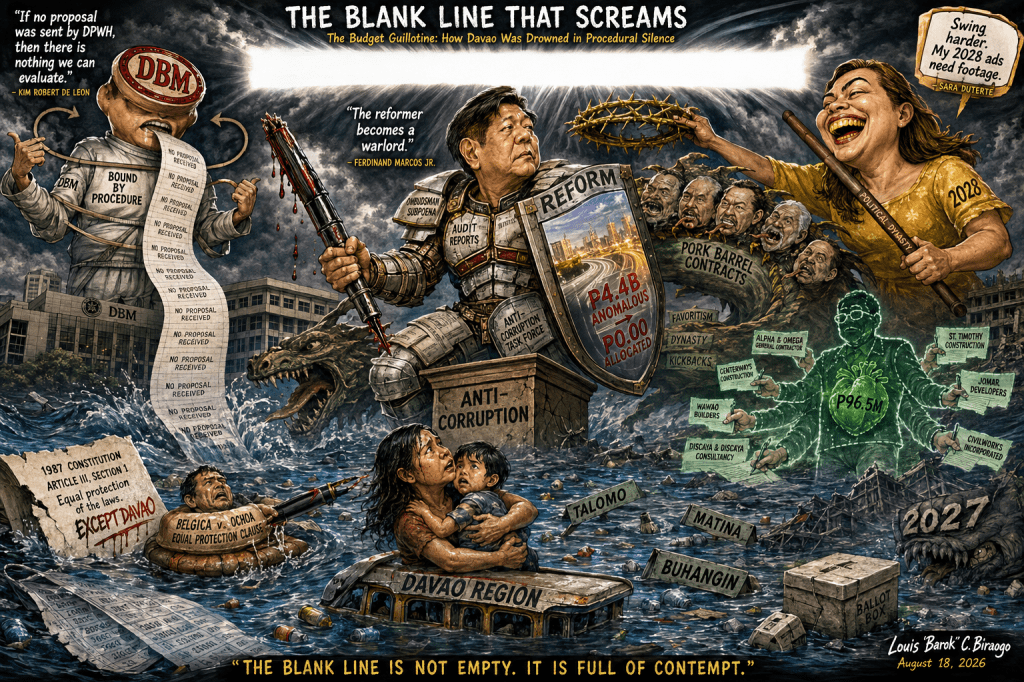
THE national budget is a confession. It reveals, in cold, unfeeling numbers, what a government truly values—and whom it has condemned. In the proposed 2027 National Expenditure Program, the confession is stark: the entire Davao Region’s flood control allocation is a blank. A void. A silent, bureaucratic scream.
The Smoking Gun in the Spreadsheets
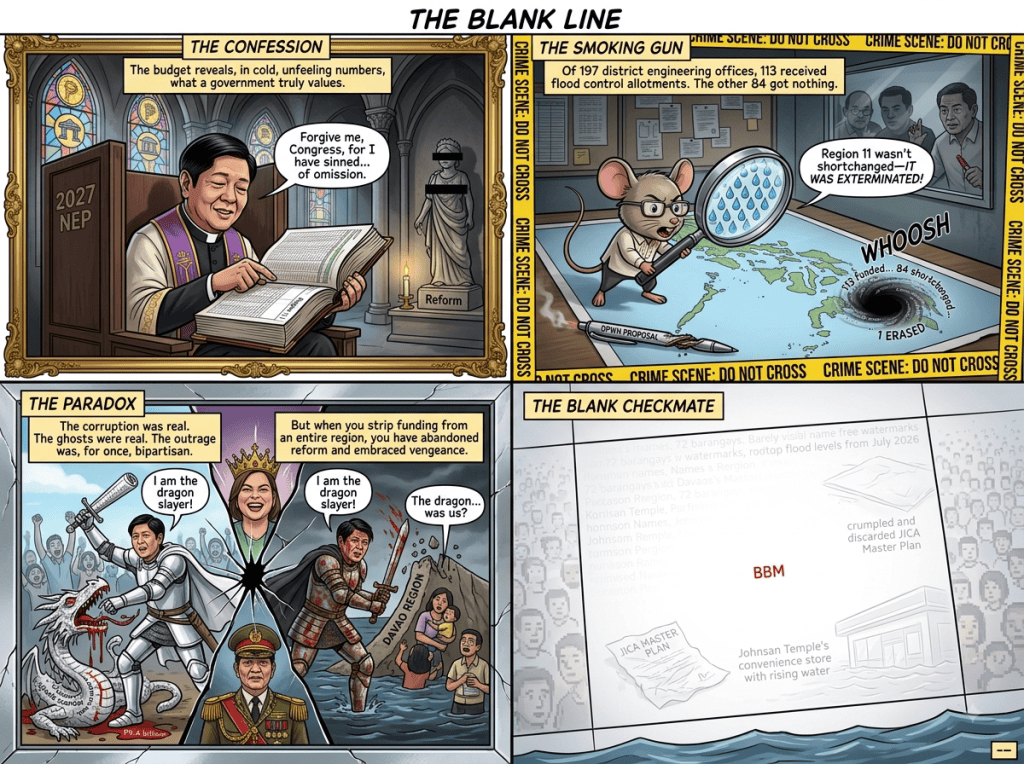
Rep. Antonio Tinio, that unlikely gadfly from the ACT Teachers party-list, has stumbled upon the smoking gun. Of 197 district engineering offices nationwide, 113 received flood control allotments. The other 84 got nothing. But Region 11—all of Davao—was not merely shortchanged. It was erased.
And the administration’s response, delivered by Acting Budget Secretary Kim Robert de Leon, was a masterclass in bureaucratic cowardice: “If no proposal was sent by DPWH, then there is nothing we can evaluate.” Translation: Don’t ask us. Ask the other guy. The Department of Budget and Management (DBM), the supposed guardian of the public fisc, has reduced itself to a passive receipt-checker, willfully blind to the political bomb ticking beneath its own spreadsheets.
Let us not be naive. This is not an administrative oversight. This is a calculated act of war.
The Paradox of Reform and Vengeance
The Marcos administration is trapped in a paradox of its own making. On one hand, it has postured as the great anti-corruption crusader, wielding the ghost-project scandal—the notorious Discaya scam in Davao Occidental—as proof that the Duterte dynasty built its empire on plunder.
Rep. Tinio himself, to his credit, filed Ombudsman complaints detailing ₱4.4 billion in anomalous flood control projects in Davao City’s First District, the political fiefdom of Rep. Paolo Duterte. The corruption was real. The ghosts were real. The outrage was, for once, bipartisan.
But here is the poison at the heart of the cure: when you strip flood control funding from an entire region—not just the tainted projects, not just the suspicious contractors, but every single district engineering office in Region 11—you have abandoned the language of reform and embraced the grammar of vengeance. The administration has not merely audited Davao; it has excommunicated it. And in doing so, it has handed the Duterte camp the most potent weapon imaginable: the martyr’s crown.
Constitutional and Fiscal Violations
The constitutional violations are glaring. Article III, Section 1 of the 1987 Constitution guarantees equal protection of the laws. Blanking out an entire administrative region while funding 113 other DEOs is a textbook case of arbitrary discrimination.
Under Belgica v. Ochoa, the Supreme Court demanded line-item specificity precisely to prevent the executive from wielding blank checks. But what is a blank line item if not a blank check in reverse—a tool for punishment rather than patronage? The DBM and Department of Public Works and Highways (DPWH) have conspired to create a budgetary black hole, and they expect Congress to simply nod along.
The fiscal law violations are equally damning. Executive Order No. 292, the Administrative Code, mandates that agency budget proposals be based on objective regional development needs, technical feasibility, and national priorities. Where in that formula does “political loyalty to Malacañang” appear? Where is the box marked “Duterte stronghold—exclude”? The DPWH’s failure to submit proposals for Region 11—if that is indeed what happened—represents either gross administrative negligence or covert political blacklisting. Neither is acceptable. Both are indictable.
The Human Cost of Political War
But the most obscene dimension of this scandal is the human cost. Davao City is not some abstract political chessboard. It is a flood-prone urban center where 72 barangays are classified as “very susceptible” to inundation. The Davao, Matina, and Talomo Rivers are not hypothetical threats; they are recurring, lethal realities.
In July 2026, monsoon flooding reached rooftop levels in Talomo and Matina. The JICA Flood Control Master Plan, completed in 2023, remains unfunded—a document of exquisite technical detail gathering dust while politicians play their dynastic games. The Marcos administration is not just punishing its rivals; it is sentencing ordinary Filipinos to drown.
The Political Economy of Neglect
The political economy of this decision is transparently toxic. The Marcos-Duterte “UniTeam” alliance has collapsed into open warfare. Sara Duterte has been impeached. Rodrigo Duterte has been arrested by the ICC. And now, the national budget has become a cudgel.
The administration is betting that by starving Davao of infrastructure, it can weaken the Duterte base ahead of 2028. But this is a gamble with other people’s lives. It treats flood resilience not as a public good but as a patronage chip—to be distributed to friends, withheld from enemies. The Dutertes are many things, but they are not stupid. They will weaponize this neglect, and rightly so. The administration has handed them a narrative of victimhood wrapped in a monsoon.
And what of the paradox? Can the Marcos administration credibly claim to be an impartial reformer while simultaneously engaging in the most blatant regional targeting since the pork barrel era? The answer is no. The moment you exempt your allies from scrutiny and apply a sledgehammer to your enemies, you have forfeited the moral high ground. The anti-corruption crusade becomes a partisan purge. The reformer becomes a warlord. This is the tragedy of the Marcos administration: it had a genuine opportunity to clean house, to dismantle the patronage networks that have strangled this nation for decades. Instead, it has chosen to become just another faction in the same dirty war.
Bureaucratic Cowardice and the Path Forward
The DBM’s deflection is particularly nauseating. Acting Secretary de Leon, a career bureaucrat, knows exactly what is happening. His claim that “there is nothing we can evaluate” is technically true but morally bankrupt. The DBM is not a mere post office. It is the final arbiter of the national budget. It has the authority—and the duty—to demand submissions, to question omissions, to flag anomalies. By hiding behind procedural technicalities, de Leon has announced that the DBM is no longer an institution of governance but a subsidiary of the political war machine.
So what is to be done? Congress must act. The House Appropriations Committee and the Senate Finance Committee must insert line-item allocations for Region 11 during markup, bypassing the executive’s petty vindictiveness. The Commission on Audit and the Office of the Ombudsman must investigate whether DBM and DPWH officials violated the Anti-Graft and Corrupt Practices Act (RA 3019) —causing undue injury through manifest partiality—or the Code of Conduct and Ethical Standards for Public Officials and Employees (RA 6713) —failing to uphold political neutrality and public trust. And civil society must demand full transparency: every excluded DEO, every evaluation criterion, every internal memorandum that led to this blank.
This is not about defending the Dutertes. It is about defending the principle that the national budget belongs to the Filipino people, not to whichever dynasty currently occupies Malacañang. The blank line for Davao is not an accounting anomaly. It is a declaration of war against the very idea of impartial governance. It is a confession that, in the Philippines, public funds are not for public safety but for political survival.
The budget is a promise. This one promises that if you live in the wrong region—if you vote for the wrong dynasty—you will be left to the mercy of the floodwaters. The Marcos administration has made its choice. It has chosen vengeance over justice, politics over people, and in doing so, it has revealed itself to be exactly what it claims to oppose: a machine of patronage, deployed not for the common good, but for the preservation of power. The blank line is not empty. It is full of contempt.
Key Citations
A. Reports & Studies
- “Project for Master Plan and Feasibility Study on Flood Control and Drainage in Davao City.” Japan International Cooperation Agency, 2023, https://www.jica.go.jp/english/our_work/social_environmental/id/asia/southeast/philippines/c8h0vm0000b4h1k6.html.
- National Expenditure Program FY 2027. Department of Budget and Management, 2026, https://www.dbm.gov.ph/index.php/2027/national-expenditure-program-fy-2027.
B. News Articles
- “Davao flood control: Why excluded from 2027 budget? – Tinio.” Inquirer.net, 17 Aug. 2026, https://newsinfo.inquirer.net/2286157/davao-flood-control-why-excluded-from-2027-budget-tinio.
- “1 dead, 1,200 displaced as floods hit Davao City.” Inquirer.net, 26 July 2026, https://newsinfo.inquirer.net/2270432/1-dead-1200-displaced-as-floods-hit-davao-city.
- “DPWH wants Curlee Discaya charged over alleged ghost project in Davao Occidental.” GMA News Online, 16 Feb. 2026, https://www.gmanetwork.com/news/topstories/nation/976710/dpwh-wants-curlee-discaya-charged-over-alleged-ghost-project-in-davao-occidental/story/.
- “Legislator asks Ombudsman to probe Davao City First District’s ₱4.4-billion flood control projects.” BusinessMirror, 19 May 2026, https://businessmirror.com.ph/2026/05/19/legislator-asks-ombudsman-to-probe-davao-city-first-districts-%E2%82%B14-4-billion-flood-control-projects/.
- “Before the rains come: Why Davao City’s garbage is flooding its streets.” MindaNews, 22 June 2026, https://mindanews.com/special-reports/2026/06/before-the-rains-come-why-davao-citys-garbage-is-flooding-its-streets-1/.
C. Official Websites & Legal Sources
- Belgica v. Ochoa. G.R. No. 208566. Supreme Court of the Philippines, 19 Nov. 2013, https://lawphil.net/judjuris/juri2013/nov2013/gr_208566_2013.html.
- The 1987 Constitution of the Republic of the Philippines. Constitute Project, https://www.constituteproject.org/constitution/Philippines_1987.
- Executive Order No. 292, s. 1987 (Administrative Code of 1987). Supreme Court E-Library, https://elibrary.judiciary.gov.ph/thebookshelf/showdocs/5/53270.
- Republic Act No. 3019 (Anti-Graft and Corrupt Practices Act). Lawphil, https://lawphil.net/statutes/repacts/ra1960/ra_3019_1960.html.
- Republic Act No. 6713 (Code of Conduct and Ethical Standards for Public Officials and Employees). Lawphil, https://lawphil.net/statutes/repacts/ra1989/ra_6713_1989.html.
- “Duterte Case.” International Criminal Court, https://www.icc-cpi.int/philippines/duterte.
- “Impeachment trial of Sara Duterte.” Wikipedia, https://en.wikipedia.org/wiki/Impeachment_trial_of_Sara_Duterte.
- ₱8B BBM Pork: CCTV for Every Captain’s Kumpare?
- ₱8.9 Billion, 331 Ghost Police Stations: The TIKAS Scandal Explained

- ₱8.4 Billion, 42,000 Barangays, 1 Election: The “Bawat Barangay Makikinabang” Vote-Buying Masterclass
- ₱75 Million Heist: Cops Gone Full Bandit

- ₱6.77B Ghost Haunts Duterte: RTC Dismisses Mans Carpio’s Desperate Plea
- ₱6.77 Billion and Zero Cash: The Sara Duterte SALN Math That Doesn’t Add Up

- ₱6.7-Trillion Temptation: The Great Pork Zombie Revival and the “Collegial” Vote-Buying Circus

- ₱58.53B, Zero Receipts: The LGSF Pork Barrel Nobody Wants to Name
- ₱53 Million Man Tells ₱695-a-Day Workers to Stop Being ‘Mayabang’: The Audacity of BSP’s Remolona
- ₱3.06 Billion for Evacuation Centers—But Nobody Knows Where They’ll Stand (Or If They’ll Exist)
- ₱10B Ghost in New Clark City: Matibag’s Haunted Séance for Cayetano

- ₱1.9 Billion for 382 Units and a Rooftop Pool: Poverty Solved, Next Problem Please





Leave a comment