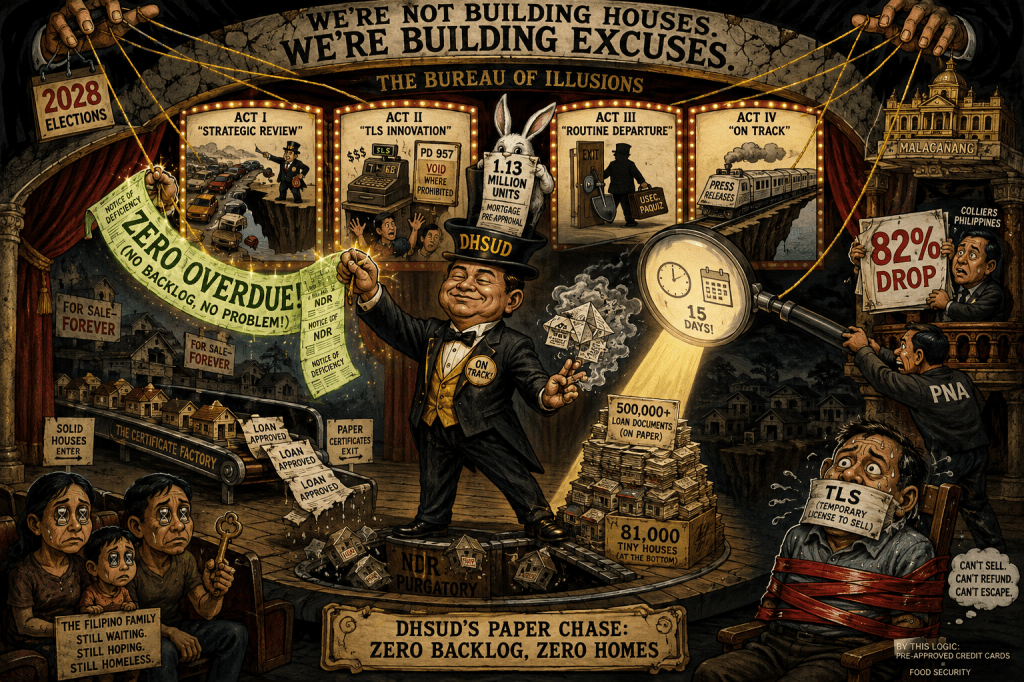
Inside the Agency That Counts Loan Approvals as Houses and Calls It a Miracle
By Louis ‘Barok‘ C. Biraogo — August 18, 2026
THE Department of Human Settlements and Urban Development (DHSUD) has just released a document so exquisitely crafted, so artfully deceptive, that it deserves a place in the pantheon of Philippine political propaganda. The August 17, 2026 press release, published dutifully by the state-run Philippine News Agency, is not a report. It is a magic trick, a sleight-of-hand designed to make you look at the magician’s right hand—waving a shiny object called “Zero Overdue Applications”—while the left hand quietly makes the actual houses disappear.
Let us be clear about what we are witnessing. This is not governance. This is the art of administrative concealment, a calculated exercise in political messaging designed to achieve four specific, and rather cynical, objectives: recast catastrophic programmatic failure as prudent, data-driven progress; package a dangerous regulatory loophole as an innovation; normalize what smells like internal policy warfare; and, of course, keep the boss in Malacañang happy.
So, let us put on our waders and step into the swamp of bureaucratic doublespeak.
The Art of the Statistical Shell Game
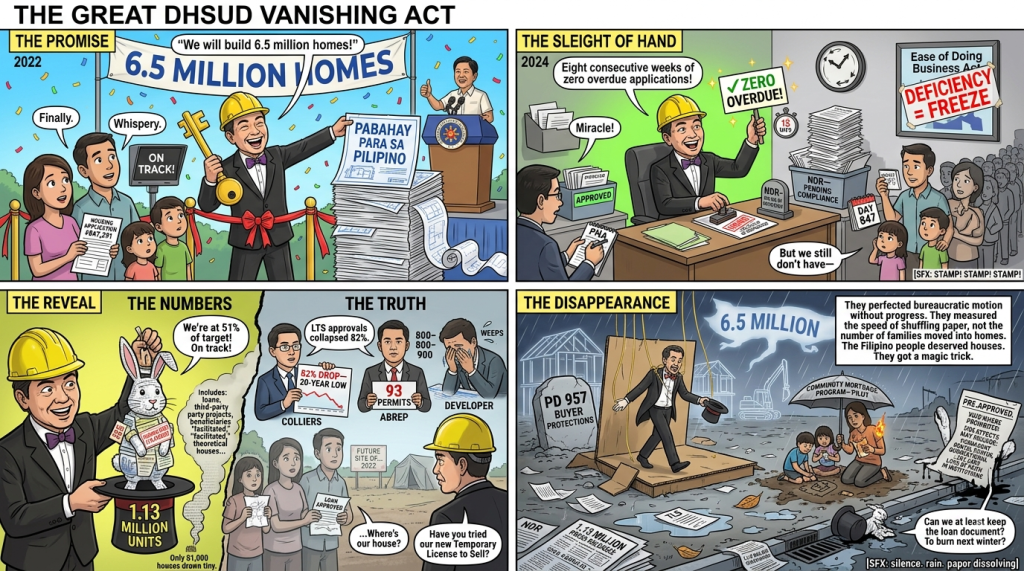
The press release proudly trumpets a singular, dazzling achievement: “eight consecutive weeks of zero overdue regulatory applications.” It sounds impressive. It sounds like efficiency. It sounds like a department that has finally gotten its act together. But what does it actually mean? Absolutely nothing for the Filipino family waiting for a home.
Our friends at DHSUD have discovered a remarkable truth: if you change the definition of “overdue,” you can achieve perfection. Under Republic Act 11032, the Ease of Doing Business Act, the regulatory clock stops the moment an application is deemed “deficient.” This is the bureaucratic equivalent of a get-out-of-jail-free card. The department’s weapon of choice is the Notice of Deficiency of Requirements (NDR). Issue an NDR, and poof—the application vanishes from the “overdue” list. It re-enters the purgatory of “pending compliance.”
This is the statistical sleight-of-hand that allows the DHSUD to claim a spotless record while the real estate industry is screaming bloody murder. The press release is a direct rebuttal to a damning finding by Colliers Philippines that License to Sell (LTS)-covered residential units fell a staggering 82% year-on-year in the first half of 2026—to roughly 38,000 units, a “20-year low.” The A Better Real Estate Philippines (ABREP) Movement independently corroborated this collapse, reporting a drop from 800-900 permits in 2025 to a pathetic 93 in 2026.
Does the DHSUD’s press release dispute these numbers? Of course not. Because they can’t. Instead, they pull the classic politician’s trick: they answer a question nobody asked. The industry asks, “Why have approvals collapsed?” The DHSUD answers, “We process paperwork within 15 days!”
This is a change of subject, not a defense. The dark arithmetic is simple: an agency can post a genuinely spotless ‘zero overdue’ record while approval volume collapses, simply by denying, returning, or converting to Temporary License to Sell (TLS) a larger share of a shrinking pool of applications. They are measuring the speed at which they shuffle paper, not the number of homes they help put on the market. They have perfected the art of bureaucratic motion without actual progress.
The Four Acts of a Communications Autopsy
This press release is a four-act play, and each act is a masterpiece of misdirection.
Act I: Recasting Failure as Prudence
The “20-year low” is not a failure; it’s a “strategic review and systematic centralization.” The bottleneck created by yanking approval authority from the regions and concentrating it in a national office that couldn’t handle the volume is not a management blunder; it’s a noble effort to “diagnose workflow bottlenecks.” You have to admire the audacity. They caused the traffic jam and are now patting themselves on the back for studying it.
Act II: Laundering a Policy Shift
The Temporary License to Sell (TLS) is presented as an “innovation” to keep “project momentum moving.” Let’s call it what it is: a legal time bomb. It is a mechanism that allows developers to start selling homes and collecting money before they have satisfied the full requirements of Presidential Decree 957, the Subdivision and Condominium Buyers’ Protective Decree. The law is clear: no sale without a License to Sell, which requires a performance bond to guarantee completion. The TLS is a loophole big enough to drive a bulldozer through, allowing developers to collect on promises they may never keep. It prioritizes developer cash flow over buyer safety. The central tension is speed versus safety, and under this administration, speed—and the political points it buys—is winning.
Act III: Normalizing Internal Friction
The department would have us believe that a senior undersecretary resigning in the middle of a regulatory firestorm is as unremarkable as a change of stationery. How reassuring. The timing—right as the most aggressive reforms are being rammed through—certainly invites the imagination to wander. Was it a principled exit? A forced march out the door? A sudden passion for gardening? The public is left to guess, because the official explanation offers all the detail of a classified obituary. When the spin machine insists something is “routine” with the enthusiasm of a hostage video, one is forgiven for suspecting the routine in question involves a shovel and a very deep hole.
Act IV: Aligning with the Palace Narrative
The entire document is crafted to serve the Marcos administration’s narrative of “decisive, inclusive housing governance.” The President needs a legacy. He needs to say he is “on track.” And so, the DHSUD dutifully provides the talking points, weaving the 1.13 million target into the press release like a prayer. But this is a prayer to a false god.
The Myth of “On Track”: The Moving Target of a Mirage
The claim of being “on track” to hit 1.13 million units is perhaps the most cynical part of this entire charade. This figure is not a product of ambition; it is the fourth, ignominious recalibration of a promise that has been shrinking like a cheap shirt. The Marcos administration initially promised 6 million units. Then it was 5.5 million. Then 3.2 million. Now it’s 1.13 million.
As I have meticulously documented in Kweba ni Barok, this is not just a change in numbers, this is not just a change in numbers; it’s a change in math. The “1.13 million” figure now includes “targeted financial assistance programs.” This is the ultimate conjuring trick: a family that receives a housing loan is now counted as a “housing unit delivered.” By this logic, the government could solve the housing crisis by mailing out pre-approved credit card offers.
This allows them to claim over 575,000 “units/families facilitated.” But peel back the layers, and the truth is ugly. Only a tiny fraction—around 81,000—represents direct housing production. The rest is financing and third-party projects. The government is conflating the disbursement of a loan with the delivery of a home. It’s like claiming you’ve solved world hunger because you handed out restaurant menus. The physical, legal, and occupied reality of a home is being replaced by the administrative reality of a bank transaction.
The Unanswered and the Unaccountable
This sophisticated charade leaves us with critical, burning questions that the DHSUD is desperately trying to bury under a mountain of process metrics.
First, what are the actual, independently verified LTS issuance figures? The department must publish the raw data, not its sanitized interpretation of it. Second, how many TLS permits have been issued, and how many of those projects have failed to reach full compliance? The TLS is a risk to the very Overseas Filipino Workers (OFWs) the department claims to protect. Third, what safeguards ensure the TLS doesn’t become a permanent legal loophole, rendering PD 957’s buyer protections a dead letter? Fourth, what was the real reason for Undersecretary Paquiz’s departure? The public deserves to know if the department’s top officials are fleeing a sinking ship. And fifth, how will the tragic BF Resort Village dispute be resolved, and what precedent will it set for homeowners across the nation?
The Filipino people deserve more than a 15-day paper chase. They deserve a government that measures its success not by how fast it moves files, but by how many families it moves into safe, secure, and affordable homes. DHSUD’s so-called “reforms” risk creating a future where the government is brilliant at moving paperwork but fails to move people into houses.
Recommendations for Restoring Sanity
To move from smoke and mirrors to substance, we demand:
- Radical Transparency: DHSUD must publish a real-time, auditable dashboard showing the full lifecycle of every application: received, approved, denied, NDRs issued, TLS granted, and projects completed. The era of self-reported, unverifiable platitudes must end.
- An Independent Audit: The Commission on Audit (COA) must conduct a forensic audit of the “1.13 million” target, separating physical construction from financing assistance to reveal the true number of homes built.
- A Legal Review of the TLS: The Solicitor General and Congress must immediately review the legality of the TLS in relation to PD 957. If it constitutes a loophole that endangers buyers, it must be closed. The speed of a project launch must never trump the safety of a family’s life savings.
The DHSUD’s press release is a carefully constructed illusion, a testament to the art of saying nothing while appearing to say everything. It is a “masterclass in bureaucratic gaslighting,” telling the public their eyes are lying. But the numbers don’t lie. The industry reports don’t lie. The families still waiting for a home don’t lie.
We are being told we are “on track.” The question is: on track to where? To a future of glittering press releases and crumbling promises, or to a nation where every Filipino finally has a decent home? The answer, buried under a pile of deficiency notices in a government office, remains profoundly, shamefully unclear.
May the rule of law rise on the third day. 🪨
Key Citations
A. Reports & Studies
- Colliers Philippines. “Decrease in issuance of LTS depresses residential property market.” BusinessMirror, 30 July 2026, https://businessmirror.com.ph/2026/07/30/decrease-in-issuance-of-lts-depresses-residential-property-market-colliers/.
- Leuterio, Anthony Gerard. Statements via A Better Real Estate Philippines (ABREP) Movement. Reported in “Housing permit backlog puts PH growth, investments at risk.” Cebu Daily News / Inquirer, 9 Aug. 2026, https://cebudailynews.inquirer.net/755040/housing-permit-backlog-puts-ph-growth-investments-at-risk.
B. News Articles
- “DHSUD assures no delays on licenses, on track in hitting PBBM’s housing target.” Department of Human Settlements and Urban Development / Philippine News Agency, 17 Aug. 2026, https://dhsud.gov.ph/news/dhsud-assures-no-delays-on-licenses-on-track-in-hitting-pbbms-housing-target/.
- “DHSUD rejects ‘20-year low’ in housing licenses issuance.” The Manila Times, 18 Aug. 2026, https://www.manilatimes.net/2026/08/18/news/national/dhsud-rejects-20-year-low-in-housing-licenses-issuance/2406974.
- “Govt hits 51% of target in housing program.” The Manila Times, 28 July 2026, https://www.manilatimes.net/2026/07/28/news/national/govt-hits-51-of-target-in-housing-program/2393332.
- “Gov’t ‘recalibrates’ housing target to 1.13 million units.” GMA Network, 12 Jan. 2026, https://www.gmanetwork.com/news/money/economy/972542/gov-t-recalibrates-housing-target-to-1-13-million-units/story/.
- Mencias, Eileen. “Sharon Paquiz reportedly out at DHSUD amid property permit delays.” Bilyonaryo, 15 Aug. 2026, https://bilyonaryo.com/2026/08/15/sharon-paquiz-reportedly-out-at-dhsud-amid-property-permit-delays/property/.
- Biraogo, Louis ‘Barok’ C. “From 6.5 Million to 2.2 Million: Marcos’ Housing Miracle (or Math).” Kweba ni Barok, 24 June 2026, kwebanibarok.com/2026/06/24/from-6-5-million-to-2-2-million-marcos-housing-miracle-or-math/.
C. Official Websites & Legal Sources
- Republic Act No. 11032. Lawphil, 2018, https://www.lawphil.net/statutes/repacts/ra2018/ra_11032_2018.html.
- Presidential Decree No. 957. Lawphil, 1976, https://lawphil.net/statutes/presdecs/pd1976/pd_957_1976.html.
- Department of Human Settlements and Urban Development. Official website and circulars on Temporary License to Sell, https://dhsud.gov.ph/ and https://dhsud.gov.ph/wp-content/uploads/2026/08/Department-Circular-No.-2026-012-13-and-14.pdf.

- “Ang Hirap Maging Mahirap”: The PAO Scandal That Proves Government Contempt Is Nothing New
- “Far-Off” My Axx: Malacañang’s Claire Castro Drowns in Her Own Legal Gaslighting
- “Forthwith” to Farce: How the Senate is Killing Impeachment—And Why Enrile’s Right (Even If You Can’t Trust Him)
- “HINDI AKO NAG-RESIGN!”
- “I Know Nothing”: Baste Duterte’s Amnesia Defense Meets ₱33M in GenCorp Contracts
- “I’m calling you from my new Globe SIM. Send load!”
- “Mahiya Naman Kayo!” Marcos’ Anti-Corruption Vow Faces a Flood of Doubt
- “Manageable” Debt, Unmanageable Lies: DBM’s ₱21 Trillion Fairy Tale
- “Meow, I’m calling you from my new Globe SIM!”
- “Natrabaho”: One Word, One Ombudsman, and a Judiciary on Trial
- “No Special Jail for Crooks!” Boying Remulla Slams VIP Perks for Flood Scammers
- “Philippine-Controlled” or Yankee Gas Station? The Davao Fuel Depot Farce Exposed





Leave a comment