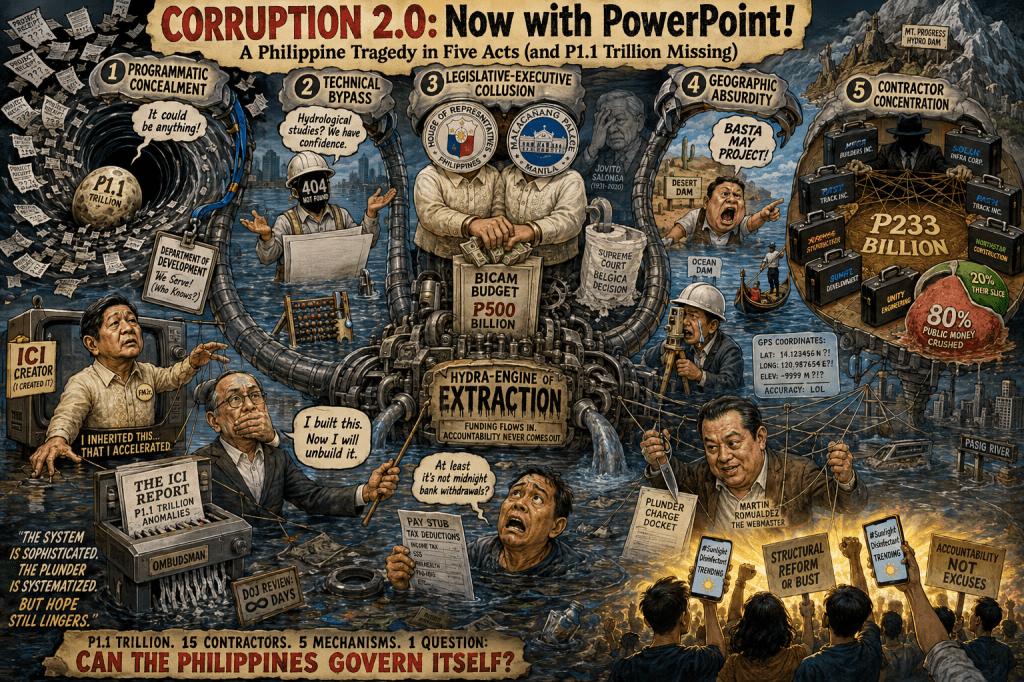
Singson’s Bombshell Reveals a Cartel of 15 Contractors, P1.1 Trillion in Hidden Funds, and a National Budget That Bled in Broad Daylight
By Louis ‘Barok‘ C. Biraogo — August 16, 2026
GATHER round, mga ka-kweba, for we have stumbled upon something far more sinister than your garden-variety Filipino corruption. What we have here is not the crude, ham-fisted thievery of the Marcos Sr. era—the midnight bank withdrawals, the Swiss accounts, the shoe collections. No, this is something altogether more elegant, more insidious, more technologically advanced.
This is corruption 2.0. Corruption with a PowerPoint presentation. Corruption with plausible deniability baked into its very architecture.
And the man who has pulled back the curtain? None other than Rogelio “Babes” Singson—former Department of Public Works and Highways (DPWH) Secretary, civil engineer, and until recently, one of five commissioners of the very body President Marcos Jr. created to investigate the flood-control scandal. The fox, it seems, has decided to give a guided tour of the henhouse.
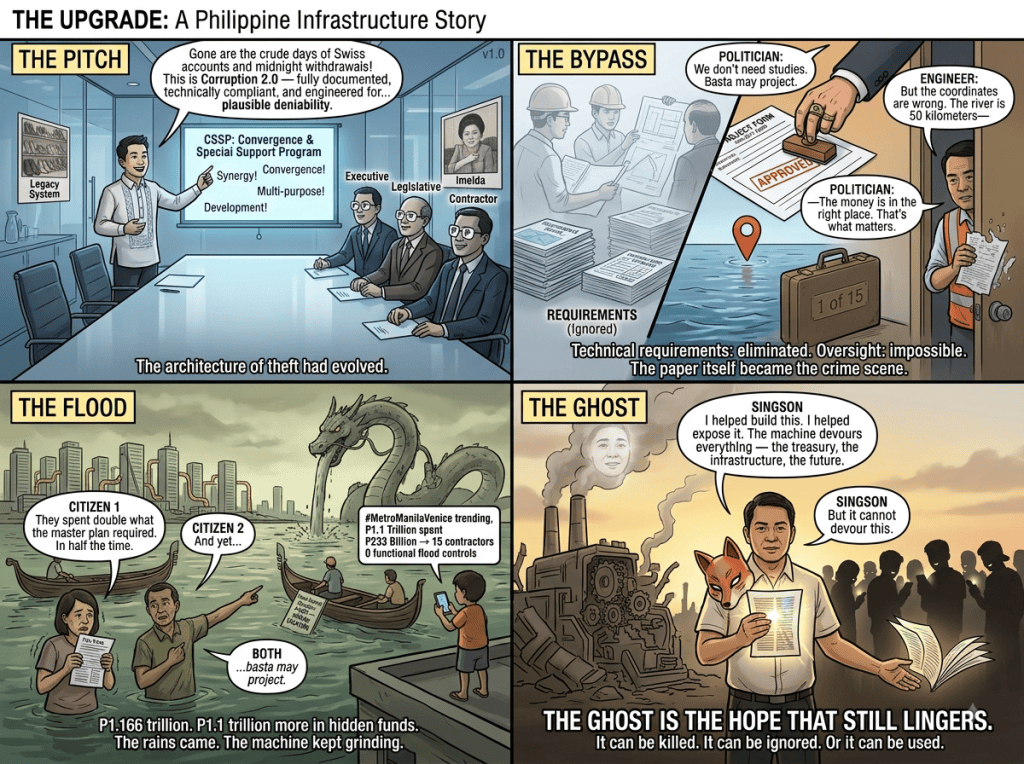
Welcome to the Philippines, where “basta may project” is national policy.
I. The Confession That Wasn’t
Let us begin with what Singson actually said, because in the carnival of Philippine political discourse, facts have a way of being trampled by the elephants of spin.
Speaking before the Philippine Construction Arbitration Conference, Singson revealed—for the first time publicly—the existence of what he called a “Convergence and Special Support Program” (CSSP), a budget category that ballooned to P1.1 trillion from 2022 to 2024. This was separate from the already staggering P1.166 trillion in flood-control appropriations during the same period.
The numbers, dear readers, are enough to make your abacus weep:
| Administration | Total DPWH Budget | Flood Control | Percentage |
|---|---|---|---|
| Aquino III (2011–2016) | P1.324 trillion | P182 billion | 14% |
| Duterte (2016–2021) | P3.135 trillion | P587 billion | 19% |
| Marcos Jr. (2022–2025) | P3.378 trillion | P1.166 trillion | 35% |
But wait—it gets better. Or worse, depending on your perspective.
Singson estimates that completing flood-control master plans for all 18 major river basins in the Philippines—covering 62 provinces—would require only P800 billion to P900 billion over five to six years. The government spent more than double that amount in half the time.
And yet, when the rains came, Metro Manila still transformed into Venice—minus the gondolas and romance.
II. The Five-Headed Hydra: Anatomy of a New Technology of Plunder
Singson’s revelations, when dissected with the precision they deserve, reveal not isolated acts of corruption but an interlocking system—a sophisticated machinery of plunder with five mutually reinforcing mechanisms.
Mechanism 1: Programmatic Concealment
The CSSP is a masterclass in hiding in plain sight. Who would question a “Convergence and Special Support Program”? It sounds so earnest, so developmental. It could be anything—roads, bridges, coastal projects, flood mitigation, farm-to-market roads, dredging, multipurpose buildings, water systems, health centers.
And that’s precisely the point.
By creating a budget category so broad it could swallow the moon, the architects of this scheme ensured that no single line item would attract scrutiny. P1.1 trillion disappeared into a programmatic black hole, dispersed across thousands of projects too numerous and too diverse to track.
This is not the corruption of the Marcos Sr. era, where money was simply stolen from the treasury. This is corruption with plausible deniability engineered into its DNA. Every peso can be accounted for—on paper. Every project can be pointed to—on paper. The genius is that the paper itself is the crime scene.
Mechanism 2: Technical Bypass
Here is where Singson’s engineering expertise becomes damning. He revealed that many projects—”many,” he said, with the understatement of a man who has seen too much—lacked the required supporting technical studies, project unit-cost estimates, and specifications.
Think about what this means.
In any functioning democracy, a flood-control project should begin with hydrological studies. It should be designed by engineers who understand river dynamics, rainfall patterns, and the complex interplay of watersheds. It should be costed with precision, specifying exactly what materials will be used, how much they will cost, and how long construction will take.
Instead, what Singson describes is a system where projects were approved without any of this. Where the technical requirements that would make oversight possible were simply eliminated.
This is not incompetence. This is design. You cannot audit what has no specifications. You cannot verify costs that were never estimated. You cannot evaluate quality when no quality standards were ever established.
The technical bypass is not a bug in the system—it is the entire point of the system.
Mechanism 3: Legislative-Executive Collusion
Singson’s most explosive revelation concerns the budget process itself. Infrastructure project insertions, he said, occurred at “virtually every important stage of budgeting”—during DPWH’s own preparation, in the House of Representatives, in the Senate, and finally during the bicameral conference committee.
At their peak in the 2024 budget, these insertions totaled an extraordinary P450 billion to P500 billion.
Let that sink in.
Half a trillion pesos—roughly the annual budget of several government departments combined—was inserted into the national budget through a process that systematically excluded technical review. And this was not the work of one branch of government acting alone. This required the active collaboration of the executive and legislative branches, working hand in glove to circumvent the constitutional safeguards that separate powers.
The 2013 Supreme Court decision in Belgica v. Ochoa (G.R. No. 208566) struck down the Priority Development Assistance Fund (PDAF) system because legislators exercised post-enactment control over project identification—essentially acting as both appropriators and implementers. The Court recognized that this violated the fundamental principle of separation of powers.
But what Singson describes is arguably worse: a system where the constitutional violation occurs before enactment, where the separation of powers is eroded not by legislative overreach but by collusion—where both branches conspire to circumvent the very controls the Constitution establishes.
Mechanism 4: Geographic Manipulation
Perhaps the most darkly comic element of Singson’s testimony involves what he called “engineering absurdities.”
Some flood-control projects were approved with specified geographic coordinates. When final surveys were undertaken, the coordinates turned out to be different—the projects were in the wrong place.
Did this trigger reconsideration? Did someone say, “Wait, we’re building a flood-control structure in the wrong location—perhaps we should reassess”?
Of course not.
The politician who sponsored the insertion simply insisted that the project be constructed somewhere—anywhere—”basta may project.”
This is corruption reduced to its purest, most absurd form. The project exists not to solve a problem but to justify an appropriation. The concrete is poured not where it’s needed but where the money demands it be poured. The entire edifice of public works—engineering, planning, cost-benefit analysis—is reduced to a theatrical performance, a Kabuki dance of development where the only real purpose is the transfer of funds.
Mechanism 5: Contractor Concentration
Singson’s final revelation is perhaps the most predictable: roughly 20% of the entire flood-control budget was channeled to just 15 favored contractors.
Fifteen companies. Twenty percent of P1.166 trillion.
That’s approximately P233 billion—distributed among a cartel small enough to fit in a single boardroom.
This is not competitive bidding. This is not free enterprise. This is oligarchy by procurement, a system where public funds are systematically funneled to a politically connected few, eliminating competition and institutionalizing kickbacks.
The contractors, of course, are merely the recipients. The real question is: who are they connected to? Who selected them? Who protected them from audit? Who ensured that their bids—if bids there were—always came out on top?
III. The Marcos Administration: Architect or Inheritor?
Now we arrive at the uncomfortable question that the Palace would very much prefer we not ask.
President Marcos Jr. created the Independent Commission for Infrastructure (ICI) in September 2025, purportedly to investigate corruption in flood-control and public works projects. He appointed Singson—a man with impeccable technical credentials—as one of five commissioners. The commission conducted 32 hearings, processed more than 1,100 documents, and submitted nine referrals involving 65 individuals.
But then something curious happened.
The commission’s final report was submitted to the Ombudsman in March 2026. And then… silence.
The complete ICI findings have never been released to the public. Malacañang has deferred to the Ombudsman and Department of Justice, who argue—with some legal justification—that premature disclosure could jeopardize investigations. Critics, with equal justification, argue that the ICI report went straight to the Ombudsman’s wastebasket.
The truth, as usual, lies somewhere in between.
The Ombudsman’s argument has merit. Releasing sensitive investigative materials before cases are filed could indeed compromise prosecutions, endanger witnesses, and allow suspects to destroy evidence. These are legitimate concerns.
But the critics’ argument also has merit. A report concerning hundreds of billions of pesos in potential corruption cannot simply disappear into an investigative bureaucracy indefinitely. The public’s right to know—enshrined in Article III, Section 7 of the 1987 Constitution of the Republic of the Philippines (1987 Constitution)—cannot be held hostage to an investigation without end.
The deeper problem is this: the Marcos administration cannot simultaneously claim credit for creating the ICI and deny responsibility for the corruption it uncovered.
The flood-control appropriations occurred during Marcos Jr.’s watch. The CSSP ballooned during Marcos Jr.’s watch. The legislative insertions—including the alleged P100 billion that Marcos himself reportedly ordered during the 2025 bicameral conference, according to former Rep. Zaldy Co—occurred during Marcos Jr.’s watch.
The administration’s defense—”we inherited this system and are now investigating it”—rings hollow when the system accelerated under its stewardship.
IV. The Rot at the Core: A Criminal Political Class
But let us not delude ourselves into thinking this scandal is about one administration, one family, or even one party.
What Singson has exposed is the operating system of Philippine governance—a deeply embedded culture of impunity that has warped public institutions into instruments of personal enrichment. The political class—that self-serving ruling caste that has weaponized public office, dynastic power, and legislative authority—has perfected what can only be described as institutionalized plunder.
The mechanisms Singson describes—programmatic concealment, technical bypass, legislative-executive collusion, geographic manipulation, contractor concentration—are not unique to the Marcos administration. They are the standard operating procedures of a political system that has normalized graft as the price of governance.
Every administration since the restoration of democracy has engaged in some version of this. The names change—Aquino, Ramos, Estrada, Arroyo, Aquino again, Duterte, Marcos again—but the technology remains the same. Only the sophistication improves.
This is the bitter truth that the Filipino people must confront: the corruption is not an aberration. It is not a bug in the democratic system. It is the purpose of the democratic system as currently constituted—a system designed not to serve the public interest but to facilitate the private enrichment of those who control the levers of power.
V. The Way Forward: Structural Reform or Perpetual Plunder?
So what is to be done?
The easy answer—prosecute the guilty—is necessary but insufficient. The Ombudsman has identified Martin Romualdez as a “central figure” in the scheme, with plunder charges reportedly “very close” to being filed. This marks a step in the investigative process. But even if every current suspect were convicted, the system that enabled them would remain intact, ready for the next generation of plunderers.
What is needed is structural reform—a fundamental redesign of the budget process to eliminate the opportunities for corruption that Singson has exposed.
Recommendation 1: Constitutional Amendment to Eliminate Post-Enactment Legislative Control
The Supreme Court’s Belgica decision struck down the PDAF, but Congress has simply found new ways to exercise post-enactment control over project implementation. The Constitution must be amended to explicitly prohibit legislators from identifying specific projects, contractors, or locations during the appropriations process.
Congress can appropriate. It cannot implement. The line must be absolute and unambiguous.
Recommendation 2: Mandatory Engineering Readiness Certification
No infrastructure project should receive an appropriation without a certification—issued by an independent technical body—that it has completed feasibility studies, hydrological analyses, engineering designs, and cost estimates. Projects that fail to meet this standard should be automatically disqualified.
This would eliminate the “technical bypass” that Singson describes—the practice of approving projects without the technical preparation that makes oversight possible.
Recommendation 3: Real-Time Public Disclosure of Budget Modifications
Every change to the budget—at every stage of the process, from NEP to GAA—should be published online in real-time, with clear attribution of who proposed the change and what it entails. The public should be able to track every peso from proposal to appropriation to obligation to disbursement.
Sunlight, as Justice Brandeis famously observed, is the best disinfectant.
Recommendation 4: Beneficial Ownership Transparency for Contractors
Republic Act No. 12009 (New Government Procurement Act) emphasizes transparency and beneficial-ownership information. This must be enforced aggressively. Every contractor receiving government funds should be required to disclose its true owners—the individuals who ultimately benefit from the contracts, not just the shell companies that sign the papers.
This would make it impossible for politicians to hide behind corporate veils while channeling public funds to their cronies.
Recommendation 5: Independent Technical Audit Commission
The ICI should not be a temporary commission that dissolves after six months. It should be a permanent, independent body with the authority to audit infrastructure projects for technical compliance, engineering soundness, and fiscal propriety. It should have subpoena power, independent funding, and protection from political interference.
The fact that the ICI was allowed to expire—its findings buried in the Ombudsman’s files—is itself a scandal that demands remedy.
VI. The Question That Cannot Be Avoided
In the end, Singson’s revelations force us to confront a question that the political class would very much prefer to avoid:
Can the Philippines govern itself?
The answer, based on the evidence before us, is: not under the current system.
The system is broken—not in the superficial sense of needing minor repairs, but in the fundamental sense that its core mechanisms have been captured by those who benefit from its dysfunction. The budget process is a mechanism for extraction, not allocation. The procurement system is a mechanism for patronage, not competition. The oversight institutions are mechanisms for theater, not accountability.
And the Filipino people—those who pay the taxes, suffer the floods, and bear the consequences of this systemic failure—are left with nothing but the hollow promise that next time it will be different.
It will not be different next time. Not without fundamental change.
VII. A Final Word to the Youth
But perhaps I am too cynical. Perhaps there is hope.
The youth of this land—those who have inherited a political system they did not create and do not control—have the power to demand more. They have the numbers, the energy, and the moral clarity to insist that the Philippines can be better.
The question is whether they will use that power.
History will record this moment as either a turning point or another chapter in the long, sad chronicle of Philippine corruption. The choice belongs to those who are willing to fight for a different future—not to the politicians who have proven, time and again, that they cannot be trusted with power.
The ghost in the machine is not Singson’s revelation. The ghost is the hope that still lingers in the hearts of millions of Filipinos who believe that their country deserves better.
That ghost cannot be killed. But it can be ignored.
And if it is ignored, the machine will grind on, devouring everything in its path—the treasury, the infrastructure, the future—until there is nothing left but the ghosts of what might have been.
Key Citations
A. Legal & Official Sources
- The 1987 Constitution of the Republic of the Philippines. Official Gazette of the Republic of the Philippines, 1987, http://www.officialgazette.gov.ph/constitutions/1987-constitution/.
- Belgica v. Ochoa. G.R. No. 208566. Supreme Court of the Philippines, 19 Nov. 2013, lawphil.net/judjuris/juri2013/nov2013/gr_208566_2013.html.
- Araullo v. Aquino. G.R. No. 209287. Supreme Court of the Philippines, 1 July 2014, lawphil.net/judjuris/juri2014/jul2014/gr_209287_2014.html.
- Republic Act No. 9184. An Act Providing for the Modernization, Standardization and Regulation of the Procurement Activities of the Government and for Other Purposes. 10 Jan. 2003, lawphil.net/statutes/repacts/ra2003/ra_9184_2003.html.
- Republic Act No. 12009. An Act Revising Republic Act No. 9184, Otherwise Known as the “Government Procurement Reform Act”, and for Other Purposes. 20 July 2024, lawphil.net/statutes/repacts/ra2024/ra_12009_2024.html.
- Republic Act No. 3019. Anti-Graft and Corrupt Practices Act. 17 Aug. 1960, lawphil.net/statutes/repacts/ra1960/ra_3019_1960.html.
- Republic Act No. 7080. An Act Defining and Penalizing the Crime of Plunder. 12 July 1991, lawphil.net/statutes/repacts/ra1991/ra_7080_1991.html.
- Republic Act No. 6713. An Act Establishing a Code of Conduct and Ethical Standards for Public Officials and Employees. 20 Feb. 1989, lawphil.net/statutes/repacts/ra1989/ra_6713_1989.html.
- Executive Order No. 94. Creating the Independent Commission for Infrastructure. 11 Sept. 2025, lawphil.net/executive/execord/eo2025/eo_94_2025.html.
- Independent Commission for Infrastructure. Reports and Referrals. Office of the President, 2025–2026.
B. News Reports
- Tiglao, Rigoberto. “Marcos’ Flood-Control Funds Doubled to P1.2 Trillion, from Duterte’s P587 Billion.” The Manila Times, 17 Aug. 2026, http://www.manilatimes.net/2026/08/17/opinion/columns/marcos-flood-control-funds-doubled-to-p12-trillion-from-dutertes-p587-billion/2406424.
- “Ang Hirap Maging Mahirap”: The PAO Scandal That Proves Government Contempt Is Nothing New
- “Far-Off” My Axx: Malacañang’s Claire Castro Drowns in Her Own Legal Gaslighting
- “Forthwith” to Farce: How the Senate is Killing Impeachment—And Why Enrile’s Right (Even If You Can’t Trust Him)

- “HINDI AKO NAG-RESIGN!”

- “I Know Nothing”: Baste Duterte’s Amnesia Defense Meets ₱33M in GenCorp Contracts

- “I’m calling you from my new Globe SIM. Send load!”

- “Mahiya Naman Kayo!” Marcos’ Anti-Corruption Vow Faces a Flood of Doubt

- “Manageable” Debt, Unmanageable Lies: DBM’s ₱21 Trillion Fairy Tale
- “Meow, I’m calling you from my new Globe SIM!”

- “Natrabaho”: One Word, One Ombudsman, and a Judiciary on Trial
- “No Special Jail for Crooks!” Boying Remulla Slams VIP Perks for Flood Scammers

- “Philippine-Controlled” or Yankee Gas Station? The Davao Fuel Depot Farce Exposed




Leave a Reply