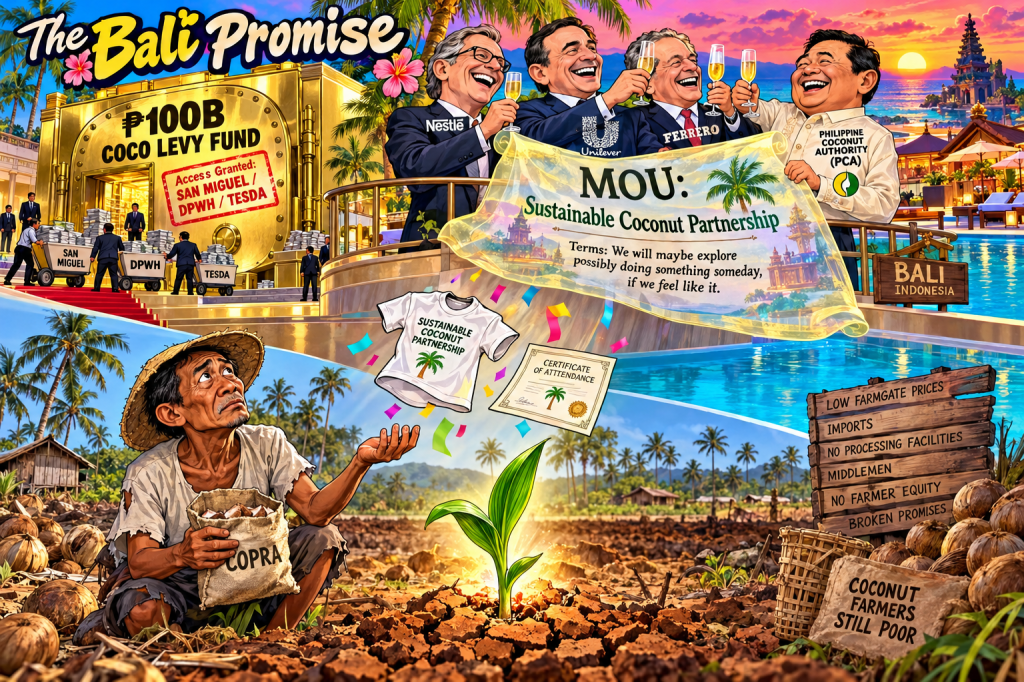
Nestlé, Unilever, and the Art of the Non-Binding Promise: A Masterclass in Corporate Greenwashing
By Louis ‘Barok‘ C. Biraogo — October 16, 2026
MGA ka-kweba, countrymen, and fellow survivors of the Philippine agricultural policy circus—welcome back to the Cave. Today we dissect the latest chapter in our national telenovela: the Philippine Coconut Authority’s (PCA) Memorandum of Understanding (MOU) with the Sustainable Coconut Partnership (SCP), signed in beautiful, exotic, far away from any actual coconut farmer Bali, Indonesia. Nothing says “we hear your cries of poverty” like a signing ceremony 2,000 kilometers from the nearest copra dryer.
Let’s begin with the headline, shall we? The PCA—an agency whose historical relationship with coconut farmers can charitably be described as “complicated,” and less charitably described as “the reason 90% of them live below the poverty line”—has partnered with a consortium of global fast-moving consumer goods (FMCG) giants including Nestlé, Unilever, and Ferrero. These are the same companies that have been buying coconut from the Philippines for decades while farmers earned roughly ₱715 to ₱1,500 per month. Now they’re here to save the coconut industry. With an MOU. That isn’t legally binding.
Forgive me if I don’t break out the tuba.
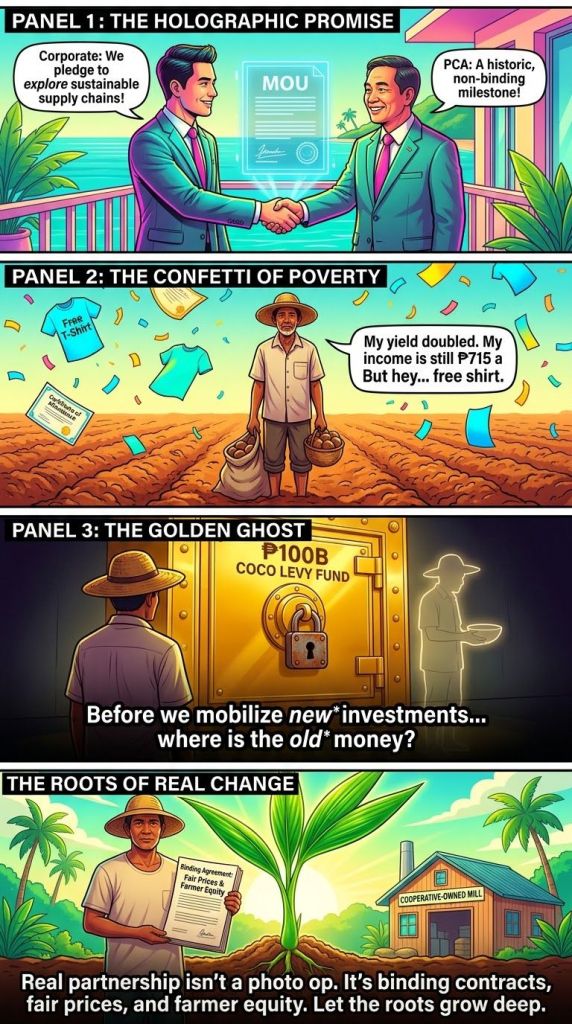
The MOU: A Legal Document for People Who Hate Legal Documents
Let’s get this straight: a Memorandum of Understanding, in Philippine legal practice, is essentially a promise to maybe possibly consider doing something at some vague future date if everyone feels like it. It’s the diplomatic equivalent of “let’s do lunch.” The Supreme Court itself—in Association of Philippine Coconut Desiccators v. PCA—already warned that the PCA cannot abdicate its regulatory functions through mere administrative issuances. An MOU is even weaker than an administrative issuance. It’s an administrative suggestion.
So what exactly has been “agreed” here? According to the reports, the parties will “mobilize investments, technical expertise, and development support.” They will “explore sustainable supply chains.” They will “support the planting of 100 million coconut palms by 2028.” They will explore. They will support. They will mobilize.
Nowhere in that list of aspirational verbs do I see “pay farmers a living wage,” “guarantee minimum farmgate prices,” or “return the coco levy funds that were stolen from them in the first place.”
But perhaps I’m being uncharitable. Perhaps the Sustainable Coconut Partnership is different. Perhaps this time, the corporations whose entire business model depends on cheap coconut will suddenly develop a conscience and decide to pay farmers more than ₱33 per kilo of copra. Perhaps Nestlé—a company with a documented history of child labor in its cocoa supply chain—will be the one to finally deliver economic justice to the Filipino coconut farmer.
And perhaps I’ll wake up tomorrow as a supermodel.
The SCP: Who Exactly Is This “Partnership,” Anyway?
The Sustainable Coconut Partnership describes itself as an “industry-led, multistakeholder platform.” Let’s parse that. “Industry-led” means the corporations are in charge. “Multistakeholder” means they’ve invited some non-governmental organizations (NGOs) to sit at the table and nod approvingly. “Platform” means it has a website and a charter and an “Assurance System” that is not actually a certification program, because if it were a certification program, someone might hold them accountable for something.
The SCP’s founding members include Barry Callebaut, Ferrero, Nestlé, Unilever, and AAK—the very companies that dominate global coconut processing and consumption. They are advised by Business for Social Responsibility (BSR), a consultancy that makes money helping corporations appear socially responsible. This is not a farmer organization. This is not a government regulator. This is the industry, regulating itself, with a consultancy holding the clipboard.
I’m sure the Assurance System is very rigorous. I’m sure it involves checkboxes. I’m sure the checkboxes are verified by the same companies that benefit from low coconut prices. What could possibly go wrong?
The Elephant in the Room: The Coco Levy Fund
But here’s what really gets me, mga ka-kweba. We are having this conversation about a shiny new international partnership when the most basic question remains unanswered: where is the ₱100 billion coco levy fund?
For those who need a refresher: the coco levy was a tax imposed on coconut farmers from 1972 to 1982, supposedly to develop the coconut industry. Instead, the money ended up in the hands of Eduardo “Danding” Cojuangco Jr. and his cronies, who used it to buy United Coconut Planters Bank, San Miguel Corporation shares, and various other assets. The Supreme Court declared the funds “prima facie public in character” in 2012. The Sandiganbayan spent 37 years adjudicating the cases. In December 2024, the cases were dismissed on grounds of “speedy disposition.” Danding was vindicated. Farmers got nothing.
Now, with the Coconut Farmers and Industry Trust Fund Act (RA 11524), there’s supposed to be a ₱100 billion trust fund for farmers. Except only 3.5% of coconut farmers are registered in the official registry, meaning 96.5% are effectively excluded from benefits. And of the initial fund release, ₱4 billion—84%—went to San Miguel Corporation, not to farmers. The remaining went to the Department of Public Works and Highways (DPWH), the Technical Education and Skills Development Authority (TESDA), and the Department of Budget and Management (DBM).
So forgive me if I’m skeptical when the PCA announces it will “mobilize investments” through a partnership with Nestlé. Whose investments? Whose money? Whose benefit?
The Productivity Illusion: More Coconuts, Same Poverty
Let’s talk economics, because this is where the sustainability-industrial complex always reveals itself. The pitch is simple: if farmers can produce more coconuts per hectare, they’ll earn more money. Therefore, the partnership will focus on productivity.
But here’s the thing about commodity agriculture: producing more of something that is already in oversupply drives prices down. If Philippine coconut yields suddenly double, and global demand doesn’t double along with it, farmgate prices will fall. Farmers will work harder, produce more, and earn the same or less.
The folks at Syntegral Global Solutions did the math: at ₱33.40 per kilo of copra (the average price over a recent 12-month period), a tenant farmer with one hectare of 100 coconut trees earns about ₱8,572 per year. That’s ₱715 per month. If prices spike to ₱68 per kilo—the historical high—that farmer might earn ₱17,453 per year, or ₱1,454 per month. Still below the poverty line.
Now, if that farmer doubles production without any change in price, they earn ₱1,430 per month. Congratulations—you’ve just doubled a number that was already catastrophically insufficient. The poverty threshold for a family of five in rural Philippines is roughly ₱12,000 per month. Even a 4x yield increase—which the Department of Science and Technology-Philippine Council for Agriculture, Aquatic and Natural Resources Research and Development (DOST-PCAARRD) claims is possible with hybrid varieties—would only get a tenant farmer to ₱5,720 per month. Still poor. Still hungry. Still wondering why the Nestlé representative is smiling in the photo op.
The only way farmers actually escape poverty is if the structure of the value chain changes: if they capture more of the final product value, if they process their own coconuts instead of selling copra, if they own the brands and the mills and the logistics. The SCP partnership, by design, does none of these things. It makes the supply chain more efficient for buyers, not more profitable for growers.
The Environmental Angle: Greenwashing with Coconut Oil
The partnership’s climate agenda deserves its own special circle of skepticism. The SCP talks about “regenerative agriculture,” “low carbon” practices, and “responsible rejuvenation.” These are lovely phrases. They are also conveniently aligned with the European Union’s Deforestation Regulation (EUDR), which requires companies to prove their supply chains are deforestation-free.
Let’s connect the dots. European buyers need traceable, “sustainable” coconut to maintain access to EU markets. The SCP provides a framework for that traceability. The PCA provides the government legitimacy. Farmers provide the labor and the land. The corporations get their “verified sustainable” coconut. The farmers get… training. And maybe a T-shirt.
Meanwhile, the PCA’s own track record on climate resilience is questionable. The agency has promoted hybrid coconut varieties whose “roots do not grow deep in the soil, making it vulnerable to typhoons.” Farmers have criticized this as maladaptation. And now the same agency is partnering with corporations to promote “climate-resilient varieties”? Which varieties? Chosen by whom? For whose benefit?
The cocolisap infestation—which affected over 500,000 trees and cost farmers millions—was met with Administrator Dexter Buted’s now-infamous assessment that it was “a very small portion…not a threat on a national level.” This is the leadership that will oversee a “climate resilience” program. What could possibly go wrong?
The Political Theatre: Why Now?
Let’s step back and ask the obvious question: why is this partnership being announced now?
The Marcos administration approved the Coconut Farmers and Industry Development Plan 2024-2028. The coco levy fund implementation is crawling. House Bill 4595 seeks to shorten the 50-year implementation period to 10 years, reflecting frustration with bureaucratic inertia. Farmers are mobilizing. The political pressure is mounting.
Enter the Sustainable Coconut Partnership, stage left, with a solution that costs the government nothing, generates positive headlines, and allows everyone to claim they’re “doing something” about coconut farmer poverty. The MOU is non-binding, so no one is actually accountable for anything. The corporations get a photo op with the PCA Administrator. The PCA gets to say it’s “mobilizing international investment.” The farmers get… a press release.
It’s the perfect political arrangement: maximum visibility, minimum commitment.
What Would Real Partnership Look Like?
I’m not against international cooperation. I’m not against corporations participating in agricultural development. What I’m against is the pretense that this constitutes meaningful action when the structural conditions of farmer poverty remain untouched.
A real partnership would include:
- Binding commitments with financial penalties for non-compliance. Not an MOU. A contract. With liquidated damages.
- Guaranteed minimum farmgate prices indexed to global market prices. If the corporations need coconut, they can pay for it.
- Farmer equity in the value chain. Joint ventures. Processing facilities owned by cooperatives. Direct participation in branding and marketing.
- Independent verification of outcomes. Not self-reporting by the corporations. Not “Assurance Systems” designed by BSR. Actual third-party audits with public disclosure of results.
- Resolution of the coco levy fund scandal. Before we talk about new money, let’s talk about the old money. Where is it? Who has it? Why are farmers still waiting?
- Farmer representation in governance. Not as beneficiaries. As decision-makers. With voting power.
None of these things are in the MOU. None of them are in the SCP’s Charter. None of them are on the agenda of the Bali Roundtable.
The Verdict
The PCA-SCP partnership is not a development program. It is a public relations exercise dressed in the language of sustainability. It allows corporations to secure traceable supply chains and burnish their environmental, social, and governance (ESG) credentials while paying lip service to farmer welfare. It allows the PCA to claim progress without spending money or confronting the structural inequalities that have impoverished coconut farmers for generations.
The coconut farmer’s dignity is the measure of this partnership’s legitimacy. And by that measure, it fails before it even begins.
But perhaps I’m being too harsh. Perhaps this time—for the first time in the long, sordid history of Philippine agricultural policy—the corporations, the government, and the international sustainability-industrial complex have finally decided to prioritize the people who actually grow the coconuts.
And perhaps I’ll wake up tomorrow as a supermodel.
MGA ka-kweba, countrymen, and fellow survivors of the Philippine agricultural policy circus—welcome back to the Cave. Keep your skepticism sharp and your coco levy receipts sharper.
Barok out.
Key Citations
A. Legal & Official Sources
- Association of Philippine Coconut Desiccators v. Philippine Coconut Authority. G.R. No. 110526, Supreme Court of the Philippines, 1998. LawPhil Project.
- Coconut Farmers and Industry Trust Fund Act. Republic Act No. 11524, Official Gazette of the Republic of the Philippines, 2021, officialgazette.gov.ph/2021/02/26/republic-act-no-11524/.
- DOST-PCAARRD. “Coco-HULIP Project Demonstrates Higher Nut Yields.” Philippine Council for Agriculture, Aquatic and Natural Resources Research and Development, 2026, pcaarrd.dost.gov.ph.
- Republic v. COCOFED. G.R. Nos. 147062-64, Supreme Court of the Philippines, 2001/2004. LawPhil Project.
- Syntegral Global Solutions. “Coconut Value Chain Analysis: Farmgate Economics and Poverty Thresholds.” Syntegral Global Solutions, 2024, syntegralsgs.com.
B. News Articles
- Lagare, Jordeene B. “PCA Taps Sustainability Group to Boost Coconut Farming.” INQUIRER.net, 14 Oct. 2026, business.inquirer.net/615719/pca-taps-sustainability-group-to-boost-coconut-farming.
- “Cocolisap Infestation Hits 500,000 Trees.” Rappler / Agriculture Monthly, 2025, agriculture.com.ph.
- “Farmers Blast Coco Levy Fund Release to San Miguel.” Philippine Daily Inquirer, 2024.
- “Nestlé Faces Child Labor Allegations in Cocoa Supply Chain.” Reuters, 2025, reuters.com.
- “PCA Chief Downplays Cocolisap Threat.” GMA News Online / Agriculture Monthly, 2025, agriculture.com.ph.
- “Philippines Coconut Exports Hit $3.57 Billion.” Philippine Statistics Authority / Philstar, 2026, philstar.com.
C. Official Websites
- Barry Callebaut. Official Website, barry-callebaut.com.
- Business for Social Responsibility (BSR). Official Website, bsr.org.
- European Union Deforestation Regulation (EUDR). European Commission, environment.ec.europa.eu.
- Ferrero. Official Website, ferrero.com.
- Nestlé. Official Website, nestle.com.
- Philippine Coconut Authority (PCA). Official Website, pca.gov.ph.
- Sustainable Coconut Partnership (SCP). Official Website, coconutpartnership.org.
- Unilever. Official Website, unilever.com.




Leave a Reply