Seven Trips, ₱11.87M in Cash Advances, and a Filing Cabinet Full of Excuses
By Louis ‘Barok’ C. Biraogo | October 16, 2026
The Irony So Thick You Could Cut It With a Sandiganbayan Ruling
Here’s a thought experiment for you: Imagine you’re a public official accused of plunder. You walk into the Sandiganbayan, and the prosecution presents a mountain of evidence against you. Your defense? “The documents are missing.”
You’d be convicted before lunch.
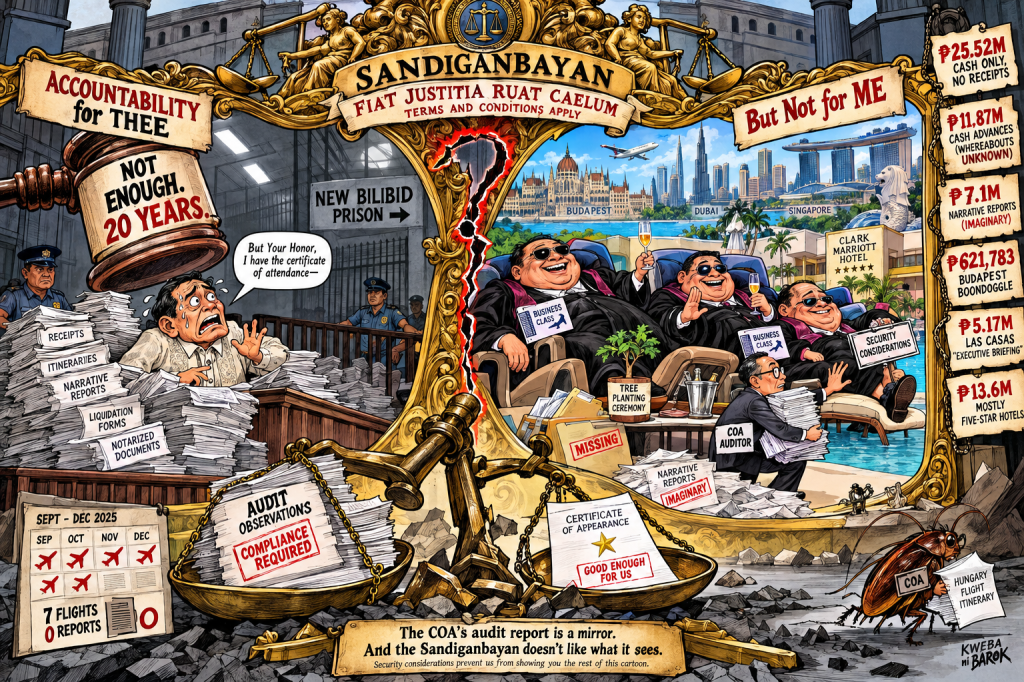
Now flip the script. The Sandiganbayan itself is asked to explain ₱25.52 million in expenses. The Commission on Audit (COA) says the documents are missing. The court’s response? Essentially, “Trust us.”
The irony is so thick you could cut it with a Supreme Court ponencia.
The COA’s 2025 annual audit report on the Sandiganbayan, published this week, reads less like a routine financial review and more like an unintentional satire of the very institution that prosecutes graft for a living. We’re talking about the court that sends officials to jail for failing to justify their expenditures. And now it can’t justify its own.
Let’s break this down, because the layers of absurdity here deserve careful excavation.
Chapter One: The Foreign Travel Mystery Tour
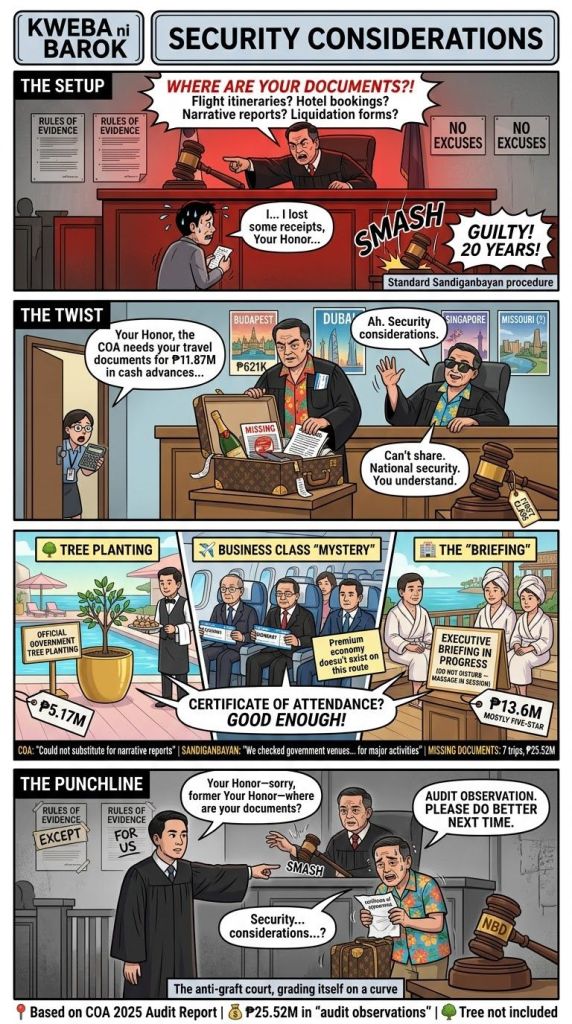
Seven foreign trips. ₱11,869,847.98 in cash advances. Zero complete documentation.
According to the COA, the Sandiganbayan sent its justices and personnel to Missouri, Australia, Hungary, Dubai, Qatar, and Singapore between September and December 2025. That’s four months. Seven trips. Nearly ₱12 million.
But here’s the kicker: the audit team couldn’t verify why anyone went anywhere because the letters of invitation weren’t submitted. The plane fare quotations? Missing. The flight itineraries? Also missing.
This is like a police officer investigating a robbery and being told, “We can’t tell you what was stolen because the inventory is confidential.”
The Sandiganbayan’s accountant reportedly offered a defense that deserves its own comedy special: the travel documents were withheld for “security considerations involving the officials concerned.”
Security considerations. For documents that are supposed to justify spending public money. The same type of documents that the Sandiganbayan itself would demand from any government official it prosecutes for malversation.
If I’m a defendant in a Sandiganbayan case and I tell the court, “Your Honors, I cannot provide the receipt for the ₱10 million cash advance because of security considerations,” what do you think happens? I get a contempt citation and a one-way ticket to the New Bilibid Prison.
But when the anti-graft court does it? It’s an “audit observation.”
Chapter Two: The Narrative Report That Never Was
Here’s my favorite part: ₱7.1 million worth of foreign trips lacked narrative reports.
For the uninitiated, a narrative report is a simple document. It explains what you did on your taxpayer-funded trip abroad. Where you went. What you learned. How it benefits the government.
It’s not a novel. It’s not a dissertation. It’s a few pages that say, “I attended this conference, here are the highlights, and here’s how it’s relevant to my job.”
The Sandiganbayan couldn’t produce these for ₱7.1 million worth of travel.
Instead, the court submitted certificates of appearance, which the COA politely noted “could not substitute for narrative reports.”
That’s like submitting a selfie at a crime scene and calling it an incident report.
Let me put this in terms the Sandiganbayan might understand: If a government official submits a certificate of appearance for a conference in Hawaii but no report on what was accomplished, the Office of the Ombudsman files a case. If the same official says, “I was there, here’s my certificate,” that’s not a defense. That’s an admission of inadequate documentation.
But again, when it’s the Sandiganbayan’s own travel? Apparently, the rules are more… flexible.
Chapter Three: The Business Class Boondoggle
Now we get to the Hungary trip, which the COA flagged with the kind of precision that suggests the auditors were enjoying themselves at this point.
₱621,783 for roundtrip tickets for three justices to Budapest. That’s over ₱207,000 per person.
The Sandiganbayan’s own rules say only the Presiding Justice is entitled to full business class. Everyone else flies economy unless a sponsor covers the difference.
But the COA found billing statements indicating economy class, while boarding passes showed business class. Then there was something about a “premium economy” designation for an Emirates flight that apparently doesn’t exist on that route.
The accountant’s explanation: officials who choose business class are required to shoulder the difference.
Okay. So show us the receipts. Show us the proof that these justices personally paid the upgrade. Show us the documents that would make this a non-issue.
Oh, right. Those are the documents that are missing.
This is the audit equivalent of a defendant saying, “I didn’t steal the money, I borrowed it,” without providing a loan agreement, a repayment schedule, or any evidence that the money was ever returned.
At some point, the “security considerations” excuse starts looking less like a legitimate concern and more like a convenient catch-all for bureaucratic amnesia.
Chapter Four: The Five-Star Hotel Procurement Follies
The venue expenses deserve their own separate essay, but I’ll be brief: ₱13,649,836.40 for 12 contracts at “mostly five-star and four-star hotels.”
The crown jewel: ₱5,175,200 for an “executive briefing and capacity building” event at Las Casas Filipinas de Acuzar in Bataan. A heritage resort. For a government briefing.
Other venues included the Clark Marriott, Baguio Country Club, and Seda Vertis North. And somewhere in there, a tree-planting activity was combined with a “special en banc session” at a five-star hotel.
Tree planting. At a five-star hotel.
I’m trying to imagine the Sandiganbayan’s procurement justification: “Your Honors, we needed to hold a tree-planting ceremony, and the Clark Marriott was the only venue that could accommodate both the shovels and the buffet.”
The COA’s finding highlights several critical failures:
- The court failed to demonstrate that it considered government-owned venues first.
- It didn’t provide written justification that private venues were “more economical and efficient.”
- It didn’t justify the use of four- and five-star hotels.
The Sandiganbayan’s defense, according to the COA: It “generally checked the availability of government facilities only for major or high-value activities.”
So for minor or low-value activities, the rules apparently don’t apply. That’s a fascinating interpretation of procurement law. I wonder if the defendants in Sandiganbayan cases can use the same logic: “Your Honors, I only embezzled a small amount, so the anti-graft law doesn’t apply.”
The Institutional Credibility Problem
Let’s step back and consider the bigger picture.
The Sandiganbayan exists for one purpose: to prosecute public officials accused of corruption. Its entire institutional legitimacy rests on the premise that it holds others to the standard of accountability that it itself upholds.
When the COA flags ₱25.52 million in questionable expenses, and the court’s response is a combination of “security considerations” and “the documents are missing,” what message does that send?
It sends the message that there are two sets of rules: one for the accused, and one for the judges.
Defense lawyers in pending Sandiganbayan cases will have a field day with this. “Your Honors, my client is accused of failing to liquidate funds. But the court itself failed to liquidate ₱11.87 million in cash advances. If the court cannot comply with the same rules it enforces, how can it sit in judgment of my client?”
That’s not a legal argument. It’s a credibility argument. And in a system that depends on public trust, credibility arguments matter.
The Excuses That Don’t Excuse
Let me be fair for a moment. The COA’s findings are “audit observations,” not final disallowances. The Sandiganbayan can still submit the missing documents. The trips may have been legitimate. The venues may have been justified.
But here’s the thing: the burden is on the Sandiganbayan to prove that. And right now, it hasn’t.
The “security considerations” excuse is particularly weak. What security concern prevents an agency from submitting flight itineraries to auditors? What national security risk arises from disclosing how much was paid for airfare?
If the Sandiganbayan has legitimate security concerns about travel documentation, it should say so in writing, with specifics. “Security considerations” as a blanket justification for missing documents is not a defense. It’s a dodge.
And the “we only check government venues for major activities” defense is even worse. The whole point of procurement rules is that they apply to all activities. The moment you start making exceptions based on someone’s subjective assessment of what’s “major,” you’ve created a loophole that any corrupt official can drive a truck through.
What Happens Next?
The COA’s findings will follow the usual path:
- The Sandiganbayan will be asked to explain.
- It will submit some documents, promise to do better, and perhaps issue new internal guidelines.
- The COA may issue a Notice of Disallowance, which the court can appeal.
The Office of the Ombudsman could investigate. The Judicial Integrity Office could look into it. Congress could hold hearings.
But let’s be honest: nothing dramatic is likely to happen. The amounts are significant but not staggering. The violations appear procedural rather than criminal. And the institutional dynamics—a constitutional commission auditing a co-equal branch—make aggressive action politically complicated.
What should happen is a thorough, transparent accounting. Every peso accounted for. Every document produced. Every justification explained.
What will happen is probably a negotiated resolution, some new office orders, and a collective sigh of relief when the news cycle moves on.
The Final Irony
The Sandiganbayan’s motto, if it has one, might as well be: “Accountability for thee, but not for me.”
The court that sends officials to prison for failing to document their expenses couldn’t document its own. The court that demands transparency from others hid behind “security considerations.” The court that enforces procurement rules ignored them for tree-planting ceremonies at five-star hotels.
This isn’t just embarrassing. It’s institutionally corrosive.
Because if the anti-graft court can’t follow the rules, why should anyone else?
The COA’s audit report is a mirror. And the Sandiganbayan doesn’t like what it sees.
Louis ‘Barok’ C Biraogo is the author of the Kweba ni Barok blog. He writes about law, politics, and the absurdities of Philippine governance. He is still waiting for someone to explain why tree-planting requires a five-star hotel.
Key Citations
A. Reports & Studies
- Commission on Audit. “2025 Annual Audit Report on the Sandiganbayan.” COA.gov.ph, 2026, https://www.coa.gov.ph.
B. News Articles
- Ong, Ghio. “COA flags Sandiganbayan justices’ foreign trips.” Philstar.com, 15 Oct. 2026, https://www.philstar.com/headlines/2026/10/15/2563329/coa-flags-sandiganbayan-justices-foreign-trips.
- “CoA flags P25.51M in Sandiganbayan expenses.” Daily Tribune, 14 Oct. 2026, https://tribune.net.ph/2026/10/14/coa-flags-p2551m-in-sandiganbayan-expenses.
- “COA flags travels of Sandiganbayan officials with insufficient documents.” Inquirer.net, 14 Oct. 2026, https://newsinfo.inquirer.net/2323813.
C. Official Websites & Legal References
- Commission on Audit. COA.gov.ph, 2026, https://www.coa.gov.ph.
- Judicial Integrity Office, Supreme Court of the Philippines. SC.Judiciary.gov.ph, 2026, https://sc.judiciary.gov.ph/jio/.
- Office of the Ombudsman. Ombudsman.gov.ph, 2026, https://www.ombudsman.gov.ph.
- Sandiganbayan. SB.Judiciary.gov.ph, 2026, https://sb.judiciary.gov.ph.
- ₱9 Billion in ‘Savings’? DILG’s Fire Truck Deal Smells Like Smoke

- ₱8B BBM Pork: CCTV for Every Captain’s Kumpare?

- ₱8.9 Billion, 331 Ghost Police Stations: The TIKAS Scandal Explained

- ₱8.4 Billion, 42,000 Barangays, 1 Election: The “Bawat Barangay Makikinabang” Vote-Buying Masterclass

- ₱75 Million Heist: Cops Gone Full Bandit

- ₱6.77B Ghost Haunts Duterte: RTC Dismisses Mans Carpio’s Desperate Plea
- ₱6.77 Billion and Zero Cash: The Sara Duterte SALN Math That Doesn’t Add Up

- ₱6.7-Trillion Temptation: The Great Pork Zombie Revival and the “Collegial” Vote-Buying Circus

- ₱58.53B, Zero Receipts: The LGSF Pork Barrel Nobody Wants to Name
- ₱53 Million Man Tells ₱695-a-Day Workers to Stop Being ‘Mayabang’: The Audacity of BSP’s Remolona
- ₱4.4 Billion and a Witness Who Can’t Explain It: The Duterte Impeachment’s Most Expensive Non-Answer
- ₱3.06 Billion for Evacuation Centers—But Nobody Knows Where They’ll Stand (Or If They’ll Exist)





Leave a Reply