Seven Percent of High-Value Drug Targets Are Government Employees. Sleep Well.
By Louis ‘Barok’ C. Biraogo — October 16, 2026
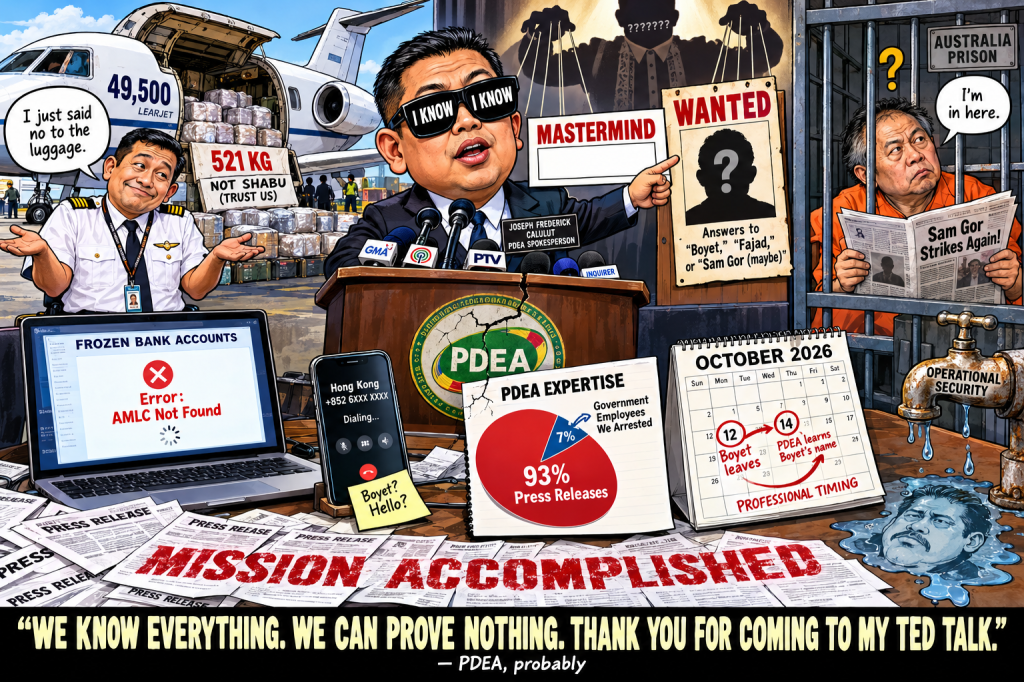
LET’S start with the obvious: 521 kilograms of methamphetamine is not a rounding error. It represents ₱3.54 billion in street value and a Learjet chartered for $49,500. It also involves two Filipino aliases—“Fajad” and “Boyet”—scattered across the Golden Triangle like so many loose ends. It’s the kind of bust that makes for excellent press releases.
It’s also the kind of bust that has “someone is about to look very stupid” written all over it.
On October 14, 2026, Philippine Drug Enforcement Agency (PDEA) spokesperson Joseph Frederick Calulut announced that authorities had identified the suspected mastermind behind the Laos shabu shipment. Not just identified—knew the names, knew the accounts, knew everything. Just didn’t feel like sharing, you understand. They claimed it was to protect the investigation.
Forgive me if I don’t pop the champagne. The PDEA’s track record on “we know who did it, we just can’t tell you” is not exactly sterling. This is the same agency that, in February 2021, got into a literal shootout with the Philippine National Police (PNP) because neither side could coordinate a buy-bust operation. The National Bureau of Investigation (NBI) eventually filed homicide and robbery charges against both agencies’ operatives. If the PDEA can’t coordinate a drug bust with its own government colleagues, what confidence should we have in its ability to track a transnational syndicate across four countries?
The Sam Gor Problem: Headless in the Golden Triangle
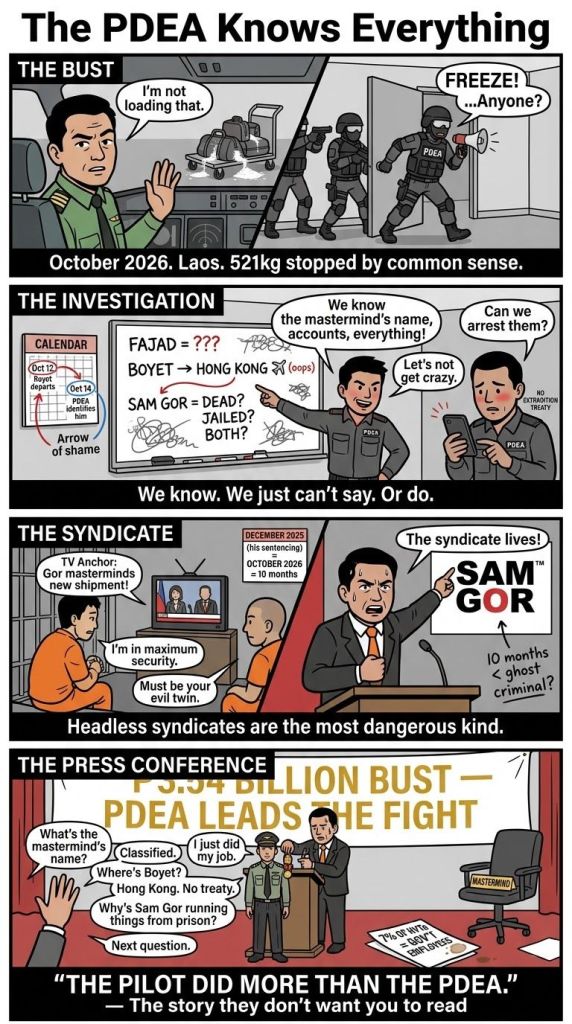
Here’s the part the PDEA hopes you won’t notice. Sam Gor—the syndicate they’re pinning this on—was decapitated nearly a year before this shipment ever touched Lao soil.
Tse Chi Lop, the Chinese-Canadian national described as “Asia’s El Chapo,” was sentenced to 16 years in an Australian prison in December 2025. The Australian Federal Police (AFP)’s Operation Volante, which had been running since 2012, finally caught up with him after Dutch authorities arrested him in Amsterdam in 2021. By October 2026, Tse was sitting in maximum-security Barwon prison, presumably nowhere near a private jet or a 521-kilo shipment.
So the PDEA wants us to believe that a syndicate whose alleged supreme leader has been behind bars for nearly a year just casually organized a $49,500 charter flight through Malaysia to Laos to the Philippines? That’s not how criminal organizations work. That’s how Prestige TV dramas work.
The AFP previously described Sam Gor at its peak as “the biggest trafficker of methamphetamine to Australia.” That’s past tense. The syndicate has been headless, its leadership prosecuted, and its operations exposed. Reports suggest regional networks have fragmented, with local actors operating with increased autonomy.
The PDEA’s decision to invoke Sam Gor reads less like investigative certainty and more like brand-name inflation. It’s easier to say “Sam Gor” than “a collection of intermediaries whose organizational structure we cannot currently prove.” One sounds like a triumph. The other sounds like actual police work.
The Boyet Vanishing Act
Let’s talk about the timing. “Boyet,” the alleged handler who arranged the charter flight, reportedly left for Hong Kong two days before the Laos bust. The PDEA didn’t know Fahad’s identity until after the fact. By the time they identified Boyet, he was already gone.
PDEA Director General Isagani Nerez admitted this openly: “Unfortunately, this Boyet was able to leave the country to Hong Kong a day before they were informed of the identity of Fahad.”
This is not the behavior of an agency in control of a situation. This is the behavior of an agency that got lucky—a pilot refused to load suspicious luggage, and the whole operation collapsed. The PDEA didn’t intercept the shipment. A Malaysian pilot with a functioning sense of self-preservation did.
Now Boyet is in Hong Kong, a jurisdiction with no bilateral extradition treaty with the Philippines. The PDEA says it’s “coordinating with foreign counterparts” to track him. Translation: they have no idea where he is, and even if they find him, they have no legal mechanism to bring him home.
The 7% Problem: When the Watchmen Are the Watched
Here’s the context the PDEA would prefer you ignore. In his 2024 State of the Nation Address (SONA), President Marcos Jr. revealed that out of 6,000 arrested high-value drug targets, 440 were government employees. Forty-two were uniformed personnel. Seventy-seven were elected officials.
That’s more than 7% of high-value targets working for the government.
Senator Robin Padilla filed Senate Resolution No. 1131 in August 2024, specifically citing “issues concerning the security breach in the Philippine Drug Enforcement Authority.” The resolution noted that government drug tests only screened for two types of drugs—a loophole so obvious it might as well have been an invitation.
So let’s do the math:
- The PDEA says it knows the mastermind’s name and accounts.
- The PDEA has documented security breaches.
- More than 7% of high-value drug targets are government employees.
- The suspect in this case, Boyet, managed to slip out of the country two days before the PDEA knew who he was.
Either the PDEA’s operational security is astonishingly porous, or someone inside the system tipped him off. Those are the options. Neither is comforting.
The Mindanao Blame Game
Calulut’s statement that Sam Gor “targets Mindanao as an entry point” and that the suspects were “based in Mindanao” carries an ugly implication. It’s a convenient narrative: drugs come from Mindanao, bad actors live in Mindanao, the problem is somewhere down south where we don’t have to look too closely.
Never mind that Mindanao has been the scapegoat for every drug enforcement failure since Duterte’s war on drugs began. Never mind that the region’s complex political landscape—Bangsamoro Autonomous Region in Muslim Mindanao (BARMM) governance, historical insurgency, poverty—makes it convenient to blame without addressing root causes.
The PDEA says it’s tracking the syndicate’s “logistical connections and front businesses in Davao City.” Davao City. The former president’s hometown. The city where Duterte famously ran a “shoot-to-kill” drug policy that somehow produced no major syndicate convictions but plenty of street-level body bags.
I’m not saying there’s a connection. I’m saying the PDEA is making a lot of noise about Mindanao connections while the actual mastermind—the person whose name and accounts they claim to know—remains carefully unnamed.
What “Knowing” Actually Means
The PDEA says it knows the mastermind’s identity and the accounts used. This is a remarkable claim that raises several questions:
- First, if you know the accounts, why haven’t they been frozen? Under the Anti-Money Laundering Act (AMLA), drug trafficking is a predicate offense. If the PDEA genuinely has account information tied to a ₱3.54 billion drug shipment, the Anti-Money Laundering Council (AMLC) should have been mobilized immediately. The absence of any announced asset freeze suggests either the PDEA is overstating its knowledge or the financial investigation is proceeding at a glacial pace.
- Second, if you know the identity, why hasn’t an arrest warrant been issued? The Philippines has mutual legal assistance frameworks through ASEAN, even without a bilateral treaty with Laos. Interpol exists. Red notices exist. If the PDEA truly knows who the mastermind is, the legal machinery should be grinding into motion. Instead, we get a press conference and a promise to keep investigating.
- Third, and most damning: knowing a name is not the same as proving a crime. The PDEA’s spokesperson said they know “the names and accounts used.” That’s intelligence, not evidence. It doesn’t establish knowledge, intent, or participation. It doesn’t prove the mastermind ordered the shipment, financed the flight, or knew what was in the luggage. The PDEA is presenting the existence of leads as if they were conclusions.
The Extradition Elephant
Assuming the PDEA eventually produces a name, what then? The Philippines has no bilateral extradition treaty with Laos. If Fahad is prosecuted in Laos—which is likely, given he was arrested there—Philippine authorities may have limited access to him. If the mastermind is in Hong Kong, as Boyet reportedly is, there’s no treaty there either.
ASEAN has been working on a regional extradition treaty since at least 2025, with meetings in Manila pushing the framework forward. But “working on” is a long way from “ratified and operational.” For now, the PDEA is relying on diplomatic channels, Interpol, and the vague promise of “foreign counterparts.”
This is not a legal framework. This is hope with a letterhead.
The Real Question Nobody’s Asking
Here’s what the PDEA isn’t telling you: the pilot refused to load the luggage. The flight was canceled. The shipment never left Laos. The only reason this is a story is because a private aviation professional did his job.
So what, exactly, is the PDEA’s achievement? They got lucky. A pilot’s suspicion, a canceled flight plan, and Lao authorities doing their jobs—that’s the sum total of the enforcement action. The PDEA’s contribution appears to be retroactive: identifying suspects after the fact, naming a syndicate that may or may not be operationally relevant, and promising to investigate.
The 521 kilos are impressive. The $49,500 charter is impressive. The Learjet is impressive. The response is not.
What Accountability Would Look Like
If the PDEA were serious, here’s what we’d see:
- Accountability mechanisms: A clear timeline of what the PDEA knew, when they knew it, and why Boyet was allowed to leave the country. An explanation of why the mastermind’s accounts haven’t been frozen under AMLA provisions.
- Coordination evidence: Concrete details on what ASEAN mutual legal assistance mechanisms have been activated, what requests have been filed, and with which countries. Not “coordinating with foreign counterparts”—actual documentation.
- Jurisdictional clarity: A clear legal strategy for prosecuting Filipino nationals for crimes committed abroad. If Philippine courts can’t touch this case, say so. If they can, explain how.
- Institutional reform: A response to Senator Padilla’s security breach concerns. If the PDEA has leaks, identify and fix them. If government employees are implicated in 7% of high-value drug cases, address the systemic problem.
None of this is happening. What’s happening is a press conference, a promise, and a syndicate name dropped like a curtain to obscure the lack of anything resembling accountability.
The Verdict
The PDEA has identified the mastermind. Allegedly. Names and accounts are known. Allegedly.
The Sam Gor syndicate is responsible. Allegedly. Boyet is in Hong Kong. Allegedly.
Here’s what’s not alleged:
- The shipment was stopped by a pilot’s suspicion, not the PDEA’s investigation.
- The suspect fled before the PDEA knew who he was.
- The mastermind remains unnamed.
- The syndicate whose leader was already imprisoned is somehow still orchestrating major trafficking operations.
- The agency making all these claims has documented security breaches and a history of inter-agency shootouts.
The PDEA doesn’t need a press conference. It needs an evidence room. It needs account freezes. It needs extradition requests and mutual legal assistance filings and prosecutorial referrals. It needs to stop telling us what it knows and start showing us what it can prove.
Until then, this is not a triumph. It’s a seizure with a press release attached. And 521 kilograms of shabu is still sitting in a Lao warehouse while the alleged mastermind—whose name the PDEA knows but won’t share—continues to live their life somewhere, presumably not in handcuffs.
The pilot did more to stop this shipment than the PDEA did. That’s the story they don’t want you to read.
Key Citations
A. Legal & Official Sources
- Padilla, Robinhood C. “Senate Resolution No. 1131: Directing the Committee on Public Order and Dangerous Drugs to Conduct an Inquiry, in Aid of Legislation, into the Implementation of the Provisions of the Comprehensive Dangerous Drugs Act of 2002.” Senate of the Philippines, 12 Aug. 2024, legacy.senate.gov.ph/press_release/2024/0812_padilla2.asp.
- – Republic of the Philippines. “Republic Act No. 9160.” *Official Gazette of the Republic of the Philippines*, 29 Sept. 2001, https://www.officialgazette.gov.ph/2001/09/29/republic-act-no-9160/.
B. News Articles
- Ramirez, Renalyn. “Suspected Mastermind in Laos Shabu Shipment to Philippines Identified — PDEA.” Philstar.com, 14 Oct. 2026, www.philstar.com/headlines/2026/10/14/2563188/suspected-mastermind-laos-shabu-shipment-philippines-identified-pdea.
- Ramirez, Renalyn. “2 Filipinos under Probe over Laos Shabu Haul Bound for PH — PDEA.” Philstar.com, 13 Oct. 2026, qa.philstar.com/headlines/2026/10/13/2562707/2-filipinos-under-probe-over-laos-shabu-haul-bound-ph-pdea.
- “Global Drug Syndicate Leader Tse Chi Lop Sentenced to 16 Years in Prison.” ABC News, 4 Dec. 2025, www.abc.net.au/news/2025-12-04/tse-chi-lop-sentence-drug-syndicate-leader/106100496.
- “Asian Drug Lord Tse Chi Lop Arrested at Amsterdam Airport.” Euronews, 24 Jan. 2021, www.euronews.com/2021/01/24/asian-drug-lord-tse-chi-lop-arrested-at-amsterdam-airport.
- “Head of Global Drug Trafficking Syndicate Jailed in Melbourne.” Australian Federal Police, 4 Dec. 2025, www.afp.gov.au/news-centre/media-release/head-global-drug-trafficking-syndicate-jailed-melbourne.
- Ramos, Marlon. “NBI Files Complaints vs Cops, PDEA Agents Involved in Misencounter.” Rappler, 6 Sept. 2021, www.rappler.com/philippines/nbi-files-complaints-cops-pdea-agents-involved-misencounter-february-2021/.
- “Marcos on Drug War Gains: No Exterminations Involved.” Philippine News Agency, 22 Jul. 2024, www.pna.gov.ph/articles/1229519.
C. Official Websites
- “2021 Quezon City PNP–PDEA Shootout.” Wikipedia, en.wikipedia.org/wiki/2021_Quezon_City_PNP%E2%80%93PDEA_shootout.
- “Treaty on Mutual Legal Assistance in Criminal Matters.” Association of Southeast Asian Nations, asean.org/our-communities/asean-political-security-community/rules-based-people-oriented-people-centred/treaty-on-mutual-legal-assistance-in-criminal-matters/.
- “Anti-Money Laundering Council.” Anti-Money Laundering Council, www.amlc.gov.ph.







Leave a Reply