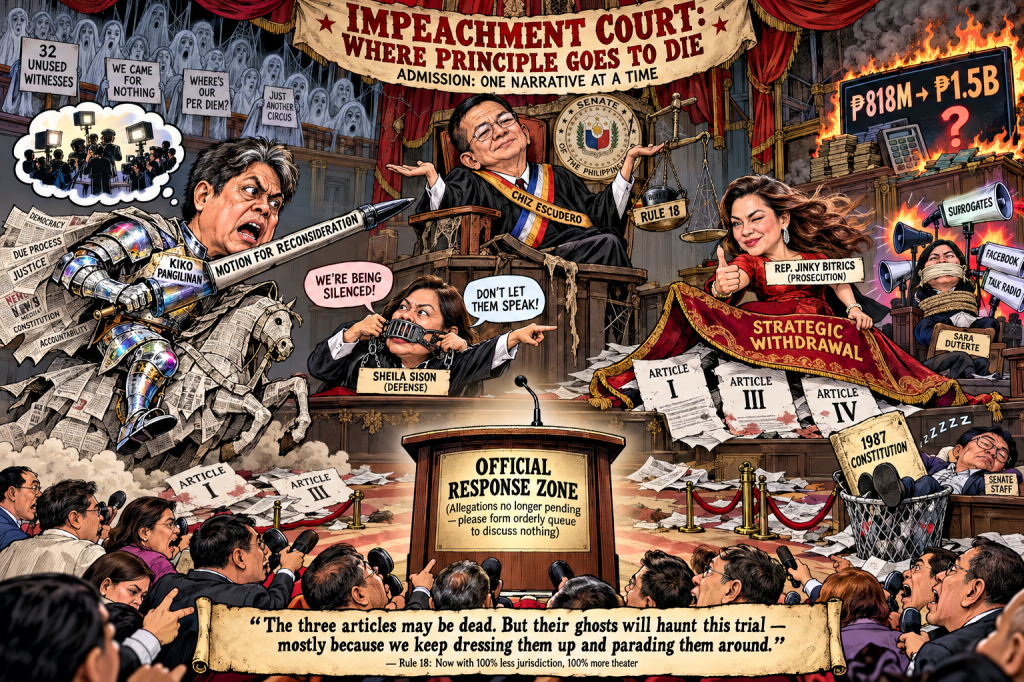
Due Process, Sub Judice, and the Fine Art of Fighting Over Charges Nobody Is Adjudicating Anymore
By Louis ‘Barok’ C. Biraogo — October 16, 2026
HERE we go again.
Just when you thought the impeachment trial of Vice President (VP) Sara Duterte couldn’t get more procedurally bizarre, the Senate has managed to turn the withdrawal of three articles of impeachment into a full-blown constitutional food fight over who gets to talk about allegations that nobody is actually adjudicating anymore.
On October 13, 2026, the House prosecution panel—led by Batangas Rep. Gerville “Jinky Bitrics” Luistro, a name that sounds less like a lead prosecutor and more like a character from a telenovela—announced it was dropping Article I (Confidential Funds), Article III (Bribery), and Article IV (Grave Threats) against the VP. Only Article II, on unexplained wealth, survives.
The prosecution’s rationale? “The evidence is substantial and compelling” on unexplained wealth alone. Translation: we spent twenty days and countless millions of public funds presenting evidence on charges we’re now abandoning, but trust us, the remaining one is solid.
Presiding Officer Francis “Chiz” Escudero—a man who has mastered the art of looking presidential while doing the bare minimum—then did something that managed to outrage both the defense and a senator-judge simultaneously. He lifted Rule 18 (Sub Judice Rule), allowing Duterte and her lawyers to publicly discuss allegations that are no longer before the court.
His reasoning? “The last thing I want anyone to say when they leave this courtroom is, ‘She was not allowed to respond in court, and now she is not even allowed to respond outside it’”.
Cue Senator-Judge Francis “Kiko” Pangilinan, who apparently woke up that morning and decided that the best use of his time was to file a motion for reconsideration seeking to maintain the gag order on allegations that have been formally abandoned, as reported in Pangilinan Seeks Reversal of Ruling on Duterte’s Dropped Charges.
Let’s unpack this.
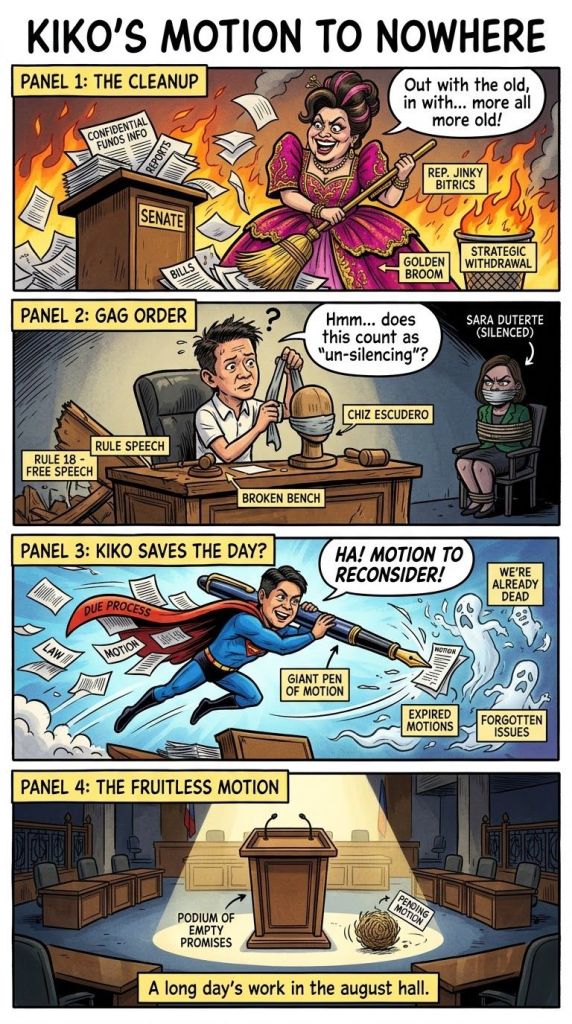
The Due Process Shell Game
Pangilinan’s motion rests on a superficially appealing argument: that lifting Rule 18 mid-trial, especially right before the defense presents its case, creates an unfair asymmetry. The prosecution spent weeks presenting evidence on Articles I and IV. The defense never got to rebut. Now the prosecution can talk about those allegations publicly, while the defense—if Pangilinan gets his way—would be muzzled.
Defense counsel Sheila Sison put it more dramatically: the ruling would allow “unregulated and unbridled exercise” of public statements. She warned of a “free-for-all” in accusing Duterte without consequence.
But here’s the thing about due process in impeachment: it’s not a suicide pact. The defense’s objection proves too much. If the withdrawn articles are no longer pending—and they aren’t—what continuing procedural purpose does a gag order serve? The sub judice rule exists to protect the integrity of pending adjudication. It is not a permanent reputation-management tool for respondents who don’t want to be talked about.
Escudero’s point is unassailable on this: you cannot simultaneously say the articles have been withdrawn (removing them from the court’s jurisdiction) and insist that the court retains authority to regulate speech about them. That’s not procedural consistency; it’s procedural convenience masquerading as principle.
The Kiko Pangilinan Show
Let’s be honest about what’s happening here. Pangilinan is not some neutral guardian of Senate procedure. He is a member of the political opposition, a man with well-documented national ambitions, and someone who has spent his entire career positioning himself as the moral compass of whatever room he’s in.
His motion for reconsideration is less about protecting the integrity of the impeachment court and more about protecting a particular narrative: that the process is being conducted in a procedurally suspect manner, and that any eventual conviction would be tainted.
“Senator-Judge Bam Aquino had raised the possibility of adjusting the trial procedure as early as July 15,” Pangilinan recalled. “Unfortunately, there was no agreement, and therefore we have to proceed as we have proceeded”.
This is the procedural equivalent of complaining that a meeting didn’t follow Robert’s Rules of Order after the meeting has already ended. If there was a prior agreement requiring mutual consent for procedural changes—and Pangilinan’s own account suggests there wasn’t, only a suggestion that changes could be considered—then Escudero’s subsequent ruling isn’t a violation. It’s just a ruling he doesn’t like.
Pangilinan’s motion is a political document dressed in procedural language. It’s designed to create a record, to give Duterte’s supporters something to point to, to frame the Senate as a body that doesn’t quite know what it’s doing.
And honestly? The Senate is making that framing remarkably easy.
The Defense’s Selective Outrage
Speaking of narratives: the defense’s sudden conversion to Rule 18 fundamentalism is enough to make a cat laugh.
Sheila Sison, Duterte’s lead counsel, stood before the court and declared that abandoning the sub judice rule “in the middle of trial and right before the defense or respondent presents her case” would undermine the integrity of the proceedings, according to a report on how the Court Lifts Sub Judice Rule on Dropped Impeachment Articles.
This is the same defense team that has spent months arguing that Duterte is the victim of political persecution, that the charges are fabricated, that the process is a sham. Now they’re clutching their pearls because the court is allowing more speech, not less?
The defense doesn’t actually want Rule 18 enforced. The defense wants Rule 18 enforced selectively—to gag the prosecution while Duterte’s surrogates flood the airwaves with “persecution” narratives.
Defense lawyer Michael Poa inadvertently revealed the game when he noted that a Quezon City Regional Trial Court (RTC) gag order already restricts Duterte from speaking about the grave threats case. “In a way, the prosecution can discuss it but we cannot,” he complained.
This is genuinely funny. The defense is objecting to a Senate rule that would give them more freedom to speak, because they’re already constrained by a different gag order in a different case. The solution to that problem is to challenge the RTC gag order, not to demand that the Senate perpetuate a restriction that no longer has any basis.
The Real Issue Nobody Wants to Discuss
Here’s what’s actually happening beneath the procedural noise: the prosecution’s case is collapsing, and everyone knows it.
Forensic accountant Alexander Cabrera testified to approximately P818 million in allegedly unexplained wealth—a figure that, when challenged, ballooned to P1.5 billion under “broader assessment”. The prosecution spent twenty trial days on Articles I and IV before abandoning them. Thirty-two witnesses will no longer be called, as detailed when the House Prosecution Drops 3 Impeachment Articles, Believes Unexplained Wealth Charge Enough to Oust VP Sara.
This doesn’t look like a prosecution confident in its case. It looks like a prosecution that overreached, got bogged down, and is now desperately trying to salvage something—anything—from the wreckage.
Article II, the sole survivor, concerns unexplained wealth, Statement of Assets, Liabilities, and Net Worth (SALN) violations, and prohibited business interests. It’s the most technical, least emotionally resonant of the four charges. It’s also the one that requires the most forensic documentation and the least public outrage.
The prosecution’s decision to withdraw the other articles may be strategically rational. But it also sends an unmistakable message: the case was never as strong as the prosecution claimed.
The Rule of Law vs. the Rule of Whoever Shouts Loudest
Escudero’s ruling is defensible on straightforward legal grounds. Rule 18, as its name suggests, is a sub judice rule. It applies to matters pending adjudication. Once three articles are withdrawn, their merits are no longer pending. The rule’s rationale evaporates.
Pangilinan’s motion, by contrast, requires accepting a proposition that has no textual or precedential support: that a gag order survives the termination of the proceeding it was designed to protect.
The Supreme Court’s 2025 decision in Duterte v. House of Representatives emphasized that impeachment is not exempt from due process requirements. But that cuts against Pangilinan’s position, not for it. Due process includes the respondent’s right to answer accusations. If the court has stopped adjudicating those accusations, the respondent’s right to answer them outside court is the only meaningful process that remains.
The Supreme Court has also emphasized—in ABS-CBN v. Ampatuan—that restrictions on speech related to judicial proceedings must be justified by a “clear and present danger” to the administration of justice. There is no clear and present danger in allowing discussion of articles that have been formally withdrawn.
What Pangilinan Actually Achieved
Let’s be generous and assume Pangilinan’s motion was filed in good faith—that he genuinely believes mid-trial procedural changes require greater deliberation, that the defense’s due process rights are being shortchanged, that the Senate risks appearing to change the rules on the fly.
Even granting all that, his motion fails on its own terms.
The defense objected to Escudero’s ruling. The defense doesn’t want more speech; they want less speech from the other side. If Pangilinan were genuinely concerned about due process symmetry, he would have proposed a solution that addresses the actual problem: the prosecution’s ability to discuss evidence the defense never rebutted.
Instead, he proposed maintaining a gag order on allegations no longer before the court. That doesn’t protect due process. It protects a narrative.
Escudero has taken the motion under advisement. The smart money says he denies it—or grants it in some narrow, face-saving form that preserves his original ruling’s substance. Either way, the damage is done: the Senate has once again demonstrated that its procedural rulings are less about legal principle than about managing political fallout.
The Bigger Picture
The Duterte impeachment was always going to be a mess. The VP is a polarizing figure with a devoted base, a famous last name, and 2028 ambitions that make every procedural decision freighted with political consequence. The Senate was always going to struggle to act like a court while its members act like politicians.
But this latest episode—the withdrawal of three articles, the lifting of Rule 18, Pangilinan’s quixotic motion—reveals something deeper: nobody involved in this process actually believes in it.
- The prosecution doesn’t believe in its case; otherwise it wouldn’t be abandoning charges it spent months prosecuting.
- The defense doesn’t believe in the process; otherwise it wouldn’t be simultaneously claiming persecution and demanding that its accusers be silenced.
- Pangilinan doesn’t believe in Escudero’s authority; otherwise he wouldn’t be second-guessing a routine procedural ruling with a motion that has no basis in the court’s rules.
And the public? The public is watching this spectacle and concluding, not unreasonably, that impeachment is just politics by other means—that the rules are whatever the majority says they are, and that “due process” is a phrase people invoke when they’re winning and abandon when they’re losing.
Escudero’s ruling may be legally correct. But correctness isn’t the same as credibility. And right now, the Senate’s credibility as an impeachment court is running on fumes.
The Bottom Line
Pangilinan’s motion for reconsideration should be denied. Not because Escudero is infallible, not because the prosecution’s conduct has been beyond reproach, and not because the defense’s complaints are baseless—but because the motion rests on a legal fiction: that a court retains authority to regulate speech about allegations it has ceased to adjudicate.
The withdrawn articles are withdrawn. They are no longer pending. The sub judice rule, by its terms, no longer applies. If Pangilinan wants to protect the surviving Article II from prejudicial publicity, he should propose restrictions that are narrowly tailored to that article—not demand that the court perpetuate a gag order whose purpose has vanished.
But that would require Pangilinan to acknowledge that Escudero’s ruling was correct in principle, even if imperfect in execution. And that, apparently, is too much to ask.
So instead we get this: a motion for reconsideration that reconsiders nothing, filed by a senator who wants to be seen as principled, in a case that has already demonstrated that principle is the first casualty of political ambition.
The three withdrawn articles may be dead. But their ghosts will haunt this trial for as long as it lasts—and probably longer.
Louis ‘Barok’ C. Biraogo is a lawyer and blogger who has covered Philippine legal and political issues for over a decade. The views expressed are his own.
Key Citations
A. Legal & Official Sources
- The 1987 Constitution of the Republic of the Philippines. Official Gazette of the Republic of the Philippines, 1987, http://www.officialgazette.gov.ph/constitutions/1987-constitution/.
- Duterte v. House of Representatives, G.R. No. 278353, Supreme Court of the Philippines, 25 July 2025, lawphil.net/judjuris/juri2025/jul2025/gr_278353_gaerlan.html.
- ABS-CBN Corporation v. Ampatuan, G.R. No. 227004, Supreme Court of the Philippines, 25 April 2023, lawphil.net/judjuris/juri2023/apr2023/gr_227004_2023.html.
- In re Almacen, 31 SCRA 562, Supreme Court of the Philippines, 18 February 1970.
B. News Reports
- Reganit, Jose Cielito. “House Prosecution Drops Impeachment Raps vs VP Sara Except Unexplained Wealth.” Philippine News Agency, 13 Oct. 2026, http://www.pna.gov.ph/article/house-prosecution-drops-impeachment-raps-vs-vp-sara-except-unexplained-wealth.
- “Pangilinan Seeks Reversal of Ruling on Duterte’s Dropped Charges.” The Manila Times, 14 Oct. 2026, http://www.manilatimes.net/2026/10/14/news/pangilinan-seeks-reversal-of-ruling-on-dutertes-dropped-charges/2445025.
- “Court Lifts Sub Judice Rule on Dropped Impeachment Articles.” Inquirer.net, 13 Oct. 2026, newsinfo.inquirer.net/2323111.
- “House Prosecution Drops 3 Impeachment Articles, Believes Unexplained Wealth Charge Enough to Oust VP Sara.” House of Representatives, 13 Oct. 2026, http://www.congress.gov.ph/media/press-releases/10322.
- ₱9 Billion in ‘Savings’? DILG’s Fire Truck Deal Smells Like Smoke

- ₱8B BBM Pork: CCTV for Every Captain’s Kumpare?

- ₱8.9 Billion, 331 Ghost Police Stations: The TIKAS Scandal Explained

- ₱8.4 Billion, 42,000 Barangays, 1 Election: The “Bawat Barangay Makikinabang” Vote-Buying Masterclass

- ₱75 Million Heist: Cops Gone Full Bandit

- ₱6.77B Ghost Haunts Duterte: RTC Dismisses Mans Carpio’s Desperate Plea

- ₱6.77 Billion and Zero Cash: The Sara Duterte SALN Math That Doesn’t Add Up

- ₱6.7-Trillion Temptation: The Great Pork Zombie Revival and the “Collegial” Vote-Buying Circus

- ₱58.53B, Zero Receipts: The LGSF Pork Barrel Nobody Wants to Name

- ₱53 Million Man Tells ₱695-a-Day Workers to Stop Being ‘Mayabang’: The Audacity of BSP’s Remolona

- ₱4.4 Billion and a Witness Who Can’t Explain It: The Duterte Impeachment’s Most Expensive Non-Answer
- ₱3.06 Billion for Evacuation Centers—But Nobody Knows Where They’ll Stand (Or If They’ll Exist)







Leave a Reply