The Marcos-Duterte War Finds Its Perfect Battlefield: A Procedural Squabble
By Louis “Barok” C. Biraogo — August 17, 2026
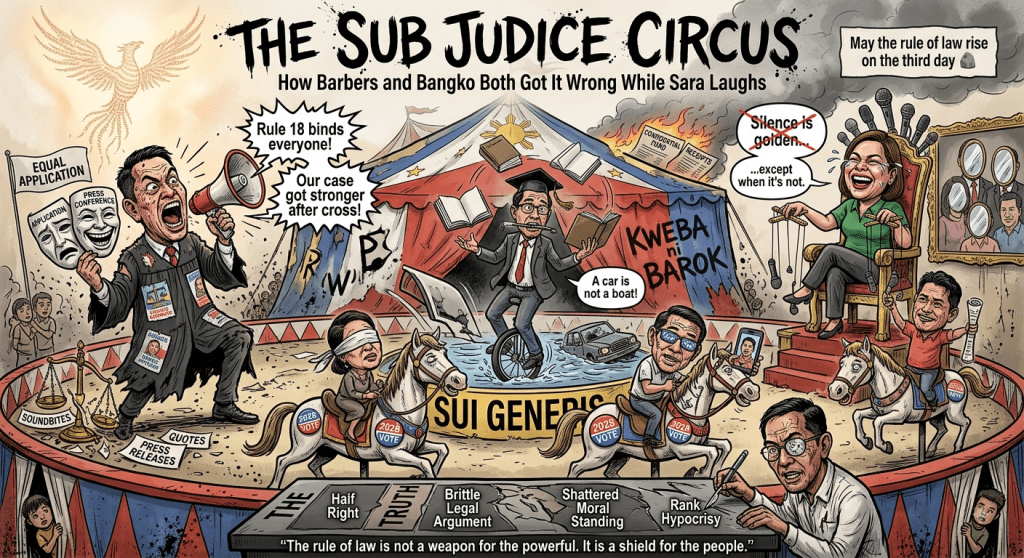
THE impeachment trial of Vice President Sara Duterte has finally produced something more entertaining than the tedious recitation of confidential fund allocations. It has produced a masterclass in legal sophistry, selective enforcement, and the theatrical deployment of constitutional principles as weapons in a dynastic war. At the center of this circus stands a deceptively simple question: who gets to talk, and who gets to shut up?
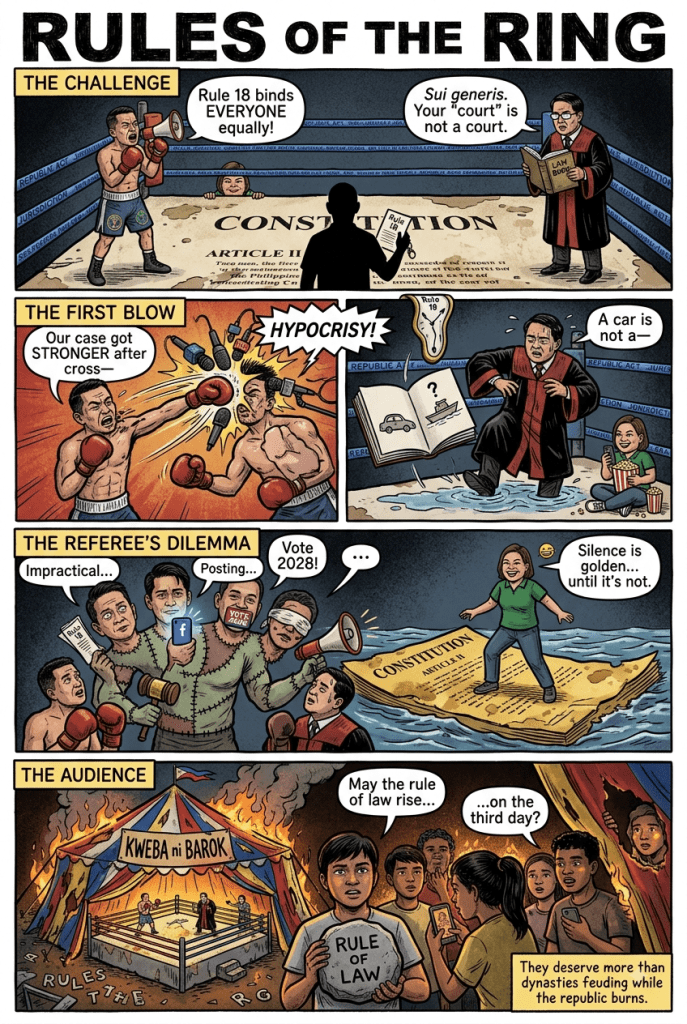
On one side stands former Rep. Robert Ace Barbers, prosecution adviser and spokesperson, invoking the solemn language of equal application. Rule 18, he insists, must bind everyone—prosecution, defense, and the respondent herself. On the other side sits Mabuhay C. Bangko, a renowned lawyer with a well-earned reputation for doctrinal rigor, arguing that the entire premise rests on a category error: impeachment is sui generis, not judicial, so the sub judice doctrine was never the right tool to reach for. Both are half right. Neither survives full scrutiny. Here is the autopsy.
I. Ang Simula — The Word on Trial
Let us begin by correcting the most common misconception poisoning this debate: the conflation of two distinct legal mechanisms. The ordinary sub judice doctrine, born of common law and codified in Rule 71 of the Rules of Court, is an exercise of judicial contempt power. It presupposes a pending case before a court of law and asks whether public commentary creates a clear and present danger of influencing the outcome. Bangko is correct that this doctrine, in its classical form, does not automatically extend to impeachment proceedings. The Senate sitting as an impeachment court is not the Supreme Court. It is a political body performing a constitutional function.
But here is where Bangko’s argument collapses like a house of cards in a typhoon. Rule 18 of the Senate’s Rules of Procedure on Impeachment Trials is not the sub judice doctrine. It is a distinct procedural rule, promulgated pursuant to Article XI, Section 3(8) of the 1987 Constitution of the Republic of the Philippines (1987 Constitution), which expressly vests Congress with the authority to promulgate its own rules on impeachment. The Senate has exercised that power. The rule exists. It binds the participants it names. The fact that impeachment is sui generis does not make it rule-free; it makes the Senate’s rule-making power the very source of its procedural architecture.
Bangko’s argument is akin to saying that because a car is not a boat, it cannot be subject to traffic laws. The category error is his own. Sui generis means “of its own kind”—not “of no kind at all.” The Senate’s Rule 18 is precisely the kind of procedural restriction that a sui generis proceeding demands. The recent Supreme Court decision in Duterte v. House of Representatives (G.R. Nos. 278353 and 278359) makes this devastatingly clear. The Court characterized impeachment as “primarily legal, but with political characteristics,” and held that the Bill of Rights, including due process, governs the entire process. The Court’s own language forecloses the simplistic dichotomy Bangko relies upon. Impeachment is not purely political; it is a constitutional process with legal guardrails. One of those guardrails is the Senate’s power to impose procedural discipline on its participants.
II. The Hypocrisy of the Hunters
But if Bangko’s legal argument is brittle, Barbers’ moral standing is practically shattered. The prosecution’s demand for “one rule, one standard, applied equally” would be more compelling if the prosecution itself had not spent weeks publicly characterizing the strength of its evidence. Barbers himself has told the media that the prosecution’s case has become “stronger” after cross-examination. He has publicly opined on whether the evidence bears on the Vice President’s fitness for office. These are not neutral statements about procedure; they are precisely the kind of public advocacy on the merits that Rule 18 is designed to prevent.
This is the rank hypocrisy that makes the Philippine political class so utterly contemptible. The prosecution demands that Sara Duterte be silenced while simultaneously conducting a parallel trial in the court of public opinion. They invoke the language of institutional integrity while treating the impeachment court as a backdrop for their own press conferences. The rule, in their hands, becomes a weapon to be deployed against the opponent while conveniently ignored for oneself. It is not a call for fairness; it is a tactical maneuver dressed in the stolen robes of principle.
And what of the respondent? The defense has previously announced that Duterte would impose a media blackout regarding the merits, citing the sub judice rules. That was when silence served their interests. Now, with the evidence mounting and the political winds shifting, silence is no longer golden. Public commentary becomes a survival tool—a way to frame the proceedings as illegitimate, to mobilize a base, to challenge the credibility of the tribunal itself. The “bending the law” remark is not a legal argument; it is a political grenade. The defense knows it cannot win on the evidence, so it seeks to win on the narrative. This is not a defense of the Constitution; it is a defense of the dynasty.
III. Sui Generis, Not Lawless
The central irony of this controversy is that both camps are right about one thing and wrong about everything else. Bangko is right that sub judice in its classical judicial form does not apply. Barbers is right that Rule 18 exists and must be enforced. But neither is willing to accept the logical consequence of their own position.
If Bangko is correct that the political character of impeachment demands maximum transparency, then he must also accept that this transparency extends to the prosecution as well as the defense. The public’s right to know is not a one-way street. If the people are entitled to sunshine, they are entitled to it from all directions. But Bangko’s argument, in practice, becomes a shield for the defense to attack the tribunal while the prosecution is expected to remain silent—or vice versa, depending on the day.
If Barbers is correct that Rule 18 must be applied equally, then he must accept that his own public statements are violations. He cannot demand that Sara Duterte be silenced while he continues to regale the media with assessments of witness credibility. The rule, if it is to mean anything, must bind the prosecution’s own spokespeople. Otherwise, it is not a rule; it is a selective gag order.
The truth is that Rule 18 was not designed to be a total muzzle. Its language—”shall refrain from making any comments and disclosures in public pertaining to the merits”—is a directive, not an absolute prohibition. It requires judgment, not robotic enforcement. There is a world of difference between discussing what happened in open court and attempting to influence the outcome by previewing evidence or attacking witnesses. The Senate’s own history reflects this nuance. Former Senator Francis Escudero himself previously called a blanket gag order “impractical, unrealistic, and difficult to implement.” The rule is a procedural restraint, not a constitutional straitjacket.
IV. The Corrupted Political Class
But let us not pretend that this controversy is really about legal doctrine. It is about power. It is about the “deeply corrupted, self-serving, and elite-captured political class that has seized power to serve private interests while betraying the public trust.” The Marcos-Duterte war—a destructive, zero-sum power struggle between rival dynasties—has paralyzed governance, polarized the nation, and subverted democratic institutions to serve narrow elite interests. The impeachment trial is not a forum for justice; it is a proxy battlefield. Every procedural ruling is weaponized. Every legal argument is deployed for political advantage.
The Senator-Judges are not neutral arbiters. They are politicians with ambitions, constituencies, and party loyalties. They face competing incentives: the institutional imperative to preserve the Senate’s legitimacy, the legal imperative to follow the Constitution, the political imperative to avoid alienating voters, and the personal imperative to position themselves for 2028 and beyond. This makes Bangko’s assumption that senators should simply be unaffected by media pressure somewhat naive. Senator-judges are not cloistered judges; they are elected officials swimming in the same polluted political waters as everyone else.
The Robin Padilla episode is instructive. A senator-judge publicly discusses evidence on Facebook, and the impeachment court spokesperson reminds him of Rule 18. The institution is already leaking. The rule is already being tested from within. If the Senate disciplines Sara Duterte but ignores its own members making comparable public statements, the prosecution’s equality argument collapses entirely.
V. Pagtatapos — A Clarion Call
So where does this leave us? The most legally defensible resolution is a narrow, principled clarification from the Presiding Officer. Escudero should distinguish between what is permitted and what is restricted. Permitted: reporting what happened in open session, explaining procedure, general criticism of the proceedings. Restricted: publicly arguing the merits, attacking witness credibility, previewing undisclosed evidence, declaring a party guilty or innocent, and publicly pressuring specific senator-judges.
This is not a call for darkness. It is a call for discipline. The public’s right to know is real, but it does not give the parties a license to litigate the case through press releases. The Senate must apply Rule 18 even-handedly, not selectively. If Sara Duterte is admonished, then Barbers must be admonished. If the prosecution demands silence, it must first impose it on itself.
The Senator-Judges must set aside all politics and ties. They must uphold Rule 18 and the Constitution. They must hear all evidence impartially, remain silent on the merits outside the impeachment court, and vote solely on the trial record and the law—conscience-driven, fearless, independent—to preserve the integrity of the nation’s highest accountability forum.
The rule of law is not a weapon for the powerful. It is a shield for the people. If our institutions are to serve the nation, not the few, they must be strengthened against the depredations of the elite. Full transparency and unflinching accountability are not luxuries; they are the price of democracy.
And in the end, we must hold onto hope—a stubborn, defiant hope for a better, fairer future for the youth of this land. They deserve more than the spectacle of dynasties feuding while the republic burns. They deserve a nation where the law is not a tool of the powerful but a refuge for the oppressed.
May the rule of law rise on the third day. 🪨
Key Citations
A. Legal & Official Sources
- The 1987 Constitution of the Republic of the Philippines. Official Gazette of the Republic of the Philippines, 1987, http://www.officialgazette.gov.ph/constitutions/1987-constitution/.
- Article XI, Section 3 of the 1987 Constitution of the Republic of the Philippines. Official Gazette of the Republic of the Philippines, http://www.officialgazette.gov.ph/constitutions/the-1987-constitution-of-the-republic-of-the-philippines/the-1987-constitution-of-the-republic-of-the-philippines-article-xi/.
- Article III (Bill of Rights) of the 1987 Constitution of the Republic of the Philippines. Official Gazette of the Republic of the Philippines, http://www.officialgazette.gov.ph/constitutions/1987-constitution/#article-iii.
- Rules of Procedure on Impeachment Trials (Senate Resolution No. 39). Senate of the Philippines, 2011, lawphil.net/congress/senate/r_39_2011.html.
- Rule 71 of the 1997 Rules of Civil Procedure (Rules of Court). Supreme Court of the Philippines, lawphil.net/courts/rules/rc_1-71_civil.html.
- Duterte v. House of Representatives, G.R. Nos. 278353 and 278359. Supreme Court of the Philippines, 25 July 2025, lawphil.net/judjuris/juri2025/jul2025/gr_278353_2025.html.
B. News Reports
- “Barbers: Sub Judice Rule Must Apply to All, Including VP Duterte.” INQUIRER.net, 16 Aug. 2026, newsinfo.inquirer.net/2285514/barbers-sub-judice-rule-must-apply-to-all-including-vp-duterte.
- Bangko, Mabuhay C. “On Sub Judice.” kuwebanibarok.wordpress.com, 16 Aug. 2026, kuwebanibarok.wordpress.com/wp-content/uploads/2026/08/wp-1786934768375.pdf.
- Pechay, Isabelle. “Tongol: Rule Bars Senator-Judges’ Comments Amid Robin Padilla FB Posts.” INQUIRER.net, 10 July 2026, newsinfo.inquirer.net/2261515/tongol-rule-bars-senator-judges-comments-amid-robin-padilla-fb-posts.
- Galvez, Daphne. “Prosecution to VP Sara: What ‘bending the law’?” Philstar.com, 8 Aug. 2026, http://www.philstar.com/headlines/2026/08/08/2547766/prosecution-vp-sara-what-bending-law.
- “Ang Hirap Maging Mahirap”: The PAO Scandal That Proves Government Contempt Is Nothing New

- “Far-Off” My Axx: Malacañang’s Claire Castro Drowns in Her Own Legal Gaslighting
- “Forthwith” to Farce: How the Senate is Killing Impeachment—And Why Enrile’s Right (Even If You Can’t Trust Him)
- “HINDI AKO NAG-RESIGN!”

- “I Know Nothing”: Baste Duterte’s Amnesia Defense Meets ₱33M in GenCorp Contracts

- “I’m calling you from my new Globe SIM. Send load!”

- “Mahiya Naman Kayo!” Marcos’ Anti-Corruption Vow Faces a Flood of Doubt

- “Manageable” Debt, Unmanageable Lies: DBM’s ₱21 Trillion Fairy Tale

- “Meow, I’m calling you from my new Globe SIM!”

- “Natrabaho”: One Word, One Ombudsman, and a Judiciary on Trial

- “No Special Jail for Crooks!” Boying Remulla Slams VIP Perks for Flood Scammers

- “Philippine-Controlled” or Yankee Gas Station? The Davao Fuel Depot Farce Exposed





Leave a comment