
The Legal Framework Says ‘Autonomy,’ But the Fine Print Screams ‘Manila’s Money Machine’
By Louis ‘Barok‘ C. Biraogo — August 16, 2026
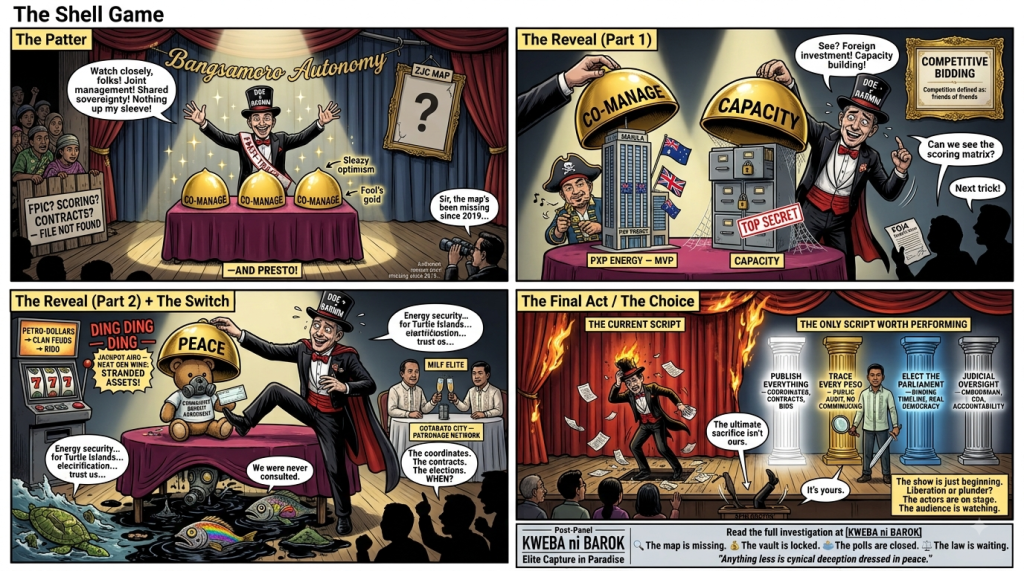
Magician’s Patter Over the Hydrocarbon Prize
The recent pronouncement from the Department of Energy (DOE) and the Bangsamoro Autonomous Region in Muslim Mindanao (BARMM) reads less like a policy update and more like a magician’s patter. “Fast-tracking,” “co-managing,” “strengthening capacity”—a dazzling array of verbal sleight-of-hand designed to distract the audience while the real action happens beneath the table. The subject of this grand illusion is the Sulu Sea, and the prize is nothing less than the hydrocarbon wealth beneath it and the very soul of Bangsamoro autonomy.
The drama centers on Petroleum Service Contracts 80 and 81, awarded to a consortium of Australian, British, and Filipino firms, including PXP Energy, the vehicle of tycoon Manuel V. Pangilinan. This isn’t a backroom deal in a corrupt backwater; it’s a high-stakes performance on the main stage of Philippine energy federalism. The legal script, Republic Act No. 11054 (Bangsamoro Organic Law), is immaculate. It mandates joint management of fossil fuels between the national and regional governments. On paper, it is a masterpiece of shared sovereignty.
The reality, however, is a chaotic mess of unanswered questions, prime for a cynical rewrite.
Missing Maps and the Jurisdictional Void
The first, and most glaring, hole in this theatrical production is the missing geography. The Bangsamoro Organic Law prescribes Zones of Joint Cooperation (ZJC) in the Sulu Sea, whose coordinates were to be established by a joint body. BARMM’s own parliament has been begging for this delineation since 2019. Now, in 2026, the government is “fast-tracking” a co-management framework for multi-billion-peso contracts that may exist in a jurisdictional void. Is this efficiency, or is it the bureaucratic equivalent of building a casino on a property line and hoping neither neighbor protests? The 2024 Supreme Court ruling in Province of Sulu v. Medialdea (G.R. No. 242255) removing the Province of Sulu from BARMM has only deepened the fog. To claim “Sulu Sea” is not “Sulu Province” is technically correct, but it is a distinction that demands precise cartography, not press-release spin. The ultimate scandal may not be that the government is moving too slowly, but that it is rushing to build a house of constitutional cards on a foundation of sand.
Elite Capture Dressed as Competitive Bidding
This opacity is the oxygen that fuels the second great failure of this initiative: the perception of elite capture. The problem isn’t that Pangilinan cashed in on Bangsamoro’s buried treasure—it’s that the map to that treasure was drawn by insiders, for insiders, and the public is expected to just trust the pirates. The consortium appears to have won a competitive bid. Free, Prior and Informed Consent (FPIC) documents were reportedly secured. These are the headlines. But the fine print—the scoring matrices, the evaluation records, the very definition of “affected Indigenous Cultural Communities” for an offshore block—remains locked in a government vault. In the absence of radical transparency, every move is suspect. The legal doctrine is not the problem; the sociology of power is. When a “peace dividend” begins to look like a charmed circle of Manila tycoons, foreign investors, and a nascent regional political class, the promise of “genuine sovereignty” rings hollow. We are not witnessing simple corruption; we are witnessing the sophisticated architecture of it, where the rule of law is not broken, but curated to favor the few.
Cuddly Community Benefits and Carbon Fig Leaves
Perhaps the most cynical character in this entire play is the proposed “Community Benefit Agreement.” A phrase so warm and cuddly it could be a development NGO’s teddy bear. But what does it mean in the context of the Sulu Sea? Without legally binding mechanisms for direct, equitable participation, it is a tool for co-optation. It becomes a slush fund for mayors and a photo-op for cabinet secretaries, designed to pacify coastal communities whose real wealth—the fish stocks and the fragile ecosystems of the Coral Triangle—is being put at existential risk. The narrative of “energy security” and “electrification” is seductive. We are told that drilling in the Sulu Sea will somehow power the remote and ecologically precious Turtle Islands. This is a profound non sequitur. It is a promise designed to launder the image of a high-risk fossil fuel venture through the language of poverty alleviation. It is the peace process being used as a fig leaf for a carbon-heavy past, rather than a bridge to a sustainable future. The absence of a robust, forward-looking climate transition plan is not an oversight; it is a policy crime, an act of intergenerational theft that will leave the next generation with stranded assets and a compromised ocean.
Peace Process or Patronage Engine?
And what of the peace? The call for “inclusive governance structures” that extend beyond the “Moro Islamic Liberation Front (MILF) elite” is a euphemism for one of the most dangerous realities in the BARMM: the concentration of power. The entire framework of autonomy, born from decades of painful struggle, risks being captured by a narrow political-bureaucratic class in Cotabato City, with its own patronage networks and vested interests. The injection of massive petroleum revenues into this system without extreme accountability is not a recipe for reconciliation; it is a catalyst for rido—the ancient, blood-soaked cycle of clan vengeance that has haunted Moro lands for generations and now stands to be weaponized by petro-dollars. These are not abstract risks. They are the history of the Moro lands—a history of resource extraction that has enriched central governments and local strongmen while the people remain mired in poverty. To move forward without a mechanism for truth-telling about this extractive past is to build the future on a foundation of unacknowledged trauma.
So, we are left with the central question, articulated so well by Elroi Son Oller Panganiban:
“These petroleum contracts could represent genuine sovereignty, or they could reproduce elite capture — unless transparency, consent, and governance safeguards are enforced immediately.”
The DOE and BARMM are attempting to write a grand epic. But unless they fundamentally alter their approach, they are producing a tragedy.
The Only Script Worth Performing
The conclusion is not to halt the project. The legal basis for co-management is real, and the potential economic benefits are real. The call is for a different kind of show—one without the magic tricks and the misdirection. The DOE and BARMM must make the ultimate sacrifice: they must give up the temptation to control the narrative and instead submit to the process.
This requires a radical, almost painful, form of transparency. The first act must be to publish everything: the exact coordinates of SC 80 and 81, the official ZJC boundaries, the full contracts, and the bid evaluation records. They must prove, not assert, that the process was competitive and lawful. Second, they must establish an independent, public audit of all revenue flows, creating a legally watertight separation between petroleum wealth and peace normalization funds. The money must be traceable by every citizen, not just by accountants in Manila and Cotabato. Third, they must enshrine a credible, binding timeline for BARMM parliamentary elections. You cannot claim to represent a people’s interests in resource development if those people have no functioning democratic mechanism to hold you accountable.
Finally, they must embrace the supremacy of the rule of law not as a shield for their decisions, but as a sword against their own potential for corruption. This means establishing judicial oversight mechanisms that can actually challenge the executive branch, strengthening the Ombudsman and the Commission on Audit, and empowering the very democratic institutions they often see as obstacles. The only path to ensuring that the Bangsamoro people become the true and lasting beneficiaries of their own resources is by making the process so transparent, so accountable, and so lawful that any attempt at capture is exposed and crushed.
This is the only hope for a better, fairer future. It is the only script worth performing. Anything less is just a cynical deception dressed in the language of peace. The ultimate sacrifice required is not from the Bangsamoro people, but from those in power who must be willing to surrender their own potential for unearned wealth to the sanctity of the law. The stakes are the highest imaginable: the future of a region, the integrity of a nation, and the soul of a peace process. The show is just beginning. Whether it will be a story of liberation or a farce of plunder is up to the actors now on stage.
Key Citations
A. Legal & Official Sources
- The 1987 Constitution of the Republic of the Philippines. Official Gazette of the Republic of the Philippines, 1987, http://www.officialgazette.gov.ph/constitutions/1987-constitution/.
- Republic Act No. 11054. An Act Providing for the Organic Law for the Bangsamoro Autonomous Region in Muslim Mindanao. 2018, lawphil.net/statutes/repacts/ra2018/ra_11054_2018.html.
- Province of Sulu v. Medialdea. G.R. No. 242255, Supreme Court of the Philippines, 26 Nov. 2024, lawphil.net/judjuris/juri2024/nov2024/gr_242255_2024.html.
B. News Reports
- Galang, Gabriell Christel. “DOE, BARMM Fast-Track Sulu Sea Petroleum Deals, Native Hydrogen Rules.” Manila Bulletin, 13 Aug. 2026, mb.com.ph/2026/08/13/doe-barmm-fast-track-sulu-sea-petroleum-deals-native-hydrogen-rules.
- Panganiban, Elroi Son Oller. “Peace Dividends: The Philippines’ Southern Gas Gamble.” LSE Southeast Asia Blog, 30 Mar. 2026, blogs.lse.ac.uk/seac/2026/03/30/peace-dividends-the-philippines-southern-gas-gamble/.
- “President Marcos Jr. unveils eight landmark petroleum service contracts to boost energy security.” Department of Energy, 7 Oct. 2025, doe.gov.ph/articles/3094548–president-marcos-jr-unveils-eight-landmark-petroleum-service-contracts-to-boost-energy-security.

- ₱9 Billion in ‘Savings’? DILG’s Fire Truck Deal Smells Like Smoke
- ₱8B BBM Pork: CCTV for Every Captain’s Kumpare?
- ₱8.9 Billion, 331 Ghost Police Stations: The TIKAS Scandal Explained

- ₱8.4 Billion, 42,000 Barangays, 1 Election: The “Bawat Barangay Makikinabang” Vote-Buying Masterclass

- ₱75 Million Heist: Cops Gone Full Bandit

- ₱6.77B Ghost Haunts Duterte: RTC Dismisses Mans Carpio’s Desperate Plea
- ₱6.77 Billion and Zero Cash: The Sara Duterte SALN Math That Doesn’t Add Up

- ₱6.7-Trillion Temptation: The Great Pork Zombie Revival and the “Collegial” Vote-Buying Circus

- ₱58.53B, Zero Receipts: The LGSF Pork Barrel Nobody Wants to Name
- ₱53 Million Man Tells ₱695-a-Day Workers to Stop Being ‘Mayabang’: The Audacity of BSP’s Remolona

- ₱4.4 Billion and a Witness Who Can’t Explain It: The Duterte Impeachment’s Most Expensive Non-Answer
- ₱3.06 Billion for Evacuation Centers—But Nobody Knows Where They’ll Stand (Or If They’ll Exist)





Leave a Reply