No Stop-Loss, No Brakes: How the SSS Rode a ₱40 Billion Equity Slide With Its Eyes Closed
By Louis ‘Barok‘ C. Biraogo | October 18, 2026
The Confession With a Calculator
Let me follow the money through this hall of mirrors.
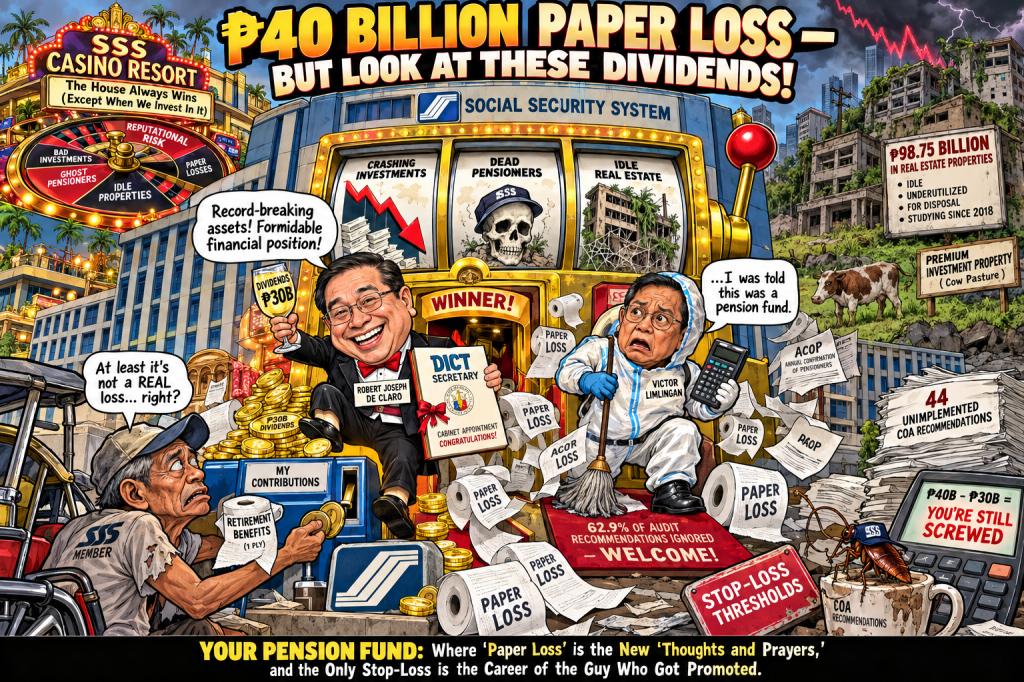
The Social Security System (SSS)—the institution holding the retirement futures of millions of Filipino workers—has managed to misplace nearly ₱40 billion in paper value on its equity portfolio, and its defense is essentially: “It’s not real money unless we sell.”
That is, I suppose, technically true. It’s also technically true that if I set your house on fire, you haven’t “lost” anything until you try to sell the ashes. The logic holds. The comfort does not.
The Commission on Audit (COA)’s 2025 annual audit report on the SSS reads less like a financial disclosure and more like a slow-motion institutional shrug. Unrealized equity losses surged from ₱11.6 billion in 2021 to ₱39.994 billion in 2025—a 245% jump—and the SSS’s response was to point at dividends and say, “Look, we made ₱30.132 billion in realized gains and dividend income from 2018 to 2025.”
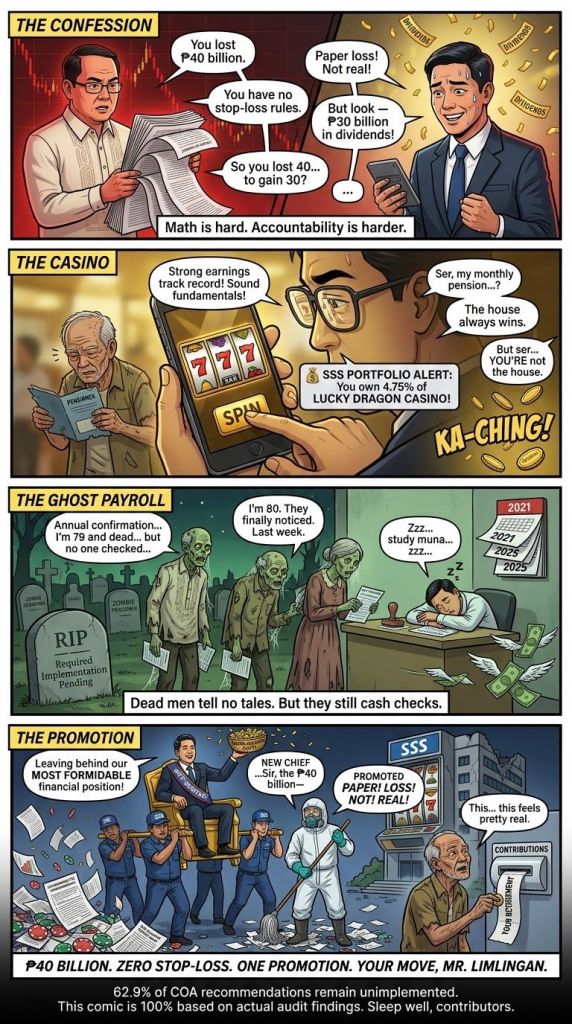
Wonderful. You lost ₱40 billion in paper value while earning ₱30 billion in actual income. That’s not a defense. That’s a confession with a calculator.
The Stop-Loss That Wasn’t There
Here is the detail that should make every SSS member reach for something strong: COA found the SSS lacked formal stop-loss thresholds—the basic risk-management tool that tells you when to cut your losses and walk away from a deteriorating position. Here is how a stop-loss works.
Imagine a casino with no betting limits, no closing time, and a dealer who says, “The cards might turn around.” That’s not a pension fund. That’s a vibes-based investment strategy.
The SSS, to its credit, adopted something called Social Security Commission (SSC) Resolution No. 553-s.2022, aligned with International Social Security Association (ISSA) frameworks. Frameworks! Aligned! And yet the losses still ballooned by 245%. This is the governance equivalent of installing a smoke detector and then removing the battery because the beeping was annoying.
COA’s recommendation was almost painfully reasonable: establish enforceable stop-loss limits, rebalancing procedures, and regular stress tests. The fact that these did not already exist at a fund managing ₱1.254 trillion in assets is not a market failure. It is a management failure dressed up in actuarial jargon.
The Casino Stake That Nobody Wants to Talk About
Then there’s the detail COA buried in plain sight: the SSS holds a 4.75% equity stake in a domestic casino and gaming company.
Auditors warned this “undermines principles of prudence and ethical investing” under Section 26 of Republic Act (RA) 11199 and exposes the fund to “regulatory scrutiny and reputational risks.”
Let me translate: Your pension fund owns a slice of a gambling operation. The people who are supposed to be protecting your retirement are invested in an industry built on the premise that the house always wins—and somehow, they’re not the house.
The SSS’s defense, predictably, is that it invests “only in companies with strong earnings track records, stable business performance, and sound fundamentals.” If the casino company has strong earnings, I suppose that’s supposed to make us feel better. It doesn’t. It makes me wonder what else qualifies as “sound fundamentals” in the SSS investment playbook. A tobacco company? A payday lender? A funeral home with a subscription model?
The optics alone are catastrophic. The SSS spends years telling pensioners there’s no money for a meaningful pension increase, then it turns out there’s money for a casino stake and a ₱40 billion equity portfolio that’s bleeding value.
The Dead Pensioners and the Living Bureaucracy
While the investment team was busy not implementing stop-loss thresholds, the benefits department was busy paying ₱490.21 million to deceased pensioners in 2025—up from ₱453.59 million the year before.
That’s an 8% increase in overpayments to people who are, by definition, no longer eligible for anything.
COA traced the problem to the SSS’s Annual Confirmation of Pensioners (ACOP) policy, which only requires annual verification for pensioners aged 80 and above. If you’re 79 and dead, apparently the system assumes you’re fine until someone checks. The dead, it seems, are remarkably compliant with paperwork requirements.
The recommended fix—mandatory verification for all pensioners regardless of age—is so obvious that its absence suggests either incompetence or a deliberate disinterest in stopping the leak. Neither explanation is comforting.
The ₱98.75 Billion in Properties Doing Nothing
And then there’s the real estate. Twenty-four investment properties valued at ₱98.75 billion were found “underused, idle or physically deteriorating.”
Let me put that in perspective. The SSS is sitting on nearly ₱100 billion worth of property that is either vacant, crumbling, or tied up in agrarian reform claims and legal disputes. This is not an investment portfolio. It’s a museum of bureaucratic paralysis.
COA recommended disposal plans and resolution of legal disputes. The SSS, presumably, is still “studying” the matter. In the time it takes the SSS to study anything, a property can deteriorate from “underused” to “condemned.”
The Timing That Smells Like a Cover-Up
Here is where the story stops being a comedy of errors and starts looking like a carefully staged exit.
The COA report was released in mid-October 2026. Within days, SSS President Robert Joseph de Claro was appointed Secretary of the Department of Information and Communications Technology.
His replacement, finance veteran Victor Alfonso Limlingan, took over on October 16.
The SSS’s farewell statement for de Claro praised him for leaving behind “the institution’s most formidable financial position to date—defined by record-breaking asset levels, a steadily growing investment reserve, and markedly improved earnings.”
Record-breaking asset levels. A steadily growing investment reserve. And a ₱40 billion paper loss sitting in the corner like a guest who won’t leave.
You don’t need to be a conspiracy theorist to notice the choreography. The man who presided over the period when these losses accumulated gets promoted to a cabinet post, and his departure is celebrated with press releases about asset growth. The audit findings become someone else’s problem.
The new SSS chief inherits a fund with:
- No enforceable stop-loss thresholds
- A casino investment nobody wants to defend
- ₱490 million in annual leakage to dead people
- ₱98.75 billion in properties doing nothing
- And a public relations strategy built on the phrase “paper loss”
Good luck, Mr. Limlingan. You’ll need more than a finance background. You’ll need a hazmat suit.
What “Paper Loss” Really Means
Let me be fair to the SSS for exactly one paragraph.
Unrealized losses are not stolen money. They are not cash that vanished into someone’s pocket. They reflect the market value of assets the fund still holds. Markets fluctuate. A long-term investor can ride out downturns. The SSS’s portfolio includes blue-chip holdings like Philippine Long Distance Telephone Company (PLDT), Universal Robina, and Security Bank, and the fund claims these have generated substantial realized gains and dividends over time.
That is a legitimate argument.
Here is why it doesn’t save them.
COA didn’t flag the losses because markets go down. It flagged them because the SSS had no mechanism to decide when to act. A pension fund without stop-loss thresholds is not a long-term investor. It is a passenger in a vehicle with no brakes, hoping the road stays straight.
The difference between a prudent investor and a negligent one is not whether losses occur. It’s whether there is a system for responding to them. The SSS had frameworks. It had resolutions. It had committees. It did not have a trigger.
The Real Scandal Is the Bureaucracy
The most damning number in the COA report isn’t ₱40 billion. It’s 44 out of 70. That’s the number of prior-year audit recommendations that remained unimplemented.
Nearly two-thirds of the fixes that auditors already identified were ignored.
This is not a one-time lapse. It is a pattern. COA finds a problem, recommends a solution, and the SSS files the recommendation in the same drawer where it keeps its stop-loss thresholds and its plans for idle real estate.
The SSS is not a poorly managed fund. It is a structurally unaccountable institution that has learned to survive audits by issuing press releases about dividends and “strong fundamentals” while the underlying problems compound.
The Question Nobody in Malacañang Wants to Answer
If the SSS is in such “formidable financial position,” as its farewell statement for de Claro claimed, why did COA find:
- No stop-loss thresholds
- A casino investment that violates prudence standards
- ₱490 million in overpayments to the dead
- ₱8.5 billion in external fund manager contracts with “significant deficiencies in contracting authority, misclassification of services, and investment strategy concerns”
- ₱98.75 billion in idle properties
- And a 62.9% non-compliance rate with prior audit recommendations
Either the SSS’s communications team is lying, or COA is lying. There is no third option.
What Should Happen
Congress should investigate. Not a performative hearing where SSS officials read prepared statements and legislators pose for cameras. A real investigation with subpoena power, document production, and consequences.
The new SSS chief should implement COA’s recommendations within 90 days, not “study” them. Stop-loss thresholds, rebalancing procedures, stress tests, mandatory pensioner verification, property disposition plans—these are not complex reforms. They are basic management practices that should have existed a decade ago.
The casino investment should be divested or publicly justified with a full risk assessment. If the SSS cannot explain why owning a piece of a gambling company serves the retirement interests of Filipino workers, it should sell.
And someone—anyone—should be held accountable for the fact that the SSS spent years telling pensioners there was no money for an increase while ₱40 billion in paper value evaporated and ₱490 million flowed to the dead.
The Bottom Line
The SSS’s defense is that “paper losses” aren’t real losses. But the absence of stop-loss thresholds is real. The casino stake is real. The dead pensioners collecting checks are real. The idle properties are real. The unimplemented recommendations are real.
The only thing that isn’t real, apparently, is anyone’s accountability.
Your pension contributions are being managed by an institution that cannot tell you when to sell a losing stock, why it owns a casino, or how to stop paying dead people. And when auditors point this out, the response is a press release about dividends and a promotion for the man in charge.
That’s not a pension fund. That’s a protection racket with a government seal.
And the ₱40 billion “paper loss”? It’s the most expensive piece of paper in the country—and you’re holding the bill.
Key Citations
A. Legal & Official Sources
- Commission on Audit. Commission on Audit, Republic of the Philippines, www.coa.gov.ph. Accessed 17 Oct. 2026.
- Philippines. Congress. “Republic Act No. 11199: Social Security Act of 2018.” The Lawphil Project, lawphil.net. Accessed 17 Oct. 2026.
B. News Articles
- “COA Flags SSS P40-B ‘Paper Loss’ in Equity Investments.” GMA News Online, GMA Network, Oct. 2026, gmanetwork.com.
- “CoA Flags P40-B SSS Paper Losses.” BusinessWorld Online, 14 Oct. 2026, bworldonline.com.
- “COA Flags P40 Billion in SSS Paper Losses and P490 Million Paid to Deceased Pensioners.” Astig.ph, Oct. 2026, astig.ph.
- “Hounded by Paper Loss Issue, SSS Sticks to Guns.” BusinessMirror, 15 Oct. 2026, businessmirror.com.ph.
- “Finance Veteran Victor Limlingan Is New SSS Chief.” Rappler, Oct. 2026, rappler.com.
- “Finance Veteran Victor Limlingan Is New SSS Chief.” The Philippine Star, 17 Oct. 2026, philstar.com.
- “Zarate Seeks Probe into Alleged Almost P40 Billion SSS Paper Stock Losses.” Philippine Daily Inquirer, Oct. 2026, newsinfo.inquirer.net.
C. Official Websites & Reference Sources
- Social Security System. Republic of the Philippines, www.sss.gov.ph.
- International Social Security Association. ISSA, ww1.issa.int.
- “Stop-Loss Order.” Investopedia, investopedia.com.
- “Unrealized Gain: Definition, How It Works, and Example.” Investopedia, investopedia.com.
- “Ang Hirap Maging Mahirap”: The PAO Scandal That Proves Government Contempt Is Nothing New
- “Far-Off” My Axx: Malacañang’s Claire Castro Drowns in Her Own Legal Gaslighting
- “Forthwith” to Farce: How the Senate is Killing Impeachment—And Why Enrile’s Right (Even If You Can’t Trust Him)
- “HINDI AKO NAG-RESIGN!”

- “I Know Nothing”: Baste Duterte’s Amnesia Defense Meets ₱33M in GenCorp Contracts
- “I’m calling you from my new Globe SIM. Send load!”

- “Mahiya Naman Kayo!” Marcos’ Anti-Corruption Vow Faces a Flood of Doubt

- “Manageable” Debt, Unmanageable Lies: DBM’s ₱21 Trillion Fairy Tale
- “Meow, I’m calling you from my new Globe SIM!”

- “Natrabaho”: One Word, One Ombudsman, and a Judiciary on Trial
- “No Special Jail for Crooks!” Boying Remulla Slams VIP Perks for Flood Scammers

- “Philippine-Controlled” or Yankee Gas Station? The Davao Fuel Depot Farce Exposed







Leave a Reply