
From 12 Years of Neglect to a ₱26B Fire Pit: The Governance Arson Behind the Smokey Mountain Scheme
By Louis “Barok” C. Biraogo — August 16, 2026
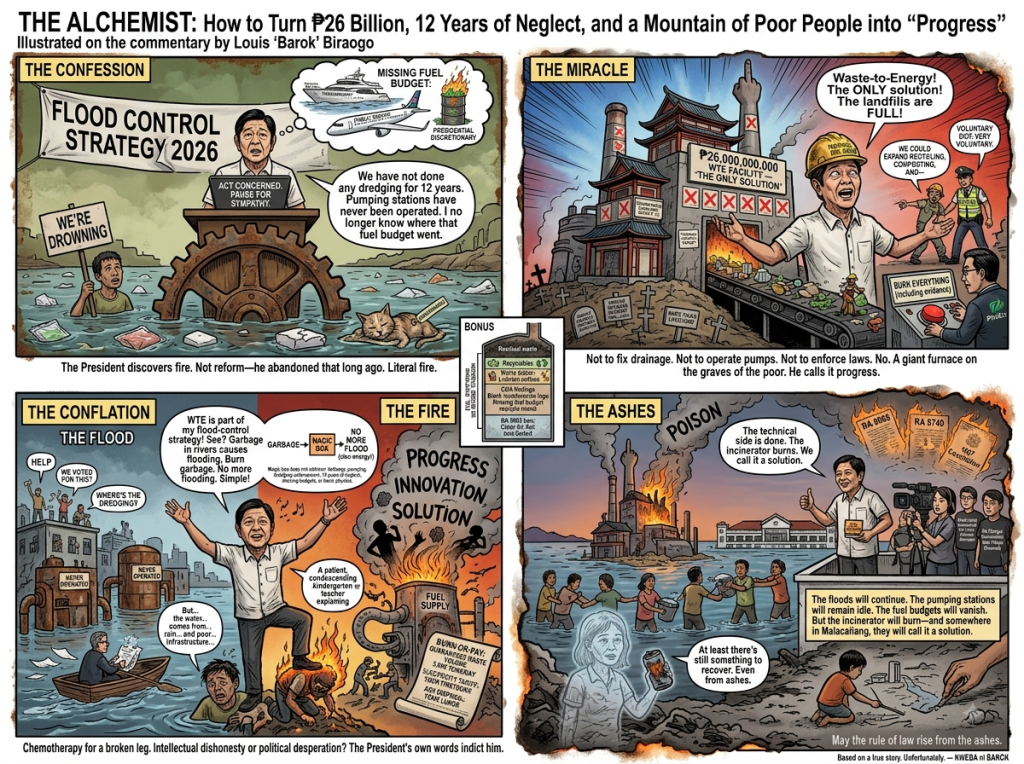
THE President has discovered fire. Not the metaphorical fire of reform—he abandoned that long ago—but literal fire. A ₱26-billion furnace to burn the garbage his government cannot be bothered to manage. Waste-to-Energy (WTE), he calls it. A “solution.” The only solution, he insists, because the landfills are full. The landfills are full! As if this were an act of God rather than two decades of deliberate neglect.
Let us savor the audacity of this proposition. Metro Manila drowns in floodwater and garbage, and the President’s answer is not to fix the drainage, not to operate the pumping stations, not to enforce the easement laws. No. His answer is to build a giant incinerator on the graves of Smokey Mountain’s poor and call it progress.
The Causal Fallacy Wrapped in a Press Release
Marcos stood before the Baclaran River—a waterway so choked with sachets and styrofoam it resembled a landfill with a drainage problem—and declared WTE part of his flood-control strategy. This is like prescribing chemotherapy for a broken leg. The two conditions may coexist in the same body, but treating one does nothing for the other.
The Manila Anti-Incinerator Alliance (MAIA) stated the obvious with the patience of a kindergarten teacher: “Garbage in waterways is a waste-management and infrastructure governance failure—not a justification for incineration.” Flooding is hydrological. Waste is logistical. Conflating them is either intellectual dishonesty or political desperation.
And here is where the President’s own words indict him. He admitted: “We have not done any dredging for 12 years.” Twelve years! He confessed that pumping stations “have never been operated since they were built.” Never operated! He wondered aloud where the fuel budget went—”I no longer know where that budget went,” he mused, as if discussing a misplaced umbrella rather than public funds that vanished into the ether.
So the government neglected every flood-control mechanism under its control for over a decade, allowed pumping stations to rust into oblivion, lost track of fuel appropriations—and now presents a ₱26-billion incinerator as the solution? This is not governance. This is arson dressed as policy.
The Legal Labyrinth of Convenient Interpretation
The environmental groups argue that Philippine law bans incineration. They cite Republic Act No. 9003 (Ecological Solid Waste Management Act of 2000), which explicitly excludes incineration from ecological solid waste management. They invoke Republic Act No. 8749 (Philippine Clean Air Act of 1999), which prohibits burning that emits poisonous and toxic fumes. They are right—but only partially.
The Supreme Court’s Metropolitan Manila Development Authority v. Jancom Environmental Corporation (MMDA v. Jancom) ruling in 2002 interpreted the Clean Air Act as prohibiting only burning processes that emit toxic fumes, not all incineration absolutely. Department of Environment and Natural Resources (DENR) Administrative Order No. 2019-21 subsequently created a regulatory framework for WTE facilities. The legal terrain is muddier than the Baclaran River after a monsoon.
But here is the rub: the fact that WTE may be legally permissible under certain conditions does not mean this WTE project is legally defensible. The burden is on the government to prove compliance with RA 9003’s waste-diversion hierarchy—reduce, reuse, recycle, compost, recover, then dispose of residuals. The burden is on the government to demonstrate that a 3,000-ton-per-day incinerator will not undermine recycling, will not displace waste pickers, will not poison the surrounding community. That burden has not been met. It has not even been acknowledged.
The Corporate Carnival at Smokey Mountain
Enter Kanadevia Corp., the Japanese technology partner, and Philippine Ecology Systems Corp. (PhilEco), the local operator with ten environmental compliance notices since 2022. Ten! A company that cannot keep its existing operations environmentally compliant is now entrusted with a ₱26-billion incinerator in the middle of a densely populated urban poor community.
MAIA alleges—credibly and chillingly—that the project has already produced “forcible displacement, intimidation, and mobility restrictions.” Security personnel are reportedly pressuring residents to accept “voluntary” exit arrangements. Voluntary in the way a mugging is voluntary when the alternative is worse.
The waste pickers of Smokey Mountain, who for generations have recovered recyclables and diverted waste from disposal, are being told their livelihoods are obsolete. An incinerator needs fuel—and recyclable materials burn beautifully. The structural incentive is obscene: the more garbage the city produces, the more valuable the incinerator becomes. Burn-or-pay contracts could lock Metro Manila into a cycle of guaranteed waste generation, making RA 9003’s waste-reduction mandates economically inconvenient.
The Governance Vacuum at the Center of the Storm
The Commission on Audit (COA) audit findings are a monument to institutional incompetence. Five completed flood-control projects delayed 13 to 322 days. Four ongoing projects delayed up to 676 days. ₱37.41 million in commitment fees paid for loans that sat unused. A 12% accomplishment rate for flood reduction targets.
The World Bank and Asian Infrastructure Investment Bank (AIIB) financed the Metro Manila Flood Management Project. They watched it flounder. They charged commitment fees while Filipinos drowned. And now the same institutional apparatus that cannot operate a pumping station proposes to operate a sophisticated thermal treatment facility.
Marcos says the “technical side” is done. Of course it is—that is the easy part. The Japanese will sell you the technology. The hard part is governance: segregation, collection, enforcement, maintenance, transparency. The hard part is admitting that no incinerator will stop a sachet from entering a river.
What Must Happen Now
First, separate WTE from flood control. Call it what it is: a residual waste management project with energy recovery. Stop pretending it will stop the floods.
Second, fix the flood infrastructure. Repair trash traps. Operate pumping stations. Fund fuel. Dredge rivers. Enforce easement laws. Demolish illegal encroachments without exception—including those belonging to political allies. Audit every peso of flood funds from the past decade. Prosecute those who cannot account for missing appropriations.
Third, enforce RA 9003 before approving WTE. Show measurable improvement in segregation, recycling, composting, and collection. If the government cannot manage source reduction, it has no business managing incineration.
Fourth, release the contracts. The public deserves to see the tipping fees, the electricity tariffs, the guaranteed waste volumes, the ash-disposal plans, the emissions models, the health-risk assessments, the displacement plans. Transparency is not a courtesy; it is a constitutional obligation.
Fifth, protect the waste pickers. Integrate them into the formal waste system. Recognize their contribution. Compensate them fairly. Do not burn their livelihoods in the name of progress.
Sixth, conduct an independent Environmental Impact Assessment (EIA). Not a DENR rubber stamp. A genuine, peer-reviewed, publicly scrutinized assessment of air quality, cumulative health impacts, ash management, and climate consequences.
The Verdict
The incinerator is not the solution. It is a distraction. It is a shiny, expensive, technologically sophisticated excuse to avoid the unglamorous work of governance: collecting garbage, maintaining drainage, enforcing laws, and serving the public.
Marcos wants to burn the evidence of his administration’s failures. He wants to incinerate the garbage his government refused to manage and call it innovation. He wants to build a monument to corporate profit on the backs of Smokey Mountain’s poor and call it progress.
The floods will continue. The pumping stations will remain idle. The fuel budgets will vanish. But the incinerator will burn—and somewhere in Malacañang, they will call it a solution.
May the rule of law rise from the ashes.
Key Citations
A. Legal & Official Sources
- The 1987 Constitution of the Republic of the Philippines. Official Gazette of the Republic of the Philippines, 1987, http://www.officialgazette.gov.ph/constitutions/1987-constitution/.
- Republic Act No. 9003. An Act Providing for an Ecological Solid Waste Management Program, Creating the Necessary Institutional Mechanisms and Incentives, Declaring Certain Acts Prohibited and Providing Penalties, Appropriating Funds Therefor, and for Other Purposes. 2001, http://www.officialgazette.gov.ph/2001/01/26/republic-act-no-9003/.
- Republic Act No. 8749. An Act Providing for a Comprehensive Air Pollution Control Policy and for Other Purposes. 1999, http://www.lawphil.net/statutes/repacts/ra1999/ra_8749_1999.html.
- Metropolitan Manila Development Authority v. Jancom Environmental Corporation, G.R. No. 147465. Supreme Court of the Philippines, 30 Jan. 2002, lawphil.net/judjuris/juri2002/jan2002/gr_147465_2002.html.
- DENR Administrative Order No. 2019-21. Guidelines Governing Waste-to-Energy (WTE) Facilities for the Integrated Management of Municipal Solid Wastes. Department of Environment and Natural Resources, 2019, eia.emb.gov.ph/wp-content/uploads/2024/02/DAO-2019-21.pdf.
B. News Reports
- Baclig, Cristina Eloisa. “Green Groups to Marcos: Waste-to-Energy No Fix for Flooding.” INQUIRER.net, 14 Aug. 2026, newsinfo.inquirer.net/2284484/green-groups-to-marcos-waste-to-energy-no-fix-for-flooding.
- Ong Ki, Czarina Nicole. “COA Flags MMDA over Delays in P167-M Flood Management Project.” Manila Bulletin, 1 Dec. 2025, mb.com.ph/2025/12/01/coa-flags-mmda-over-delays-in-p167-m-flood-management-project.

- “Ang Hirap Maging Mahirap”: The PAO Scandal That Proves Government Contempt Is Nothing New

- “Far-Off” My Axx: Malacañang’s Claire Castro Drowns in Her Own Legal Gaslighting
- “Forthwith” to Farce: How the Senate is Killing Impeachment—And Why Enrile’s Right (Even If You Can’t Trust Him)

- “HINDI AKO NAG-RESIGN!”

- “I Know Nothing”: Baste Duterte’s Amnesia Defense Meets ₱33M in GenCorp Contracts
- “I’m calling you from my new Globe SIM. Send load!”

- “Mahiya Naman Kayo!” Marcos’ Anti-Corruption Vow Faces a Flood of Doubt

- “Manageable” Debt, Unmanageable Lies: DBM’s ₱21 Trillion Fairy Tale
- “Meow, I’m calling you from my new Globe SIM!”

- “Natrabaho”: One Word, One Ombudsman, and a Judiciary on Trial
- “No Special Jail for Crooks!” Boying Remulla Slams VIP Perks for Flood Scammers

- “Philippine-Controlled” or Yankee Gas Station? The Davao Fuel Depot Farce Exposed






Leave a Reply