From Emergency to Overachievement: Just Redefine Everything
By Louis ‘Barok‘ C. Biraogo — June 24, 2026
HERE is a riddle worthy of a Manila policy salon: When is 6.5 million not 6.5 million? Answer: When it becomes politically inconvenient.
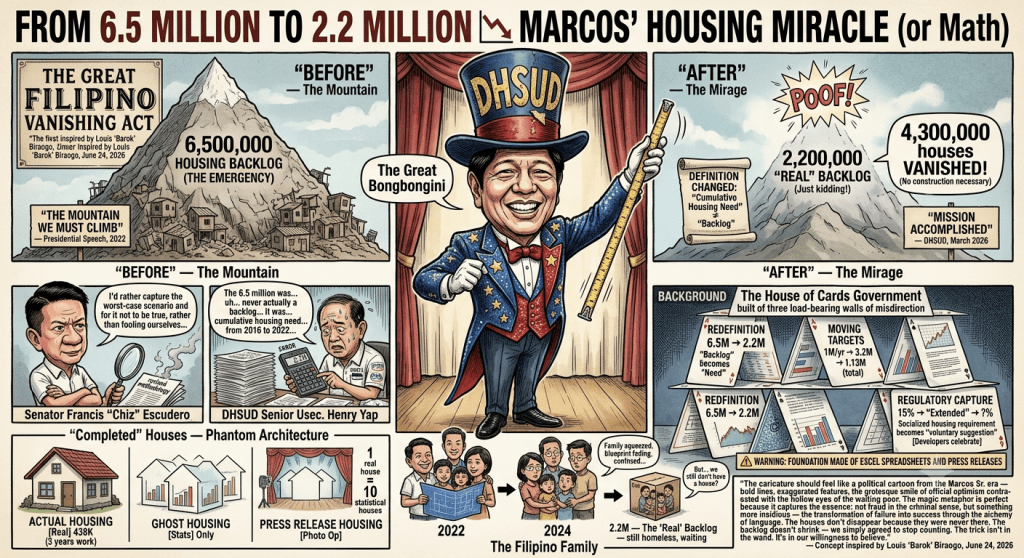
Somewhere in the marble corridors of the Department of Human Settlements and Urban Development (DHSUD), a statistician must be weeping. The agency formerly told Filipinos — and the President himself — that the nation faced a housing backlog of 6.5 million units. This was the emergency that justified the flagship Pambansang Pabahay para sa Pilipino Program (4PH). This was the number invoked in budget hearings, press releases, and presidential speeches. This was the mountain we were told we must climb.
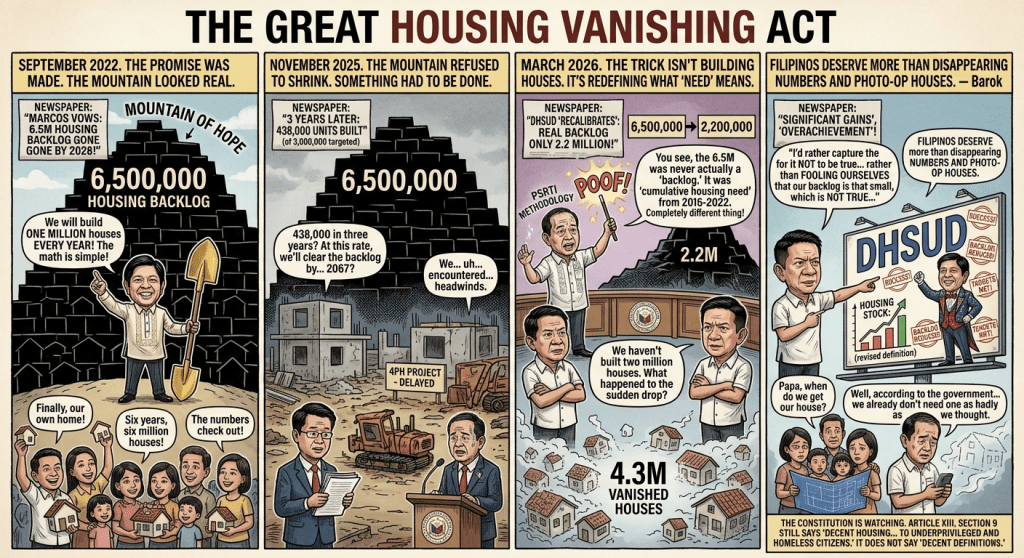
Then, at a Senate hearing in March 2026, something remarkable happened. The mountain shrank. Under questioning, DHSUD Senior Undersecretary Henry Yap explained that the 6.5-million figure was never actually a “backlog” at all. It was, he said, merely the “cumulative housing need” from 2016 to 2022 — a forward-looking projection that had been improperly conflated with accumulated unmet demand. Under a revised methodology, the real backlog stood at 2.2 million. Just like that, 4.3 million missing homes vanished from the government’s ledger.
Senator Francis Escudero, to his credit, did not applaud this statistical legerdemain. “I’d rather have a definition that encompasses everything,” he retorted on the record. “I’d rather capture the worst-case scenario, and for it not to be true, rather than fooling ourselves into thinking that our backlog is that small, which is not true, just so that we can say we accomplished something during our term.”
The senator’s suspicion — that DHSUD changed the definition rather than closed the gap — captures something essential about how this administration constructs its legacies. It does not always build the houses. Sometimes it simply rebuilds the numbers.
The Architecture of Appearances
Let us be precise about what we are examining. This is not a plunder scandal. No criminal complaint currently ties DHSUD leadership to graft in the Expanded 4PH Program. The Commission on Audit has not issued damning findings. No Sandiganbayan information has been filed. What exists instead is something more subtle and, in its way, more instructive: a documented pattern of managing appearances rather than delivering results.
The pattern has three distinct features, each reinforcing the others like load-bearing walls in a structure of misdirection.
First, the redefinition of the backlog. The timing is damning. DHSUD adopted its revised methodology only after missing its original targets for three consecutive years — and the revision moved in only one direction, toward a smaller number that transformed underperformance into overperformance. Had this occurred in a publicly listed corporation’s securities disclosures, securities regulators would be asking pointed questions about selective presentation of performance metrics.
The underlying technical distinction between “backlog” and “housing need” may have legitimate scholarly basis — housing economists do indeed differentiate between accumulated unmet demand and forward-looking projections incorporating new household formation. But a legitimate methodology correction is typically pre-registered, published with full documentation, and subjected to independent review before the politically relevant outcome is known. Here, the sequence ran in reverse: years of missed targets, followed by a convenient recalculation.
Second, the repeated downward revision of production targets. The President’s original commitment — one million housing units per year to clear a 6.5-million backlog by 2028 — has been revised downward twice: first to 3.2 million units, then to 1.13 million units for the remainder of the term. Senator Sherwin Gatchalian noted in November 2025 budget hearings that DHSUD had completed only 438,000 units in three years against the original target trajectory. Each revision was accompanied by public messaging emphasizing “momentum” and “significant gains” — the very language of the Philippine Daily Inquirer feature that occasioned this analysis. If the target is a moving one, always descending to meet whatever number the agency can actually produce, then “success” becomes a tautology rather than an achievement.
Third, the consistent regulatory leniency toward non-compliant developers. The Balanced Housing Development Program under Republic Act No. 10884 requires private developers to set aside socialized housing equivalent to 15 percent of subdivision area or cost, or 5 percent of condominium area or cost — a hard-won statutory mandate to ensure that the private housing boom serves more than just the well-housed. Yet when DHSUD disclosed in mid-2025 that significant numbers of developers had failed to comply, the agency’s response was not enforcement. It was accommodation: an extension to March 2026, paired with an increase in the socialized-housing price ceiling from ₱850,000 to as much as ₱1.8 million, explicitly framed as an incentive to draw reluctant developers back into compliance.
The price-ceiling increase can be defended as enforcement realism — a ceiling that is economically unrealistic will be ignored regardless of penalty severity. But critics rightly note that pairing a compliance extension with sweeter terms inverts the law’s incentive structure: it rewards delay with better conditions rather than penalizing it. This is a recognizable pattern in Philippine regulatory practice, one scholars of administrative law call regulatory capture — where the regulated industry shapes enforcement timing and terms to its own commercial advantage, with the law’s intended beneficiaries bearing the cost of delay.
The Case for DHSUD (Such As It Is)
Fairness requires presenting the agency’s strongest arguments. Several have genuine merit.
The expanded program’s diversification of housing modalities represents a substantive improvement over the original 4PH’s near-exclusive emphasis on vertical condominium developments — a model poorly suited to informal settler families, disaster-displaced populations, and rural communities. The pivot to rental housing pilots, the revival of the Enhanced Community Mortgage Program (ECMP), the introduction of incremental housing, and the deployment of disaster shelter units all respond to critiques that housing-rights advocates have leveled for years. The ECMP in particular directly addresses security of tenure, which many urban-poor advocates consider more pressing than unit construction itself. If a family already occupies land, the threat is eviction, not homelessness in the abstract — and legal tenure eliminates that threat.
The rental housing component reflects modern urban planning principles employed in Singapore, Austria, and South Korea. Not every Filipino family can or should immediately pursue homeownership. Students, migrant workers, young professionals, and informal settlers awaiting permanent relocation all benefit from affordable rental options. The UP Diliman, UP Los Baños, Iloilo City, Quezon City, and Victorias City pilots represent a policy sophistication that previous administrations’ housing programs largely lacked.
Target recalibration, moreover, is not inherently dishonest. Government infrastructure and housing targets are routinely revised mid-term in response to budget constraints, construction capacity, and market conditions — this is standard practice across administrations and is not, by itself, evidence of bad faith. DHSUD’s public acknowledgment of construction delays and budget shortfalls as early as the 2024 House budget deliberations suggests the agency was not concealing underperformance but disclosing it through ordinary legislative channels.
And the backlog/housing-need distinction does have a legitimate technical basis. The recalculated 2.2-million figure was produced by the Philippine Statistical Research and Training Institute under NEDA — a technical body with institutional credibility independent of DHSUD. If the methodology is sound, the correction is defensible.
But here we arrive at the crux: defensible in theory does not mean credible in context. The question Senator Escudero posed is the one that matters. Not whether a distinction exists, but why it was discovered precisely when the original number became politically lethal.
The Deeper Question: What Does Success Look Like?
Beneath the statistical disputes lies a more fundamental issue that the Inquirer feature — and much of the administration’s messaging — consistently elides. The critical metric for Philippine housing policy is not how many units are constructed. It is whether residents stay housed, safe, and self-sufficient long after relocation.
This is where Philippine housing history offers its most sobering lessons. Previous administrations launched ambitious programs that looked successful during the ribbon-cutting phase but encountered cascading failures afterward. Units were built but never occupied because beneficiaries could not afford amortization, or because joblessness, absent transportation, and missing utilities rendered the sites uninhabitable in practice. Units were occupied but abandoned within years because maintenance costs exceeded residents’ capacity. Relocated families drifted back to informal settlements closer to their livelihoods, leaving behind ghost subdivisions of decaying government housing.
The Expanded 4PH Program has not yet demonstrated that it can avoid these pathologies. The Inquirer feature‘s figures — 45 ECMP projects approved, 27,000 individuals benefited, cash assistance released to 16 organized communities, 3,590 rental units under construction — are sourced entirely from DHSUD itself. No COA audit citation. No independent NGO verification. No breakdown by region, completion percentage, or occupancy rate. This does not mean the figures are false. It means the journalism did not seek independent verification — a methodological weakness in the reporting itself, separate from any wrongdoing by the agency.
The risks that lie ahead are not speculative. They are the documented failure modes of Philippine housing programs across administrations:
- Affordability gaps. Can beneficiaries actually sustain monthly amortization, association dues, utilities, and maintenance costs? Or will we see, five years hence, a portfolio of non-performing housing loans and families facing eviction from the very homes built for them?
- Ghost beneficiaries. Housing is one of the most politically valuable government benefits. Historically, allocations have occasionally been vulnerable to favoritism, patronage, and manipulation of beneficiary lists. Transparent selection mechanisms are essential — and not yet demonstrated at scale.
- Construction quality. Mass housing programs routinely encounter contractor disputes, structural defects, and materials substitution scandals. The procurement framework under Republic Act No. 9184 provides safeguards, but enforcement requires vigilant monitoring.
- Unresolved land disputes. Presidential Proclamation land dispositions — underway in Lucena City, Tala, Palawan, and other sites — are legally complex. Families occupying government lands for years may have equitable claims, but competing claimants, bureaucratic delays, and legal challenges can stall tenure regularization for decades.
What Accountability Would Look Like
The Senate Committee on Urban Planning, Housing and Resettlement is exercising its constitutionally contemplated oversight function — the system, in this instance, is working as designed, whether or not Congress ultimately concludes DHSUD acted in bad faith. But accountability requires more than legislative hearings.
The Commission on Audit should conduct a performance audit examining DHSUD’s basis for both the original 6.5-million and revised 2.2-million backlog figures. COA possesses subpoena-like document-production authority over national agencies independent of the DOJ or Ombudsman’s criminal processes. A Freedom of Information request for the full PSRTI working paper underlying the revised methodology would allow independent technical scrutiny of Senator Escudero’s “books look good” allegation on its merits.
DHSUD should publish occupancy data, not merely construction data. It should publish beneficiary audits to preempt favoritism allegations. It should publish financial sustainability reports addressing subsidies, amortization schedules, and default risk projections. Independent monitoring by universities, NGOs, and housing experts — pre-committed, not post-hoc — would provide the external validation the program currently lacks.
The Balanced Housing Law’s mandatory set-aside is not optional. Congress wrote 15 percent and 5 percent into the statute for a reason: the market, left alone, under-produces socialized housing. Regulatory flexibility has a place, but it cannot become a substitute for enforcement. If price-ceiling adjustments are necessary, they should be paired with accelerated compliance timelines, not extensions — and developers who remain non-compliant after reasonable accommodation should face the statutory penalties the law already provides.
The Constitution Is Watching
Article XIII, Section 9 of the 1987 Constitution directs the State to “undertake, in cooperation with the public sector, a continuing program of urban land reform and housing which will make available at affordable cost decent housing… to underprivileged and homeless citizens.” This is not a suggestion. It is an enumerated constitutional directive, and DHSUD’s performance against its housing targets is not merely an administrative metric — it bears on the fulfillment of a constitutional obligation.
The ultimate test of the Expanded 4PH Program will not be press releases, inspection photos, or even Senate testimony. It will be whether families remain housed, secure, and economically sustainable years after the cameras leave. If DHSUD can demonstrate high occupancy, genuine affordability, transparent governance, and lasting tenure security, the program could become one of the most consequential social policy achievements of any Philippine administration.
If it cannot — if the numbers keep shrinking, the targets keep descending, and the occupied units never quite match the constructed ones — then the program will become another chapter in a long and dispiriting history: ambitious housing reforms that looked solid during construction but proved hollow upon inhabitation.
From miracle math to vanishing promises: Filipinos deserve more than disappearing numbers and photo-op houses.
Key Citations
A. News Articles
- Doguiles, Danilo. “Marcos Jr. Admin, DHSUD to Close Housing Gap by 2028.” Philippine Information Agency, 24 Oct. 2022, https://mirror.pia.gov.ph/news/2022/10/24/marcos-jr-admin-dhsud-to-close-housing-gap-by-2028.
- Mendoza, John Eric. “Escudero: Gov’t housing data adjusted to look good to fool ourselves.” Inquirer.net, 10 Mar. 2026, https://newsinfo.inquirer.net/2193407/escudero-govt-housing-data-adjusted-to-look-good-to-fool-ourselves.
- “Housing Built on Sand.” Inquirer.net, 2 Jan. 2026, https://opinion.inquirer.net/188689/housing-built-on-sand.
- “Building PBBM’s Housing Legacy through Expanded 4PH.” Inquirer.net, 22 June 2026, https://business.inquirer.net/596489/building-pbbms-housing-legacy-through-expanded-4ph.
- Oliquino, Edjen. “DHSUD: 6.5-million housing backlog a ‘misconception’.” Tribune.net.ph, 10 Mar. 2026, https://tribune.net.ph/2026/03/10/dhsud-65-million-housing-backlog-a-misconception.
- Montemayor, Ma. Teresa. “DHSUD Orders Private Developers to Comply with Balanced Housing Law.” Philippine News Agency, 30 Oct. 2025, https://www.pna.gov.ph/articles/1262174.
B. Laws and Official Documents
- Republic of the Philippines. Republic Act No. 10884. 17 July 2016. https://lawphil.net/statutes/repacts/ra2016/ra_10884_2016.html.
- Republic of the Philippines. Republic Act No. 9184. 10 Jan. 2003. https://lawphil.net/statutes/repacts/ra2003/ra_9184_2003.html.
- Republic of the Philippines. The 1987 Constitution of the Republic of the Philippines. Art. XIII, Sec. 9. https://elibrary.judiciary.gov.ph/thebookshelf/showdocs/45/25566.
C. Government Agencies and Programs
- Department of Human Settlements and Urban Development. https://dhsud.gov.ph/.
- Social Housing Finance Corporation. Enhanced Community Mortgage Program. https://shfc.gov.ph/.
- Commission on Audit. https://www.coa.gov.ph/.
D. Reports & Studies
- Organisation for Economic Co-operation and Development. Housing Dynamics in Korea. OECD Publishing, 2018, https://www.oecd.org/content/dam/oecd/en/publications/reports/2018/04/housing-dynamics-in-korea_g1g8d29b/9789264298880-en.pdf.
- “Ang Hirap Maging Mahirap”: The PAO Scandal That Proves Government Contempt Is Nothing New

- “Far-Off” My Axx: Malacañang’s Claire Castro Drowns in Her Own Legal Gaslighting
- “Forthwith” to Farce: How the Senate is Killing Impeachment—And Why Enrile’s Right (Even If You Can’t Trust Him)
- “HINDI AKO NAG-RESIGN!”

- “I Know Nothing”: Baste Duterte’s Amnesia Defense Meets ₱33M in GenCorp Contracts






Leave a Reply