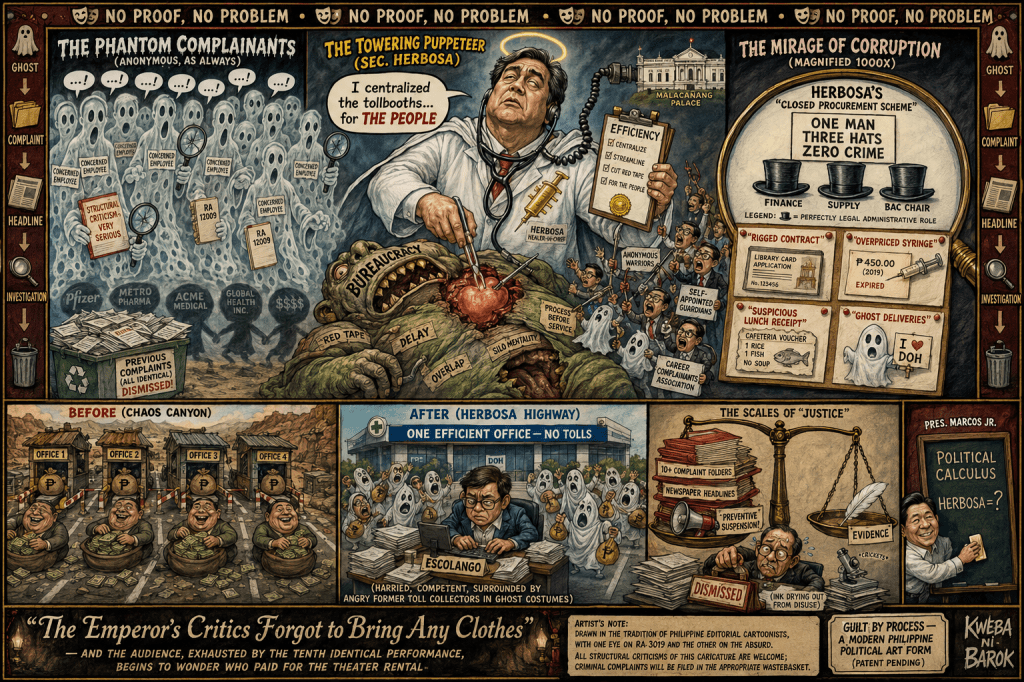
Anonymous DOH Ghosts Strike Again—Zero Evidence, Maximum Drama
By Louis ‘Barok‘ C. Biraogo — June 25, 2026
WHO watches the watchmen? At the Department of Health (DOH), apparently, it’s a recurring cast of unnamed “concerned employees” whose theatrical specialty is filing complaints conspicuously devoid of what lawyers call evidence and normal people call a point.
The latest production—a graft complaint against Health Secretary Teodoro “Ted” Herbosa and Undersecretary Randy Escolango—premiered this week with all the dramatic flair we’ve come to expect: breathless allegations, demands for preventive suspension, and the now-familiar sound of no actual corruption being proven whatsoever.
Let us dissect this farce with the analytical rigor it pretends to deserve.
The Allegation: A Structure Without a Crime
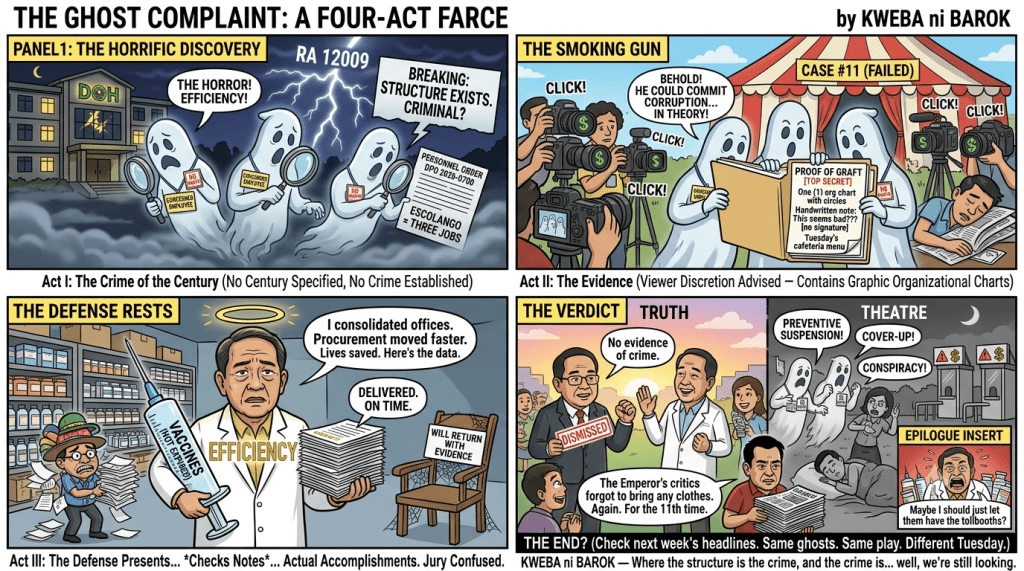
The complainants’ case orbits a single celestial body: a February 2026 Department Personnel Order designating Escolango as head of both Financial and Management Service and Supply Chain Management Service, while also chairing the Central Office Bids and Awards Committee (BAC). This, they howl, constitutes a “closed procurement scheme” that violates the sacred separation-of-functions doctrine under RA 12009, the New Government Procurement Act.
Notice what is conspicuously absent from this indictment: a single rigged contract. One overpriced syringe. A solitary favor to a politically connected bidder. Even a suspicious lunch receipt would be welcome. Instead, we are treated to structural criticism masquerading as a criminal complaint—a governance seminar paper dressed in handcuffs.
The complainants argue that Escolango’s consolidated roles could enable mischief. Undeniably. Just as a surgeon could commit malpractice, a banker could embezzle, and a food critic could be insufferable at dinner parties. But our legal system, for all its flaws, still draws a bright line between potential and proof. The complainants have filed ten-plus cases and still can’t locate that line with a microscope and a search warrant.
The Defense: Efficiency Is Not a Crime
Let us conduct the systematic defense Herbosa deserves.
First, the administrative reorganization argument is legally formidable. Cabinet secretaries possess broad latitude to structure their departments for operational efficiency according to the Administrative Code of 1987. Herbosa inherited a DOH notorious for procurement paralysis—expired medicines languishing in warehouses while patients went without, vaccines stalled in bureaucratic limbo. Consolidating oversight under one capable undersecretary is not corruption; it is competent management. The complainants essentially ask the Ombudsman to micro-manage the DOH org chart, a remedy found nowhere in Republic Act No. 3019 (RA 3019), the Anti-Graft and Corrupt Practices Act.
Second, the supposed violation of RA 12009’s separation requirements is, upon close reading, a mirage. Section 41.2.5 of RA 12009, the New Government Procurement Act prohibits the Chief Accountant from serving as a regular BAC member. Escolango is not the Chief Accountant. The law envisions finance-area representation on the BAC precisely to ensure fiscal competence in procurement decisions. The complainants conflate “finance officer” with “accountant” because the distinction destroys their narrative. What they call a “glaring conflict of interest,” the law calls compliance.
Third, and most devastatingly, no evidence exists. No ghost deliveries. No favored contractors receiving midnight phone calls. No government loss. The Supreme Court in Lihaylihay v. People could not have been clearer: bad faith must be proven, not presumed. The complainants’ entire case is a presumption dressed in a complaint form.
Fourth, the “pattern” they cite—the ten-plus previous complaints—cuts against them more effectively than it cuts against Herbosa. As DOH Assistant Secretary Albert Domingo observed, there is a pattern indeed: repeated frivolous filings that collapse under the weight of their own emptiness. A serial complainant is not necessarily a whistleblower. Sometimes, they are simply serial.
The True Architects: Follow the Resources
Now we arrive at the dark heart of this comedy—the obvious dots the evidence connects. Who benefits from Herbosa’s removal?
The DOH administers hundreds of billions in procurement annually. Medicines, vaccines, equipment, infrastructure—every contract represents a river of money flowing through the department. Before Herbosa centralized oversight, those rivers meandered through multiple offices, each a potential tollbooth for entrenched interests. Consolidation eliminates tollbooths. Elimination of tollbooths enrages toll collectors.
The complainants are anonymous for a reason. Anonymity serves two purposes: it protects them from accountability for false accusations, and it obscures their connection to the networks Herbosa disrupted. Real whistleblowers—those with actual evidence of actual crimes—attach their names to complaints because credibility requires a face. Phantom filers require shadows because exposure would reveal their alignment with the very corruption they pretend to combat.
The playbook is transparent because it is recycled: plant unverified claims, amplify through compliant media, deploy PR operatives to frame administrative reform as corruption, stoke public distrust through repetition rather than proof, and pressure authorities to launch investigations that themselves become headlines. Guilt by process—a modern Philippine political art form.
The Options: A Roadmap of Absurdity
Consider the Office of the Ombudsman’s dilemma. Granting preventive suspension would validate allegations built on structural criticism alone—a precedent that would paralyze every agency head who dares reorganize. Denying it risks the usual accusations of complicity. The complainants bet on the latter generating enough political heat to force Herbosa’s removal regardless of legal merit.
For Herbosa, resignation is precisely what the shadow architects want—a bloodless coup where the reformer departs and the tollbooths reopen under a “cooperative crony.” Fighting requires endurance, but surrender guarantees defeat for the universal healthcare agenda he was appointed to advance.
President Marcos Jr. faces his own calculus. Removing Herbosa admits appointment failure and rewards complaint-harassment as a removal strategy. Retaining him demonstrates loyalty but requires weathering manufactured scandal fatigue. The Palace’s previous denial of suspension rumors suggests clarity on which path serves governance.
Resolution and Recommendation
The Office of the Ombudsman should dismiss this complaint with the briskness it merits. Structural disagreements belong in policy discussions and administrative circulars, not criminal dockets. A clear ruling would deter the weaponization of grievance.
Congress should consider clarifying RA 12009’s separation provisions to eliminate the ambiguity these complainants exploit. The law’s intent—preventing actual corruption—is undermined when its language enables harassment suits against reformers.
Most critically, the public must recognize the stakes. Accessible, quality healthcare for Filipinos requires procurement systems that work. Herbosa’s centralization represents the hard work of governance—unsexy, administrative, and fiercely opposed by those who profited from dysfunction. The anonymous complainants offer nothing but resistance. Herbosa offers results.
This is not a procurement scandal. It is a reformer-under-siege narrative, authored by ghosts, edited by opportunists, and reviewed by a public understandably exhausted by both. The Ombudsman has a chance to write the final chapter. It should be short, decisive, and titled: Dismissed for Lack of Evidence—and Merit.
Solidarity with proven advocates like Herbosa is not blind loyalty. It is the rational conclusion of examining the evidence and finding, yet again, that the emperor’s critics forgot to bring any clothes.
Key Citations
A. Laws and Official Documents
- Republic of the Philippines. Republic Act No. 12009. 20 July 2024. https://lawphil.net/statutes/repacts/ra2024/ra_12009_2024.html.
- Republic of the Philippines. Republic Act No. 3019. 17 August 1960. https://lawphil.net/statutes/repacts/ra1960/ra_3019_1960.html.
- Republic of the Philippines. Executive Order No. 292: Instituting the “Administrative Code of 1987.” 25 July 1987, https://lawphil.net/executive/execord/eo1987/eo_292_1987.html. Accessed 25 June 2026 .
- Government Procurement Policy Board. Implementing Rules and Regulations of Republic Act No. 12009. 10 February 2025. https://www.gppb.gov.ph/wp-content/uploads/2025/02/IRR-of-RA-No.-12009.pdf.
B. Court Decisions
- Lihaylihay v. People, G.R. No. 191219. Supreme Court of the Philippines, 2013. https://jur.ph/jurisprudence/lihaylihay-v-people.
C. News Articles
- Inquirer.net. “Herbosa, DOH undersecretary face raps over alleged fiscal lapses.” Inquirer.net, 24 June 2026. https://newsinfo.inquirer.net/2252113/herbosa-doh-undersecretary-face-raps-over-alleged-fiscal-lapses.
- Manila Bulletin. “DOH personnel seek probe of Herbosa, Escolango over procurement appointments.” Manila Bulletin, 24 June 2026. https://mb.com.ph/2026/06/24/doh-personnel-seek-probe-of-herbosa-escolango-over-procurement-appointments.
- The Manila Times. “Health officials face graft complaint over multibillion-peso procurement scheme.” The Manila Times, 24 June 2026. https://www.manilatimes.net/2026/06/24/news/health-offficials-face-graft-complaint-over-multibillion-peso-procurement-scheme/2371708.
- Rappler. “Herbosa faces graft complaint as P1.5B worth of medicines, vaccines ‘wasted’.” Rappler, 1 April 2026. https://www.rappler.com/philippines/department-health-expired-undelivered-medicines-vaccines-graft-complaint-march-2026/.
- DZRH News. “Herbosa, Escolango face graft raps anew over alleged DOH procurement control system.” DZRH, 24 June 2026. https://www.dzrh.com.ph/post/herbosa-escolango-face-graft-raps-anew-over-alleged-doh-procurement-control-system.
D. Official Websites
- Department of Health. “About DOH.” https://doh.gov.ph/.
- Office of the Ombudsman. “Homepage.” https://www.ombudsman.gov.ph/.
- “Ang Hirap Maging Mahirap”: The PAO Scandal That Proves Government Contempt Is Nothing New
- “Far-Off” My Axx: Malacañang’s Claire Castro Drowns in Her Own Legal Gaslighting
- “Forthwith” to Farce: How the Senate is Killing Impeachment—And Why Enrile’s Right (Even If You Can’t Trust Him)
- “HINDI AKO NAG-RESIGN!”

- “I Know Nothing”: Baste Duterte’s Amnesia Defense Meets ₱33M in GenCorp Contracts
- “I’m calling you from my new Globe SIM. Send load!”

- “Mahiya Naman Kayo!” Marcos’ Anti-Corruption Vow Faces a Flood of Doubt

- “Manageable” Debt, Unmanageable Lies: DBM’s ₱21 Trillion Fairy Tale
- “Meow, I’m calling you from my new Globe SIM!”

- “Natrabaho”: One Word, One Ombudsman, and a Judiciary on Trial
- “No Special Jail for Crooks!” Boying Remulla Slams VIP Perks for Flood Scammers

- “Philippine-Controlled” or Yankee Gas Station? The Davao Fuel Depot Farce Exposed



Leave a Reply