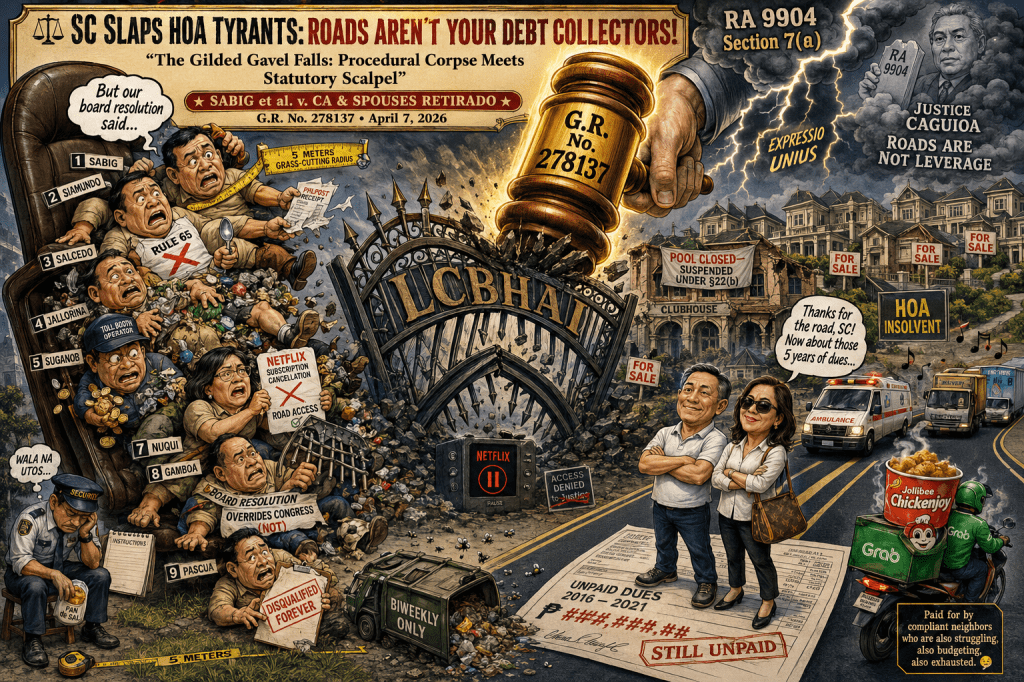
No more private toll roads in subdivisions—SC draws the line at RA 9904 and sends 9 officers packing
By Louis “Barok” C. Biraogo — June 25, 2026
SOME cases reshape constitutional doctrine. Others redefine property rights. And then there is Sabig, et al. v. Court of Appeals and Spouses Retirado (G.R. No. 278137)—a decision that does neither, yet somehow manages to expose the pathetic underbelly of Philippine suburban governance with the precision of a scalpel wielded by a stand-up comic.
The Supreme Court Third Division, through Associate Justice Alfredo Benjamin Caguioa, has declared what any reasonable person already knew: a homeowners’ association (HOA) cannot weaponize a subdivision gate against a delinquent member as if it were a medieval portcullis. Roads, the Court held, are not leverage. They are not collection tools. They are not optional amenities that a board of petty potentates can switch off like a Netflix subscription. The decision is a masterclass in statutory literalism, procedural carnage, and the quiet humiliation of nine individuals who apparently believed that a board resolution could override an act of Congress.
Let us dissect this farce—its heroes, its villains, its freeloaders, and the impending chaos it has unleashed upon every gated community from Bacolod to Baguio.
THE GILDED GAVEL FALLS: PROCEDURAL CORPSE MEETS STATUTORY SCALPEL
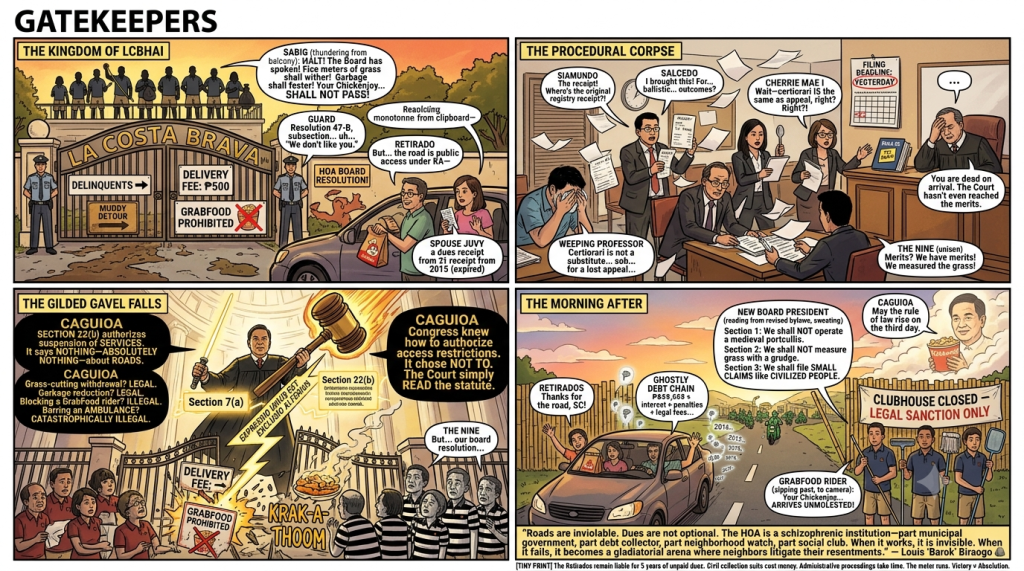
The case arrived at the Supreme Court already a procedural corpse. The nine officers of the La Costa Brava Homeowners’ Association Inc. (LCBHAI)—names I shall immortalize here for posterity: Sabig, Siamundo, Salcedo, Jallorina, Suganob, Cherrie Mae I, Nuqui, Gamboa, and Pascua—had already bungled their appeal before the Court of Appeals by serving the wrong party and failing to produce the original registry receipt. Let that sink in. A dispute involving constitutional dimensions of property access, worth millions in potential liability, was derailed by a missing Post Office stub. Somewhere, a remedial law professor weeps into their syllabus.
The officers compounded this incompetence by filing a Rule 65 petition for certiorari when the proper remedy was a Rule 45 appeal. This is the legal equivalent of bringing a spoon to a gunfight and then complaining about the ballistic outcome. The Supreme Court, in its infinite patience, explained that certiorari is not a substitute for a lost appeal—and even if one treated it charitably as a Rule 45 petition, it was late. The officers were dead on arrival, and the Court hadn’t even reached the merits.
But reach the merits it did, because the bench apparently wanted to leave a monument. Justice Caguioa’s ponencia performs a surgical dissection of Republic Act No. 9904 (Magna Carta for Homeowners and Homeowners’ Associations). Section 7(a) grants two distinct rights: (1) the right to basic community services and facilities, and (2) the right to use common areas, including subdivision roads. Section 22(b) authorizes suspension of the first right for delinquency. It says nothing—absolutely nothing—about the second. Expressio unius est exclusio alterius. The inclusion of one is the exclusion of the other. Congress knew how to authorize access restrictions; it chose not to. The Court simply read the statute.
The result: grass-cutting withdrawal? Legal. Garbage collection reduction? Legal. Blocking a GrabFood rider from delivering chickenjoy to a delinquent homeowner? Illegal. Barring an ambulance? Catastrophically illegal. The nine officers, in their infinite wisdom, had imposed all of these, plus mandatory fees on delivery trucks entering the subdivision—essentially operating a private toll road on property they did not own.
The Court’s substantive holding is elegant in its simplicity: roads are not a luxury. They are not a clubhouse pool. They are the means by which a residence remains livable. An HOA can starve you of amenities; it cannot starve you of existence.
DEVIL’S ADVOCATE VS. THE GAVEL: CLASH OVER THE RULING
For the Ruling: Textualism Slays the Gatekeeping Dragon
Let us first praise the Court for slaying a dragon that has terrorized Filipino subdivisions for decades. The gate-control racket is a known pathology: a board member with a personal grudge, a delinquent homeowner who dared criticize the annual budget, and suddenly the security guard has “instructions” to deny entry to visitors, delivery vans, and ride-hailing vehicles. It is extralegal debt collection dressed in the robes of community governance.
The textualist argument is unanswerable. RA 9904 was enacted in 2010 after extensive deliberation. If the legislature intended to grant HOAs the power to block road access, it would have inserted that language into Section 22(b) with the same clarity it used for services suspension. It did not. For the Court to read such a power into the statute would be judicial legislation of the most brazen kind.
There is also the safety dimension. The Court explicitly noted that the restrictions impaired “the delivery of basic necessities.” An HOA that blocks a GrabExpress rider is not collecting dues; it is engineering a slow-motion humanitarian crisis, one canceled order at a time. Multiply this by the tens of thousands of associations nationwide, and you have a recipe for preventable tragedy.
Against the Ruling: The Treasurers’ Nightmare and the Freeloader’s Paradise
Now let us entertain the howls of HOA treasurers across the archipelago, because their nightmare is real. The Retirado spouses owed dues from 2016 to 2021—five years of non-payment. Five years during which they continued to drive on association-maintained roads, benefit from security patrols funded by their neighbors, and enjoy property value appreciation subsidized by everyone else. This is not delinquency; this is parasitism elevated to a lifestyle.
The Court’s ruling effectively removes the only immediate, non-judicial leverage an HOA possesses against chronic non-payers. Filing a civil collection suit costs money. Administrative proceedings before the Human Settlements Adjudication Commission (HSAC) take time. Small claims actions require effort. Gate control, by contrast, was swift, free, and devastatingly effective. Now it is gone.
The free-rider problem is not theoretical. If paying members realize that non-payment carries no meaningful access consequences, compliance rates may crater. Associations with thin margins—which is most of them—face insolvency. The roads that the Court so zealously protected may eventually crumble because no one is left willing to pay for their upkeep. This is the tragedy of the commons, gated-community edition.
THE JESTER’S ANATOMY OF FOLLY: BOARD, FREELOADERS, AND THE COMING CARNIVAL
Petty Tyrants in Polo Shirts
The nine disqualified officers of LCBHAI deserve their own section in a textbook on how not to run an association. Their sanctions were not merely illegal; they were theatrical in their pettiness. Grass-cutting “within five meters of the couple’s property” was restricted unless neighbors requested it—a policy so absurdly specific it suggests someone paced out the distance with a measuring tape and a grudge. Garbage collection reduced to once every two weeks? In the Philippine climate? This is not governance; this is biological warfare.
The officers apparently believed that a board resolution could override a national statute. This is the legal equivalent of a barangay captain declaring his jurisdiction an independent republic. Their procedural blunders—serving the wrong party, misplacing a receipt, filing the wrong remedy—merely confirm what the substantive violations suggest: a board operating on pure, distilled incompetence, unburdened by legal counsel or basic rationality.
The permanent disqualification is the cherry on this sundae of disgrace. RA 9904 Section 23 imposes joint and several liability on officers who authorize violations, and the HSAC wielded it like a sledgehammer. The nine are now barred from holding office. Forever. Their names will appear in legal databases as the cautionary tale of how a dispute over association dues metastasized into career-ending infamy.
The Retirado Paradigm: Legal Victory Without Moral Absolution
But let us not canonize the Retirados prematurely. They owed five years of dues. Five years. This is not a family fallen on hard times who missed a quarter; this is sustained, strategic non-payment. Common experience shows that financial strain, low trust in governance, and weak transparency often fuel association delinquency—turning reluctant payers into strategic freeloaders. Perhaps. But the Retirados had the resources to litigate their case up to the Supreme Court—through the HSAC, the Court of Appeals, and finally the Third Division. This suggests resources that might have been deployed toward, say, paying their obligations.
The freeloader thrives in environments of procedural slowness and evidentiary chaos. When association records are sloppy, enforcement is inconsistent, and the board is more focused on gate theatrics than bookkeeping, the non-payer flourishes. The Retirados won a legal victory, but they remain liable for the debt. The new LCBHAI board will pursue them through civil channels, and the meter is still running on interest and penalties. The Court gave them their road; it did not give them a moral absolution.
The Carnival of Unintended Consequences
What happens next is a carnival of unintended consequences. Every delinquent homeowner in the Philippines now has a Supreme Court citation to wave at the security guard. HSAC will be inundated with copycat complaints. Associations will scramble to audit their by-laws, frantically deleting access-restriction clauses before their own officers face disqualification.
But human ingenuity in the service of pettiness is infinite. Watch for the workarounds: the “universal visitor registration” that just happens to be onerously slow for certain households; the clubhouse access suspension that renders a home unsellable; the sudden, selective enforcement of architectural guidelines. The Court closed the gate on one form of abuse; the boardroom Machiavellis are already sketching blueprints for the next.
THE CLUBHOUSE SERMON: ROADS INVIOLABLE, DUES NON-OPTIONAL
Here, dear reader, I must set aside the scalpel and speak plainly. The HOA is a schizophrenic institution. It is part municipal government, part debt collector, part neighborhood watch, part social club. When it works, it is invisible—roads maintained, garbage collected, security present. When it fails, it becomes a gladiatorial arena where neighbors litigate their resentments.
The Supreme Court has drawn a line. Roads are inviolable. This is correct as law and as policy. But the corollary must also be spoken: dues are not optional. The homeowner who expects pristine asphalt, vigilant guards, and well-lit streets while contributing nothing is not a rights-bearer; they are a thief of community labor.
Peace requires both sides to abandon their worst instincts. HOAs must abandon the extralegal thuggery of gate control and embrace the slower but lawful remedies of civil collection, statutory liens, and HSAC proceedings. Homeowners must recognize that community infrastructure is not a government entitlement; it is a cooperative enterprise funded by neighbors who are also struggling, also budgeting, also exhausted.
The vision is not utopian. It is the minimum condition for avoiding the next Sabig—the next board of disqualified officers, the next family blockaded behind a gate, the next decade of legal fees over a quarterly due that could have been settled with a conversation.
MANDAMUS FOR THE MASSES: REFORMS BEFORE THE NEXT SABIG
For Homeowners’ Associations
- Audit your by-laws immediately. Any provision that mentions access restriction, gate denial, or delivery prohibition for delinquency must be purged. The cost of non-compliance is permanent disqualification of officers.
- Shift to lawful sanctions. Suspend clubhouse access, pool privileges, and recreational facilities. These fall squarely within “basic community services” and are suspendable under Section 22(b) of RA 9904.
- Establish clear, transparent collection protocols. Issue formal demand letters. Maintain meticulous records. File small claims actions for sums within the jurisdictional threshold. Nothing terrifies a freeloader more than a well-organized paper trail.
- Train your board. Every officer should understand RA 9904, its Implementing Rules and Regulations, and the Sabig ruling. Ignorance is not a defense; it is a pre-existing condition.
For Homeowners
- Pay your dues. The Court protected your road access. It did not extinguish your debt. Civil liability persists, and the interest accrues while you celebrate your procedural victory.
- Engage before litigating. If financial hardship prevents payment, negotiate a payment plan with the board. Most associations would prefer partial payment over a legal war.
- Demand transparency. The best antidote to freeloading is a well-run association with open books. If you know where your money goes, you are less likely to resent paying it.
For Legislators
- Amend RA 9904 to create a statutory lien mechanism. Give associations the power to record a lien against delinquent properties, enforceable upon sale or transfer. This preserves collection leverage without resort to gate-blocking.
- Establish a fast-track administrative process for dues collection before HSAC. The current system is too slow; the temptation of self-help is directly proportional to the slowness of lawful remedies.
- Codify the Sabig holding. Eliminate any ambiguity by expressly stating in the statute that common area access may never be conditioned on dues payment.
The rule of law, like a well-maintained subdivision road, requires constant upkeep. The Supreme Court has repaved a stretch that had fallen into disrepair under the weight of HOA overreach. It is now up to associations and their members to drive on it without crashing into each other.
May the rule of law rise on the third day. And may your GrabFood arrive unmolested. 🪨
Key Citations
A. Legal & Official Sources
- Sabig, Reuben Mikhail P., et al. v. Court of Appeals (18th Division – Cebu City) and Spouses Linley and Juvy Retirado. G.R. No. 278137. 7 Apr. 2026. Supreme Court of the Philippines, https://sc.judiciary.gov.ph/278137-reuben-mikhail-p-sabig-et-al-vs-court-of-appeals-18th-division-cebu-city-and-spouses-linley-and-juvy-retirado/.
- Republic Act No. 9904. An Act Providing for a Magna Carta for Homeowners and Homeowners’ Associations, and for Other Purposes. 2010. https://lawphil.net/statutes/repacts/ra2010/ra_9904_2010.html.
- Supreme Court of the Philippines. 2019 Amendments to the 1997 Rules of Civil Procedure. A.M. No. 19-10-20-SC, effective 1 May 2020, lawphil.net/courts/rules/am_19-10-20-sc_2019.html.
- Department of Human Settlements and Urban Development. 2024 Revised Implementing Rules and Regulations of Republic Act No. 9904. Department Circular No. 2024-018. https://dhsud.gov.ph/wp-content/uploads/Laws_Issuances/05_Department_Circulars/2024/Department%20Circular%20No.%202024-018.pdf.
B. News Reports
- Lagunda, Kevin. “SC: Blocking road access over unpaid dues illegal.” SunStar Cebu, 21 June 2026, http://www.sunstar.com.ph/cebu/sc-blocking-road-access-over-unpaid-dues-illegal.d92c3b
- ₱9 Billion in ‘Savings’? DILG’s Fire Truck Deal Smells Like Smoke

- ₱8B BBM Pork: CCTV for Every Captain’s Kumpare?
- ₱8.9 Billion, 331 Ghost Police Stations: The TIKAS Scandal Explained

- ₱8.4 Billion, 42,000 Barangays, 1 Election: The “Bawat Barangay Makikinabang” Vote-Buying Masterclass

- ₱75 Million Heist: Cops Gone Full Bandit

- ₱63 to the Dollar: The Only Thing Falling Faster Than the Peso Is the Government’s Credibility

- ₱6.77B Ghost Haunts Duterte: RTC Dismisses Mans Carpio’s Desperate Plea
- ₱6.77 Billion and Zero Cash: The Sara Duterte SALN Math That Doesn’t Add Up

- ₱6.7-Trillion Temptation: The Great Pork Zombie Revival and the “Collegial” Vote-Buying Circus

- ₱58.53B, Zero Receipts: The LGSF Pork Barrel Nobody Wants to Name
- ₱53 Million Man Tells ₱695-a-Day Workers to Stop Being ‘Mayabang’: The Audacity of BSP’s Remolona
- ₱4.4 Billion and a Witness Who Can’t Explain It: The Duterte Impeachment’s Most Expensive Non-Answer





Leave a Reply