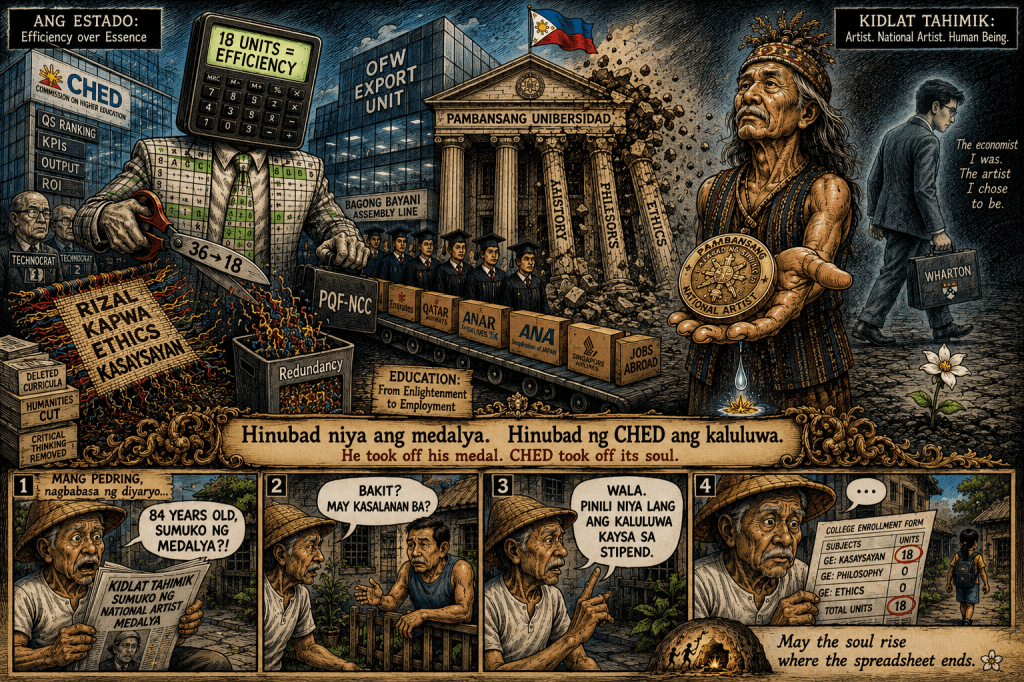
From Wharton Economist to National Artist Rebel: Kidlat Tahimik Rejects a Nation of “Bagong Bayanis” Without History
By Louis ‘Barok‘ C. Biraogo — June 24, 2026
THIS is a story about a medal and a spreadsheet, and how the spreadsheet is winning.
A Baguio Stage and a Hunger Strike for the Filipino Soul
Let’s start on a Baguio stage, where an 84-year-old man named Eric de Guia—a Wharton-trained economist turned filmmaker who reinvented himself as the icon Kidlat Tahimik—announced he was giving up his life’s highest honor. He held a National Artist medallion, a token of state gratitude forged by the Central Bank, and declared he would hand it back. Not because he had committed a crime. Not because he was ungrateful. But because he had concluded that the state that honored him no longer believes in what he stands for: a vision of education that produces citizens, not just workers.
Kidlat surrendered the medallion, his monthly stipend, his healthcare, and—in a detail of almost theatrical morbidity—his right to be buried at the Libingan ng mga Bayani. All of it. At 84, the man is essentially giving up the state’s promise to bury him as a hero because the state is busy burying the humanities. The operatic absurdity of this gesture should not obscure its deadly seriousness. This is a hunger strike for the Filipino soul.
The RGEC: Reframing or Intellectual Starvation?
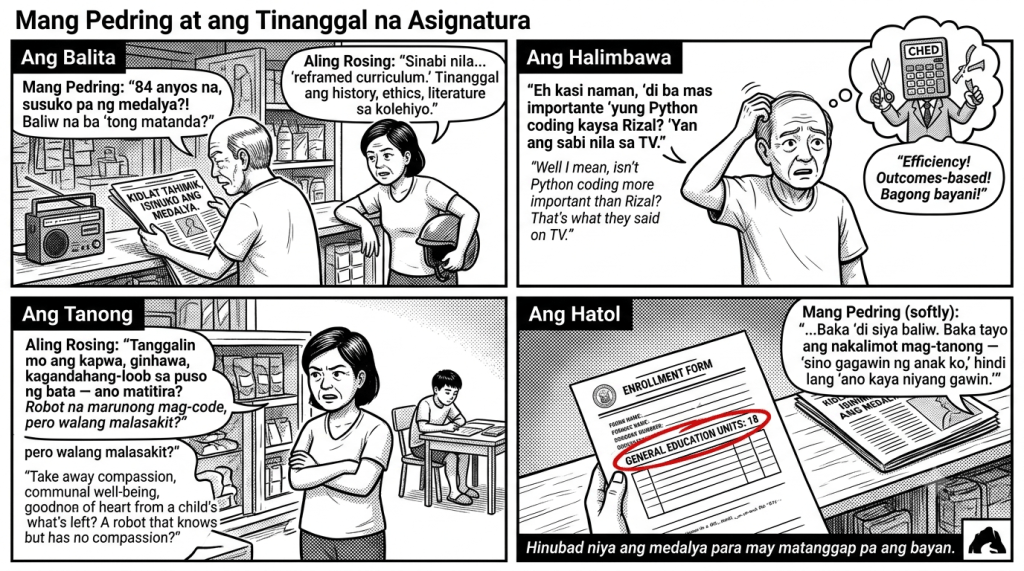
At the heart of this telenovela-meets-policy-seminar is a bureaucratic three-letter acronym that sounds like a sound effect for indigestion: the RGEC, or Reframed General Education Curriculum, a proposal from the Commission on Higher Education (CHED) to slash mandatory general education units in college from 36 to a skeletal floor of 18. CHED’s technocrats, no doubt armed with PowerPoint decks and the latest international benchmarks, call this “reframing.” Kidlat calls it what it is: the intellectual starvation diet of an export-oriented economy that views its youth as “bagong bayanis”—new heroes—only when they can wire back dollars.
Let us be clear about the stakes, because CHED’s cheerleaders certainly are. Their argument, polished to a high neoliberal gloss, is seductively logical. Why, they ask, should college students spend precious units on Philippine history, ethics, or literature when the K-12 curriculum has supposedly already covered this ground? Why force an engineering student to read Rizal when she could be mastering Python? This is not malice, they’d have you believe; it’s efficiency. The Philippine Qualifications Framework demands outcomes-based education. The global labor market demands specialists. The economy is ailing, and the remittances of skilled, export-ready graduates are the prescribed medicine. As one policy paper chillingly celebrates, the RGEC is about eliminating “curricular redundancy.”
This is the logic of the warehouse applied to the mind. It is an argument so bloodlessly econometric that it could only have been conceived by the very MBAs Kidlat skewers in his protest letter—the same tribe the younger Eric de Guia once belonged to before he fled the temple of quantification and found his soul behind a camera. The flaw isn’t just philosophical; it’s factual. The entire RGEC edifice rests on a single, catastrophic lie of omission: the assumption that K-12 has done its job. It hasn’t. DepEd has left tens of thousands of teaching positions vacant. Assessments persistently reveal weaknesses in reading, scientific literacy, and civic and historical understanding. CHED isn’t eliminating redundancy; it is blithely removing the last safety net for civic literacy from a basic education system that is a publicly documented catastrophe. As one academic analysis dryly notes, this assumption is “implicitly” baked into the policy. In reality, it’s a willful act of national self-harm disguised as reform.
What CHED Is Eager to Cut
And what is it that CHED is so eager to cut? Kidlat gives them names that sound foreign in the boardrooms of McKinsey but resonate in every barangay: pakikipag-kapwa (compassionate ethics), ginhawa (communal well-being), kapwa-kalikasan (harmony with nature), kagandang loob (spiritual balance). The RGEC frames these—explicitly—as a “waste of time.” Time that could be better spent mastering the skills that make a young Filipino a more attractive commodity for a foreign employer. The historical irony is so sharp it could draw blood: a nationalist artist, honored for his uniquely Filipino voice, is telling the state that its official policy treats Filipino consciousness itself as dead weight.
Legal Hubris and the Supreme Court Shadow
Kidlat’s critics will call his gesture symbolic. Of course it is. He knows he cannot legally erase a presidential proclamation by handing over a gold disc, just as CHED knows its own draft policy contains a legal tripwire. R.A. 7722, CHED’s own charter, empowers it to set minimum requirements for higher education. Yet the draft RGEC gleefully sets a 36-unit maximum cap—even for autonomous universities like Ateneo de Manila, whose own position paper points out this overreach. This is the bureaucrat’s hubris: not just to set a floor below which no university may sink, but to construct a ceiling above which no university may rise. It is a policy that treats the University of the Philippines’ intellectual ambition as a regulatory nuisance to be caged. Expect this to land in the Supreme Court, where the doctrine against ultra vires rule-making will make uncomfortable reading for CHED’s lawyers.
The Colonial Irony in the Age of AI
The deeper scandal is a failure of imagination that borders on the colonial. CHED claims it is following the “Western model” of specialization. But which West? Harvard, Yale, and the University of Chicago are currently fortifying their core humanities requirements, not gutting them, precisely because they recognize that an age of artificial intelligence and disinformation demands graduates who can think ethically, not just code efficiently. The irony—and with Kidlat Tahimik, there is always a cosmic irony—is that AI is making his case for him. If machines can perform the quantifiable, specialized, repetitive tasks, then the uniquely human, unquantifiable capacities cultivated by history, philosophy, and art become not ornamental, but existential. The Philippines, in its perpetual rush to mimic the West, is as always a decade late to the trend, feverishly dismantling the humanities at the very moment the real global leaders are rebuilding them.
CHED’s Choice: Tantrum or Gift?
So here we are. A genuine national treasure, a man who could have rested on a velvet cushion of state perks, has chosen to make himself a nuisance. He has weaponized his own honor. The Commission on Higher Education, led by Chair Shirley Agrupis, now faces a choice. It can hunker down, dismiss this as the quixotic tantrum of a filmmaker who doesn’t understand “modernization,” and march toward 2028 with a curriculum designed for a nation of obedient call-center agents and data encoders. Or it can recognize this moment for what it is: a gift. A forced pause. An opportunity to use the 2028 deferral not as a countdown to implementation, but as a genuine cooling-off period to build a policy that serves a republic, not a remittance ledger.
A Practical Compromise
The compromise is not complicated.
- Raise the floor to 24-30 units.
- Mandate an irreducible core of Philippine History, Ethics, and Literature that even the most algorithm-obsessed computer science student must take.
- Crucially, drop the insulting 36-unit cap on autonomous universities—stop legislating the maximum intellectual ambition of Filipino institutions.
- And most importantly, pull DepEd into the room and answer the question everyone is dodging: if K-12 is the foundation, why is the foundation riddled with cracks?
Kidlat Tahimik surrendered his medal. He should not have had to. It is a damning indictment of a nation’s priorities when its artists must choose between accepting honor from the state and defending the very soil of culture that makes art possible. The MBAs and econometrists in the room may see an unquantifiable waste of time. The rest of us, if we still know our history, will see a man who remembered that a nation’s heroes are not just those who bring back dollars. They are the ones who, with a gesture of magnificent, heartbreaking absurdity, demand that we slow down, apply the brakes, and ask not just “What can our students do?” but “Who will they become?”
Key Citations
A. News Articles
- Inquirer.net. “Kidlat Tahimik Gives Up Natl Artist Perks to Protest College Curriculum.” Inquirer.net, 2026. https://newsinfo.inquirer.net/2247499/kidlat-tahimik-gives-up-natl-artist-perks-to-protest-college-curriculum.
- Rappler. “Things to Know: CHED’s Proposed Reframed General Education Curriculum.” Rappler, May 2026. https://www.rappler.com/philippines/things-to-know-ched-proposed-reframed-general-education-curriculum-may-2026/.
- “The Future of the Liberal Arts Looks a Lot Like the Past.” The Harvard Crimson, 28 May 2026. https://www.thecrimson.com/article/2026/5/28/editorial-harvard-liberal-arts-future/.
B. Official Reports, Laws & Position Papers
- Ateneo de Manila University. “Ateneo de Manila University’s Comments on the CHEd Proposed Reframed GE Curriculum.” Ateneo.edu, May 2026. http://www.ateneo.edu/statement/2026/05/ched-reframed-ge-position-letter.
- Organisation for Economic Co-operation and Development. “PISA 2022 Results (Volume I and II) – Country Notes: Philippines.” OECD, 5 Dec. 2023. https://www.oecd.org/en/publications/pisa-2022-results-volume-i-and-ii-country-notes_ed6fbcc5-en/philippines_a0882a2d-en.html.
- Republic of the Philippines. “Republic Act No. 7722: An Act Creating the Commission on Higher Education.” Lawphil, 1994. https://lawphil.net/statutes/repacts/ra1994/ra_7722_1994.html.
- Republic of the Philippines. “Republic Act No. 10968: An Act Institutionalizing the Philippine Qualifications Framework (PQF), Establishing the PQF-National Coordinating Council (PQF-NCC) and Appropriating Funds Therefor.” Lawphil, 18 Jan. 2018, https://lawphil.net/statutes/repacts/ra2018/ra_10968_2018.html.
C. Additional Context
- Inquirer.net. “Over 32,000 New Teaching Positions Approved for SY 2026-2027 – DepEd.” Inquirer.net, May 2026. https://newsinfo.inquirer.net/2230723/over-32k-new-teaching-positions-approved-for-sy-2026-2027-deped.
- “Ang Hirap Maging Mahirap”: The PAO Scandal That Proves Government Contempt Is Nothing New

- “Far-Off” My Axx: Malacañang’s Claire Castro Drowns in Her Own Legal Gaslighting
- “Forthwith” to Farce: How the Senate is Killing Impeachment—And Why Enrile’s Right (Even If You Can’t Trust Him)
- “HINDI AKO NAG-RESIGN!”

- “I Know Nothing”: Baste Duterte’s Amnesia Defense Meets ₱33M in GenCorp Contracts

- “I’m calling you from my new Globe SIM. Send load!”

- “Mahiya Naman Kayo!” Marcos’ Anti-Corruption Vow Faces a Flood of Doubt

- “Manageable” Debt, Unmanageable Lies: DBM’s ₱21 Trillion Fairy Tale
- “Meow, I’m calling you from my new Globe SIM!”

- “Natrabaho”: One Word, One Ombudsman, and a Judiciary on Trial

- “No Special Jail for Crooks!” Boying Remulla Slams VIP Perks for Flood Scammers

- “Philippine-Controlled” or Yankee Gas Station? The Davao Fuel Depot Farce Exposed




Leave a Reply