From ₱100B Flood Scandal Resignation to Islamic Bank Throne — Delicadeza Never Looked So Fake
By Louis ‘Barok‘ C. Biraogo — July 14, 2026
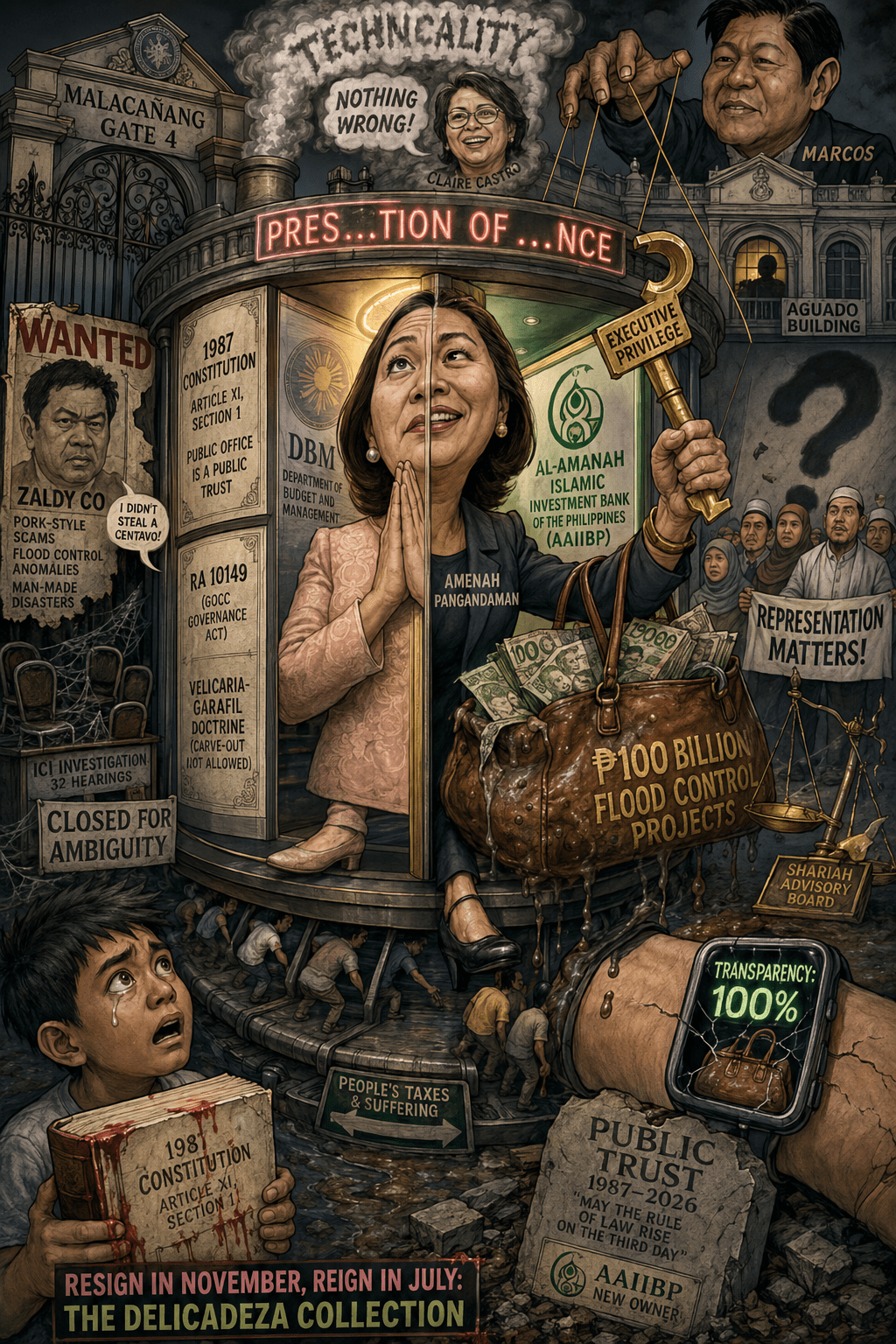
Let us cut straight to the bone about what happened on July 10, 2026. Amenah F. Pangandaman—who resigned as Budget Secretary eight months earlier because her name was dragged into the biggest corruption scandal since the pork barrel—was handed the chairmanship of Al-Amanah Islamic Investment Bank of the Philippines (AAIIBP). The same woman who, according to a former congressman, personally relayed President Marcos’ order to insert ₱100 billion in graft-tainted flood control projects into the national budget.
And now, delicadeza apparently means “I’ll take that GOCC post, thank you very much.”
The Legal Fig Leaf: A Presidential Masterpiece in Bad Faith
Let us first give the Palace its due. Their defense is a thing of beauty—a legal argument so pristine, so technically unassailable, that it achieves the impossible: it makes corruption look like due process.
Presidential Communications Office Undersecretary Claire Castro declared: “There is nothing wrong with appointing someone whom the President believes can do the job well.”
And legally speaking? She’s not wrong.
Pangandaman has not been charged with a crime. No Ombudsman finding of probable cause exists. Under Article III, Section 14(2) of the 1987 Constitution of the Republic of the Philippines (1987 Constitution), she enjoys the presumption of innocence—and technically, she’s not even an “accused,” so her constitutional armor is even thicker. The President’s appointing power under Article VII, Section 16 of the 1987 Constitution is plenary and discretionary. As the Supreme Court held in Velicaria-Garafil v. Office of the President, G.R. No. 203372, the choice of an appointee is “the heart of the power to appoint.”
Then there’s Republic Act No. 10149 (GOCC Governance Act of 2011). Its Fit and Proper Rule disqualifies a person only upon an adjudicated finding of administrative liability—not upon allegations that would make a lesser mortal unemployable at a 7-Eleven. No adjudication? No disqualification. Q.E.D.
The Palace has constructed a fortress of legal technicality. And from within its battlements, it invites us to admire the architecture while the treasury burns.
The Delicadeza Scam: Resigning Only to Return When Convenient
Here is where the satire writes itself, and the tragedy deepens.
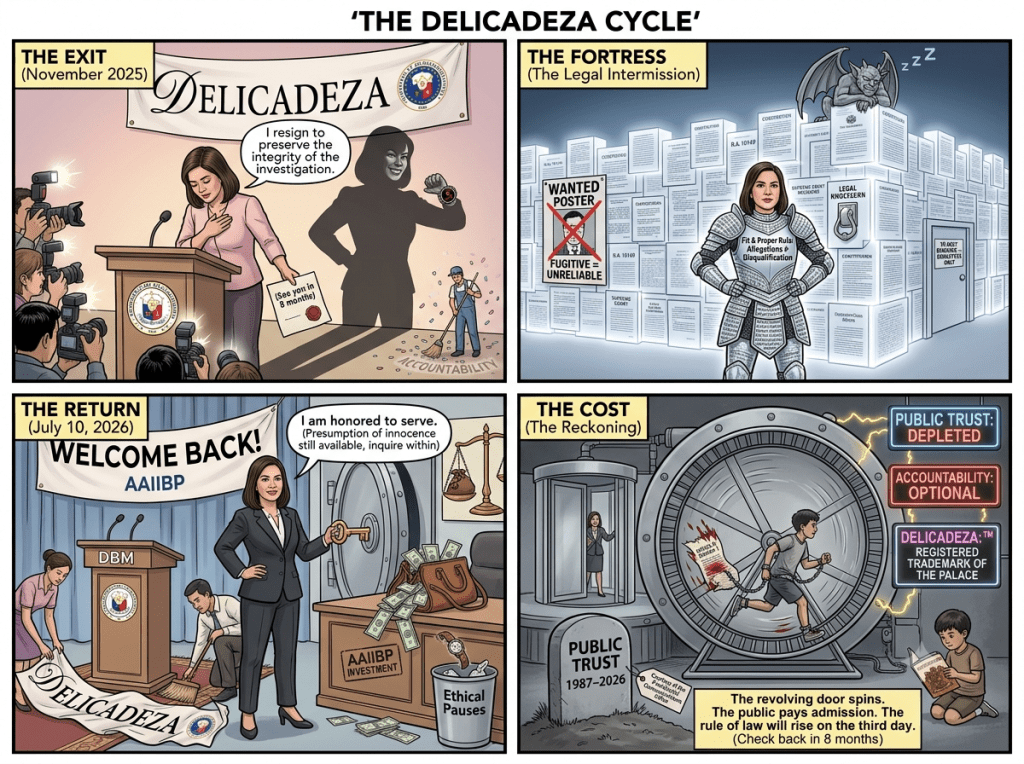
In November 2025, Pangandaman resigned “out of delicadeza”—that unwritten Filipino ethical norm demanding public officials avoid even the appearance of impropriety. The resignation was explicitly framed not as an admission of guilt, but as a courtesy to allow investigations to proceed unimpeded.
But what is delicadeza in reverse? If one resigns to preserve the integrity of an investigation, what does it mean to accept a new government post while that same investigation remains unresolved? It means delicadeza was never a principle; it was a pause button. Pangandaman stepped out of the Department of Budget and Management (DBM)’s back door only to re-enter through AAIIBP’s front lobby, waving her presumption of innocence like a Get Out of Accountability Free card.
The Palace insists the appointment “does not mean that Marcos has already absolved her.” This is sophistry. An appointment is a form of absolution—material, if not legal. It says: “We trust you with a state-owned bank’s governance even as you remain entangled in the factual matrix of the country’s largest corruption scandal.” The message to every public official watching: resign when the cameras are rolling, lie low for a few months, and a GOCC post will be waiting.
The Phantom Investigation and the Fugitive’s Paradox
Now we must confront the inconvenient ghost at this feast: Zaldy Co.
The former congressman is the central witness against Pangandaman. His account is lurid and specific: a phone call from Pangandaman relaying the President’s order; a meeting at the Aguado Building across Malacañang’s Gate 4; a list of projects drawn from a brown leather bag Co recognized as Marcos’ from the 2022 Singapore trip; and ₱100 billion in insertions that followed.
But Co is a fugitive. The Sandiganbayan declared him one in December 2025. He faces a ₱289.5-million ghost project case. Anti-Money Laundering Council (AMLC) investigators testified he personally received roughly ₱802 million in transactions tied to his family’s construction firm. His graft case has been archived. His last known whereabouts: France.
This makes Co a catastrophically compromised accuser. His allegations against Pangandaman are the uncorroborated, largely hearsay account of a man with every incentive to spread culpability upward—to recast himself as a mere errand boy rather than the central alleged beneficiary of a ghost project empire.
The Palace has weaponized this weakness brilliantly. “Look at the source!” they cry. “A fugitive! A liar!”
And they are right. Co’s credibility is a smoking crater.
But here is the question that cuts through the Palace’s triumphant deflection: If the allegations are so baseless, and the accuser so demonstrably unreliable, why has no independent investigation definitively cleared Pangandaman?
The Independent Commission for Infrastructure (ICI)—created by Marcos himself via Executive Order No. 94 (Creating the Independent Commission for Infrastructure)—held 32 hearings involving 36 witnesses. It referred nine cases covering 65 individuals to the Ombudsman and the Department of Justice (DOJ). Those referrals named sitting and former lawmakers. But where is the Pangandaman referral? Where is the formal finding that her alleged role was too insubstantial to pursue?
The answer: it doesn’t exist. What we have instead is an investigative vacuum—a deliberate, carefully maintained ambiguity. The Ombudsman has not cleared her. The Ombudsman has not charged her. She floats in a legally constructed limbo where the absence of a case is treated as the equivalent of innocence, and the failure to investigate is repackaged as vindication by default.
This is not due process. This is due process as a shield against ever having to undergo due process.
The Competence Smokescreen: So She’s Good at Budgeting—Whose Budget?
Ah, but Pangandaman is a competent technocrat, her defenders cry. The New Government Procurement Act! The Philippine Open Government Partnership! Blockchain-enabled budget tracking! The 2023 Open Budget Survey, where the Philippines ranked first in Asia!
This is all true. But competence in public financial management is not a moral quality. It is a technical skill, morally neutral, like knowing how to drive a getaway car. The question is not whether Pangandaman knows how to manage a budget. The question is whether she allegedly used that expertise to facilitate the insertion of ₱100 billion in graft-tainted projects at the direction of her political patrons.
A blockchain budget tracker does not retroactively sanitize a brown leather bag full of insertions. The same hands that allegedly passed along the order to loot the treasury also built the digital systems to track the loot. This is not integrity; this is the aesthetic of reform without its substance—a Potemkin village of fiscal transparency, behind which the old machinery of plunder continues to hum.
Article XI, Section 1: The Constitutional Standard the Palace Forgot
Now we arrive at the crux. Article XI, Section 1 of the 1987 Constitution declares: “Public office is a public trust. Public officers and employees must at all times be accountable to the people, serve them with utmost responsibility, integrity, loyalty, and efficiency.”
This is not a criminal statute. It is a constitutional command that exists independent of the Penal Code. It does not require a conviction, an indictment, or even a formal charge to be violated. It requires only that a public officer’s conduct has fallen short of “utmost responsibility” and “integrity” in a manner that erodes public trust.
By this standard—the highest in the Philippine legal order—the Pangandaman appointment is an abomination.
When a Cabinet secretary resigns amid allegations of facilitating a ₱100-billion budget insertion scheme, and then resurfaces as CEO of a state bank, the public trust is not just damaged; it is openly mocked. The message: the Constitution’s lofty rhetoric about accountability is precisely that—rhetoric. Window dressing for a system in which the powerful protect their own, and “public trust” is a phrase reserved for commencement speeches and plaque unveilings.
The burden of proof for a criminal conviction is beyond reasonable doubt. The burden for a public appointment should be something closer to “will this appointment strengthen or corrode the public’s faith in their institutions?”
The Pangandaman appointment fails that test spectacularly.
The Muslim Community Shield: A Legitimate Hope, Cynically Weaponized
There is one genuinely positive dimension here. Sulu Governor Sakur Tan and the National Commission on Muslim Filipinos have welcomed Pangandaman’s elevation to AAIIBP. For them, this is a milestone: a Muslim Filipina technocrat with genuine fiscal expertise leading the country’s only Islamic bank, an institution charged with serving a historically marginalized community.
This support is neither naive nor corrupt. But here is the tragedy: the Palace is using this genuine aspiration as a human shield.
The question of Pangandaman’s fitness is not answered by her religious affiliation. The Muslim community deserves a leader for its Islamic bank whose integrity is beyond reproach—not one whose appointment forces them to choose between celebrating representation and condoning impunity. An Islamic bank governed by Shariah principles emphasizing ethical finance and transparency is now to be led by a figure whose public standing is shrouded in precisely the kind of unresolved moral hazard that Islamic finance exists to prevent. One wonders what the bank’s Shariah advisory board makes of this.
The Revolving Door as Institutional Rot
Zoom out, and the picture darkens. This appointment is a symptom of systemic pathology.
The Philippine government has a revolving door. Officials implicated in scandal resign “out of delicadeza,” spend a few months waiting by the phone, and then resurface in GOCC posts, regulatory agencies, or diplomatic assignments. The GOCC sector—with its generous compensation packages and relative obscurity—is the preferred landing zone.
This is how impunity becomes institutionalized. Each appointment normalizes the previous one. Each defense—”no case has been filed,” “the President has discretion”—becomes precedent. Over time, the public ceases to be outraged, not because the appointments have become defensible, but because fatigue sets in.
The deterrent value of the entire anti-corruption architecture depends on the perception that being named in a scandal carries consequences. If the consequence is an eight-month vacation followed by a bank chairmanship, what lesson has been taught?
What Is To Be Done?
The Kweba ni Barok does not merely diagnose rot; it prescribes.
First, Congress must amend Republic Act No. 10149 (GOCC Governance Act of 2011). The Fit and Proper Rule must explicitly disqualify any person subject to a pending formal investigation for a grave offense related to their prior public office. The current rule is a loophole factory, and the Pangandaman appointment is the proof of concept.
Second, the Ombudsman and the Department of Justice (DOJ) must resolve the limbo. If there is evidence, file it. If there is not, say so—and explain why. The current state of affairs—no charges, no clearance, just a fugitive’s uncorroborated account—is corrosive to public confidence.
Third, Amenah Pangandaman herself must act. If her integrity is more than a legal presumption, she should formally and publicly waive any claim to executive privilege or bank secrecy with respect to the flood control insertions. She should invite the Ombudsman to examine every relevant document. Her silence is not innocence; it is a strategy.
Fourth, the President must be held to his own words. Marcos called the flood control scandal “disturbing.” He created the ICI. He promised accountability. Appointing one of the scandal’s central figures before the ICI’s work is complete is not accountability; it is preemptive rehabilitation.
The Stress Test: What Kind of Country Are We?
Ultimately, the Pangandaman appointment is not about Amenah Pangandaman. It is about us.
It is a stress test of the Philippine state’s capacity to distinguish between legality and legitimacy, between formal compliance and substantive integrity, between the letter of the law and the spirit of public trust.
A country that permits an official named in a billion-peso corruption scandal to resurface as CEO of a state bank is a country that has abandoned the pretense of accountability. It is a country where public office is not a trust but a franchise—revocable only by electoral defeat, and even then, not really.
This is the Philippines the Marcos administration is building: a Philippines where the powerful are recycled, where delicadeza is a performance rather than a principle, and where the youth are told—by the example of their leaders—that integrity is optional and corruption carries no lasting stigma.
We demand better. We demand that the Marcos administration select officials for proven integrity, not political loyalty. We demand a Philippines where the rule of law is not a punchline, and where the brown leather bag does not have the last word.
The youth are watching. The institutions are trembling. The public trust is bleeding out.
May the rule of law rise on the third day. 🪦
Key Citations
A. Legal & Official Sources
- The 1987 Constitution of the Republic of the Philippines. Official Gazette of the Republic of the Philippines, 1987, http://www.officialgazette.gov.ph/constitutions/1987-constitution/.
- Republic Act No. 10149. An Act to Promote Financial Viability and Fiscal Discipline in Government-Owned or -Controlled Corporations and to Strengthen the Role of the State in Its Governance and Management to Make Them More Responsive to the Needs of Public Interest and for Other Purposes. 6 June 2011. Official Gazette, http://www.officialgazette.gov.ph/2011/06/06/republic-act-no-10149/.
- Executive Order No. 94. Creating the Independent Commission for Infrastructure. 11 Sept. 2025. Wikisource, en.wikisource.org/wiki/Executive_Order_No.94(Bongbong_Marcos).
- Velicaria-Garafil v. Office of the President. G.R. No. 203372. Supreme Court of the Philippines, 16 June 2015. jur.ph, jur.ph/jurisprudence/velicaria-garafil-v-office-of-the-president.
B. News Reports
- Cabalza, Dexter. “Can Amenah Pangandaman Continue Reforms in PH’s Sole Islamic Bank?” Inquirer.net, 13 July 2026, newsinfo.inquirer.net/2262443/can-amenah-pangandaman-continue-reforms-in-phs-sole-islamic-bank.
- Cabalza, Dexter. “Palace Defends Pangandaman Appointment.” Inquirer.net, 14 July 2026, newsinfo.inquirer.net/2263154/palace-defends-pangandaman-appointment.
- ₱8B BBM Pork: CCTV for Every Captain’s Kumpare?

- ₱8.9 Billion, 331 Ghost Police Stations: The TIKAS Scandal Explained

- ₱8.4 Billion, 42,000 Barangays, 1 Election: The “Bawat Barangay Makikinabang” Vote-Buying Masterclass

- ₱75 Million Heist: Cops Gone Full Bandit

- ₱6.77B Ghost Haunts Duterte: RTC Dismisses Mans Carpio’s Desperate Plea

- ₱6.77 Billion and Zero Cash: The Sara Duterte SALN Math That Doesn’t Add Up

- ₱6.7-Trillion Temptation: The Great Pork Zombie Revival and the “Collegial” Vote-Buying Circus

- ₱58.53B, Zero Receipts: The LGSF Pork Barrel Nobody Wants to Name
- ₱53 Million Man Tells ₱695-a-Day Workers to Stop Being ‘Mayabang’: The Audacity of BSP’s Remolona
- ₱4.4 Billion and a Witness Who Can’t Explain It: The Duterte Impeachment’s Most Expensive Non-Answer
- ₱3.06 Billion for Evacuation Centers—But Nobody Knows Where They’ll Stand (Or If They’ll Exist)
- ₱16 Billion, 280 Accounts, 8 Helicopters: Boying Remulla’s Case Against the Yaps Is Not a Drill







Leave a comment