A Vice Mayor Screamed ‘Thieves.’ The DILG Secretary Screamed ‘Addict.’ Only One of Them Took a Drug Test.
By Louis ‘Barok‘ C. Biraogo — October 7, 2016
LET me tell you what I love about Philippine politics. It’s not the policy. It’s not the governance. It’s the sheer, unadulterated theater of it all.
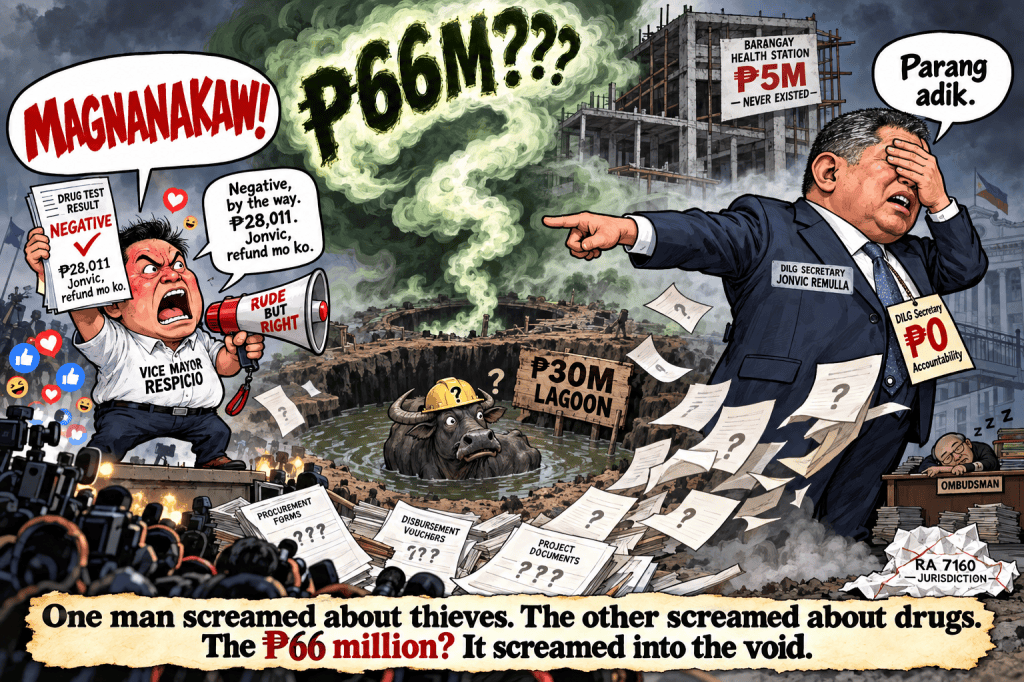
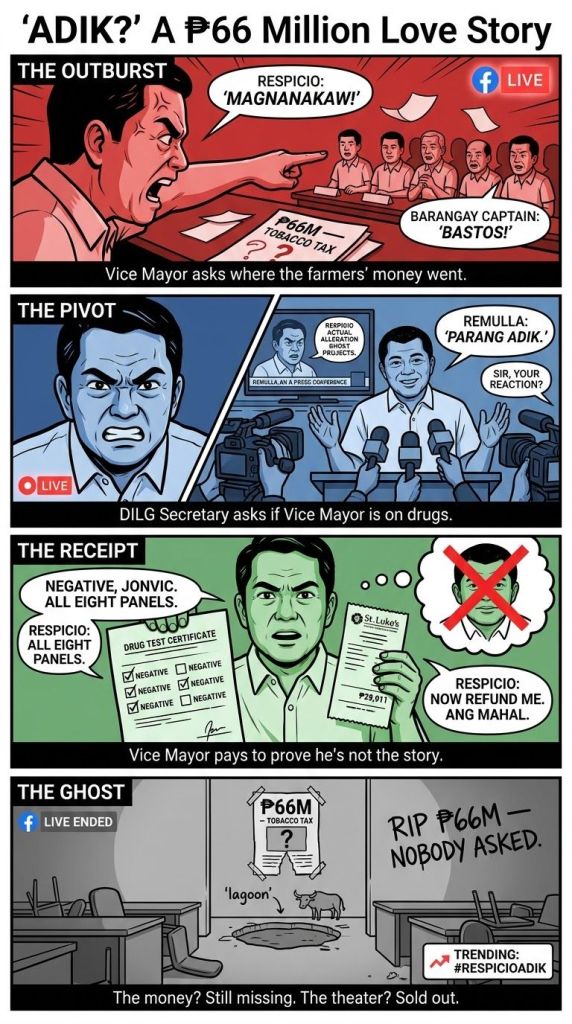
Case in point: Reina Mercedes, Isabela Vice Mayor Jeryll Harold Respicio. A man who, by all accounts, is a lawyer and a CPA—so presumably not an idiot—decided to spend his Monday morning screaming at barangay captains over ₱66 million in tobacco excise taxes. He called them “magnanakaw” (thieves). They called him “bastos” (rude). There was profanity. There was a police intervention. And because it’s 2026, it was all livestreamed on Facebook for the world to enjoy.
The video went viral. The Internet did its thing.
But here’s where the story gets interesting.
Interior Secretary Jonvic Remulla—who, to be fair, has never met a camera he didn’t like—weighed in. He called Respicio’s conduct “inexcusable.” He said it was “a sad day for local government.” And then, in a moment of rhetorical restraint that would make a carnival barker blush, he suggested Respicio should undergo a drug test because “parang adik” (he seems like an addict).
Yes. The Interior Secretary of the Philippines, a man whose job includes overseeing local government units, publicly speculated—without evidence, without a medical degree, without anything resembling due process—that an elected official might be on drugs because he shouted during a meeting.
Let that sink in.
The Substance Nobody Wants to Discuss
Here’s what actually happened before the name-calling started.
Respicio was questioning barangay officials about ₱66 million in tobacco excise tax funds. These are not discretionary funds. They’re earmarked under Republic Act No. 8240 (Tobacco Excise Tax Law) for programs benefiting tobacco farmers—livelihood projects, cooperative development, infrastructure. The money is supposed to go to farmers, not to “ghost projects” that exist only on paper.
Respicio raised a very specific, very checkable allegation: a ₱5-million barangay health station in Banquero that appeared in the previous year’s appropriation but was never built. He also flagged a ₱30-million lagoon project where, according to him, all you can see is a hole with a carabao standing in it.
Now, you can call Respicio rude. You can call him theatrical. You can even call him a showboat. But here’s what you cannot call him: wrong without checking.
Because if those projects don’t exist, and the money was appropriated anyway, that’s not a decorum issue. That’s malversation. That’s graft. That’s the kind of thing the Office of the Ombudsman exists to investigate.
And yet, somehow, the national conversation became about whether Respicio is on drugs.
The Drug Test Nobody Asked For
Let’s dissect Remulla’s logic, shall we?
- Step 1: Local official shouts during a meeting.
- Step 2: Therefore, he must be on drugs.
- Step 3: Publicly announce this theory to reporters.
- Step 4: ???
- Step 5: Governance.
This is not just legally problematic. It’s profoundly stupid as political strategy. Under Republic Act No. 9165 (Comprehensive Dangerous Drugs Act of 2002), drug testing of public officials is governed by specific procedures. You don’t get to just declare someone an addict because they were loud.
But here’s the beautiful part: Respicio actually did it.
He went to St. Luke’s Medical Center, paid ₱28,011 out of his own pocket, and took the drug test. Then he challenged Remulla to do the same. “Jonvic, i-refund mo ko,” he said. “Ang mahal ng drug test.”
The results came back negative—for methamphetamine, THC, cocaine, ecstasy, benzodiazepines, opiates, propoxyphene, and tricyclic antidepressants.
I have to hand it to the guy. That’s a masterclass in turning a smear into a spectacle. Remulla tried to brand him a drug addict. Respicio responded by getting tested, proving him wrong, and demanding the Secretary either put up or shut up.
The drug test results weren’t just negative. They were humiliating for Remulla.
The Man, the Myth, the Serial Controversy
Now, let’s be clear: Respicio is not some innocent lamb.
This is a man who, in February 2025, claimed on social media that he could manipulate vote-counting machines. The Commission on Elections (COMELEC) filed cyber libel charges under Article 154 of Act No. 3815 (Revised Penal Code) in relation to Section 6 of Republic Act No. 10175 (Cybercrime Prevention Act of 2012). He surrendered, posted bail, and was later proclaimed vice mayor anyway.
In May 2026, the Cybercrime Investigation and Coordinating Center (CICC) filed complaints against him for allegedly inciting sedition and rebellion over posts asking followers if they were willing to start a revolution against the government.
So when Remulla looks at Respicio and sees a pattern of attention-seeking provocation, he’s not entirely wrong. The man has a brand, and that brand is “I say inflammatory things on social media.”
But here’s the thing: having a brand doesn’t mean you’re wrong.
And the substance of what Respicio was raising—missing tobacco excise tax projects—deserves investigation regardless of whether the messenger is a saint or a serial provocateur.
The Jurisdiction Problem Remulla Should Know About
Here’s where the legal analysis gets fun.
Secretary Remulla announced he was “leaving it to Governor Albano” to handle the Respicio matter. That’s actually a smart retreat, because if he’d tried to directly discipline Respicio himself, he’d have walked into a jurisdictional minefield.
Under Republic Act No. 7160 (Local Government Code of 1991), the disciplinary authority for a municipal vice mayor is the Sangguniang Panlalawigan (Provincial Board), not the Department of the Interior and Local Government (DILG) Secretary. The DILG can investigate as part of its general supervisory function, but it cannot simply impose discipline on an elected municipal official.
Remulla, to his credit, seems to have recognized this. But not before publicly speculating that Respicio was a drug addict.
The Fiscal Elephant in the Room
Let’s talk about the ₱66 million.
According to reports, Mayor Malou Respicio-Saguban defended the use of the funds, saying allocations complied with legal guidelines and supported “long-term investments”.
“Long-term investments.” That’s a lovely phrase. It can mean anything. It can mean a hospital that actually exists. It can also mean a “lagoon” that’s just a hole with a carabao in it.
The question investigators should be asking is embarrassingly simple: Where is the money?
Not rhetorically. Actually.
For each peso of that ₱66 million:
- Was there an appropriation ordinance?
- Was there a procurement process?
- Was there a contract?
- Was there a disbursement?
- Was there a project?
- Does the project exist?
- If it exists, does it function?
- If it doesn’t exist, who signed off on it?
These are not hard questions. They’re just tedious. And tedious is the enemy of viral politics.
The Irony That Should Offend Everyone
Here’s what makes this whole circus so frustrating.
Respicio is being criticized for publicly accusing people of being thieves without proof. Fair enough. Calling someone “magnanakaw” in a livestreamed session is not exactly parliamentary procedure.
But Remulla responded by publicly accusing Respicio of being a drug addict without proof. That’s not just ironic. It’s structurally identical. Both men used their platforms to make unsubstantiated allegations against another public official.
The difference is that Remulla holds a national position and has the machinery of the DILG behind him. When he says “parang adik,” it carries more weight than a vice mayor’s shouted insult.
If the standard is “public officials shouldn’t make baseless accusations,” then Remulla failed his own test.
The Real Question: Will Anyone Check the Money?
The most likely outcome of this controversy is that it fades away. Respicio will continue being Respicio. Remulla will move on to the next viral moment. The barangay captains will go back to their barangays.
And the ₱66 million? It will remain unaudited, unexplained, and conveniently forgotten.
Unless someone—the Ombudsman, the Commission on Audit (COA), the provincial board, anyone—actually looks.
Respicio’s conduct was not admirable. He shouted. He insulted. He made the session a spectacle. But his question was legitimate: where did the tobacco farmers’ money go?
If the investigation only focuses on whether Respicio was rude—or whether he’s on drugs—then we’ve learned nothing. We’ve simply punished the messenger and ignored the message.
And that, my friends, is exactly how ghost projects survive.
The Barok Verdict
Respicio: Loud, theatrical, and possibly reckless. But he asked the right question.
Remulla: Politically tone-deaf and legally sloppy. The drug-test comment was beneath his office.
The barangay officials: Defensive, but the burden is on them to prove the projects exist.
The ₱66 million: Still missing. Still unaccounted for. Still the only thing that actually matters.
Audit the pesos. Investigate the conduct. But for the love of everything holy, don’t let the shouting match become the story.
Because the story should be about the money. Not about who called whom an addict.
Louis ‘Barok’ C. Biraogo is a lawyer in an alternate universe. In this one, he just writes about law, politics, and the absurd theater they produce. He blogs at Kweba ni Barok.
Key Citations
A. Legal & Official Sources
- Republic Act No. 7160. An Act Providing for a Local Government Code of 1991. Official Gazette of the Republic of the Philippines, 1991, http://www.officialgazette.gov.ph/1991/10/10/republic-act-no-7160/.
- Republic Act No. 8240. An Act Amending Sections 138, 139, 140 and 142 of the National Internal Revenue Code, as Amended, and for Other Purposes. 1996, lawphil.net/statutes/repacts/ra1996/ra_8240_1996.html.
- Republic Act No. 9165. Comprehensive Dangerous Drugs Act of 2002. Official Gazette of the Republic of the Philippines, 2002, http://www.officialgazette.gov.ph/2002/06/07/republic-act-no-9165/.
- Republic Act No. 10175. Cybercrime Prevention Act of 2012. Official Gazette of the Republic of the Philippines, 2012, http://www.officialgazette.gov.ph/2012/09/12/republic-act-no-10175/.
- Republic Act No. 3019. Anti-Graft and Corrupt Practices Act. Official Gazette of the Republic of the Philippines, 1960, http://www.officialgazette.gov.ph/1960/08/17/republic-act-no-3019/.
- Act No. 3815. The Revised Penal Code of the Philippines. 1930, lawphil.net/statutes/acts/act1930/act_3815_1930.html.
B. News Reports
- Visaya, Villamor, Jr. “Alleged Anomalous Tobacco Tax Use Sparks Heated Exchange in Isabela.” Inquirer.net, 5 Oct. 2026, newsinfo.inquirer.net/2317610/alleged-anomalous-tobacco-tax-use-sparks-heated-exchange-in-isabela.
- Tupas, Emmanuel. “Vice Mayor Probed for Outburst during Session.” Philstar.com, 7 Oct. 2026, http://www.philstar.com/nation/2026/10/07/2561393/vice-mayor-probed-outburst-during-session.
- Ramos, Martin. “Panoorin: ‘Parang Nakasinghot’ — Jonvic sa Paninigaw ni Respicio.” Pilipino Star Ngayon, 7 Oct. 2026, http://www.philstar.com/pilipino-star-ngayon/bansa/2026/10/07/2561553/panoorin-parang-nakasinghot-jonvic-sa-paninigaw-ni-respicio.
- “Respicio Undergoes Drug Test, Challenge Remulla to Refund His Expenses.” Daily Tribune, 7 Oct. 2026, tribune.net.ph/2026/10/07/respicio-undergoes-drug-test-challenge-remulla-to-refund-his-expenses.
- Rita, Joviland. “Respicio Drug Test Result: Negative.” GMA News Online, 7 Oct. 2026, http://www.gmanetwork.com/news/topstories/nation/1005076/respicio-drug-test-result-negative/story/.
- Abad, Michell. “Comelec Sues Vice Mayoral Bet Jeryll Harold Respicio over Video Claiming Ability to Manipulate VCMs.” Rappler, 28 Feb. 2025, http://www.rappler.com/philippines/elections/comelec-sues-vice-mayoral-bet-jeryll-harold-respicio-video-claiming-ability-manipulate-vcms/.
- “Cybercrime Body Sues Lawyer over Online Posts.” Inquirer.net, 22 May 2026, newsinfo.inquirer.net/2233048/cybercrime-body-sues-lawyer-over-online-posts.
- “‘Kalabaw ang Nakikita Ninyo sa Butas’: Respicio Flags P30M ‘Ghost’ Lagoon Project in Isabela Town.” POLITIKO, 7 Oct. 2026, politiko.com.ph/kalabaw-ang-nakikita-ninyo-sa-butas-respicio-flags-p30m-ghost-lagoon-project-in-isabela-town/.
- ₱9 Billion in ‘Savings’? DILG’s Fire Truck Deal Smells Like Smoke
- ₱8B BBM Pork: CCTV for Every Captain’s Kumpare?
- ₱8.9 Billion, 331 Ghost Police Stations: The TIKAS Scandal Explained

- ₱8.4 Billion, 42,000 Barangays, 1 Election: The “Bawat Barangay Makikinabang” Vote-Buying Masterclass
- ₱75 Million Heist: Cops Gone Full Bandit

- ₱63 to the Dollar: The Only Thing Falling Faster Than the Peso Is the Government’s Credibility
- ₱6.77B Ghost Haunts Duterte: RTC Dismisses Mans Carpio’s Desperate Plea
- ₱6.77 Billion and Zero Cash: The Sara Duterte SALN Math That Doesn’t Add Up

- ₱6.7-Trillion Temptation: The Great Pork Zombie Revival and the “Collegial” Vote-Buying Circus

- ₱58.53B, Zero Receipts: The LGSF Pork Barrel Nobody Wants to Name
- ₱53 Million Man Tells ₱695-a-Day Workers to Stop Being ‘Mayabang’: The Audacity of BSP’s Remolona
- ₱4.4 Billion and a Witness Who Can’t Explain It: The Duterte Impeachment’s Most Expensive Non-Answer



Leave a Reply