They Walked Out on the Threshold Vote—Now They Want the Supreme Court to Save It
Louis “Barok” C. Biraogo — October 8, 2026
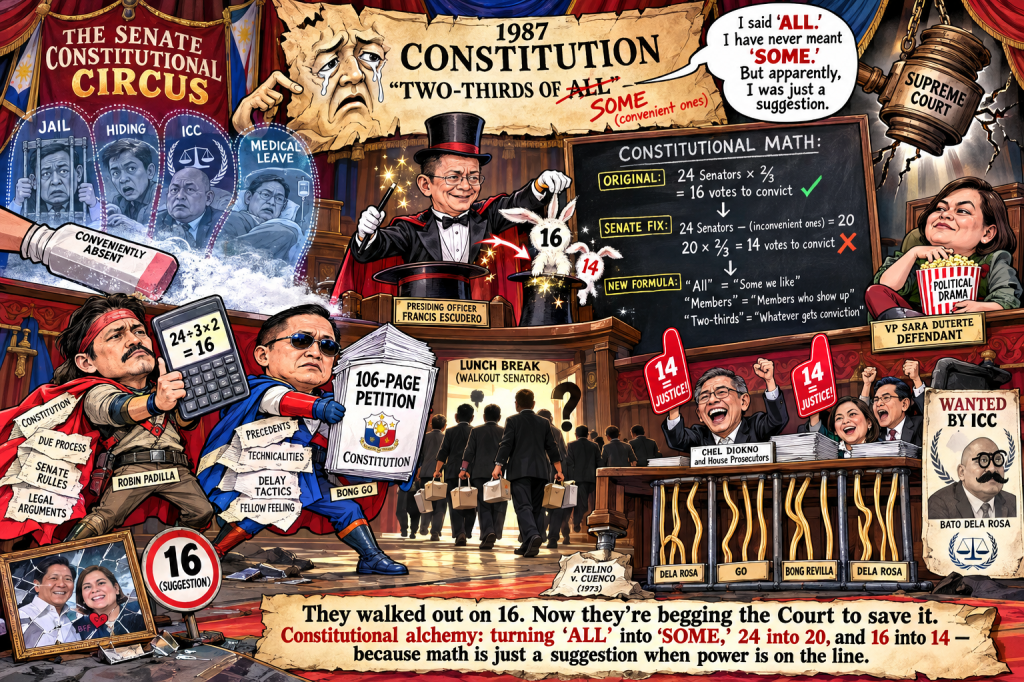
I Have spent the better part of three weeks watching the Philippine Senate perform what can only be described as constitutional alchemy—transforming the word “all” into “some,” converting 24 into 20, and somehow arriving at 14 when the arithmetic textbook clearly says 16.
And now, Senators Robinhood Padilla and Bong Go—two men whose combined legal expertise could charitably be described as “aspirational”—have filed a 106-page petition asking the Supreme Court of the Philippines (Supreme Court) to restore the constitutional text that the Senate impeachment court spent 64 days pretending didn’t exist.
This is either the most important constitutional case of the decade or the most elaborate political theater since Ferdinand Marcos Jr. and Sara Duterte pretended to like each other during the 2022 campaign. Possibly both. Probably both.
Let me be clear about what’s happening here: The Senate impeachment court, having failed to convict Vice President Sara Duterte through the normal presentation of evidence, has now resorted to a more elegant strategy—changing the definition of conviction itself. It’s not that the prosecution can’t secure 16 votes; it’s that the Senate has decided 16 was always a suggestion, not a requirement. Like the speed limit. Or the constitutional prohibition on political dynasties.
The September 23 ruling, adopted 13-1 with six abstentions (because nothing says “constitutional courage” like abstaining), effectively rewrote Article XI, Section 3(6) of the 1987 Constitution of the Republic of the Philippines to read:
“No person shall be convicted without the concurrence of two-thirds of all the Members of the Senate we deem capable of participating, minus anyone who is detained, hiding, on medical leave, or otherwise inconvenient to the prosecution’s vote count”.
That’s not a constitutional interpretation. That’s a constitutional hostage situation.
The Arithmetic of Constitutional Fraud
Let me walk you through the math, because someone clearly needs to.
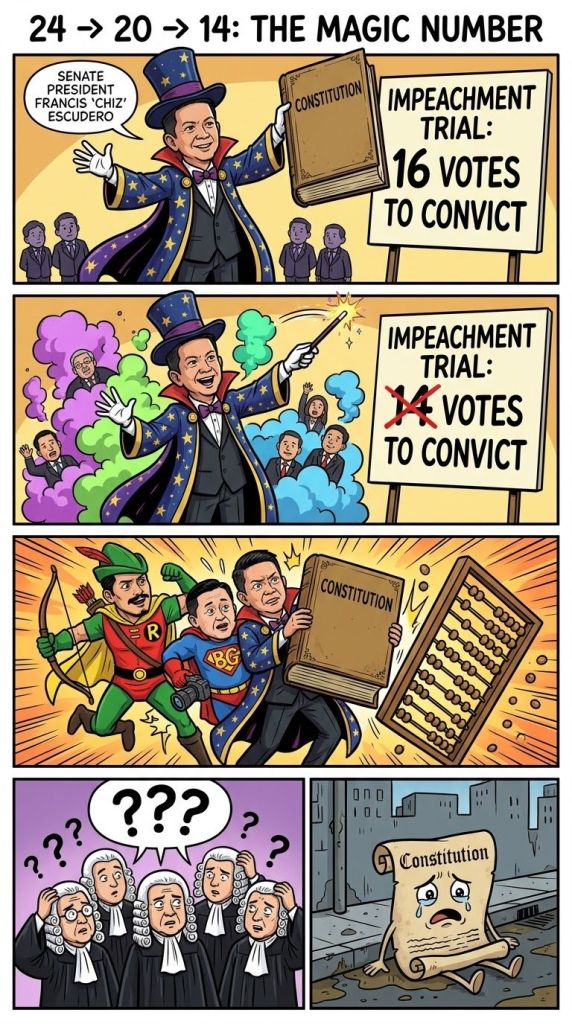
The Constitution: “Two-thirds of all the Members of the Senate.”
The Senate’s translation: “Two-thirds of the Members of the Senate who are legally and factually capable of participating, as determined by the Senate itself, excluding anyone facing criminal charges, international arrest warrants, or medical conditions that prevent attendance, with the understanding that ‘capable’ is a flexible concept subject to whatever political circumstances prevail at the moment of calculation” .
With 24 senators, two-thirds equals 16.
With 20 “participating” senators, two-thirds equals 14.
That’s not a rounding error. That’s a constitutional downgrade. The Senate has effectively amended the Constitution by ordinary resolution, something that normally requires a constitutional convention, a constituent assembly, or a people’s initiative—none of which involve lunch-break walkouts.
Senator Robinhood Padilla’s petition puts it with admirable clarity: “The Constitution does not count only the Senators it finds convenient. It says ‘all,’ and ‘all has never meant ‘some.’ Two-thirds of twenty-four is sixteen” .
This is the kind of statement that would be utterly uncontroversial in any jurisdiction that took constitutional text seriously. In the Philippine Senate, it’s a radical proposition requiring Supreme Court intervention.
The Vanishing Senators: A Mystery in Four Parts
Now, let’s examine the four senators whose absence from the denominator has conveniently reduced the conviction threshold.
- Jinggoy Estrada — detained on plunder charges.
- Rodante Marcoleta — also detained on plunder charges.
- Ronald “Bato” dela Rosa — hiding from an International Criminal Court (ICC) arrest warrant for crimes against humanity.
- Loren Legarda — on extended medical leave abroad while the Office of the Ombudsman (Ombudsman) investigates her.
I want to be careful here. I don’t believe the Marcos administration orchestrated the ICC warrant for dela Rosa. I don’t believe the plunder charges against Estrada and Marcoleta were timed to coincide with the impeachment trial. I don’t believe Legarda’s medical leave was coordinated with the prosecution to reduce the denominator.
But I do believe in patterns. And the pattern here is striking: every senator excluded from the denominator is either a Duterte ally (Marcoleta, dela Rosa) or from a political family historically hostile to the Marcoses (Estrada) or an independent whose exclusion benefits the prosecution (Legarda) .
The prosecution now needs 14 votes instead of 16. That’s not a minor adjustment. That’s the difference between conviction and acquittal in a closely divided Senate.
The petitioners argue that “no senator who holds office may be excluded from the count by reason of detention, suspension, incapacity, absence, non-participation or any similar circumstance” . This is a direct repudiation of the Senate’s new rule, which essentially says that any senator who can’t participate doesn’t count.
The problem with the Senate’s position is that it conflates membership with participation. The Constitution doesn’t say “two-thirds of senators present.” It doesn’t say “two-thirds of senators voting.” It doesn’t say “two-thirds of senators capable of participating.” It says “two-thirds of all the Members.”
A senator who is detained is still a senator. A senator who is hiding is still a senator. A senator who is sick is still a senator. Membership in the Senate is not conditioned on attendance. If it were, half the chamber would have been constitutionally expelled years ago.
The Avelino Precedent: A Dangerous Half-Truth
The Senate’s defenders have leaned heavily on Avelino v. Cuenco (G.R. No. L-2821), the 1949 case where the Supreme Court held that senators beyond the Senate’s coercive jurisdiction could be excluded from the quorum count.
But as I’ve argued before, quorum and conviction are not the same constitutional animal.
Quorum determines whether the body can conduct business. It’s a procedural threshold designed to ensure legitimacy. Conviction determines whether a specific person is removed from office—a fundamentally different constitutional act with different stakes and different safeguards.
The Senate’s defenders want you to believe that because Avelino allows exclusion for quorum purposes, the same logic applies to conviction thresholds. This is like saying that because you can leave the house without a jacket, you can also leave without your wallet, your keys, and your pants.
The Supreme Court itself has cautioned against overreading Avelino. As the petitioners note, the case was decided based on “peculiar circumstances” and should not be treated as an “all-purpose magic spell” for lowering constitutional denominators.
But the Senate doesn’t need an all-purpose magic spell. It just needs one that works for this impeachment, in this Senate, with this Vice President. And it found it.
The “Acquittal by Default” Canard
The prosecution’s favorite rhetorical weapon is the specter of “acquittal by default”—the supposedly absurd scenario where an impeached official escapes conviction because enough senators were unavailable to reach the threshold.
House Prosecutor Chel Diokno put it bluntly: “A situation where a senator cannot hear the evidence, deliberate, and vote… Their inability to participate is beyond dispute. And yet, if the denominator is fixed at 24, conviction would always require 16 votes. Absurd” .
Is it absurd? Or is it the constitutional design?
The two-thirds requirement is deliberately difficult. It is meant to prevent conviction by a bare majority. It is meant to ensure that removal from office commands overwhelming consensus. If the Senate cannot muster 16 votes, the constitutional result is acquittal. That is not a bug. It is a feature.
The “acquittal by default” argument assumes that the purpose of impeachment is conviction. But the Constitution’s purpose is legitimacy. A conviction that occurs because the threshold was lowered by excluding senators who would have voted against it is not a legitimate conviction. It is a procedural coup.
And here’s the uncomfortable corollary: if absence can lower the threshold, then absence becomes a tool. A party that wants to convict could theoretically engineer the absence of opposition senators to reduce the denominator. The Senate’s new rule says only senators “legally and factually incapable” of participating are excluded. But “incapable” is a contested category. Is a senator who is “in hiding” incapable? Dela Rosa could surrender. Is a senator on “medical leave” incapable? Legarda could return. Is a senator who is “detained” incapable? Estrada and Marcoleta could be released.
The line between “incapable” and “unwilling” is not as clear as the Senate pretends. And once you start drawing that line, you invite strategic behavior.
The Six Who Walked Out
Let me say something about the six senators who didn’t participate in the threshold vote: Alan Peter Cayetano, Pia Cayetano, Bong Go, Imee Marcos, Robinhood Padilla, and Camille Villar.
They walked out during lunch break and didn’t return.
This is not a legal argument. It is a political statement. And it deserves to be named as such. These are senators from the minority bloc—the faction aligned with the Duterte camp. Their absence from the vote is a signal: they do not accept the legitimacy of the proceeding.
But here’s the thing: their absence from the threshold vote is exactly the kind of absence that the new rule normalizes. If six senators can skip a vote on the threshold, why can’t they skip the final vote? And if they skip the final vote, does the denominator shrink again? Does the threshold drop to 12? To 10?
The Senate is creating a system where participation is optional and absence is rewarded. That is not a recipe for legitimate constitutional adjudication. That is a recipe for institutional collapse.
The Standing Problem: Why Padilla and Go Are Different
The Supreme Court dismissed three earlier petitions challenging the same Senate ruling—filed by former Executive Secretary Victor Rodriguez, constitutional lawyer Ernesto Francisco Jr., and disbarred lawyer Berteni Causing—on procedural grounds including lack of standing and prematurity .
Padilla and Go argue that their petition is different because they are sitting senator-judges whose “own votes, seats, and oaths are directly affected by the ruling” . This is a much stronger standing argument than the earlier petitioners could muster. They are not mere citizens with a generalized interest in constitutional compliance; they are participants in the very proceeding whose voting rules are being challenged.
But there’s a problem. Padilla and Go themselves did not participate in the September 23 vote that produced the challenged ruling. They were among the six who abstained or absented themselves.
The Supreme Court could therefore ask: How can you claim that your vote was impaired when you voluntarily declined to participate in the very vote establishing the disputed rule?
The respondents could characterize the injury as self-created rather than legally imposed. Padilla and Go will likely answer that their nonparticipation does not waive their constitutional rights as senators, and that the disputed formula governs the eventual final vote, where their votes remain directly affected.
That’s a respectable answer. But it creates a difficult distinction: their strongest standing argument comes from being active participants in the impeachment court, but their conduct on September 23 gives the respondents ammunition to argue that they voluntarily removed themselves from that particular institutional process.
The Ripeness Question: Why Waiting Is Not an Option
The earlier petitions were dismissed partly because the challenge was premature. The Senate could say: “Nobody has yet been convicted using 14 votes.”
But Padilla and Go have a better response: The challenged rule is already operative. This is not merely a hypothetical future formula. The impeachment court has already decided that when judgment is rendered, the denominator will be determined according to its new eligibility formula.
The petitioners argue that “ripeness does not require petitioners to await the very harm the Constitution was designed to prevent” . This is a strong ripeness argument. The Supreme Court has recognized that actual controversies require a concrete conflict of legal rights rather than an abstract disagreement. But an imminent application of a challenged rule can satisfy ripeness where the threatened injury is sufficiently concrete.
The Constitution’s two-thirds requirement was designed precisely to prevent conviction by a reduced threshold. If the Senate has already adopted a rule that would permit such a conviction, waiting for the actual vote is waiting for the harm to materialize.
The Due Process Problem: Changing the Rules Mid-Game
The defense has raised a due process argument that deserves serious attention: changing the threshold mid-trial violates Vice President Duterte’s right to fair notice and a consistent legal framework.
The trial began in July. Presiding Officer Francis Escudero ruled on Day 1 that the threshold was 16. The defense prepared its case, examined witnesses, and built its strategy on the assumption that 16 votes were needed for conviction. Then, on Day 29, the Senate changed the rule.
The Senate says it didn’t change the Constitution—it merely clarified what “all Members” means. This is lawyerly sophistry. If the interpretation changes the practical burden on the defense—if it means the prosecution needs only 14 votes instead of 16—then it is a material change in the rules of the game.
The Supreme Court has already recognized that due process applies to impeachment proceedings. In Duterte v. House of Representatives, G.R. No. 278353 (2025), the Court held that impeachment is a “legal, political, and constitutional process” and that due process, fairness, and non-arbitrariness are required . The Court emphasized that the process must follow the “strict framework and procedure outlined in the Constitution.”
Changing the threshold mid-trial does not obviously violate the Constitution. But it does raise serious questions about fairness. The defense has relied on the 16-vote rule for two months. The Senate has now told them that reliance was misplaced.
If the Supreme Court reviews this—and the defense has signaled it will try—the justices will have to decide whether the Senate’s “clarification” is a permissible interpretation or a retroactive rule change that violates due process.
The Bottom Line: This Is Not About Math
The threshold dispute is not really about arithmetic. It is about power.
The Senate has the “sole power to try and decide all cases of impeachment.” That power is vast. But it is not unlimited. The Constitution imposes limits—including the two-thirds requirement—and the Supreme Court has the power to determine whether those limits have been exceeded.
By adopting a variable denominator, the Senate has expanded its own power. It has given itself the authority to decide, on a case-by-case basis, who counts as a “Member” for purposes of conviction. It has created a mechanism by which the threshold can be adjusted based on circumstances that the Senate itself evaluates.
That is not constitutional interpretation. That is constitutional amendment by majority vote.
And here’s the deepest irony: the senators who voted for this rule did so in the name of fairness—fairness to the prosecution, fairness to the process, fairness to the Filipino people who deserve a functioning impeachment court. But the rule they adopted is profoundly unfair to the respondent, who now faces a lower conviction threshold than the one announced at the start of her trial.
The Constitution does not guarantee a convenient process. It guarantees a lawful one. And lawful process means following the rules as written—not rewriting them when the math becomes inconvenient.
The Supreme Court’s Impossible Choice
The Supreme Court now faces a decision that will define its institutional legacy.
If it dismisses the petition on standing or prematurity grounds—again—it will effectively endorse the Senate’s position that constitutional voting requirements are subject to whatever interpretation the Senate finds convenient at any given moment. That would be a devastating precedent, one that would make future impeachments subject to the same kind of arithmetic manipulation.
If it grants the petition and restores the 16-vote threshold, it will be accused of interfering with the Senate’s “sole power” to conduct impeachment trials. The Senate may resist. A constitutional crisis could ensue.
If it upholds the Senate’s variable denominator, it will have effectively amended the Constitution by judicial fiat, endorsing a reading of “all Members” that renders the word “all” meaningless.
None of these options is attractive. But only one is constitutionally defensible.
The Constitution says “two-thirds of all the Members of the Senate.” With 24 senators, that is 16 votes. Full stop. No exceptions. No functional interpretations. No capacity tests. No variable denominators.
The Senate’s ruling is not a constitutional interpretation. It is a constitutional violation dressed in the robes of expediency.
The Supreme Court should say so.
And Padilla and Go—whatever their motives, whatever their political allegiances, whatever their questionable commitment to judicial neutrality—have filed a petition that, for once, actually deserves to be heard.
The irony is exquisite. The Constitution’s defenders are the Duterte allies. The Constitution’s violators are the administration’s allies. And the Supreme Court, which the Dutertes have spent years accusing of political bias, now holds the fate of the Duterte impeachment in its hands.
God has a sense of humor. So does the Constitution. Unfortunately, the Senate doesn’t.
Louis ‘Barok’ C. Biraogo is a professional spectator of constitutional disasters. He has been wrong before, but never this entertaining.
Key Citations
A. Legal & Official Sources
- The 1987 Constitution of the Republic of the Philippines. Official Gazette of the Republic of the Philippines, 1987, http://www.officialgazette.gov.ph/constitutions/1987-constitution/.
- The 1987 Constitution of the Republic of the Philippines, art. II, sec. 26. Official Gazette of the Republic of the Philippines, 1987, http://www.officialgazette.gov.ph/constitutions/the-1987-constitution-of-the-republic-of-the-philippines/the-1987-constitution-of-the-republic-of-the-philippines-article-ii/.
- The 1987 Constitution of the Republic of the Philippines, art. XI, sec. 3(6). Official Gazette of the Republic of the Philippines, 1987, http://www.officialgazette.gov.ph/constitutions/the-1987-constitution-of-the-republic-of-the-philippines/the-1987-constitution-of-the-republic-of-the-philippines-article-xi/.
- The 1987 Constitution of the Republic of the Philippines, art. XVII. Official Gazette of the Republic of the Philippines, 1987, http://www.officialgazette.gov.ph/constitutions/the-1987-constitution-of-the-republic-of-the-philippines/the-1987-constitution-of-the-republic-of-the-philippines-article-xvii/.
- Avelino v. Cuenco, G.R. No. L-2821. Supreme Court of the Philippines, 4 Mar. 1949, lawphil.net/judjuris/juri1949/mar1949/gr_l-2821_1949.html.
- Duterte v. House of Representatives, G.R. No. 278353. Supreme Court of the Philippines, 25 July 2025, lawphil.net/judjuris/juri2025/jul2025/gr_278353_2025.html.
- International Criminal Court. Home page, http://www.icc-cpi.int/.
- Office of the Ombudsman. Home page, http://www.ombudsman.gov.ph/.
B. News Reports
- Gabriel, Kaela Patricia B. “Senate Court Lowers Vote Threshold in VP Duterte’s Impeachment Trial.” BusinessWorld, 23 Sept. 2026, https://bworldonline.com/the-nation/2026/09/23/780964/senate-court-lowers-vote-threshold-in-vp-dutertes-impeachment-trial/.
- Bacelonia, Wilnard. “Senate Court Drops Fixed 16-Vote Threshold in VP Trial.” Philippine News Agency, 23 Sept. 2026, http://www.pna.gov.ph/articles/1284670.
- Depasupil, William B. “Padilla, Go Ask SC to Back 16-Vote Rule.” The Manila Times, 8 Oct. 2026, http://www.manilatimes.net/2026/10/08/news/national/padilla-go-ask-sc-to-back-16-vote-rule/2441109.
- “Prosecution Warns against Acquittal by Default if Absent Senators Allowed to Vote.” GMA News Online, GMA Network, 23 Sept. 2026, http://www.gmanetwork.com/news/topstories/nation/1003380/prosecution-warns-against-acquittal-by-default-if-absent-senators-allowed-to-vote/story/.
- Chi, Cristina. “Senate Scraps Fixed 16-Vote Threshold in Sara Duterte Impeachment.” Philstar.com, 22 Sept. 2026, http://www.philstar.com/headlines/2026/09/22/2558345/senate-scraps-fixed-16-vote-threshold-sara-duterte-impeachment.
- Laqui, Ian. “SC Dismisses Petitions vs Vote Threshold in Sara Duterte Impeachment Trial.” Philstar.com, 30 Sept. 2026, http://www.philstar.com/headlines/2026/09/30/2560026/sc-dismisses-petitions-vs-vote-threshold-sara-duterte-impeachment-trial.
- De Leon, Dwight. “Escudero Settles Threshold: 16 Votes to Convict Sara Duterte.” Rappler, 6 July 2026, http://www.rappler.com/philippines/escudero-settles-conviction-threshold-debate-16-needed-remove-sara-duterte/.
- “Ang Hirap Maging Mahirap”: The PAO Scandal That Proves Government Contempt Is Nothing New

- “Far-Off” My Axx: Malacañang’s Claire Castro Drowns in Her Own Legal Gaslighting

- “Forthwith” to Farce: How the Senate is Killing Impeachment—And Why Enrile’s Right (Even If You Can’t Trust Him)

- “HINDI AKO NAG-RESIGN!”

- “I Know Nothing”: Baste Duterte’s Amnesia Defense Meets ₱33M in GenCorp Contracts

- “I’m calling you from my new Globe SIM. Send load!”

- “Mahiya Naman Kayo!” Marcos’ Anti-Corruption Vow Faces a Flood of Doubt

- “Manageable” Debt, Unmanageable Lies: DBM’s ₱21 Trillion Fairy Tale

- “Meow, I’m calling you from my new Globe SIM!”

- “Natrabaho”: One Word, One Ombudsman, and a Judiciary on Trial

- “No Special Jail for Crooks!” Boying Remulla Slams VIP Perks for Flood Scammers

- “Philippine-Controlled” or Yankee Gas Station? The Davao Fuel Depot Farce Exposed







Leave a comment