
₱10.44 billion in alleged plunder. ₱24 billion in DOE penalties. ₱72,000 in bail. One family. Zero accountability—so far.
Louis ‘Barok‘ C. Biraogo | October 8, 2026
MGA ka-kweba, let me tell you a story about a ₱72,000 arrest warrant.
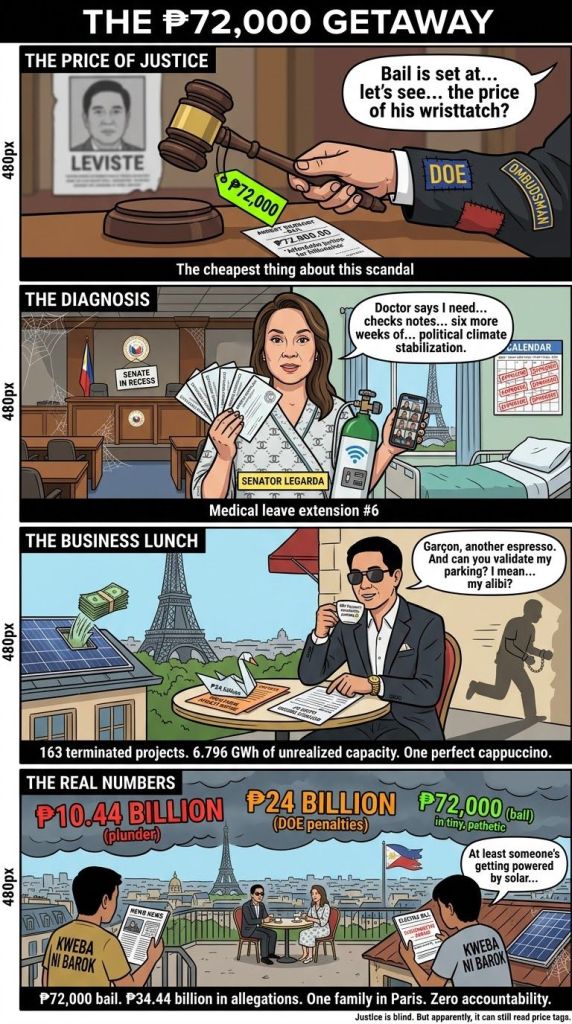
On the surface, it sounds almost quaint. A Makati court wants a congressman arrested, and the bail is roughly the price of a decent wristwatch in Greenbelt. For a man once dubbed the Philippines’ youngest billionaire, ₱72,000 is not even a rounding error. It’s the cost of a good dinner at a Michelin-starred restaurant in Paris—which, coincidentally, is where our protagonist currently happens to be.
But here’s the thing about Philippine politics: the most consequential cases often arrive wrapped in the most modest packaging. The arrest warrant against Batangas Rep. Leandro Leviste isn’t really about ₱72,000. It’s about a ₱10.44-billion plunder investigation, a ₱24-billion Department of Energy (DOE) penalty, a mother-senator’s six consecutive medical leave extensions, and a family that has somehow managed to turn “caring for an ailing parent” into a geopolitical strategy.
Let me walk you through what the headlines won’t tell you.
The Legal Architecture: A Primer on Congressional Immunity
First, the legal basics. Article VI, Section 11 of the 1987 Constitution grants members of Congress immunity from arrest “in all offenses punishable by not more than six years imprisonment” while Congress is in session. Note the qualifier: not more than six years.
Section 25 of Commonwealth Act No. 146 (Public Service Act), as amended by Republic Act No. 11659 (Amendments to the Public Service Act), carries a penalty of not lower than six years and one day and not higher than twelve years. Do the math. Six years and one day is more than six years. The immunity doesn’t apply. The Supreme Court made this crystal clear in People v. Jalosjos (2000), where it held that the privilege from arrest was never intended to shield legislators from serious crimes.
So the “he’s a congressman, he can’t be arrested” argument? Legally weak. Constitutionally illiterate. And politically desperate. Leviste’s lawyers know this, which is why they’re not leading with it.
The real battle will be fought elsewhere: on the terrain of probable cause, venue, and the sufficiency of the Information. That’s where the government’s case could either solidify or shatter.
The Makati Question: Why There?
Here’s where it gets interesting.
The arrest warrant lists Leviste’s address as Paraiso, Calatagan, Batangas. The alleged franchise violations involve Solar Para sa Bayan Corporation, which was supposed to operate in remote and underserved areas—presumably not in Makati’s Central Business District.
So why is the case in Makati Regional Trial Court (RTC) Branch 235?
Rule 110, Section 15 of the Rules of Criminal Procedure provides that criminal actions must be instituted and tried where the offense was committed or where any essential ingredient occurred. The Supreme Court has repeatedly held that venue in criminal cases is an essential element of jurisdiction—not a mere procedural nicety that can be waived or glossed over.
Now, there could be legitimate explanations. Maybe Solar Para sa Bayan’s corporate headquarters is in Makati. Maybe critical documents were filed there. Maybe regulatory communications originated from there. The prosecution has the burden of establishing that an essential ingredient of the alleged offense occurred within Makati’s territorial jurisdiction.
But here’s the question that should haunt every reader of this column: Has the government actually established that? Or did it simply choose Makati because it’s convenient, accessible, and has a reputation for efficient judicial processing?
The answer matters. Because if the Information fails to allege facts establishing Makati as the proper venue, Leviste’s legal team has a jurisdictional challenge that could torpedo the entire case before it even gets to trial. The Supreme Court has been clear: courts cannot acquire jurisdiction by acquiescence. If the offense occurred elsewhere, the case must be dismissed for want of jurisdiction.
So far, no one has publicly explained why Makati is the proper venue. That silence is deafening.
The DOE Complaint: Form Over Substance?
Let’s talk about the substantive charge.
The Department of Energy filed its complaint in May 2026, alleging that Solar Para sa Bayan failed to fulfill the obligations under its 2019 legislative franchise. The franchise, granted under Republic Act No. 11357 (Solar Para sa Bayan Franchise), was supposed to run for 25 years and require the company to develop renewable energy microgrids in remote, unserved, and underserved areas.
According to the DOE, the company never filed the necessary applications, never submitted compliance reports, and never commenced significant operations. Meanwhile, Leviste’s other company, Solar Philippines Power Project Holdings Inc. (SPPPHI), allegedly continued developing commercial solar projects—including the 63.3-megawatt Calatagan Solar Farm.
The DOE characterized this as “badges of fraud” and argued for piercing the corporate veil. The theory: Leviste used one company to obtain the franchise, then diverted the actual business to another entity, effectively monetizing the franchise while evading its obligations.
It’s a compelling narrative. But it faces a significant legal hurdle: When does regulatory noncompliance become criminal liability?
RA 11357 itself contains specific mechanisms for franchise noncompliance. Section 22 provides penalties for failure to submit annual reports. The franchise is deemed automatically revoked if operations cease for two consecutive years. These are administrative remedies, not criminal penalties.
The defense’s argument will be straightforward: The government had regulatory tools to address noncompliance. It chose criminal prosecution instead. Why? And more importantly, does Section 25 of the Public Service Act actually cover this conduct?
Section 25 requires “knowingly and willfully” causing a public service corporation to neglect its obligations. That’s a high bar. The prosecution must prove not just that the company failed to perform, but that Leviste personally, knowingly, and willfully caused that failure. Corporate failure is not automatically criminal failure.
The DOE’s complaint alleges that Leviste was chairman, president, CEO, and director of Solar Para sa Bayan. That establishes control. But control alone doesn’t establish the requisite mens rea. The prosecution must prove that Leviste knew about the franchise obligations, deliberately chose not to fulfill them, and did so with the intent to violate the law.
Good luck proving that beyond reasonable doubt.
The France Problem: Caregiver or Fugitive?
Now let’s address the elephant in the Parisian apartment.
Leviste left the Philippines on August 2, 2026—just days after the Ombudsman announced its plunder investigation. He has been in France since, ostensibly caring for his mother, Senator Loren Legarda, who is undergoing treatment for a lung and autoimmune condition.
The defense narrative is straightforward: A dutiful son accompanying his ailing mother for medical treatment. Legarda’s spokesperson, Tony La Viña, has repeatedly emphasized that she is “eager to come home” and that Leviste is simply fulfilling his filial obligations.
The prosecution narrative is equally straightforward: A congressman fled the country immediately after learning he was under investigation, and he’s now using his mother’s illness as a convenient excuse to avoid arrest.
Which narrative is true?
Let’s examine the timeline. The Ombudsman announced the investigation in late July. Legarda and Leviste left on August 2. Legarda’s medical leave began August 3 and has been extended six times, most recently until October 9. The arrest warrant was issued October 5—two months after Leviste left the country.
Here’s the problem with the defense narrative: If Legarda is genuinely eager to return, why has she sought six consecutive extensions? A lung and autoimmune condition is serious, certainly. But six extensions spanning more than two months suggests either a catastrophic medical situation or a strategic calculation about the political and legal landscape back home.
And here’s the problem with the prosecution narrative: The arrest warrant was issued two months after Leviste left. If the government truly believed he was a flight risk, why did it wait so long to file charges? The timing suggests either prosecutorial indecision or a deliberate strategy to create maximum political pressure.
The truth is probably somewhere in between. Legarda may genuinely be ill. Leviste may genuinely be caring for her. But both facts can coexist with a strategic decision to remain abroad while the legal and political situation evolves. The French Riviera is a lovely place to wait out an investigation, especially when your mother happens to be a four-term senator with significant political capital.
The National Bureau of Investigation (NBI) has announced it will coordinate with immigration authorities and the Department of Foreign Affairs (DFA) regarding possible passport cancellation. The legal basis exists: Republic Act No. 8239 (Philippine Passport Act) allows passport cancellation for persons with pending criminal cases. The Supreme Court has upheld hold-departure orders when sufficiently connected to criminal proceedings (Silverio v. Court of Appeals).
But here’s the catch: You can’t arrest someone who’s in France. A Philippine arrest warrant is not a global arrest warrant. Enforcement requires international cooperation, and the Philippines’ extradition treaty with France is either nonexistent or toothless. The government’s best hope is that Leviste voluntarily returns—which he might, once the political calculus shifts.
The Mother-Son Dynamic: A Political Dynasty in Crisis
Let’s talk about the family dimension, because it’s impossible to separate the legal from the political here.
Loren Legarda is one of the most recognizable figures in Philippine politics. Four terms in the Senate. Former journalist. Environmental advocate. Senate President Pro Tempore. She has spent decades cultivating an image of competence, integrity, and public service.
Her son, Leandro Leviste, is a first-term congressman who was once dubbed the Philippines’ youngest billionaire. He entered politics after building a renewable energy empire—an empire that is now the subject of a ₱10.44-billion plunder investigation.
The irony is almost too perfect. Legarda filed an anti-political dynasty bill in 2025. Now she and her son are the subject of a corruption investigation that critics say exemplifies the very dynastic privilege her bill was supposed to address.
The Ombudsman alleges that Legarda used her position as chair of the Senate Finance Committee to help her son obtain government contracts and franchises. The theory: She leveraged her legislative power to benefit her son’s business interests, creating a conflict of interest that violates Article VI, Section 14 of the 1987 Constitution.
The defense response is predictable: Legarda has no ownership stake in her son’s companies. She is not a shareholder, officer, or beneficiary. She is simply his mother.
But here’s the thing about corruption investigations: They don’t require direct financial benefit. They require proof of influence peddling. If the prosecution can establish that Legarda used her position to facilitate her son’s business dealings—even without direct financial gain—that could constitute a violation of anti-graft laws.
Enter Lito Atienza.
The former Manila mayor and congressman has alleged that Legarda personally approached him in 2019, offering ₱10 million in government funding in exchange for his support for her son’s solar franchise application. According to Atienza, Legarda explicitly invoked her position as Senate Finance Committee chair during the conversation.
“Sabi niya, ‘Alam mo Lito chairman ako ng Committee on Appropriations sa Senado, I can help you with your P10 million fund basta pumayag ka lang tutulungan mo ang anak ko’.”
Legarda has dismissed the allegation as “utterly false and baseless.” Atienza has no corroborating evidence beyond his own account. But if the Ombudsman can substantiate this claim through other witnesses or documentary evidence, it transforms the investigation from a corporate regulatory matter into a direct corruption case.
Atienza’s account is unproven. But it’s also specific, detailed, and consistent with the timeline of the franchise application. That makes it worth watching.
The Corporate Veil: Piercing the Fiction
The DOE’s theory of the case relies heavily on piercing the corporate veil. The argument: Leviste used Solar Para sa Bayan to obtain a legislative franchise, then diverted actual business operations to SPPPHI, effectively monetizing government-granted privileges while evading the corresponding obligations.
This is a sophisticated legal theory, and it could be devastating if proven. But it’s also difficult to establish.
Philippine jurisprudence permits piercing the corporate veil when the corporate entity is used to defeat public convenience, justify wrong, protect fraud, or defend crime. The DOE alleges that Leviste’s corporate structure was designed to do exactly that.
But the defense will argue that separate corporate entities are a legitimate business practice. Leviste had different companies for different purposes—one for the franchise, another for commercial projects. That’s not fraud; that’s corporate organization.
The key question: Did Solar Para sa Bayan ever have the capacity to fulfill its franchise obligations? If the company was never capitalized adequately, never had the operational capacity, and was always intended as a placeholder, then the DOE’s theory gains traction. If the company genuinely attempted to operate but failed due to regulatory obstacles and market conditions, then the case becomes much weaker.
Leviste’s public statements complicate matters. He has reportedly said that Solar Para sa Bayan “was shut down many years ago” and that the franchise was “ipso facto revoked” in 2022. If that’s true, then why did he continue to hold the franchise? Why didn’t he formally surrender it? And why did he transfer actual operations to a different company?
These are questions that the prosecution will ask. Leviste’s answers will determine whether the corporate veil holds or falls.
The Information: The Document That Will Decide Everything
Here’s the most important thing you need to understand about this case: The arrest warrant tells us almost nothing about the strength of the government’s evidence.
Under Rule 112, Section 6, a judge must personally evaluate the prosecutor’s resolution and supporting evidence before issuing a warrant. The judge must find probable cause—not proof beyond reasonable doubt, but sufficient evidence to believe that a crime was committed and that the accused likely committed it.
Probable cause is a low bar. A single credible affidavit can establish probable cause. The judge does not conduct a trial. He does not weigh conflicting evidence. He determines whether there’s enough to justify bringing the accused before the court.
What matters is the Information—the formal charging document that must allege every element of the offense. The Supreme Court has been clear: An Information that fails to allege all essential elements is defective and can be quashed. The accused has a constitutional right to be informed of the nature and cause of the accusation.
So the critical questions are:
- Does the Information specifically allege what Leviste personally did or failed to do?
- Does it identify the precise statutory obligation he allegedly violated?
- Does it establish the required “knowingly and willfully” mental state?
- Does it establish venue—why Makati?
- Does it establish compliance with the “notice and hearing” requirement in Section 25?
If the Information is vague, conclusory, or fails to connect Leviste’s personal conduct to the alleged violation, his lawyers have grounds for a motion to quash. If the Information is specific and well-drafted, the case proceeds.
We haven’t seen the Information yet. That’s the document that will determine whether this case has legs or whether it collapses under the weight of its own legal deficiencies.
The Political Calculus: Lawfare or Accountability?
Let’s step back and look at the bigger picture.
The Ombudsman’s investigation comes amid a broader political context: Vice President Sara Duterte’s impeachment trial, the Marcos administration’s anti-corruption campaign, and Leviste’s own public criticisms of alleged corruption in flood control projects and the House of Representatives.
Legarda’s camp has characterized the investigation as “lawfare”—the weaponization of legal processes for political purposes. They argue that Leviste is being targeted because he exposed corruption and criticized the administration.
The Ombudsman, Jesus Crispin “Boying” Remulla, has denied political motivation. He has described the alleged scheme as “ghost electricity”—contracts obtained but electricity never delivered.
Both narratives have elements of truth. Political motivation and legitimate legal concerns are not mutually exclusive. The Ombudsman may genuinely believe Leviste committed crimes. He may also be responding to political pressure from administration allies. The two can coexist.
But here’s what matters legally: Political motivation does not invalidate a prosecution. Even a politically motivated case can result in a valid conviction if the evidence supports it. Conversely, the absence of political motivation cannot cure a defective Information or a lack of jurisdiction.
That’s why the defense should focus on the legal architecture, not just the political narrative. The “lawfare” argument is politically potent but legally insufficient. It may sway public opinion, but it won’t win in court unless it’s paired with substantive legal challenges.
What Comes Next?
Here’s my assessment of the most likely scenarios:
- Scenario 1: Leviste returns voluntarily. He posts bail, challenges the Information, and the case proceeds to trial. This is the most straightforward outcome and probably the best for his legal position. It transforms the narrative from “fugitive congressman” to “accused who intends to face the courts.”
- Scenario 2: The jurisdictional challenge succeeds. If the Information fails to establish Makati as the proper venue, the case could be dismissed outright. This would be a devastating blow to the prosecution and a major victory for Leviste.
- Scenario 3: The Information is quashed. If the Information fails to allege all essential elements of the offense, the court could quash it, forcing the prosecution to refile. This would delay the case and potentially weaken it.
- Scenario 4: The case proceeds to trial, and the prosecution fails to prove its case beyond reasonable doubt. Probable cause is not proof of guilt. Many cases that look strong at the warrant stage collapse at trial when the prosecution must present actual evidence. The DOE’s case relies heavily on documentary evidence and regulatory findings. If the defense can create reasonable doubt about Leviste’s personal culpability, acquittal is possible.
- Scenario 5: Plunder charges are filed. The Ombudsman’s investigation is ongoing. If it results in plunder charges, the legal landscape changes dramatically. Plunder carries life imprisonment and is non-bailable. That would raise the stakes exponentially and make Leviste’s return to the Philippines a much more difficult decision.
The Bottom Line
The arrest warrant against Leandro Leviste is legally plausible but not necessarily legally sound. The government has established probable cause—or at least a judge has determined that probable cause exists. But probable cause is the beginning of the story, not the end.
The real battle will be fought over the sufficiency of the Information, the propriety of venue, the establishment of the requisite mental state, and the interpretation of the Public Service Act’s criminal provisions.
The political battle will be fought over whether this is accountability or persecution. Whether Leviste is a corrupt businessman hiding behind his mother’s political power or a reformist entrepreneur targeted for exposing corruption.
The truth, as always, is probably more complicated than either narrative allows.
What’s clear is this: The ₱72,000 bail is a distraction. The real numbers—₱10.44 billion in alleged plunder, ₱24 billion in DOE penalties, 163 terminated projects, 6.796 gigawatt-hours of unrealized capacity—tell a story of systemic failure, regulatory breakdown, and the political economy of renewable energy in the Philippines.
Whether that failure constitutes a crime is for the courts to decide.
But the court of public opinion has already rendered its verdict. And in that court, the image of a congressman and his senator-mother sipping espresso in France while an arrest warrant gathers dust in Makati will be Exhibit A for the prosecution.
The defense has a lot of work to do.
Louis ‘Barok’ C. Biraogo is the author of the Kweba ni Barok blog, where he writes about Philippine politics, law, and the absurdities of public life.
Key Citations
A. Legal & Official Sources
- The 1987 Constitution of the Republic of the Philippines, art. VI, secs. 11, 14. Official Gazette of the Republic of the Philippines, 1987, http://www.officialgazette.gov.ph/constitutions/the-1987-constitution-of-the-republic-of-the-philippines/the-1987-constitution-of-the-republic-of-the-philippines-article-vi/.
- Commonwealth Act No. 146. An Act to Reorganize the Public Service Commission, Prescribe Its Powers and Duties, Define and Regulate Public Services, Provide and Fix the Rates and Quota of Expenses to Be Paid by the Same, and for Other Purposes (Public Service Act). 7 Nov. 1936, lawphil.net/statutes/comacts/ca1936/ca_146_1936.html.
- Republic Act No. 11659. An Act Amending Commonwealth Act No. 146, Otherwise Known as the Public Service Act, as Amended. 21 Mar. 2022, http://www.officialgazette.gov.ph/2022/03/21/republic-act-no-11659/.
- Republic Act No. 11357. An Act Granting Solar Para sa Bayan Corporation a Franchise to Construct, Install, Establish, Operate, and Maintain Distributed Energy Resources and Microgrids in the Remote and Unviable, or Unserved or Underserved Areas in Selected Provinces of the Philippines to Improve Access to Sustainable Energy. 31 July 2019, http://www.officialgazette.gov.ph/2019/07/31/republic-act-no-11357/.
- Republic Act No. 8239. Philippine Passport Act of 1996. 22 Nov. 1996, http://www.officialgazette.gov.ph/1996/11/22/republic-act-no-8239/.
- Revised Rules of Criminal Procedure, rules 110, sec. 15, and 112, sec. 6. Supreme Court of the Philippines, 1 Dec. 2000, lawphil.net/courts/rules/rc_110-127_2000.html.
- People v. Jalosjos. G.R. Nos. 132875-76, 3 Feb. 2000, lawphil.net/judjuris/juri2000/feb2000/gr_132875_2000.html.
- Silverio v. Court of Appeals. G.R. No. 94284, 8 Apr. 1991, lawphil.net/judjuris/juri1991/apr1991/gr_94284_1991.html.
B. News Reports
- Rita, Joviland. “Leandro Leviste Faces Arrest Warrant over Alleged Public Service Act Violation.” GMA News Online, GMA Network, 6 Oct. 2026, http://www.gmanetwork.com/news/topstories/nation/1005015/leandro-leviste-faces-arrest-warrant-over-alleged-public-service-act-violation/story/.
- Servallos, Neil Jayson. “Legarda, Son Face Probe over P10 Billion Solar Franchise.” Philstar.com, The Philippine Star, 1 Aug. 2026, http://www.philstar.com/headlines/2026/08/01/2546158/legarda-son-face-probe-over-p10-billion-solar-franchise.
- Cordero, Ted. “COA Flags P10.4-B Terminated Contracts of Leviste’s Solar Philippines.” GMA News Online, GMA Network, 3 Oct. 2026, http://www.gmanetwork.com/news/topstories/nation/1004633/coa-flags-p10-4-b-terminated-contracts-of-leviste-s-solar-philippines/story/.
- Laqui, Ian. “Arrest Warrant out for Leandro Leviste over Alleged Public Service Act Violation.” Philstar.com, The Philippine Star, 7 Oct. 2026, http://www.philstar.com/headlines/2026/10/07/2561534/arrest-warrant-out-leandro-leviste-over-alleged-public-service-act-violation.
- Reyes, Mary Ann LL. “Serious Allegations.” Philstar.com, The Philippine Star, 20 Sept. 2026, http://www.philstar.com/business/2026/09/20/2557416/serious-allegations.
- “Ang Hirap Maging Mahirap”: The PAO Scandal That Proves Government Contempt Is Nothing New

- “Far-Off” My Axx: Malacañang’s Claire Castro Drowns in Her Own Legal Gaslighting

- “Forthwith” to Farce: How the Senate is Killing Impeachment—And Why Enrile’s Right (Even If You Can’t Trust Him)

- “HINDI AKO NAG-RESIGN!”

- “I Know Nothing”: Baste Duterte’s Amnesia Defense Meets ₱33M in GenCorp Contracts

- “I’m calling you from my new Globe SIM. Send load!”

- “Mahiya Naman Kayo!” Marcos’ Anti-Corruption Vow Faces a Flood of Doubt

- “Manageable” Debt, Unmanageable Lies: DBM’s ₱21 Trillion Fairy Tale

- “Meow, I’m calling you from my new Globe SIM!”

- “Natrabaho”: One Word, One Ombudsman, and a Judiciary on Trial
- “No Special Jail for Crooks!” Boying Remulla Slams VIP Perks for Flood Scammers

- “Philippine-Controlled” or Yankee Gas Station? The Davao Fuel Depot Farce Exposed






Leave a Reply