
Or: How to Spend Half a Decade Investigating the Obvious and Conclude That Water Is Not Wet
By Louis ‘Barok‘ C. Biraogo — October 7, 2026
The Setup: A Complaint So Simple a Barangay Captain Could Resolve It
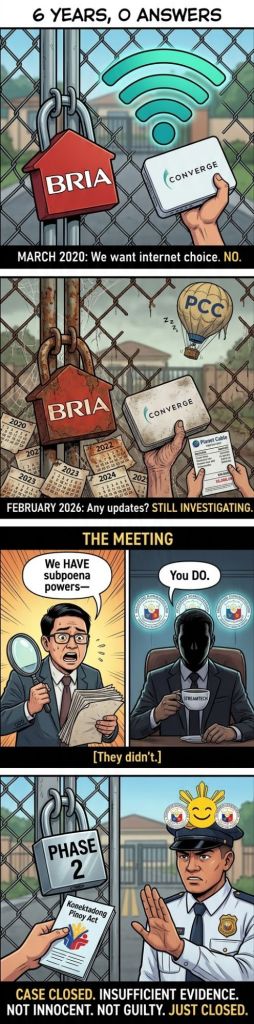
In March 2020, homeowners at Bria Homes’ Northridge Grove subdivision in Bulacan did something radical: they complained. They said they couldn’t get internet from anyone except Planet Cable—the Internet Service Provider (ISP) owned by the same family that built their homes. Converge, apparently, was blocked from installing infrastructure.
This is not complicated. This is not ambiguous. This is the telecommunications equivalent of a landlord saying “you can only buy groceries from my brother’s store.”
Six years later, on February 16, 2026, the Philippine Competition Commission (PCC) closed the case for “insufficient evidence.”
Six. Years.
The Evidence Problem: When “Insufficient” Becomes a Euphemism
The PCC’s official explanation reads like a masterclass in passive-voice bureaucratic exculpation. Let me translate:
PCC said: “There is no sufficient evidence to prove that ISPs other than Streamtech were prevented by Bria Homes from operating in Northridge.”
Translation: We couldn’t find a document that said “Bria hereby prohibits all ISPs except Streamtech.” Never mind that Republic Act No. 10667 (Philippine Competition Act) defines “agreement” to include tacit understandings, informal arrangements, and concerted action—you know, the way actual anticompetitive conduct works in the real world.
PCC said: “Delays and difficulties obtaining categorical statements from complainants.”
Translation: Homeowners who live in a subdivision controlled by a company owned by a family with three sitting senators became… hesitant to testify. Shocking. It’s almost as if people fear retaliation from powerful developers who control their Homeowners’ Association (HOA), their roads, and their ability to live peacefully.
PCC said: “Converge was present in Northridge as early as 2021.”
Translation: One competitor showed up at some point, so obviously there’s robust competition. Never mind asking: How many subscribers? What areas? What conditions? Was their entry before or after the PCC investigation began? Did their presence increase or decrease after the complaint? These are questions an investigator might ask. The PCC apparently did not.
PCC said: “Some ISPs withdrew rather than were barred.”
Translation: We couldn’t prove formal rejection, so we’re treating voluntary withdrawal as evidence of… nothing to see here. Never mind that “raising rivals’ costs” is a recognized anticompetitive theory. Never mind that making entry sufficiently burdensome that competitors self-exclude is exactly how sophisticated foreclosure works. If the ISP wasn’t formally denied, the PCC apparently believes no harm occurred.
The Legal Framework: A Statute That Anticipated This Exact Problem
Here’s the thing: the Philippine Competition Act (RA 10667) was written by people who understood that anticompetitive conduct is rarely documented in signed confessions.
Section 14(c) prohibits agreements “whether formal or informal, explicit or tacit, written or oral” that have the object or effect of substantially preventing competition.
The word “tacit” exists for a reason. The word “informal” exists for a reason. The word “effect” exists for a reason.
The PCC’s own Rules of Procedure require only “reasonable belief” to file a Statement of Objections (SO)—a threshold deliberately lower than final proof. Section 2.11 says an SO should be filed if there are “facts and circumstances that would engender reasonable belief that there is a violation.”
After six years, the PCC couldn’t meet the “reasonable belief” standard.
Let that sink in.
The Timeline: A Masterclass in Strategic Delay
Let me walk you through how to make a competition case disappear without ever saying you’re making it disappear:
| Date | Event | Significance |
|---|---|---|
| March 2020 | Homeowners complain | Case begins |
| November 2020 | PCC preliminary inquiry | 8 months to start looking |
| February 2021 | Full investigation launched | 4 more months |
| October 2022 | Show Cause Order issued | 20 months to formally accuse |
| 2022–2024 | Negotiations with Bria | Two years of “settlement talks” |
| December 2024 | PCC rejects Bria’s proposal as “insufficient” | PCC found merit! |
| December 2024 | PCC orders investigation to continue | PCC still found merit! |
| February 2026 | Case closed for “insufficient evidence” | What changed? |
The 14-month gap between “investigation must continue” and “case closed” is unexplained. What happened between December 2024 and February 2026?
- New evidence emerged exonerating Bria? (Then where is it? Why not publish it?)
- Key witnesses recanted? (Under what circumstances? Were they pressured?)
- PCC leadership changed priorities? (Commissioners have seven-year terms—who left?)
- Political intervention? (The Villars control three Senate seats and have a partnership with the Marcos administration)
The PCC won’t say. And that silence is itself an answer.
The 8990 Holdings Precedent: When the PCC Actually Enforces
In 2019, the PCC fined 8990 Holdings/Urban Deca Homes P27.11 million for essentially the same conduct—exclusive ISP arrangements that blocked competitors.
What was different?
| Factor | 8990 Holdings | Bria Homes |
|---|---|---|
| Exclusive contract | Clear, documented | “Requirements” only |
| Blocking conduct | Property manager actively blocked ISPs | ISPs “withdrew” |
| Respondent admission | Admitted violation | Denied throughout |
| Respondent profile | Publicly listed, no political dynasty | Villar family, three senators |
| Outcome | P27.11M fine | Case closed |
The critical difference, apparently, is that Bria Homes didn’t leave a paper trail and denied everything. The 8990 case worked because the developer admitted it. The Bria case failed because the developer didn’t.
This means the PCC’s enforcement strategy depends on respondents voluntarily incriminating themselves. When they don’t—when they’re sophisticated enough to use informal barriers and procedural burdens—the agency simply gives up.
The Vertical Integration Problem: When the Fox Builds the Henhouse
Let’s map the Villar ecosystem:
Upstream (Services):
- Streamtech/Planet Cable (ISP)
- PrimeWater (water utility)
- AllTV (media)
Downstream (Real Estate):
- Bria Homes (mass housing)
- Camella Homes
- Vista Land
- Starmalls/Vista Malls
Control Points:
- Subdivision access gates
- HOA governance structures
- Right-of-way permissions
- Infrastructure conduits
This is vertical integration on steroids. The Villar family controls both the ISP and the physical infrastructure through which all ISPs must pass. They control the HOA that theoretically represents homeowners. They control the roads, the conduits, the access points.
Under competition law principles, this creates an “essential facilities” problem. ISPs cannot build parallel fiber networks in a gated subdivision—it’s economically and physically impossible. The developer controls access to the residents.
When the same entity that controls access also owns the dominant ISP, the incentive to exclude competitors is obvious. The question is whether that incentive translated into conduct.
The PCC’s answer: We couldn’t prove it, so we’re not going to say it happened.
The Constitutional Problem: Speedy Disposition for Whom?
Article III, Section 16 of the 1987 Constitution guarantees “the right to a speedy disposition of their cases before all judicial, quasi-judicial, or administrative bodies.”
Six years for a subdivision-level ISP dispute is not speedy. It’s glacial.
But here’s the perverse twist: the delay primarily benefits Bria. After six years:
- Homeowner memories fade
- ISP personnel transfer
- Documents get archived
- Witnesses become unavailable
- The evidentiary trail grows cold
- The PCC can claim “insufficient evidence” without ever admitting it failed to gather evidence diligently
The Supreme Court’s Cagang v. Sandiganbayan framework asks whether delay was reasonable given context. Six years for a localized competition case—when the PCC has subpoena powers, can compel testimony, and can require document production—is hard to defend.
The Investigative Failure: Tools Unused, Powers Unexercised
The PCC has extraordinary powers under RA 10667:
- Section 12(f): Issue subpoenas duces tecum and ad testificandum
- Section 12(g): Conduct inspections
- Section 12(d): Act on substantial evidence
- Section 31: Conduct fact-finding and preliminary inquiries
The 2017 Rules of Procedure of the Philippine Competition Commission (PCC Rules of Procedure) specifically empower the Enforcement Office to request documents, electronically stored information, and to issue subpoenas.
So why was the investigation “dependent on complainant cooperation”?
If homeowners were hesitant to give “categorical statements,” the PCC could have:
- Issued subpoenas
- Offered witness protection
- Conducted confidential interviews
- Used documentary evidence to corroborate
- Subpoenaed Bria’s internal communications
- Subpoenaed Streamtech’s installation records
- Subpoenaed Converge’s communications with Bria
- Subpoenaed HOA minutes
- Subpoenaed security logs
Did the PCC do these things? The public record doesn’t show it. And that’s the problem.
An enforcement agency that depends on voluntary cooperation from witnesses who fear retaliation from a powerful developer is not enforcing competition law. It’s hoping respondents will incriminate themselves.
The Converge “Presence” Finding: A Case Study in Misleading Evidence
The PCC’s reliance on Converge’s “presence” in Northridge as evidence of competition is analytically weak.
What does “presence” mean?
- A marketing office?
- Full infrastructure build-out?
- Limited pilot service?
- Service to all residents?
- Service to some phases only?
The timeline matters enormously. If Converge entered after the March 2020 complaint, its presence could show that Bria relaxed restrictions in response to scrutiny—not that restrictions never existed.
If Converge serves only part of the subdivision, its presence doesn’t disprove exclusivity for other areas.
If Converge faced the same “requirements” as other ISPs—burdensome letters of intent, approval processes controlled by Bria—its presence might show that one competitor managed to navigate the barriers, not that the barriers don’t exist.
The PCC’s analysis treats “presence” as binary: either an ISP is there or it isn’t. Real competition analysis asks: On what terms? Under what conditions? At what cost?
The Letters of Intent Problem: Structural Barriers to Entry
Here’s the allegation that should have been investigated more thoroughly:
Prospective providers abandoned their applications after being told that letters of intent (LOI) had to be submitted to Bria rather than to the homeowners’ associations.
Let’s analyze this:
What it means structurally:
- The developer—not the homeowners—controls the application process
- The developer can set the timeline for review
- The developer can impose subjective criteria
- The developer can delay indefinitely
- Competitors have no transparency into approval standards
What it means economically:
This is a classic “raising rivals’ costs” strategy. If you make entry sufficiently burdensome, competitors will rationally choose not to enter. The exclusion happens through attrition, not formal denial.
What it means legally:
Under Section 14(c), an agreement with the “effect” of substantially lessening competition is prohibited. The effect here is clear: competitors abandoned entry. Whether that abandonment was “voluntary” in a formal sense is irrelevant—it was economically rational given the barriers Bria imposed.
The PCC found no violation because it couldn’t prove formal rejection. But the statute doesn’t require formal rejection. It requires proof of anticompetitive effect.
The Political Economy: When Independence Is a Fiction
Let’s address the elephant in the room.
The Villar family’s political power is extraordinary:
- Manny Villar: Former Senate President, House Speaker, presidential candidate, Nacionalista Party president
- Cynthia Villar: Senator since 2013, chairs Senate environment committee
- Mark Villar: Senator since 2022, former Department of Public Works and Highways (DPWH) Secretary
- Camille Villar: Senator, former Las Piñas Representative
The PCC is an “independent” agency. But its commissioners are appointed by the President. And the Villars have partnered with the Marcos administration’s political party for midterm elections.
This doesn’t prove interference. But it creates an appearance problem that the PCC’s silence does nothing to dispel.
When a regulator closes a case involving a politically powerful family after six years, citing “insufficient evidence,” and provides no detailed explanation of what evidence was gathered or why it fell short, the public is entitled to ask questions. When the agency refuses to answer those questions, suspicion becomes rational.
The Konektadong Pinoy Act: A New Hope (Or Another Paper Tiger?)
In 2025, Congress passed Republic Act No. 12234 (Konektadong Pinoy Act), which declares a policy of removing barriers to competition in data transmission.
Section 18 requires PCC and National Telecommunications Commission (NTC) to ensure fair competition and eliminate barriers to entry. The implementing rules (IRR) establish an open-access framework requiring fair, reasonable, and non-discriminatory treatment.
Critically, the IRR contemplates:
- Access to passive infrastructure
- Objective grounds for refusal
- Information disclosure
- Infrastructure sharing
- Requirements that subdivisions be constructed with cable entrances and ducts permitting nondiscriminatory access to multiple providers
This is potentially transformative. It shifts the regulatory question from “Did the developer secretly exclude a competitor?” to “Are access rules open, fair, reasonable, and nondiscriminatory?”
The new framework makes the Northridge problem much easier to address prospectively. But it doesn’t answer what happened at Northridge between 2020 and 2026.
The Parallel Cases: A Pattern Worth Examining
Camella Cerritos Heights (Bacoor, Cavite): Globe Telecom allegedly blocked from laying fiber. Still unresolved.
PrimeWater: Ombudsman graft complaints filed against Villar family members over “clearly disadvantageous” water district contracts.
Bria Homes Northridge Grove: Case closed, no charges.
Multiple regulatory fronts against Villar interests, with varying outcomes. The pattern is suggestive but not conclusive. What it does suggest is that the Villar business empire intersects with multiple regulatory agencies—and that outcomes vary depending on the agency, the evidence, and perhaps other factors.
What the PCC Should Have Done: A Counterfactual
Imagine if the PCC had approached this case differently:
- 2020: Immediately issue subpoenas to Bria, Streamtech, Planet Cable, Converge, and the HOA. Compel production of all ISP-related communications.
- 2020: Interview homeowners confidentially, with explicit assurances of protection from retaliation. Document their statements formally.
- 2021: Subpoena Streamtech’s installation records. Determine whether Streamtech received expedited access that was denied to competitors.
- 2021: Subpoena Converge’s records. Determine the terms of its entry. Was it before or after the complaint? What conditions did it face?
- 2022: Build an access-event database tracking every ISP inquiry, application, and outcome. Analyze patterns statistically.
- 2022: If evidence of discriminatory treatment emerges, file an SO and litigate. If not, close the case with a detailed public explanation.
- 2026: Either a precedent-setting enforcement action or a transparent vindication. Either way, an answer.
Instead, the PCC spent six years, conducted negotiations that went nowhere, and closed the case without answering the fundamental question: Were Northridge residents deprived of ISP choice by anticompetitive conduct?
The Deeper Problem: Competition Enforcement as Theater
The Bria Homes case exposes a structural weakness in Philippine competition enforcement: the PCC can only catch the sloppy.
The 8990 Holdings case succeeded because the developer left a paper trail and admitted wrongdoing.
The Bria Homes case failed because the developer was sophisticated enough to use informal barriers, procedural burdens, and implicit threats rather than explicit prohibitions.
This creates a perverse incentive: sophisticated firms learn that if they avoid smoking-gun documents, they can engage in exclusionary conduct with impunity. The PCC’s message becomes: “We only prosecute when you confess.”
That’s not competition enforcement. That’s theater.
What Happens Next?
Option 1: Accept the Closure
The PCC says the evidence is insufficient. Maybe it is. But “insufficient evidence” is not the same as “innocent.” The case is closed, not adjudicated. Bria is not exonerated; it is simply not prosecuted.
Option 2: Reopen with New Evidence
The PCC Rules say closure is without prejudice to reopening if new evidence emerges. If homeowners, ISPs, or journalists can produce documents showing explicit exclusivity arrangements, the case could return.
Option 3: Regulatory Reform
The Konektadong Pinoy Act provides new tools. The PCC and NTC could jointly develop standards for ISP access in subdivisions. The Department of Human Settlements and Urban Development (DHSUD) could require developers to disclose ISP access policies. Congress could mandate open-access infrastructure.
Option 4: Civil Litigation
Under Section 45 of RA 10667, private parties can sue for damages caused by anticompetitive conduct. Homeowners could pursue civil claims, though the burden of proof would be on them.
Option 5: Nothing
The case is closed. Homeowners continue with limited ISP choice. Bria continues with its practices. Other developers learn that informal barriers work. The PCC’s credibility erodes further.
The Verdict: Not Guilty, Not Innocent, Just Closed
The PCC’s closure of the Bria Homes investigation is legally defensible. The agency cannot prosecute without evidence, and if the evidence genuinely fell short of the “reasonable belief” threshold, closing the case was appropriate.
But legally defensible is not the same as institutionally adequate. The PCC had six years, subpoena powers, and a specialized competition mandate. It ended up with “insufficient evidence.”
That outcome demands explanation. Not a press release. Not a one-page summary. A detailed, transparent accounting of:
- What evidence was gathered
- What evidence was sought but not obtained
- Why Converge’s presence was deemed sufficient to disprove exclusivity
- Why the LOI requirement was not treated as a barrier to entry
- Why six years was necessary to conclude that six years wasn’t enough
The PCC owes the public that explanation. The homeowners of Northridge Grove deserve it. And the credibility of Philippine competition enforcement depends on it.
The Bottom Line
The Bria Homes case is not primarily about whether the Villar family broke the law. It’s about whether Philippine competition enforcement is capable of addressing sophisticated anticompetitive conduct by powerful, politically connected firms.
The answer, based on this case, is: not yet.
The PCC’s tools are adequate on paper. Its powers are substantial. But its execution—at least in this case—was slow, passive, and ultimately inconclusive.
The Konektadong Pinoy Act offers a new framework. The PCC-NTC cooperation agreement offers new coordination. The PCC-DHSUD partnership offers new integration.
But none of that matters if the PCC continues to depend on complainant cooperation, fails to use its compulsory powers aggressively, and closes cases when the evidence gets hard rather than when the investigation is complete.
The Northridge homeowners asked a simple question in 2020: Why can’t we choose our internet provider?
Six years later, they still don’t have an answer. Neither does anyone else.
And that’s the real scandal.
Louis “Barok” C. Biraogo is the author of Kweba ni Barok, where he writes about law, politics, and the intersection of the two. He has no financial interest in any ISP, subdivision developer, or political family—though he occasionally wishes he did, because then he could afford better internet.
Key Citations
A. Legal & Official Sources
- The 1987 Constitution of the Republic of the Philippines. Official Gazette of the Republic of the Philippines, 1987, http://www.officialgazette.gov.ph/constitutions/1987-constitution/.
- Republic Act No. 10667. An Act Providing for a National Competition Policy Prohibiting Anti-Competitive Agreements, Abuse of Dominant Position and Anti-Competitive Mergers and Acquisitions, Establishing the Philippine Competition Commission and Appropriating Funds Therefor. 2015, lawphil.net/statutes/repacts/ra2015/ra_10667_2015.html.
- Republic Act No. 12234. Konektadong Pinoy Act. 2025, lawphil.net/statutes/repacts/ra2025/ra_12234_2025.html.
- Philippine Competition Commission. 2017 Rules of Procedure of the Philippine Competition Commission. Commission Resolution No. 20-2017, 11 Sept. 2017, phcc.gov.ph/enforcement/rules-of-procedure.
- Cagang v. Sandiganbayan. G.R. Nos. 206438, 206458, and 210141-42, 31 July 2018, Supreme Court of the Philippines, lawphil.net/judjuris/juri2018/jul2018/gr_206438_2018.html.
B. News Reports
- Mencias, Eileen. “Not Enough Proof: PCC Drops Six-Year ISP Probe into Villar’s Bria Homes.” Bilyonaryo, 6 Oct. 2026, https://bilyonaryo.com/not-enough-proof-pcc-drops-six-year-isp-probe-into-villars-bria-homes/. Accessed 7 Oct. 2026.
- “Basbas ng Homeowners, Tablado: Globe Hinarang sa Camella Homes.” Abante, 28 May 2021, http://www.abante.com.ph/2021/05/28/basbas-ng-homeowners-tablado-globe-hinarang-sa-camella-homes/.
- “PCC Investigation: Condo Developer Charged for Abuse of Dominance over Exclusive Internet Setup.” ASEAN Competition, 2020, asean-competition.org/read-cases-pcc-investigation-condo-developer-charged-for-abuse-of-dominance-over-exclusive-internet-setup.
- Luna, Enzo. “BRIA Homes and Streamtech Inked Partnership to Provide Reliable Home Internet Connectivity.” Manila Bulletin, 24 Feb. 2021, mb.com.ph/2021/02/24/bria-homes-and-streamtech-inked-partnership-to-provide-reliable-home-internet-connectivity/.
- Macasaet-Acaban, Maria Christina, and Lara Camille Lee. “Philippine Competition Commission Resolves First Abuse of Dominance Case.” Global Compliance News, 3 Dec. 2019, http://www.globalcompliancenews.com/2019/12/03/philippine-competition-commission-resolves-first-abuse-of-dominance-case-20191127/.

- “Ang Hirap Maging Mahirap”: The PAO Scandal That Proves Government Contempt Is Nothing New

- “Far-Off” My Axx: Malacañang’s Claire Castro Drowns in Her Own Legal Gaslighting
- “Forthwith” to Farce: How the Senate is Killing Impeachment—And Why Enrile’s Right (Even If You Can’t Trust Him)
- “HINDI AKO NAG-RESIGN!”

- “I Know Nothing”: Baste Duterte’s Amnesia Defense Meets ₱33M in GenCorp Contracts

- “I’m calling you from my new Globe SIM. Send load!”

- “Mahiya Naman Kayo!” Marcos’ Anti-Corruption Vow Faces a Flood of Doubt

- “Manageable” Debt, Unmanageable Lies: DBM’s ₱21 Trillion Fairy Tale

- “Meow, I’m calling you from my new Globe SIM!”

- “Natrabaho”: One Word, One Ombudsman, and a Judiciary on Trial

- “No Special Jail for Crooks!” Boying Remulla Slams VIP Perks for Flood Scammers

- “Philippine-Controlled” or Yankee Gas Station? The Davao Fuel Depot Farce Exposed








Leave a comment