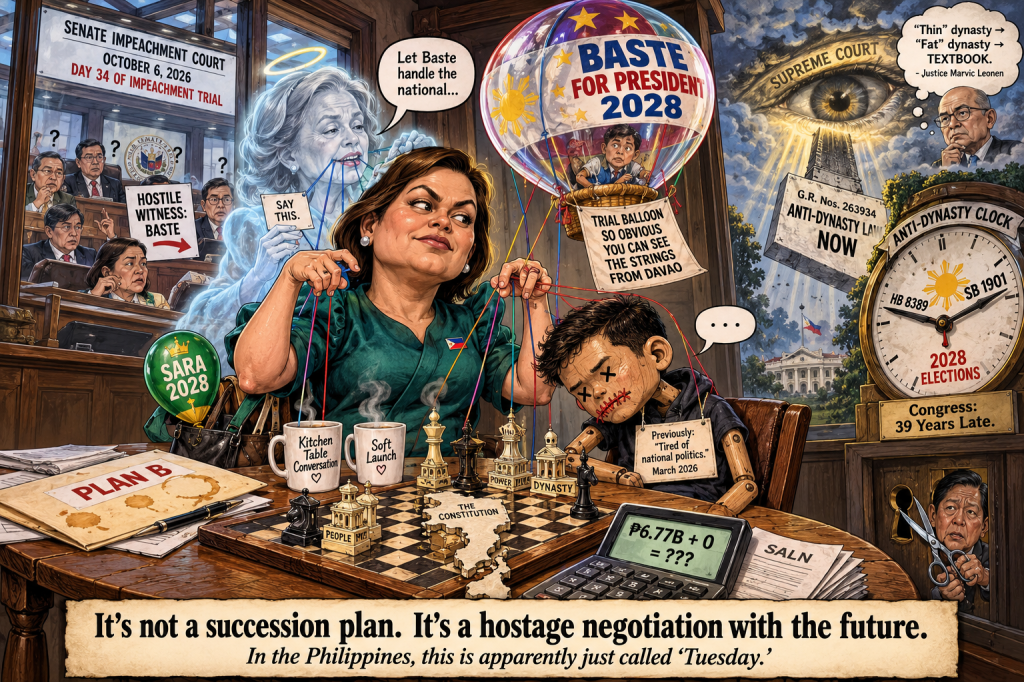
From Impeachment Court to Succession Narrative: The Timing Nobody’s Buying
By Louis ‘Barok’ C Biraogo — October 7, 2026
LET’S pause the succession telenovela for a moment: Sara Duterte did not announce that her brother Baste is running for president. She did not say she’s dropping out. She did not confirm a Duterte dynasty succession plan.
What she did was something far more calculated, far more cynical, and frankly, far more entertaining for those of us who enjoy watching political families pretend they’re just regular folks having casual kitchen-table conversations.
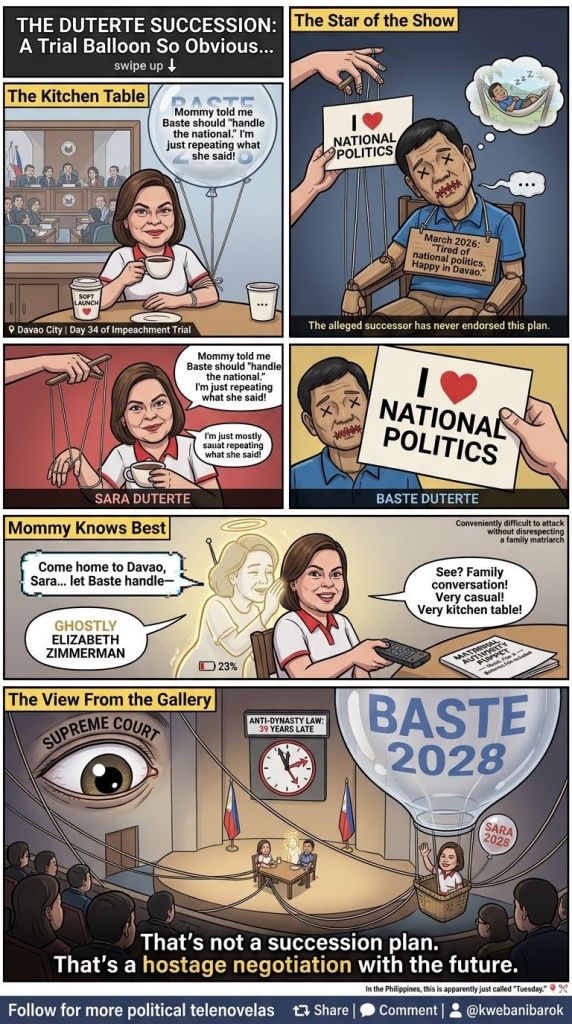
Speaking at a press conference in Davao City on Tuesday, the Vice President—currently on trial in the Senate impeachment court, because apparently that’s just background noise now—recalled that her mother, Elizabeth Zimmerman, once told her to “come home to Davao” and let Baste “handle the national” political role. Sara was careful to note she and Baste have not discussed him running for president. She did not specify which national office her mother had in mind. She did not say Baste agreed to anything.
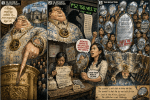
This, ladies and gentlemen, is what political operatives call a “trial balloon.” And this one is so transparent you can practically see the strings from the gallery of the Senate impeachment court.
#DuterteDynasty #TrialBalloon”
The Art of Saying Nothing While Saying Everything
Let’s appreciate the craftsmanship here. Sara Duterte has managed to accomplish four things simultaneously:
- She did not withdraw her own presidential candidacy. She’s still a “presumptive candidate” for 2028, a phrase that sounds like she’s preparing for a wedding she hasn’t decided to attend.
- She did not announce Baste’s candidacy. She’s just repeating what mommy said. It’s not her fault if the media runs with it.
- She placed Baste’s national political future into the public conversation at precisely the moment when her own political survival is under extraordinary scrutiny.
- She gave herself maximum deniability. If the public loves the idea of Baste for president, great. If they hate it, “I never said that, I was just reporting a family conversation.”
This is the political equivalent of a “soft launch” on Instagram. You post a photo of two coffee cups, and everyone knows you’re dating, but you haven’t technically confirmed anything.
The Credibility Problem: Hearsay, Family Edition
Now, let’s talk about the actual evidentiary value of this statement. Because here’s the thing about Sara’s carefully worded revelation: it’s essentially hearsay wrapped in a familial anecdote.
Under Philippine evidence law, hearsay is an out-of-court statement offered to prove the truth of the matter asserted. If Sara says “my mother told me Baste should run nationally,” she can testify that she heard those words. She cannot, however, automatically establish that her mother actually intended Baste to run, or that Baste will actually do it.
Sara’s statement has three layers of credibility, each shakier than the last:
- Layer 1: Sara heard her mother say something. This is firsthand. Fine.
- Layer 2: Sara interprets her mother’s statement as meaning Elizabeth Zimmerman wants Baste to run nationally. This is an inference. Not a fact.
- Layer 3: Baste will actually run. This is completely unproven. And here’s the kicker—Baste himself previously rejected a higher national bid in March 2026, saying he was tired of national politics and content with Davao.
So we have a situation where the person who allegedly wants to run has previously said he doesn’t want to run, and the person reporting the conversation is the one whose political career is on the line.
This is not a succession plan. This is a narrative insurance policy.
The Timing Is Not Subtle
Let’s talk about when Sara decided to share this little family anecdote.
She’s currently in the middle of an impeachment trial. The Senate impeachment court recently declared Baste a hostile witness after he refused to testify voluntarily, citing his “perception” that the impeachment was designed to prevent Sara from running in 2028. Baste has been publicly defending his sister and questioning the motives behind the proceedings.
And now Sara casually mentions that their mother thinks Baste should “handle the national.”
If you don’t see the connection, let me spell it out: Sara is telling the Duterte faithful, “If they take me down, Baste is still here.” She’s telling the Marcos administration, “Eliminating me doesn’t eliminate the Duterte threat.” And she’s telling potential anti-dynasty advocates, “The Duterte brand has redundancy.”
This is not a family conversation. This is a political message delivered through the vessel of maternal authority, which is conveniently difficult to attack without looking like you’re disrespecting a family matriarch.
The Dynasty Elephant in the Room
Here’s where things get constitutionally interesting.
The Supreme Court, in a unanimous decision announced September 16, 2026, ruled that Congress committed grave abuse of discretion by failing for 39 years to enact an anti-political dynasty law as mandated by Article II, Section 26 of the Constitution. The Court directed Congress to act “at the earliest opportunity,” leaving the definition and scope of the prohibition to the legislature.
Senior Associate Justice Marvic Leonen, in a concurring opinion, explicitly cited the Duterte family as an example of both a “thin” dynasty (successive relatives holding the same position) and a “fat” dynasty (multiple family members simultaneously holding different offices). He described the succession of Rodrigo, Sara, and Baste Duterte in Davao City as textbook dynasty behavior.
So when Sara publicly floats Baste as a national candidate, she’s doing so in a constitutional environment where the Supreme Court has just declared that political dynasties are a problem Congress has been unconstitutionally ignoring for four decades.
That’s not just politically tone-deaf. It’s practically begging for scrutiny.
The “Plan B” Theory Wasn’t Even Sara’s Idea
The most damning aspect of this entire affair is that Sara’s statement doesn’t reveal anything new. The “Baste as Plan B” narrative was already in the political bloodstream months before this press conference.
In April 2026, Deputy Minority Leader Antonio Tinio explicitly described Baste as the Duterte family’s “Plan B” following his election as Partido Demokratiko Pilipino (PDP-Laban) president. Political analyst Prof. Ramon Beleno III made the same observation in September, citing Baste’s party leadership and his performance during the impeachment trial as evidence that he’s being positioned for a larger role.
So Sara isn’t revealing a secret. She’s confirming what political observers already suspected. She’s taking the “Plan B” narrative from the realm of speculation and giving it the Vice President’s implicit blessing.
That’s not transparency. That’s ratification.
What Baste Actually Thinks (Spoiler: Nobody Knows)
The most glaring hole in this entire saga is the absence of Baste himself. The Davao City mayor has not publicly responded to his sister’s statement. He has not confirmed or denied any national ambition. His previous public position—that he was tired of national politics and happy in Davao—remains the only direct evidence we have of his actual intentions.
This creates an absurd situation where the entire political commentariat is analyzing a succession plan that the alleged successor has never endorsed. Sara is speaking for her mother. The mother isn’t speaking publicly. Baste isn’t speaking at all.
It’s a family conversation where everyone’s talking except the person who matters.
The Anti-Dynasty Clock Is Ticking
While the Duterte family plays its little game of strategic ambiguity, Congress is actually moving on the anti-dynasty legislation that could fundamentally reshape the 2028 electoral landscape.
The House of Representatives passed House Bill 8389, the proposed Anti-Political Dynasty Act, on third reading in June 2026 by a vote of 267-20. The measure defines prohibited relationships within the second degree of consanguinity or affinity and covers both simultaneous and successive holding of elective office. It’s now pending in the Senate, where a counterpart bill is on second reading.
Deputy Speaker Janette Garin has expressed confidence that an anti-dynasty law can be enacted before the 2028 elections, though she acknowledged the challenge of completing the implementing rules in time.
If Congress actually passes this law—and the Supreme Court’s ruling makes inaction increasingly untenable—the Duterte family’s “Sara for President, Baste for VP” fantasy ticket could become constitutionally problematic.
The Bottom Line
Sara Duterte’s statement about Baste is not a candidacy announcement. It’s not a withdrawal. It’s not even really about Baste.
It’s about Sara.
It’s about keeping her political options open while creating a backup narrative. It’s about signaling to supporters that the Duterte movement has depth beyond one person. It’s about pressuring the Marcos administration to think twice about the political cost of a successful impeachment conviction.
And it’s about doing all of this while maintaining plausible deniability. “I never said Baste would run. I just said my mother said it. And I haven’t even talked to Baste about it.”
That’s not a succession plan. That’s a hostage negotiation with the future.
The only person who can actually resolve this—Baste Duterte—remains silent. And until he speaks, we’re all just watching a family play political chess with the Constitution as the board.
Which, in the Philippines, is apparently just called “Tuesday.”
Key Citations
A. Reports & Studies
- Supreme Court of the Philippines. Decision, G.R. Nos. 263934, 272370, and 279201. 26 Aug. 2026, announced 16 Sept. 2026.
- Leonen, Marvic M.V.F. Concurring Opinion, G.R. Nos. 263934, 272370, and 279201. Supreme Court of the Philippines, 26 Aug. 2026.
- House of Representatives of the Philippines. House Bill No. 8389: An Act Prohibiting Political Dynasties. 20th Congress, approved on third reading 3 June 2026.
- Senate of the Philippines. Senate Bill No. 1901: The Anti-Political Dynasty Act. 20th Congress, pending second reading, 2026.
B. News Articles
- Badilla, Joselle. “Sara Duterte: Mom Prefers Baste for National Politics.” INQUIRER.net, 6 Oct. 2026, https://newsinfo.inquirer.net/2318449/sara-duterte-mom-prefers-baste-for-national-politics.
- Office of the Vice President of the Philippines. “06 October 2026 | Day 34 of Impeachment Trial of Vice President Sara Duterte.” YouTube, 6 Oct. 2026.
- PhilstarLIVE, and Cristina Chi. “LIVE Coverage: Sara Duterte’s Impeachment Trial, Oct. 6.” Philstar.com, 6 Oct. 2026.
- Torregoza, Hannah. “Baste Declared Hostile Witness in VP Sara Trial.” Tempo, 29 Sept. 2026.
- Panti, Llanesca T. “Tinio: Baste Is Dutertes’ Plan B for 2028 Presidential Elections.” GMA News Online, 13 Apr. 2026.
- SunStar Davao. “Mayor Baste Says Duterte Family Ready amid ICC Case vs FPRRD.” SunStar, 6 Mar. 2026.
- Galvez, Daphne. “SC Directs Congress: Pass Anti-Dynasty Law.” Philstar.com, 17 Sept. 2026.
- Reganit, Jose Cielito. “House Passes Anti-Political Dynasty Bill on Final Reading.” Philippine News Agency, 3 June 2026.
- Pacpaco, Ryan Ponce. “Garin Confident Anti-Political Dynasty Law Can Be Enacted before 2028 Polls.” Journal News Online, 19 Sept. 2026.
- Brigada News. “Mayor Baste Duterte, Posibleng Inihahanda bilang ‘Plan B’.” Brigada News, Sept. 2026.
C. Official Websites
- Supreme Court of the Philippines. Official Website.
- House of Representatives of the Philippines. Official Website.
- Senate of the Philippines. Official Website.
- Partido Demokratiko Pilipino. PDP-Laban Official Website.
- Office of the Vice President of the Philippines. Official Website.

- ₱8B BBM Pork: CCTV for Every Captain’s Kumpare?

- ₱8.9 Billion, 331 Ghost Police Stations: The TIKAS Scandal Explained

- ₱8.4 Billion, 42,000 Barangays, 1 Election: The “Bawat Barangay Makikinabang” Vote-Buying Masterclass

- ₱75 Million Heist: Cops Gone Full Bandit

- ₱6.77B Ghost Haunts Duterte: RTC Dismisses Mans Carpio’s Desperate Plea
- ₱6.77 Billion and Zero Cash: The Sara Duterte SALN Math That Doesn’t Add Up

- ₱6.7-Trillion Temptation: The Great Pork Zombie Revival and the “Collegial” Vote-Buying Circus

- ₱58.53B, Zero Receipts: The LGSF Pork Barrel Nobody Wants to Name
- ₱53 Million Man Tells ₱695-a-Day Workers to Stop Being ‘Mayabang’: The Audacity of BSP’s Remolona
- ₱3.06 Billion for Evacuation Centers—But Nobody Knows Where They’ll Stand (Or If They’ll Exist)

- ₱16 Billion, 280 Accounts, 8 Helicopters: Boying Remulla’s Case Against the Yaps Is Not a Drill

- ₱10B Ghost in New Clark City: Matibag’s Haunted Séance for Cayetano









Leave a comment