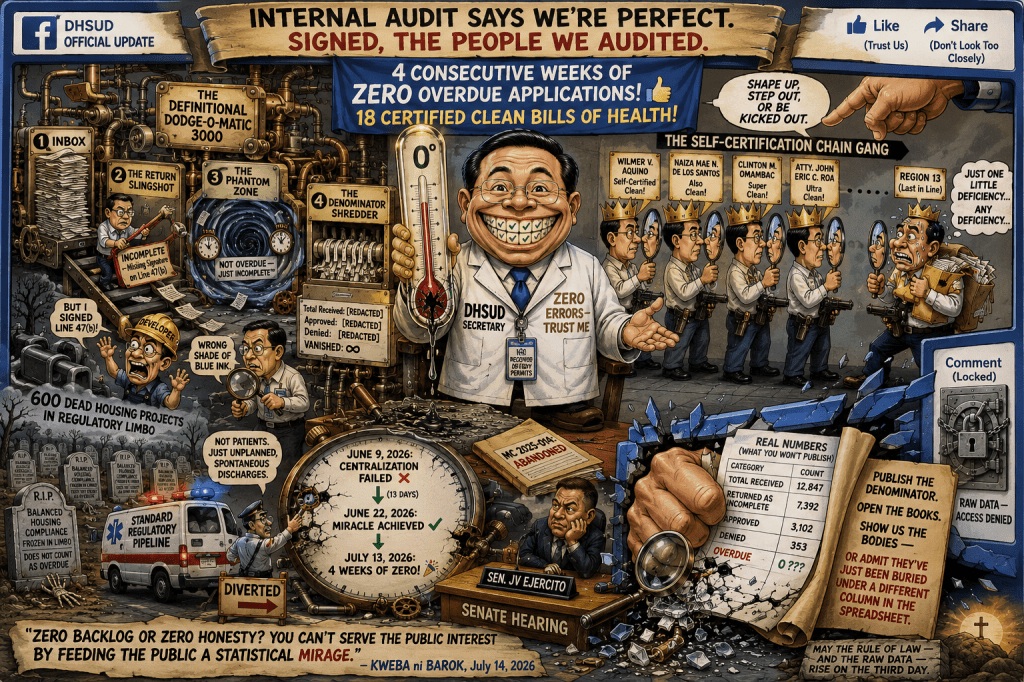
Internal Audit Says We’re Perfect. Signed, The People We Audited.
By Louis ‘Barok‘ C. Biraogo — July 14, 2026
FOUR consecutive weeks of zero overdue regulatory applications. The phrase has the sterile, triumphant ring of a hospital administrator announcing zero surgical errors—only to have you later discover the surgeons reclassified “patient deaths” as “unplanned, spontaneous discharges.” The Department of Human Settlements and Urban Development (DHSUD) gifted us this numerical nirvana on July 13, 2026, a Facebook post that is either the first genuine proof that our bureaucracy can heal itself or the most elaborate statistical séance yet conducted by a government agency desperately trying to summon the ghost of competence.
Let’s legally disembowel this thing and see which organs are missing.

The Tension Between Zeal and Truth
Government has an undeniable duty to report achievements. Republic Act No. 6713 (An Act Establishing a Code of Conduct and Ethical Standards for Public Officials and Employees), demands “commitment to public interest” and “responsiveness.” Republic Act No. 11032 (Ease of Doing Business and Efficient Government Service Delivery Act of 2018), which amended Republic Act No. 9485 (Anti-Red Tape Act of 2007), essentially commands agencies to get their act together or face the cane. Publicizing a win is legitimate. But this duty of promotional zeal operates on a leash held by an equally sacred obligation in the same RA 6713: the duty of “professionalism,” “justness,” and “sincerity.” You cannot serve the public interest by feeding the public a statistical mirage.
This Facebook post is the precise battlefield where the duty of promotion may have slaughtered the duty of veracity and buried it in a shallow, unmarked grave lined with infographics. The DHSUD didn’t just announce a milestone; it issued 18 self-certified clean bills of health from officers whose careers depend entirely on a clean diagnosis. The central question isn’t whether the department believes its own hype; it’s whether the claim can survive contact with the raw data the agency refuses to release.
The Definitional Dodge: What “Zero” Doesn’t Say
Let’s get forensic. The post’s mortal wound is its failure to define its star term. What is “overdue”? Under the Citizen’s Charter mandated by Republic Act No. 9485, as strengthened by RA 11032, an application has a ticking clock. But any halfway competent bureaucrat knows how to stop time. The clock isn’t a physical law; it’s a procedural suggestion. An application is returned to the developer for an “additional requirement”—a missing certification, a slightly blurry tax map, a signature on the wrong line. The application vanishes from the “pending” queue and enters a bureaucratic phantom zone. The clock resets. It’s not overdue; it’s “incomplete.”
Zero overdue is not zero pending. It is not zero delayed. It is a semantic fortress designed to be technically defensible while being substantively empty. If I stop grading your exams the moment you stub your pencil and hand it back to you for sharpening, I too can boast a perfect track record of grading all completed exams on time. This isn’t just sophistry; it’s a page straight out of the How to Game Performance Metrics for Fun and Career Advancement manual. By avoiding the publication of the denominator—total received, approved, denied, returned, and withdrawn applications—the department leaves the public unable to distinguish between a regulatory machine running at peak efficiency and a whitewashed logbook.
The Structural Scam of Self-Certification
This leads us to the architecture of the proof: a self-certification chain. Eighteen named officials—from Wilmer V. Aquino at Central Office to Naiza Mae N. De Los Santos in Region 13—certify their own offices are at zero. Secretary Aliling’s message to them was reported to be a poetic “shape up, step out, or be kicked out.” This is an ultimatum, not a management framework. When the boss publicly hands you a loaded gun and tells you to report a clean kill, do you honestly expect to hear about the one that got away?
To believe this certification is to believe a student who, facing expulsion for a failing grade, is handed the final exam, locked in a room with the answer key, and told to report his score. The structural incentive to under-report, reclassify, or quietly park applications is not a bug in this system; it is the system’s defining feature. A regional director with one difficult case about to breach the deadline faces a clear choice: certify a failure and be publicly branded the only red box on a national dashboard, or find a deficiency, any deficiency, to return the file and protect the perfect score. This is human nature, weaponized by a perverse incentive structure, all wrapped in the flag of administrative reform.
The Manipulated Timeline: Miracles Don’t Happen on a Monday
Context is the assassin of public relations. The chronology is devastating. DHSUD spent eight months in a failed centralization experiment (Department of Human Settlements and Urban Development Memorandum Circular No. 2025-014 (MC 2025-014)) that drew a formal Senate inquiry from no less than the DHSUD Charter’s own author, Senator JV Ejercito. On June 9, 2026, the agency effectively conceded defeat by devolving processing back to the Regional Offices. The “zero overdue” streak began just thirteen days later, on June 22.
This is not the story of a well-oiled machine; this is the story of a freshly reset counter. Throw in the 600 developer projects hit with cease-and-desist orders for balanced housing compliance—projects effectively frozen outside the standard pipeline—and you have the ingredients for a magically clean queue. It’s like declaring a hospital emergency room empty after you’ve diverted all the ambulances to another facility and defined “patient” only as someone currently being stitched up. The boast of “four consecutive weeks” starts to sound less like a marathon and more like bragging about running four laps around a track you just finished bulldozing.
The Case for the Defense—And Why It Collapses
To be fair—because analytical rigor demands it, even when mockery is more fun—the post has strengths. It names certifying officials, creating individual accountability trails. The Zero Backlog Program follows a documented internal audit that found genuine regional bottlenecks. Industry groups like SHDA have publicly commended the transparency push. And the outcome, if real, is precisely what RA 11032 was designed to achieve.
But this defense collapses under the weight of its central failure: verifiability. A claim of cosmic significance demands evidence of equal gravity. Where is the independent audit from the Anti-Red Tape Authority (ARTA) or the Commission on Audit (COA)? Nowhere to be found. Laud the ambition of RA 11032 all you want, but the post’s methodological opacity is itself a violation of the transparency that the same law demands. It is not enough to be right; a public trustee must be demonstrably, verifiably, independently right. Otherwise, the department is asking for a standing ovation while refusing to let anyone backstage to see the props.
The Verdict: Not Proven—And a Demand
The state has a duty to build a case that holds up in the court of public reason. The DHSUD has presented a conclusion without evidence. This is the fatal flaw. The agency asking for applause is simultaneously withholding the very data that would make the applause meaningful. A “zero” figure without auditable source data is worse than useless; it erodes the very concept of public accountability by making it a performative ritual. This creates a dangerous precedent for every other government agency that might prefer a clean social media card to the messy, difficult work of genuine reform—a Potemkin village of good governance.
Therefore, my demand is simple, radical, and non-negotiable. Publish the denominator. Release the raw data: total received, approved, denied, and returned as incomplete. Define the exact moment the “overdue” clock stops. Distinguish between big-firm and low-cost housing timelines to reveal whether the “zero” score is achieved by prioritizing politically connected players. Invite ARTA and COA to validate. DHSUD has chosen the language of certification, not a slogan. A slogan says, “Trust us.” A certification says, “Hold me accountable.”
We accept the invitation. Open the books. Show us the bodies—or admit they’ve just been buried under a different column in the spreadsheet.
May the rule of law—and the raw data—rise on the third day. 🪨
— Barok
Key Citations
A. Legal & Official Sources
- Republic Act No. 6713. An Act Establishing a Code of Conduct and Ethical Standards for Public Officials and Employees. Official Gazette of the Republic of the Philippines, 20 Feb. 1989, http://www.officialgazette.gov.ph/1989/02/20/republic-act-no-6713/.
- Republic Act No. 11032. An Act Promoting Ease of Doing Business and Efficient Delivery of Government Services, Amending for the Purpose Republic Act No. 9485, Otherwise Known as the Anti-Red Tape Act of 2007, and for Other Purposes. Official Gazette of the Republic of the Philippines, 28 May 2018, http://www.officialgazette.gov.ph/2018/05/28/republic-act-no-11032/.
- Republic Act No. 9485. An Act to Improve Efficiency in the Delivery of Government Service to the Public by Reducing Bureaucratic Red Tape, Preventing Graft and Corruption, and Providing Penalties Therefor. Official Gazette of the Republic of the Philippines, 2 June 2007, http://www.officialgazette.gov.ph/2007/06/02/republic-act-no-9485/.
- Department of Human Settlements and Urban Development. Memorandum Circular No. 2025-014. 2025.
B. News Reports and Official Announcements
- Department of Human Settlements and Urban Development. “Zero overdue regulatory applications announcement.” Facebook, 13 July 2026, http://www.facebook.com/share/p/1EQFthZGUR/.
- Calalo, Arlie O. “DHSUD Sustains Zero Overdue Applications.” The Manila Times, 8 July 2026, http://www.manilatimes.net/2026/07/08/news/national/dhsud-sustains-zero-overdue-applications/2380187.
- “DHSUD Reverts to Decentralized Processing of Housing Applications.” CREBA, http://www.creba.ph/dhsud-reverts-to-decentralized-processing-of-housing-applications/.

- ₱9 Billion in ‘Savings’? DILG’s Fire Truck Deal Smells Like Smoke

- ₱8B BBM Pork: CCTV for Every Captain’s Kumpare?

- ₱8.9 Billion, 331 Ghost Police Stations: The TIKAS Scandal Explained

- ₱8.4 Billion, 42,000 Barangays, 1 Election: The “Bawat Barangay Makikinabang” Vote-Buying Masterclass

- ₱75 Million Heist: Cops Gone Full Bandit

- ₱63 to the Dollar: The Only Thing Falling Faster Than the Peso Is the Government’s Credibility

- ₱6.77B Ghost Haunts Duterte: RTC Dismisses Mans Carpio’s Desperate Plea

- ₱6.77 Billion and Zero Cash: The Sara Duterte SALN Math That Doesn’t Add Up

- ₱6.7-Trillion Temptation: The Great Pork Zombie Revival and the “Collegial” Vote-Buying Circus

- ₱58.53B, Zero Receipts: The LGSF Pork Barrel Nobody Wants to Name

- ₱53 Million Man Tells ₱695-a-Day Workers to Stop Being ‘Mayabang’: The Audacity of BSP’s Remolona

- ₱4.4 Billion and a Witness Who Can’t Explain It: The Duterte Impeachment’s Most Expensive Non-Answer







Leave a Reply