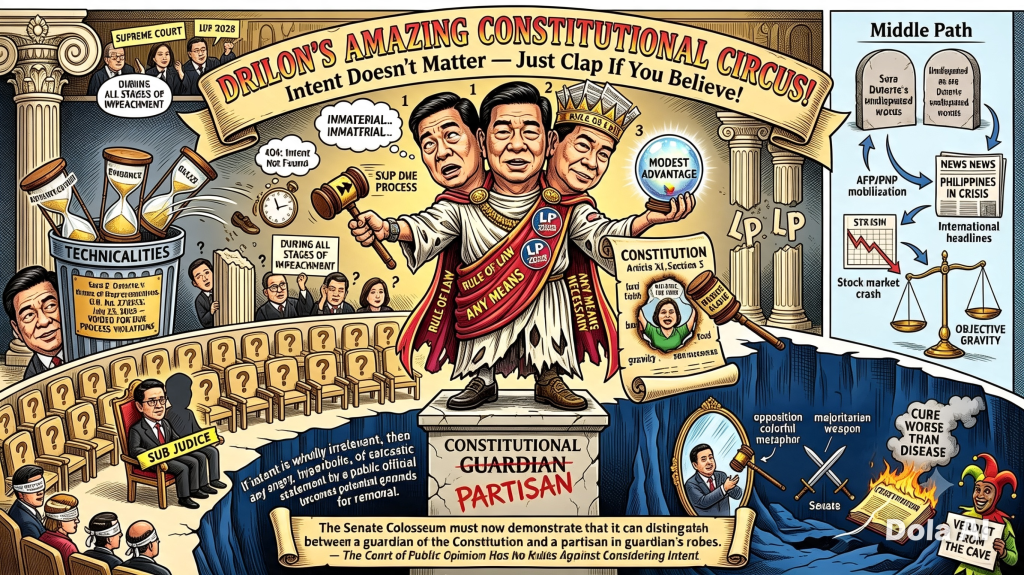
No mind-reading needed, says Drilon — just convict on the words alone. Due process? Optional.
By Louis ‘Barok‘ C. Biraogo — July 13, 2026
FORMER Senate President Franklin Drilon, that perennial statesman who has never met a camera he didn’t like, has descended from Olympus to bestow upon us mere mortals his latest constitutional revelation: Sara Duterte’s intent when she publicly declared she had arranged the assassination of the President, First Lady, and Speaker is, and I quote, “immaterial.”
Immaterial. Let that word marinate.
According to the Grand Inquisitor, the Senate Colosseum need not trouble itself with whether our Vice President actually meant to contract a hit squad or was merely indulging in some stress-relief hyperbole. The mere utterance, stripped of context and intent, is sufficient for constitutional damnation. It’s a breathtakingly convenient thesis—and one that collapses under the slightest legal scrutiny.
Drilon’s intervention comes in three parts: the immateriality thesis itself, a lament about trial inefficiency over video authentication, and an assessment that the prosecution holds a “modest advantage.” Let’s examine each before the Court of Public Opinion.

The Three-Headed Argument: Superficially Plausible, Substantively Brittle
On the immateriality thesis, Drilon is doctrinally half-right and dangerously half-wrong. Yes, impeachment is sui generis. Yes, Article XI, Section 3(7) of the 1987 Constitution of the Republic of the Philippines bifurcates impeachment removal from subsequent criminal prosecution. Yes, the 2012 Corona impeachment established that betrayal of public trust does not require a predicate crime—Chief Justice Corona was convicted for non-disclosure in his Statement of Assets, Liabilities, and Net Worth (SALN), a civil infraction, not a felony. These points are Constitution 101.
But here’s where the Elder Statesman’s logic performs a spectacular belly flop.
Corona was about an omission—a failure to disclose. Article IV against Duterte charges an affirmative, violent utterance: a declaration that she had “already given instructions” for retaliatory killings, punctuated with “No joke, no joke.” The distinction is not academic sophistry; it is the entire game. The constitutional gravity of an omission can be assessed largely from the objective fact of non-disclosure. But the gravity of a statement—is it a genuine threat, a rhetorical outburst, or a panicked cry from a mother who believes her family is under “Operation Romanov” surveillance?—cannot be assessed in a vacuum divorced from what the speaker actually meant.
The Supreme Court in Emilio A. Gonzales III v. Office of the President of the Philippines (G.R. No. 196231, September 4, 2012) defined betrayal of public trust as acts “attended by bad faith and of such gravity and seriousness as the other grounds for impeachment.” Bad faith. Gravity. These are not objective metrics that float free from intent. They are inquiries into the character and state of mind of the accused. Even retired Justice Adolfo Azcuna, has taken a different analytical route than Drilon, argues that intent must be inferred from capability and context—itself a mens rea inquiry that implicitly concedes intent’s materiality. You cannot simultaneously argue intent is irrelevant while constructing a circumstantial case to prove it. That’s not legal reasoning; that’s having your rhetorical cake and eating it too.
The Due-Process Irony: A Masterclass in Selective Memory
Drilon’s second argument—that the first three trial days were “wasted” on video authentication when Duterte’s camp has never denied she uttered the words—is procedurally pragmatic and constitutionally obtuse. He suggests a stipulation of facts — akin to Rule 118 of the 2000 Revised Rules of Criminal Procedure on pre-trial — would have saved everyone valuable time.
Let us all pause to savor the irony.
This is the same impeachment process where, merely one year ago in July 2025, the Supreme Court voided the first impeachment complaint against Duterte precisely on due-process grounds (Sara Z. Duterte v. House of Representatives (G.R. No. 278353, July 25, 2025)). The Court emphasized that procedural protections apply “during all stages of impeachment.” Yet here comes Drilon, dismissing the defense’s authentication objections as mere “technicalities” that obstruct the righteous march toward conviction.
Authentication under the Rules on Electronic Evidence (A.M. No. 01-7-01-SC) is not ceremonial nonsense. Whether a video is complete, unedited, and properly sourced are legitimate evidentiary questions. The defense has a constitutional right to demand that the prosecution prove its case rather than stipulate itself into a coffin. Drilon’s efficiency critique has surface appeal, but it conveniently ignores that the Senate’s own institutional legitimacy remains sub judice—the Escudero presiding-officer challenge and the 16-vote threshold dispute are live controversies that could retroactively taint every “efficient” ruling Drilon so desperately craves.
Calling due process a technicality from a man who styles himself a constitutional guardian is not just rich. It’s a trust fund of hypocrisy.
The Premature Coronation: Prophet or Partisan?
Finally, Drilon declares the prosecution holds an early “modest advantage.” At this stage? When only one witness has been fully cross-examined? When the “hitman” witness, Zuleika Lopez, and National Bureau of Investigation (NBI) Director Lotoc have yet to testify? When three of four articles—the ones involving ₱612.5 million in confidential funds, $110 million in flagged bank transactions, and Department of Education (DepEd) bribery allegations—remain completely untouched?
This is not analysis. This is narrative-shaping from a former Senate President who chairs the Liberal Party, the political organization historically opposed to the Duterte dynasty. Drilon’s likely motivations include “elder-statesman positioning” and “signaling to the Senate majority bloc.” He is not a neutral commentator describing the battlefield from a safe distance. He is a combatant firing artillery to soften the ground before the infantry advances.
The Central Tension: A Catch-All Without a Net
This brings us to the constitutional abyss Drilon’s thesis opens. How far can “betrayal of public trust” extend beyond criminal law without becoming an unlimited political weapon?
The framers of the 1987 Constitution, through Fr. Joaquin Bernas, intended the phrase as a catch-all for gross unfitness that falls short of indictable crime—tyrannical abuse of power, gross negligence, obstruction of justice. But Commissioner Christian Monsod also warned that a “plain error of judgment” should not casually become an impeachable betrayal. The Supreme Court in Gonzales v. Ochoa reinforced this by requiring conduct of “such gravity and seriousness as the other grounds for impeachment.”
Drilon’s “immaterial” formulation erases these limiting principles. If intent is wholly irrelevant, then any angry, hyperbolic, or sarcastic statement by a public official becomes potential grounds for removal. Today, a Vice President’s violent rhetoric. Tomorrow, an opposition senator’s colorful metaphor. Impeachment transforms from a constitutional safeguard into a majoritarian weapon, wielded by whichever faction controls the House and two-thirds of the Senate. The cure would be worse than the disease.
The Verdict from the Cave
The Senate must reject Drilon’s false binary. The choice is not between proving criminal grave threats under Article 282 of the Act No. 3815, otherwise known as the Revised Penal Code beyond reasonable doubt and convicting on an amorphous, intent-free standard of “unfitness.” A constitutionally sound middle path exists.
The Senate must determine that a Vice President—the immediate constitutional successor to the Presidency under Article VII of the 1987 Constitution—who publicly declares she has arranged the retaliatory assassination of the President, First Lady, and Speaker has committed an act of betrayal of public trust of the highest objective gravity. This determination requires no mind-reading, no speculation about subjective intent, no proof of an actual assassin. The words themselves, undisputed by the defense, and their institutional impact—the national security alarm, the mobilization of the Armed Forces of the Philippines (AFP) and the Philippine National Police (PNP), the international reputational damage—are the betrayal.
This path preserves the broad accountability purpose of “betrayal of public trust” while maintaining the gravity requirement that prevents it from becoming a partisan bludgeon. It delivers justice without sacrificing due process. It strengthens democratic institutions by establishing that violent rhetoric from the country’s second-highest official is per se incompatible with continued occupancy of the office.
Franklin Drilon is not wrong that impeachment is not a criminal trial. But he is dangerously wrong that intent is immaterial. The Senate Colosseum must now demonstrate that it can distinguish between a guardian of the Constitution and a partisan in guardian’s robes. The republic is watching. And the court of public opinion has no rules against considering intent.
Key Citations
A. Legal & Official Sources
- The 1987 Constitution of the Republic of the Philippines. Official Gazette of the Republic of the Philippines, 1987, http://www.officialgazette.gov.ph/constitutions/1987-constitution/.
- Emilio A. Gonzales III v. Office of the President of the Philippines. G.R. No. 196231. Supreme Court of the Philippines, 4 Sept. 2012. Lawphil, lawphil.net/judjuris/juri2012/sep2012/gr_196231_2012.html.
- Sara Z. Duterte v. House of Representatives. G.R. No. 278353. Supreme Court of the Philippines, 25 July 2025. Supreme Court of the Philippines, sc.judiciary.gov.ph/278353-278359-sara-z-duterte-vs-house-of-representatives-et-al-atty-israelito-p-torreon-et-al-vs-house-of-representatives-et-al/.
- Act No. 3815. An Act Revising the Penal Code and Other Penal Laws. 8 Dec. 1930. Official Gazette of the Republic of the Philippines, http://www.officialgazette.gov.ph/1930/12/08/act-no-3815-s-1930/.
- A.M. No. 01-7-01-SC (Rules on Electronic Evidence). 17 July 2001. Supreme Court of the Philippines. Lawphil, lawphil.net/courts/supreme/am/am_01-7-01_sc_2001.html.
- 2000 Revised Rules of Criminal Procedure. Supreme Court of the Philippines. Lawphil, https://lawphil.net/courts/rules/rc_110-127_crim.html.
B. News Reports
- Nazario, Dhel. “Drilon Says It’s ‘Immaterial’ if VP Duterte Meant Death Threat or Not.” Manila Bulletin, 11 July 2026, mb.com.ph/2026/07/11/drilon-says-its-immaterial-if-vp-duterte-meant-death-threat-or-not.efefb9
- Azcuna, Adolfo. “Azcuna: Grave Threat ‘Strongest’ Article vs VP Sara but Proving Malice Will Be Hard.” ANC, ABS-CBN News, 8 July 2026, http://www.youtube.com/watch?v=H5vt7nYxh50.
- Tolentino, Francis. “Defining ‘Betrayal of Public Trust’.” Manila Bulletin, 24 Feb. 2022, https://mb.com.ph/2022/2/24/defining-betrayal-of-public-trust

- “Ang Hirap Maging Mahirap”: The PAO Scandal That Proves Government Contempt Is Nothing New
- “Far-Off” My Axx: Malacañang’s Claire Castro Drowns in Her Own Legal Gaslighting
- “Forthwith” to Farce: How the Senate is Killing Impeachment—And Why Enrile’s Right (Even If You Can’t Trust Him)
- “HINDI AKO NAG-RESIGN!”

- “I Know Nothing”: Baste Duterte’s Amnesia Defense Meets ₱33M in GenCorp Contracts

- “I’m calling you from my new Globe SIM. Send load!”

- “Mahiya Naman Kayo!” Marcos’ Anti-Corruption Vow Faces a Flood of Doubt

- “Manageable” Debt, Unmanageable Lies: DBM’s ₱21 Trillion Fairy Tale

- “Meow, I’m calling you from my new Globe SIM!”

- “Natrabaho”: One Word, One Ombudsman, and a Judiciary on Trial
- “No Special Jail for Crooks!” Boying Remulla Slams VIP Perks for Flood Scammers

- “Philippine-Controlled” or Yankee Gas Station? The Davao Fuel Depot Farce Exposed





Leave a Reply