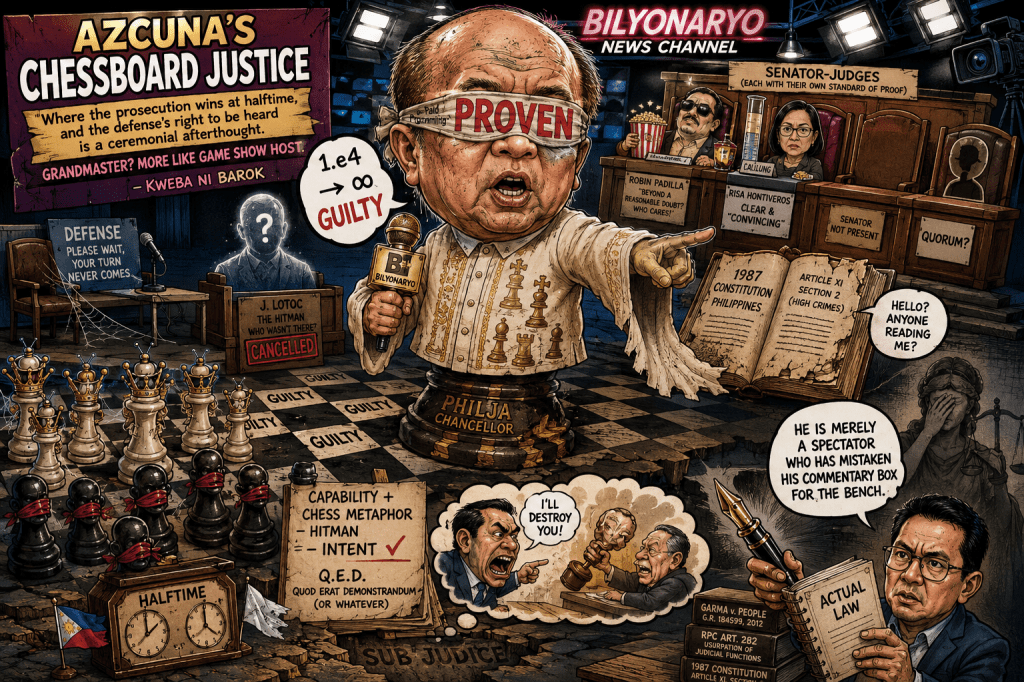
Grave threats proven before the defense even speaks — welcome to Azcuna’s impeachment.
By Louis “Barok” C. Biraogo — July 11, 2026
SOME retired justices spend their golden years writing memoirs, tending gardens, or quietly fading into the jurisprudential wallpaper. Not Adolfo Azcuna. The constitutional framer, former Supreme Court Associate Justice, and current Chancellor of the Philippine Judicial Academy (PHILJA) has apparently decided that his post-bench calling is to serve as the House prosecution’s unpaid closing-argument consultant—delivering his services not in a memorandum, but on Bilyonaryo News Channel, where he has unilaterally declared the impeachment trial of Vice President Sara Duterte essentially over after exactly one prosecution witness.
The legal community should be embarrassed. Not because Azcuna weighed in—retired justices have every right to speak. But because what spilled forth was less a careful doctrinal intervention and more a jurisprudential magic trick: behold the alchemy—’capability’ plus a chess metaphor, subtract a hitman, and somehow, poof, criminal intent appears
Let us count the ways this was a disaster wrapped in a barong.
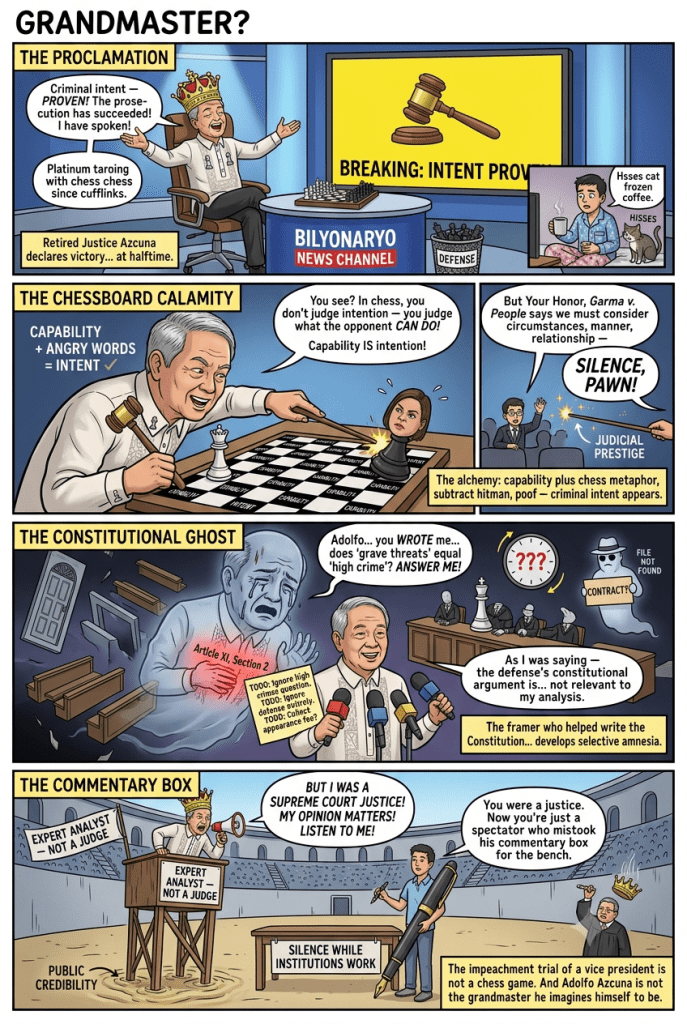
I. The Premature Verdict: Intent Proven, Trial Optional
Azcuna’s headline-grabbing assertion is that the prosecution “succeeded, I think, in proving criminal intent.” Let that sink in. After the testimony of exactly one witness—National Bureau of Investigation (NBI) Senior Agent John Mark Calilung, whose role was limited to authenticating a video—a retired Supreme Court justice has concluded that the mens rea (guilty mind) for grave threats is now a settled matter.
This is temporally incompetent. The defense has not presented a single witness. The NBI’s regional director, Jeremy Lotoc—the one actually expected to testify about the alleged hitman—had not yet taken the stand when Azcuna popped his judicial champagne. House prosecutor Ligutan himself conceded that the video may not “100 percent prove” that Duterte actually contracted an assassin. If the prosecution’s own lawyer hedges on the actus reus (guilty act), by what alchemy does Azcuna find the specific mens rea (guilty mind) for that unproven act conclusively established?
The defense has telegraphed a substantive theory: that the November 23, 2024 statement was conditional (“if I am killed”), emotionally charged (made amid the detention of Duterte’s chief of staff Zuleika Lopez), and thus lacking the unqualified deliberateness that dolo (malice) demands under Article 3 of Act No. 3815 (Revised Penal Code). Whether this defense succeeds is for the senator-judges to decide. That it exists at all makes Azcuna’s declaration of victory—before the defense has uttered a word in rebuttal—a grotesque parody of due process. In Azcuna’s courtroom, it seems, the prosecution wins at halftime, and the defense’s constitutional right to be heard is a ceremonial afterthought.
The hitman-shaped hole in the record is not a minor inconvenience; it is a chasm. The prosecution charges Duterte with contracting an assassination. Where is the contractor? Where is the contract? A ghost cannot anchor criminal intent. Azcuna’s willingness to ignore this absence suggests less a rigorous legal mind and more a theater critic reviewing a play after reading only the program notes.
II. The Chess Analogy Calamity: Capability Is Not Intent
Azcuna’s rhetorical centerpiece was a chess analogy: “You do not judge the opponent based on what you think his intention is; you base it on what he can do based on the position… Intention is shown by capability.”
This is, to be charitable, legally imprecise. To be accurate, it is doctrinal malpractice.
Capability and intent are distinct elements in criminal law. Article 282 of the Revised Penal Code (RPC), as interpreted by Garma v. People (G.R. No. 248317, March 16, 2022), requires an objective assessment of whether a reasonable person would consider the words as conveying a genuine threat, considering “the circumstances in which they were uttered, the manner in which they were spoken, the person to whom they were addressed, [and] the relationship between the accused and the complainant.” Yes, Azcuna correctly cites the objective test. But the Garma framework demands a holistic inquiry—precisely the sort that would weigh the conditional phrasing, the emotional context, and the absence of corroborating overt acts. A “reasonable person” does not mechanically input “Vice President + Angry Words = Criminal Intent” and call it a day.
Azcuna’s capability-equals-intention formula is a threat-assessment heuristic—useful for the NBI deciding whether to assign a security detail, not for a tribunal determining guilt. Conflating “she could do it” with “she intended to do it” is magical thinking dressed in juridical robes. If Azcuna’s logic governed, every CEO who bellows “I’ll destroy you” at a competitor would face conviction for grave threats simply because their bank account proves capability. This is not law; it is fortune-telling with a gavel.
Let’s state the obvious: capability may corroborate intent when combined with other evidence—the “no joke” admission, the pattern of prior violent remarks. Azcuna could have made that defensible, narrow argument. Instead, he offered a soundbite that collapses two distinct legal elements into one, gifting the defense a textbook example of prosecutorial overreach to flog on appeal.
III. The Constitutional Amnesia: What About “High Crimes”?
For a man who literally helped write the 1987 Constitution of the Republic of the Philippines, Azcuna displays a curious silence on the most consequential legal question in the room: even assuming Duterte committed grave threats under Article 282 of the RPC, does that constitute an impeachable “high crime” under Article XI, Section 2 of the 1987 Constitution?
Defense counsel Mark Vinluan has explicitly argued it does not: “Grave threats and inciting to sedition are ordinary RPC felonies triable before first-level courts—not constitutionally contemplated high crimes.” This is not a frivolous argument. It goes to the very heart of whether the Senate even has jurisdiction to remove a vice president for what is, at bottom, an alleged RPC violation. The Constitution’s impeachment grounds—treason, bribery, graft, culpable violation of the Constitution, betrayal of public trust, other high crimes—suggest offenses that strike at the political order itself, not every felony on the books.
Azcuna, a framer who presumably understands what the Constitutional Commission intended, says nothing about this. His entire analysis operates on the unstated and highly contestable premise that an RPC felony automatically translates into an impeachable offense. This is not an oversight; it is an evasion. For a man who has styled himself as the public’s legal educator throughout this impeachment saga, ignoring the single most constitutionally significant defense argument is either intellectual cowardice or a deliberate choice to play prosecutor rather than professor.
The Senate’s standard of proof only compounds the absurdity. As House prosecutor Rep. Luistro candidly acknowledged, the impeachment court has not adopted a uniform quantum of evidence—each senator-judge applies their own (preponderance, substantial evidence, or clear and convincing). Azcuna’s definitive “proved” is, therefore, mathematically incoherent. Proved by whose metric? Senator Robin Padilla’s? Senator Risa Hontiveros’? He doesn’t say. He cannot say. Because the trial is operating in an evidentiary void that his premature adjudication conveniently ignores.
IV. The Ethical Tightrope Walk (and Fall)
Azcuna is no longer a sitting magistrate, so the 2025 Code of Judicial Conduct and Accountability (A.M. No. 25-04-04-SC) prohibition on public commentary does not formally bind him. But he remains a member of the Philippine Bar, subject to the Code of Professional Responsibility and Accountability (A.M. No. 22-09-01-SC) general norm against statements calculated to influence pending adjudications. He is also the sitting Chancellor of the Philippine Judicial Academy (PHILJA)—an office that carries the institutional expectation of neutrality, or at minimum, of measured, scholarly distance.
What Azcuna offered was neither measured nor distant. It was legal artillery deployed on a business news channel, timed precisely to the trial’s opening week, advocating for one side’s theory of the case with the unearned finality of a verdict. This is not legal education. This is a retired high priest descending from the mountain to cheerlead in the coliseum, his judicial prestige serving as the prosecution’s unsworn expert witness.
The specter of sub judice (under judgment) looms large. Even if Azcuna’s comments fall short of formal contempt, they erode the public perception of judicial detachment. When a former Supreme Court justice declares a defendant’s criminal intent “proven” before the defense speaks, the message to the public is unmistakable: the fix is in, the robes have chosen sides, and the trial is mere pageantry.
He has, in short, politicized the very institutional capital his career accumulated. The PHILJA Chancellor should be teaching judges to avoid precisely this kind of prejudicial commentary. Instead, he has modeled it.
V. Synthesis: A Roadmap to Legitimate Conviction, or a How-To Guide for Reversible Error?
Azcuna’s defenders will say he merely offered a roadmap for how the Senate could legitimately convict: pattern evidence, objective capability assessment, the “no joke” admission. Fair enough. That roadmap exists and is legally coherent—if built carefully, with proper acknowledgment of counterarguments and the incomplete record.
But Azcuna didn’t build it carefully. He bulldozed the defense’s case, ignored the constitutional gravity question, and papered over the absence of the alleged hitman with a chess metaphor that doesn’t withstand five minutes of legal scrutiny. His commentary does not clarify the law; it weaponizes it. It does not educate the public; it poisons the well.
If the Senate convicts on Article IV, Azcuna’s premature cheerleading will have provided the defense a convenient appellate narrative: that the senator-judges were swayed not by evidence, but by the extrajudicial pronouncements of a retired justice wielding unearned authority. If the Senate acquits, his credibility as a dispassionate legal analyst will lie in tatters alongside his chessboard.
Call to Action and Recommendations
Transparency and accountability demand better. Justice demands that the Senate decide based on the full record, not on retired justices’ mid-trial media tours. The strengthening of democratic institutions requires that legal titans exercise their influence with discipline, not abandon it for soundbite glory.
To the Senate Impeachment Court: Adopt, immediately and publicly, a uniform evidentiary standard—preferably clear and convincing evidence—to eliminate the chaotic, standard-less environment Azcuna so gleefully exploits. Resolve the quorum and presiding-officer disputes decisively so that verdicts, when rendered, cannot be retroactively voided.
To Retired Justice Azcuna: Issue a public clarification. State, unambiguously, that your assessment was a provisional analysis of the prosecution’s theory, not an adjudicative finding. Acknowledge that the defense must be fully heard, and that the constitutional question of what constitutes a “high crime” remains unsettled. If you cannot bring yourself to do this, then at least have the decency to remain silent until the final gavel falls.
To the Legal Community: True institutionalism sometimes requires the discipline of silence while the institution you swore to serve does its work. Azcuna’s performance was a cautionary tale in how not to wield post-judicial influence. Let it be a lesson, not a template.
The impeachment trial of a vice president is not a chess game. And Adolfo Azcuna, for all his credentials, is not the grandmaster he imagines himself to be. He is, at this moment, merely a spectator who has mistaken his commentary box for the bench. The Senate must now show the discipline he has abandoned.
— Barok out.
Key Citations
A. Legal & Official Sources
- The 1987 Constitution of the Republic of the Philippines. Official Gazette of the Republic of the Philippines, 1987, http://www.officialgazette.gov.ph/constitutions/1987-constitution/.
- Act No. 3815. An Act Revising the Penal Code and Other Penal Laws. 8 Dec. 1930, http://www.officialgazette.gov.ph/1930/12/08/act-no-3815/.
- Garma v. People, G.R. No. 248317, 16 Mar. 2022, http://www.lawphil.net/judjuris/juri2022/mar2022/gr_248317_2022.html.
- New Code of Judicial Conduct for the Philippine Judiciary, A.M. No. 03-05-01-SC, 27 Apr. 2004.
- Code of Professional Responsibility and Accountability, A.M. No. 22-09-01-SC, 11 Apr. 2023, http://www.digest.ph/laws/code-of-professional-responsibility-and-accountability.
B. News Reports
- Bagaporo, Ruby Rose D. “Prosecution Proved Criminal Intent in VP Sara Death Threat – Ex-Justice.” Manila Standard, 8 July 2026, https://manilastandard.net/news/314764072/prosecution-proved-criminal-intent-in-vp-sara-death-threat-ex-justice.html.
- Bilyonaryo News Channel. “Did the Prosecution Establish Criminal Intent?” YouTube, 9 July 2026, https://youtu.be/k5o_JL-UvIU.
- ₱9 Billion in ‘Savings’? DILG’s Fire Truck Deal Smells Like Smoke

- ₱8B BBM Pork: CCTV for Every Captain’s Kumpare?

- ₱8.9 Billion, 331 Ghost Police Stations: The TIKAS Scandal Explained

- ₱8.4 Billion, 42,000 Barangays, 1 Election: The “Bawat Barangay Makikinabang” Vote-Buying Masterclass

- ₱75 Million Heist: Cops Gone Full Bandit

- ₱63 to the Dollar: The Only Thing Falling Faster Than the Peso Is the Government’s Credibility

- ₱6.77B Ghost Haunts Duterte: RTC Dismisses Mans Carpio’s Desperate Plea
- ₱6.77 Billion and Zero Cash: The Sara Duterte SALN Math That Doesn’t Add Up

- ₱6.7-Trillion Temptation: The Great Pork Zombie Revival and the “Collegial” Vote-Buying Circus

- ₱58.53B, Zero Receipts: The LGSF Pork Barrel Nobody Wants to Name
- ₱53 Million Man Tells ₱695-a-Day Workers to Stop Being ‘Mayabang’: The Audacity of BSP’s Remolona

- ₱4.4 Billion and a Witness Who Can’t Explain It: The Duterte Impeachment’s Most Expensive Non-Answer





Leave a Reply