Quorum Assassination: How Cayetano Chose Political Survival Over Senate Duty
By Louis ‘Barok‘ C. Biraogo — June 2, 2026
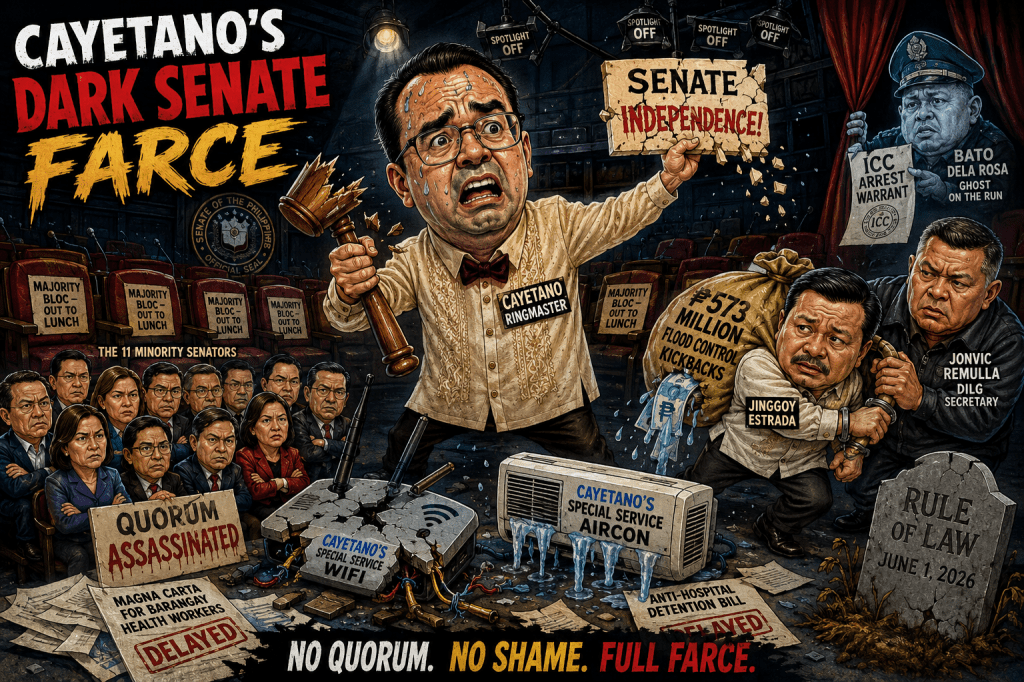
THE Senate chamber went dark on June 1, 2026. Air-conditioning off. WiFi cut. Eleven minority senators sat waiting like fools in an empty theater while the Cayetano-led majority staged the most transparent political walkout since the PDAF scam. This was not “Senate independence.” This was a quorum assassination in broad daylight, dressed up in constitutional drag.
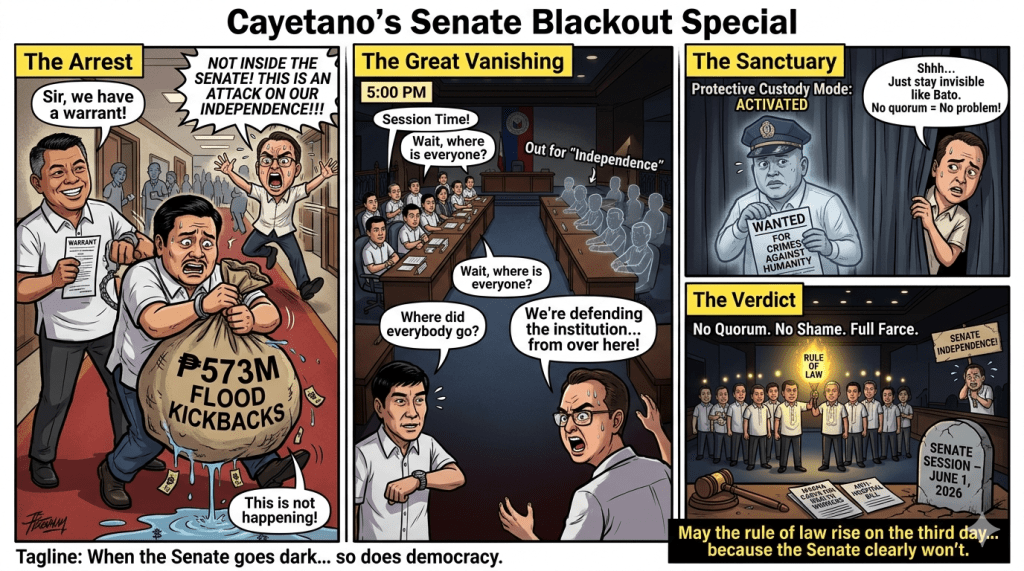
What actually happened is brutally simple. Hours after the Sandiganbayan’s Fifth Division issued a no-bail plunder warrant against Sen. Jinggoy Estrada for ₱573 million in alleged flood-control kickbacks, DILG Secretary Jonvic Remulla personally served it inside the Senate. Senate President Alan Peter Cayetano threw a tantrum, invoked some phantom “historical courtesy” from the Salonga-Enrile era, and then simply failed to show up for the 5 p.m. session. Eleven majority senators vanished with him. No quorum. No legislation. Just power arithmetic in its ugliest form.
The Quorum Hit Job: Boycott or Political Suicide?
The minority is right: this was a deliberate political boycott, not institutional resistance. The Cayetano bloc’s majority had already been reduced to a precarious 11-11 parity by Estrada’s arrest and Ronald “Bato” dela Rosa’s extended vacation from justice. A floor test would have exposed the Senate President’s grip as mathematical fiction. So they killed the session rather than risk it. Public business — the Magna Carta for Barangay Health Workers, the Anti-Hospital Detention Bill, citizenship measures, CA appointments — became acceptable collateral damage.
Public office is a public trust, Article XI, Section 1 of the 1987 Constitution of the Republic of the Philippines declares. On June 1 the majority treated it as a private sanctuary.
Legal Fiction Unmasked: The Constitutional Farce Unravels
Let us be legally rigorous. Article VI, Section 11 of the 1987 Constitution of the Republic of the Philippines is crystal clear: senators enjoy arrest privilege only for offenses punishable by not more than six years imprisonment. Plunder under Republic Act No. 7080 (Plunder Law) carries reclusion perpetua. Graft under Republic Act No. 3019 (Anti-Graft and Corrupt Practices Act), Section 3(e) carries 6-15 years. The privilege does not apply.
The Supreme Court settled this decades ago in People v. Jalosjos (G.R. Nos. 132875-76, 2000): a legislator’s confinement for a non-bailable offense does not violate the Constitution. Legislative functions do not create a force field around criminals. Cayetano’s theatrical invocation of “co-equal branch” independence is legally hollow and morally bankrupt. There is no constitutional, statutory, or Senate rule granting the chamber sanctuary status. Remulla was correct: the “courtesy” was forfeited the moment the Senate helped Bato dela Rosa slip out during that conveniently timed “shooting incident.”
Cayetano’s “Independence” Smoke Screen, Torched
The boycott itself flirts with procedural abuse. Article VI, Section 16(2) requires a majority quorum to do business, but it does not authorize the presiding officer to unilaterally cancel a scheduled session to protect his numbers. Senate Rule IX on quorum and the spirit of collective self-governance were weaponized for factional survival. This is not independence; this is institutional sabotage.
Jinggoy’s No-Bail Plunder Warrant: Rule of Law Wins
Cayetano’s strongest card — selective prosecution and executive timing — deserves acknowledgment before demolition. Yes, the Marcos-Duterte rupture provides motive. Yes, the arrest’s timing was politically exquisite. And yes, flood-control anomalies have implicated players across factions.
But selective prosecution claims require clear proof of bad faith. A lawful Sandiganbayan warrant after probable cause is not nullified by political suspicion. More damning: Cayetano’s own leadership was born of a coup enabled by a fugitive senator evading an ICC warrant for crimes against humanity. If the Senate President truly believed in independence, he would not have installed himself on the deciding vote of a man hiding from international justice, then cried “encroachment” when the executive finally enforced domestic law against a plunder suspect. The hypocrisy is so thick you could flood-control an entire province with it.
Bato’s Long Shadow: The Fugitive Who Paralyzed the Senate
Jinggoy Estrada is a recidivist in the dock — previously arrested for plunder in 2001 alongside his father and again in the 2014 pork barrel scam. The current charges allege an “intricate mechanism” of budget insertions at DPWH in exchange for kickbacks exceeding ₱500 million. This is not political persecution; this is the anti-graft machinery finally doing its job on a serial offender.
The minority’s position is unassailable: the Senate cannot function as a sanctuary for corruption suspects. Republic Act No. 6713 (Code of Conduct and Ethical Standards for Public Officials and Employees) demands professionalism and avoidance of conduct prejudicial to public service. Boycotting sessions to shield an ally violates that duty. Presidential Decree No. 1829 (Obstruction of Justice)’s provisions may even loom over Cayetano’s personal intervention during warrant service.
The Great Flood Control Heist: Kickbacks in the Budget
At the gravitational center sits Bato dela Rosa — ICC fugitive, coup kingmaker, and living proof that the Senate has become a halfway house for the internationally wanted. His absence (plus Estrada’s detention) created the 11-11 parity Cayetano refused to test. The Marcoleta virtual-voting gambit was a naked attempt to launder a fugitive’s participation. The minority walkout on May 26 correctly killed that constitutional abomination.
Obstruction and Ethics Charges: The Majority’s Growing Legal Headache
The deeper rot is the flood-control racket itself — massive appropriations, recurring floods, and persistent rumors of legislative insertions turned into kickback pipelines. This mirrors the PDAF and DAP scandals. It is systemic patronage masquerading as public works. Every arrested senator reinforces the public’s correct suspicion that infrastructure budgets remain a political ATM.
Democracy Held Hostage: The Real Victim of Senate Paralysis
Cayetano’s conduct invites scrutiny under Presidential Decree No. 1829 (Obstruction of Justice), Republic Act No. 6713 ethics violations, and potentially Article 150 of the Revised Penal Code (RPC) (Disobedience to Summons Issued by Congress). The boycotting senators risk ethics complaints under Article VI, Section 16(3) for disorderly behavior. The Ombudsman and Sandiganbayan should treat the boycott as a live exhibit of institutional capture. Citizen complaints are not only warranted — they are democratic duty.
This is not mere theater. Legislative paralysis, quorum weaponization, and sanctuary politics erode public trust at the exact moment the Senate should be checking executive power and addressing real crises. When senators prioritize faction over Filipino people, democracy itself becomes the hostage.
Barok’s Antidote: Reforms to Kill the Sanctuary
- Immediate ethics complaints and possible Ombudsman cases against the boycotters and Cayetano for dereliction and obstruction.
- Senate rule reforms codifying compelled attendance with real penalties (salary forfeiture, censure).
- Ban on virtual voting for members evading lawful process.
- Full expansion of the flood-control probe — no sacred cows.
- Judicial clarification via mandamus or quo warranto on the Senate President’s duty to convene scheduled sessions.
- Structural budget reform ending opaque legislative insertions.
Barok’s Final Verdict: The Senate Belongs to the People
The minority bloc stood for the rule of law. The Cayetano majority stood for survival at any cost — even the cost of turning the Senate into a darkened, air-conditioned tomb while the people’s business died outside.
“Senate independence” was never the issue. The issue was whether the chamber belongs to the Filipino people or to political dynasties, fugitives, and plunder artists. On June 1, 2026, the majority gave its answer.
The rule of law does not knock politely at the Senate door and wait for permission. It enters. It arrests. It demands accountability. And any senator who treats that entrance as an “encroachment” has already confessed whose side he is truly on.
May the rule of law rise on the third day. 🪨
Key Citations
A. Legal & Official Sources
- The 1987 Constitution of the Republic of the Philippines. Official Gazette of the Republic of the Philippines, 1987, https://www.officialgazette.gov.ph/constitutions/1987-constitution/.
- Philippines, Congress. Republic Act No. 7080: An Act Defining and Penalizing the Crime of Plunder. 1991, https://lawphil.net/statutes/repacts/ra1991/ra_7080_1991.html.
- Philippines, Congress. Republic Act No. 3019: Anti-Graft and Corrupt Practices Act. 1960, https://lawphil.net/statutes/repacts/ra1960/ra_3019_1960.html.
- Philippines, Congress. Republic Act No. 6713: The Code of Conduct and Ethical Standards for Public Officials and Employees. 1989, https://lawphil.net/statutes/repacts/ra1989/ra_6713_1989.html.
- Philippines, Office of the President. Presidential Decree No. 1829: Penalizing Obstruction of Justice and Certain Other Acts. 1981, https://lawphil.net/statutes/presdec/pd1981/pd_1829_1981.html.
- Philippines. Senate. Rules of the Senate. 20th Congress, Senate of the Philippines, Sept. 2025, legacy.senate.gov.ph/rules%20of%20the%20senate-Sept.%209,%202025.pdf.
- Philippines. “Act No. 3815, s. 1930 (The Revised Penal Code).” Official Gazette of the Republic of the Philippines, 8 Dec. 1930, http://www.officialgazette.gov.ph/1930/12/08/act-no-3815-s-1930/.
- Philippines, Supreme Court. People v. Jalosjos. G.R. Nos. 132875-76, 3 Feb. 2000, https://lawphil.net/judjuris/juri2000/feb2000/gr_132875_2000.html.
B. News Reports
- “Senate Majority Absent as Session Fails to Convene on June 1, 2026.” Rappler, 1 June 2026, https://www.rappler.com/philippines/senate-majority-absent-session-june-1-2026/.
- Servallos, Neil Jayson. “Majority No-Show as Senate Fails to Convene.” Philstar.com, Philstar, 2 June 2026, https://www.philstar.com/headlines/2026/06/02/2532177/majority-no-show-senate.
- “Ang Hirap Maging Mahirap”: The PAO Scandal That Proves Government Contempt Is Nothing New
- “Far-Off” My Axx: Malacañang’s Claire Castro Drowns in Her Own Legal Gaslighting
- “Forthwith” to Farce: How the Senate is Killing Impeachment—And Why Enrile’s Right (Even If You Can’t Trust Him)
- “HINDI AKO NAG-RESIGN!”

- “I Know Nothing”: Baste Duterte’s Amnesia Defense Meets ₱33M in GenCorp Contracts

- “I’m calling you from my new Globe SIM. Send load!”

- “Mahiya Naman Kayo!” Marcos’ Anti-Corruption Vow Faces a Flood of Doubt

- “Manageable” Debt, Unmanageable Lies: DBM’s ₱21 Trillion Fairy Tale
- “Meow, I’m calling you from my new Globe SIM!”

- “Natrabaho”: One Word, One Ombudsman, and a Judiciary on Trial
- “No Special Jail for Crooks!” Boying Remulla Slams VIP Perks for Flood Scammers

- “Philippine-Controlled” or Yankee Gas Station? The Davao Fuel Depot Farce Exposed






Leave a Reply