
When Loyalty Trumps Law: Dayanghirang’s Pre-Judged Verdict
By Louis ‘Barok‘ C. Biraogo — July 9, 2026
MY beloved Dabawenyos, fellow travelers in this sinking archipelago we call a republic, gather ’round the cave. Barok has seen the headlines, and frankly, I need a stiff drink. From the hallowed, or perhaps hollowed, halls of the Davao City Council, a new prophet has emerged. His name is Councilor Danilo Dayanghirang, and on July 7, in the Year of Our Lord 2026, he delivered a sermon at the Pulong-Pulong sa Dabawenyos that deserves to be framed and hung in the gallery of Philippine political absurdities.
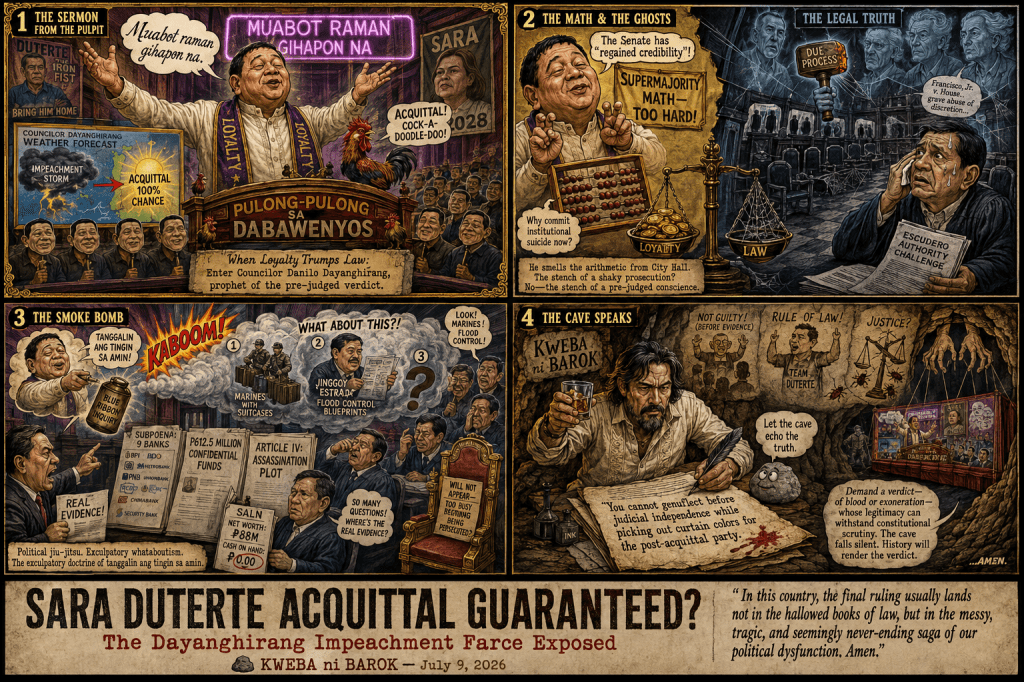
The Sermon from the Councilor’s Pulpit
Our subject’s thesis, delivered with the serene confidence of a man betting on a cockfight, is that Vice President Sara Duterte’s impeachment trial is a mere formality en route to a divinely ordained acquittal. “Muabot raman gihapon na,” he says—it will come eventually. A legal analysis so profound it echoes the existential musings of a weather forecaster. He praises the Senate for “regaining credibility” while simultaneously predicting they will fail to convict, a rhetorical maneuver akin to complimenting a surgeon’s bedside manner while betting your life savings he’ll botch the operation. This is not political analysis; it is political acupuncture, strategically placing tiny, painless needles of loyalty to relieve the pressure on his dynastic patrons.
Sixteen Cold Hearts: The Supermajority Math
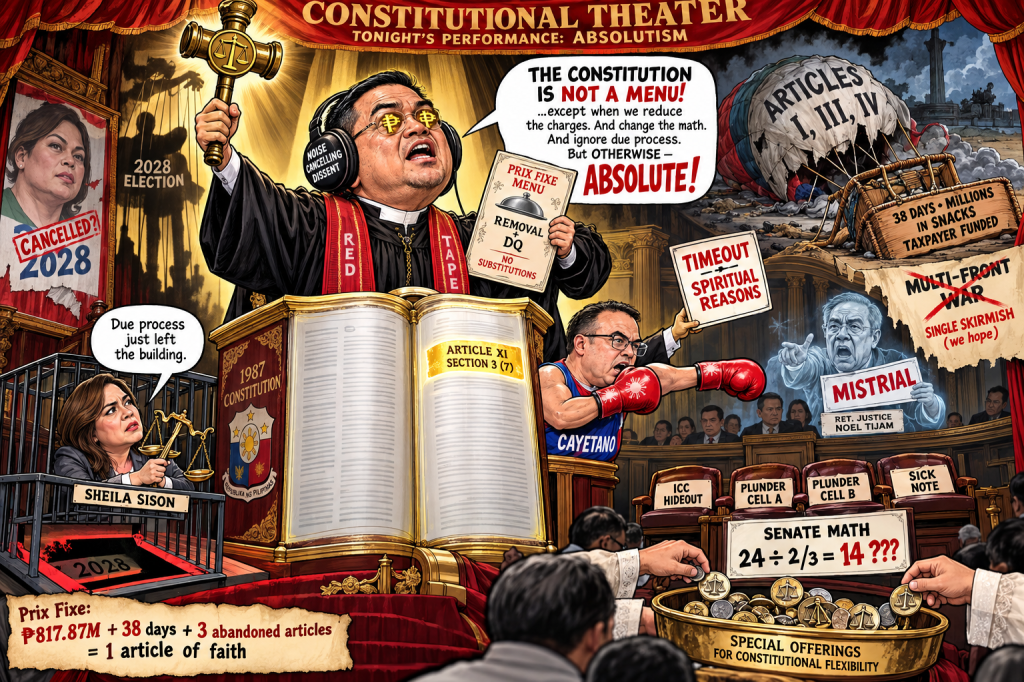
Let us dissect the beauty of this intellectual mess. Dayanghirang’s position is most compelling not on the law, but on the raw, ugly math. He knows, as we all do, that the constitutional threshold for conviction under Article XI, Section 3(6) of the 1987 Constitution of the Republic of the Philippines is a brutal two-thirds supermajority of the Senate—16 cold, beating hearts in a 24-member chamber. He can smell the arithmetic from City Hall, and the stench of a shaky prosecution case is unmistakable. The Supreme Court’s 2025 demolition of the first impeachment complaint in Sara Z. Duterte v. House of Representatives, G.R. No. 278353 wasn’t just a legal setback; it was a constitutional branding iron that seared due process into the flesh of the House’s gung-ho prosecutors. The defense’s subsequent petition to the High Court, questioning Senator Francis Escudero’s very authority to preside, is not a frivolous technicality. It is a ghost story the senator-judges hear every night, a chilling whisper of Francisco, Jr. v. House of Representatives, G.R. No. 160261 that reminds them their every move is potentially a grave abuse of discretion justiciable by a Supreme Court eager to police its turf. The councilor’s restraint in delaying a formal City Council resolution is, I concede, a pearl of political wisdom. Why commit institutional suicide now when you can wait for the trial to bleed out on its own?
The Cardinal Sin of the Pre-Judger
But here in the Kweba, we trade in law, not in horoscopes. And Dayanghirang’s prophecy crumbles upon contact with the most basic standard of his own professed respect for the rule of law. This man preaches deference to the senator-judges as the “duty-bound” arbiters of the Constitution in one breath, and in the next, declares their verdict a foregone conclusion before a single witness has survived cross-examination. You cannot logically genuflect before the altar of judicial independence while simultaneously picking out the curtain colors for the post-acquittal victory party. This is the cardinal sin of the pre-judger, a direct, if unenforceable, affront to the Republic Act No. 6713 (Code of Conduct and Ethical Standards for Public Officials and Employees) ethical standards he is ostensibly bound by, specifically the norms of “justness and sincerity” and “commitment to public interest,” which are violently incompatible with publicly rigging the outcome of a constitutional process. It’s like a juror announcing a “not guilty” verdict before hearing the evidence, then lecturing the defendant on the sanctity of the trial. A farce of the first order.
Smoke, Mirrors, and the Blue Ribbon Diversion
And then there is the masterstroke of misdirection: Dayanghirang’s call for a Blue Ribbon Committee inquiry into the “Marines and flood-control projects.” Oh, maestro. This is not a genuine call for systemic accountability. This is political jiu-jitsu. As the impeachment court finally gets to the business of subpoenaing nine banks for the VP’s potentially non-existent cash deposits, the councilor heroically throws a smoke bomb of whataboutism into the arena. “Look over there!” he cries. “Marines with mystery suitcases and Jinggoy Estrada’s flood-control kickbacks!” This is the exculpatory doctrine of ayaw mi tan-awa (divert your gaze from us). Evidence of potential corruption elsewhere does not vaporize the damning Article IV charges of an assassination plot against a sitting President, nor does it magically transform P612.5 million in confidential funds into clean, unassailable public service. It is a diversionary tactic, pure and simple, and a transparently desperate one at that.
The Toxic Marcos-Duterte Colosseum
Let’s now eviscerate the theater entire, this toxic Marcos-Duterte political war that makes the Colosseum look like a Sunday picnic. The Duterte camp’s legal strategy is not a defense; it’s a machine designed to run out the clock until 2028. They disrupt, they delay, they file endless petitions, they challenge the very jurisdiction of a Senate whose members they once called allies. Their argument—”there’s no proof she hired an assassin”—is a legal magician’s misdirection. They frame the charge as a failed murder conspiracy, ignoring that under the majestic, terrifyingly broad standard of “betrayal of public trust,” a Vice President’s invocation of murder against a President is the crime itself, whether money changed hands or not. Their goal is a self-fulfilling prophecy: by labeling the whole thing a political persecution, they seek to harden the resolve of their senatorial bloc to a point where the supermajority becomes mathematically impossible.
Across the aisle, the prosecution’s toolkit is just as tarnished. The House’s raw, 255-lawmaker vote to impeach wasn’t a pure cry for accountability; it was a political blitzkrieg. We are left to decipher what shadows lurk behind the scenes: coercion to secure votes, disinformation campaigns to shape public narrative, and the weaponizing of congressional probes, all meant to mask political interference as legal procedure. The subpoenas served on nine banks are the perfect crucible. This is where the trial truly becomes explosive. The prosecution thinks its impeachment power is a universal skeleton key that can blow open the absolute confidentiality of foreign currency deposits under Republic Act No. 6426 (Foreign Currency Deposit Act of the Philippines). The defense is counting on the Supreme Court’s bank secrecy jurisprudence—the hallowed ghost of Salvacion v. Central Bank of the Philippines, G.R. No. 94723—to slam that door shut. The financial forensics of Duterte’s spectacularly absurd Statement of Assets, Liabilities, and Net Worth (SALN), which claims a net worth of P88 million with zero cash on hand, will either be the prosecution’s guillotine or its own fatal overreach.
Democracy’s Cesspool at High Tide
This is the sewer of Philippine democracy at high tide. We witness the extra-legal toolkit deployed in all its glory: bribery, blackmail, witness intimidation, rigged procedural rules, and procedural ambushes orchestrated through a compromised Senate leadership wrestling with an existential constitutional silence over who, in heaven’s name, should preside.
What Must the Senator-Judges Do?
So what is to be done, other than stockpile canned goods? The senator-judges, if they wish to salvage a crumb of institutional honor, must stop acting like party whips and start acting like what the 1987 Constitution demands: impartial judges of fact and law, who understand that Article XI, Section 1’s declaration that “public office is a public trust” is not just a preamble slogan. The Supreme Court must rule, and rule decisively, on the Escudero question, for ambiguity is the breeding ground for anarchy. And the public? Your duty is to see with clear eyes. Do not be a Dayanghirang, a partisan hack cloaking predictions of loyalty in the vestments of legal analysis. Demand a verdict, be it of blood or exoneration, whose legitimacy can withstand the most rigorous constitutional scrutiny.
For now, the cave falls silent. The councilor has made his prediction. I have made my critique. History will render the verdict. And as I pour myself another metaphorical whiskey to wash the taste of this tragedy from my mouth, I know that in this country, the final ruling usually lands not in the hallowed books of law, but in the messy, tragic, and seemingly never-ending saga of our political dysfunction. Amen.
🪨 Let the cave echo the truth.
Key Citations
A. Legal & Official Sources
- The 1987 Constitution of the Republic of the Philippines. Official Gazette of the Republic of the Philippines, 1987, http://www.officialgazette.gov.ph/constitutions/1987-constitution/.
- Republic Act No. 6713. An Act Establishing a Code of Conduct and Ethical Standards for Public Officials and Employees. 20 Feb. 1989. Lawphil Project, lawphil.net/statutes/repacts/ra1989/ra_6713_1989.html.
- Republic Act No. 6426. An Act Instituting a Foreign Currency Deposit System in the Philippines, and for Other Purposes. 4 Apr. 1974. Lawphil Project, lawphil.net/statutes/repacts/ra1974/ra_6426_1974.html.
- Sara Z. Duterte v. House of Representatives. G.R. No. 278353. Supreme Court En Banc, 25 July 2025. Lawphil, lawphil.net/judjuris/juri2025/jul2025/gr_278353_2025.html.
- Francisco, Ernesto B., Jr. v. House of Representatives. G.R. No. 160261. Supreme Court of the Philippines, 10 Nov. 2003, lawphil.net/judjuris/juri2003/nov2003/gr_160261_2003.html.
- Salvacion v. Central Bank of the Philippines. G.R. No. 94723. Supreme Court En Banc, 21 Aug. 1997. Official Gazette of the Republic of the Philippines, http://www.officialgazette.gov.ph/1997/08/21/g-r-no-94723-august-21-1997/.
B. News Reports
- Patumbon, Rojean Grace G. “Dayanghirang Expects Sara Duterte Acquittal.” SunStar, 8 July 2026, http://www.sunstar.com.ph/story/davao/dayanghirang-expects-duterte-acquittal.
- “Ang Hirap Maging Mahirap”: The PAO Scandal That Proves Government Contempt Is Nothing New

- “Far-Off” My Axx: Malacañang’s Claire Castro Drowns in Her Own Legal Gaslighting
- “Forthwith” to Farce: How the Senate is Killing Impeachment—And Why Enrile’s Right (Even If You Can’t Trust Him)

- “HINDI AKO NAG-RESIGN!”

- “I Know Nothing”: Baste Duterte’s Amnesia Defense Meets ₱33M in GenCorp Contracts

- “I’m calling you from my new Globe SIM. Send load!”

- “Mahiya Naman Kayo!” Marcos’ Anti-Corruption Vow Faces a Flood of Doubt

- “Manageable” Debt, Unmanageable Lies: DBM’s ₱21 Trillion Fairy Tale
- “Meow, I’m calling you from my new Globe SIM!”

- “Natrabaho”: One Word, One Ombudsman, and a Judiciary on Trial

- “No Special Jail for Crooks!” Boying Remulla Slams VIP Perks for Flood Scammers

- “Philippine-Controlled” or Yankee Gas Station? The Davao Fuel Depot Farce Exposed





Leave a Reply