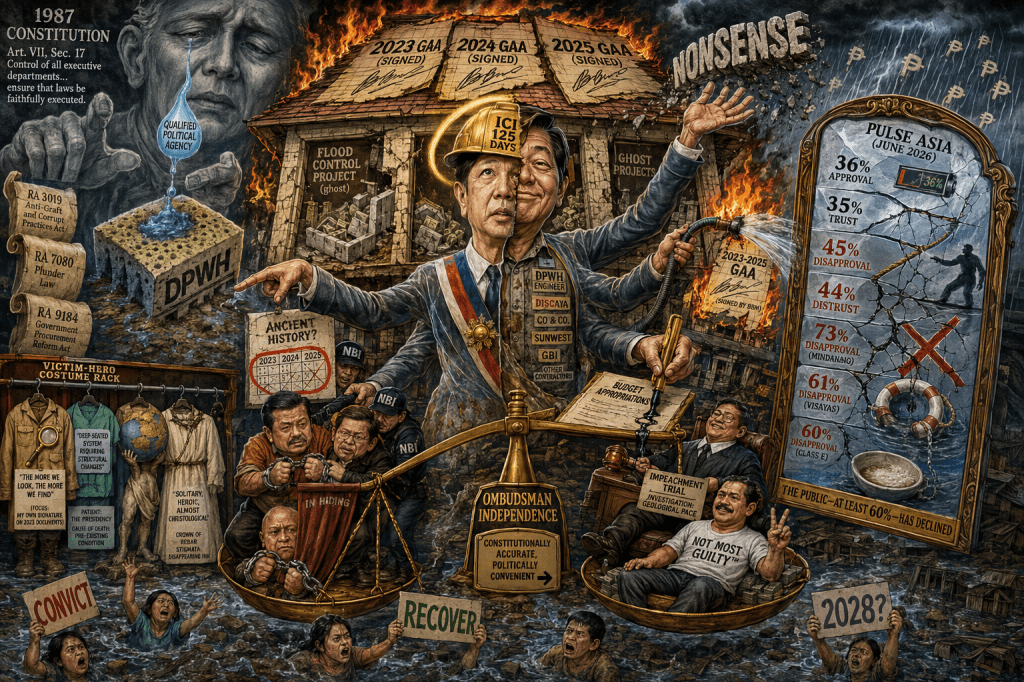
Selective justice, inherited graft, and one word that says it all: Nonsense.
By Louis ‘Barok‘ C. Biraogo — July 7, 2026
SOMEWHERE between a trade handshake and a diaspora photo-op, President Ferdinand “Bongbong” Marcos Jr. paused his North American charm offensive to deliver what may be the most unintentionally revealing presidential statement since his father declared martial law and called it “democratic revolution.”
The occasion? A reporter’s question about calls for his ouster over the metastasizing flood control corruption scandal. The response? A single word that deserves engraving on Malacañang’s gates as this administration’s unofficial motto: “Nonsense.”
Not “I understand the public’s concern.” Not “We are investigating thoroughly.” Not even the classic Filipino deflection of “That is a matter best addressed to the proper authorities.”
Nonsense. As if impeachment, public accountability, and the inconvenient fact that the largest budget manipulations occurred on his watch could all be waved away with a royal hand-swipe.
But let us not be hasty. In that single word lies the entire architecture of Marcos’s defense — a construction so audacious, so structurally unsound, and yet so politically familiar that it deserves forensic dissection.
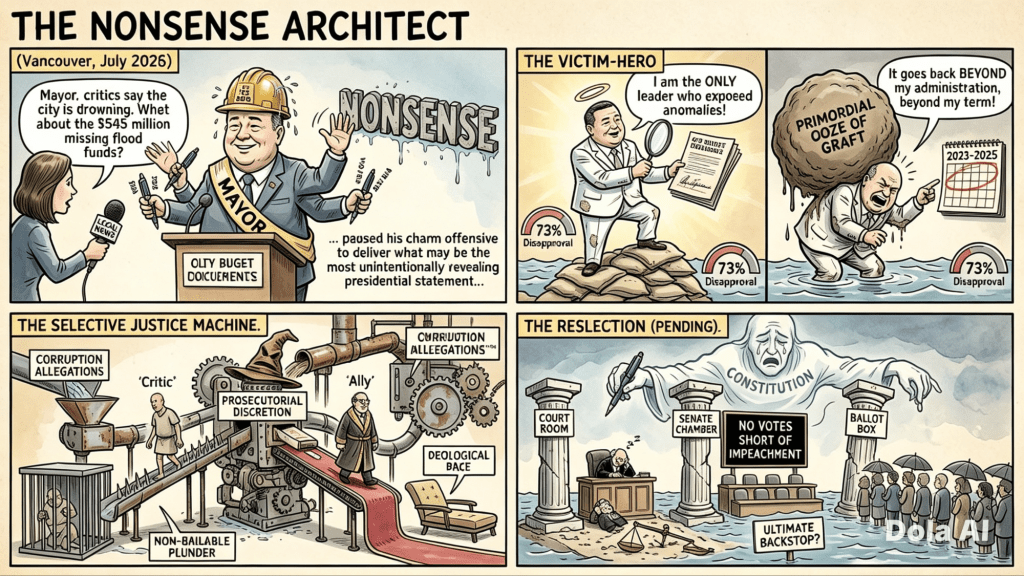
The Victim-Hero: A Character Study
There is a particular species of political narrative that flourishes in Philippine governance: the leader who arrives to find the house burning, grabs a hose, and demands gratitude for the water — while ignoring that he signed the fire code exemptions, approved the faulty wiring, and lived in the house three years before noticing the flames.
Marcos’s Vancouver statement is a masterclass:
“I am the only president who exposed anomalies.” Not “I exposed anomalies.” But “I am the only president.” The comparative framing transforms belated acknowledgment into singular presidential courage. Previous presidents didn’t look. Duterte knew but did nothing. Marcos alone — solitary, heroic, almost Christological — had the courage to peek under the rug.
“It goes back beyond my administration, beyond my term.” The corruption is prehistoric. It predates consciousness. Marcos inherited this primordial ooze of graft and now, Atlas-like, shoulders the burden of cleaning a mess stretching back to administrations he did not serve, decisions he did not make, and budgets he… wait. Here the narrative begins its slow, almost imperceptible collapse.
“We are not done yet… the more we look, the more we find.” The archaeologist defense: we keep digging, discovering artifacts of ancient malfeasance. The sheer volume of historical corruption explains both the slow pace and the absence of high-profile convictions.
“A deep-seated system requiring structural changes and a change in attitude.” The pièce de résistance: the president presiding over the system diagnoses it as sick. The surgeon who performed the operation declares the patient dying before the scalpel touched skin. The captain announces the vessel was already taking water when he assumed command — and demands commendation for finally noticing the flooding.
Three Collapse Points
Like a building on liquefied soil, the victim-hero paradox appears solid until subjected to cross-examination’s tremors.
One: The Temporal Contradiction
The largest documented budget manipulations occurred between 2023 and 2025. These are not ancient history. They are not sins of the fathers. They are sins of this administration, signed into law by this president, executed by this executive branch.
The 2023 General Appropriations Act bore Marcos’s signature. The 2024 budget — his signature. The 2025 budget — his signature again. The unprogrammed appropriations, confidential funds, and legislative insertions that transformed the national budget into a slush fund with line items — all passed through the same presidential pen now claiming to have been “shocked” by their existence.
This is not merely political; it is logical. Either Marcos knew about the manipulations when signing (making his “discovery” fraudulent), or he did not know (demolishing his claim of competence as Chief Executive). There is no third door.
The Independent Commission for Infrastructure (ICI) operated for a mere 125 days — a sliver of the time during which corruption occurred, and corruption occurring substantially during the presidency of the man who created the commission. This is not cleanup; it is archaeological excavation of one’s own kitchen midden, conducted with the solemn air of discovering a previous civilization’s crimes.
Two: The Constitutional Duty Problem
Article VII, Section 17 of the 1987 Constitution of the Republic of the Philippines vests in the President “control of all the executive departments, bureaus, and offices.” The doctrine of qualified political agency holds that Cabinet secretaries act as the President’s alter egos. When the Department of Public Works and Highways (DPWH) disbursed funds for ghost projects, it did so as an extension of executive authority. When the Department of Budget and Management (DBM) facilitated congressional insertions, it did so within a chain of command terminating at the President’s desk.
The same provision commands the President to “ensure that the laws be faithfully executed.” Republic Act No. 3019 (Anti-Graft and Corrupt Practices Act) is a law. Republic Act No. 7080 (An Act Defining and Penalizing the Crime of Plunder) is a law. Republic Act No. 9184 (Government Procurement Reform Act) is a law. The President’s constitutional obligation is to ensure their faithful execution — not to express surprise when violated on an industrial scale, not to create a temporary commission to investigate violations on his watch, and certainly not to dismiss accountability calls as “nonsense.”
Claimed ignorance provides no valid defense. The Chief Executive cannot plead unfamiliarity with the executive branch’s operations. If flood control corruption was as pervasive as Marcos now claims, his constitutional duty was to know about it, prevent it, and stop it — not “discover” it three years into his term and demand applause.
Three: The Public Skepticism Problem
Pulse Asia‘s March 2026 numbers are brutal: 36% approval, 35% trust, 45% disapproval, 44% distrust. Mindanao: 73% disapproval. Visayas: 61% disapproval. Class E: 60% disapproval. These are not numbers of a president whose anti-corruption narrative resonates. These are numbers of a president whose public has stopped believing.
Public opinion is not a legal argument — the Constitution provides no removal by poll number. But sustained skepticism erodes the political capital necessary to govern. It emboldens opponents. It transforms “nonsense” from elegant dismissal into a question the president can no longer avoid.
For the public to accept the victim-hero framing, they must believe Marcos was simultaneously powerful enough to be betrayed and powerless enough to be ignorant, simultaneously in control enough to “expose” corruption and out of control enough to have presided over its expansion. The public — at least 60% — has declined.
The Selective Justice Problem
The administration’s defense rests on Ombudsman independence. The Ombudsman, not the President, makes prosecutorial decisions. This is constitutionally accurate — and politically convenient in ways that strain coincidence past its breaking point.
Consider the pattern:
Senator Jinggoy Estrada — charged with non-bailable plunder, arrested, suspended.
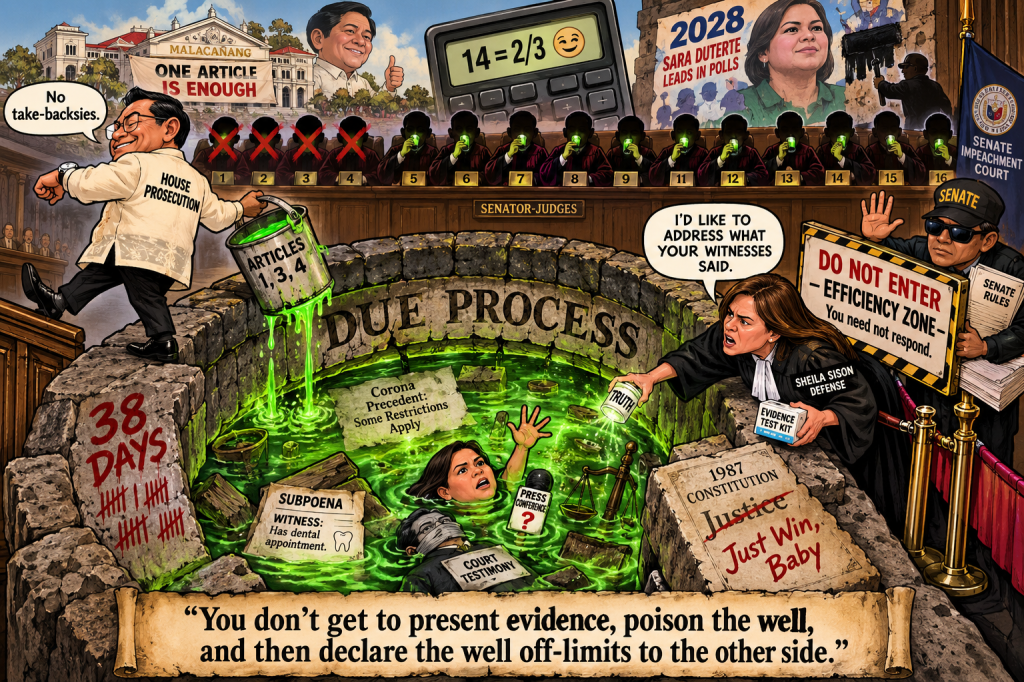
Senator Rodante Marcoleta — charged with plunder on a novel legal theory, arrested hours before he was to sit as senator-judge in Sara Duterte’s impeachment trial.
Senator Ronald dela Rosa — facing charges, reportedly in hiding.
All three are aligned against the Marcos administration.
Now the other side:
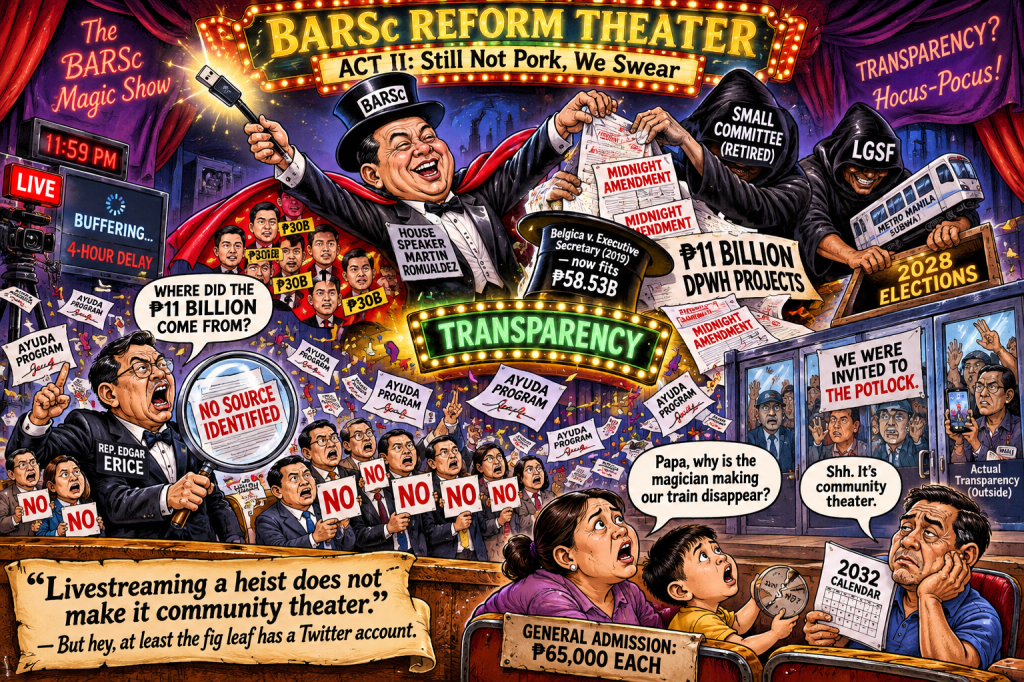
Former Speaker Martin Romualdez — the President’s cousin — named “master plunderer” but no information filed, no arrest, investigation proceeding at geological pace.
Senator Francis Escudero — also “master plunderer,” also no information, also no arrest, currently presiding over Duterte’s impeachment trial.
Secretary Manuel Bonoan — the President’s alter ego in DPWH — charged with plunder, then immediately converted to state witness under a deal Justice Carpio has publicly flagged as legally problematic.
The pattern is not proof. Individual cases may have individual merits. But patterns matter in law. The Supreme Court’s due-process jurisprudence recognizes that the “appearance of injustice” can itself constitute a violation. When every major prosecution targets a Marcos critic and every major delay protects a Marcos ally, selective justice is not a partisan smear — it is a reasonable inference from observable facts.
The Bonoan deal deserves particular scrutiny. Rule 119, Section 17 of the Revised Rules of Criminal Procedure requires that a discharged accused “does not appear to be the most guilty.” A Cabinet secretary who presided over the department where corruption flourished — can he credibly claim not to be “most guilty”? The Ombudsman says yes, on the theory that Bonoan was a mere implementer while legislators were architects. But Carpio’s restitution question cuts deeper: if Bonoan keeps disputed funds while escaping prosecution, the deal becomes not selective justice but subsidized corruption.
The Toxic Political War
The flood control scandal is the primary battlefield in a Marcos-Duterte clan war that has consumed the Senate, paralyzed the House, and transformed constitutional processes into political weapons.
Timeline of the Marcos-Duterte Clan War
- 2022: UniTeam alliance formed.
- 2023–2024: Growing tensions emerge.
- May 2025: Midterm election bloodbath.
- July 2025: Supreme Court throws out Duterte impeachment; weeks later, Marcos unveils the flood control scandal.
- November 2025: Fugitive Zaldy Co claims Marcos received ₱25 billion in kickbacks.
- April 2026: Ombudsman recommends plunder charges against Romualdez and Escudero.
- July 2026: Duterte impeachment trial opens; Marcoleta arrested hours before sitting as senator-judge; Marcos dismisses oust calls as “nonsense.”
This is not governance. This is blood feud conducted through governmental instruments. Both sides accuse the other of weaponizing state power; both are correct.
The toxicity manifests in four pathologies: Instrumental anti-corruption (pursuing cases against rivals, not corruption as such); mutual assured destruction logic (both camps possess kompromat, preventing full accountability for either); institutional capture through proceduralism (rule-of-law arguments deployed as tactical weapons, not principled commitments); and the public as spectator-casualty (citizens treated as audience to elite warfare rather than as the sovereign whose interests government exists to serve).
Resolving the Paradox
The victim-hero paradox cannot be resolved through narrative reframing. It requires action measured against specific standards:
- Impartial accountability, not selective justice. Romualdez and Escudero must face equivalent procedural velocity to Estrada and Marcoleta, or the asymmetry must be publicly justified.
- Structural reform, not just individual prosecution. Unprogrammed appropriations, confidential funds, and legislative insertions must be eliminated or subjected to real-time public disclosure. A permanent anti-corruption commission must replace the temporary ICI.
- Constitutional fidelity. The President must accept ultimate responsibility for executive branch conduct during his tenure. The “inherited problem” narrative is political argument, not constitutional defense.
- Outcome measurement, not process theater. Success must be measured by convictions obtained, wealth recovered, institutions strengthened, and flood-control outcomes improved — not by press releases and frozen account totals.
Recommendations
- To the administration: End the “nonsense” rhetoric. Accelerate Romualdez and Escudero prosecutions or publicly explain the delay. File parallel forfeiture action against Bonoan or explain why none is warranted. Submit genuine budget reform legislation. Respect impeachment as a constitutional mechanism, not an irritant.
- To the opposition: Consolidate fragmented messaging around impartial accountability and structural reform. Build the factual record through whistleblower protection and document authentication. Avoid mirroring the administration’s pathologies — the goal is equal justice, not protecting one’s own allies.
- To the Supreme Court: Resolve the Senate legitimacy question expeditiously. Clarify Biraogo v. Truth Commission limits on executive fact-finding bodies. Give real teeth to the “appearance of injustice” doctrine.
- To the public: Maintain pressure. Demand metrics, not narratives — convictions, recoveries, institutional reforms. Prepare for 2028; electoral accountability is the ultimate backstop.
Coda
The Philippines has seen this script before: spectacular exposés, initial outrage, selective prosecution, eventual normalization. The jueteng scandal. The fertilizer fund scandal. The pork barrel scandal. Each followed the same arc: revelation, investigation, a few prosecutions of mid-level officials or political opponents, then silence. The system remained intact. The next scandal germinated before the last was resolved.
Whether this time differs depends on whether institutions, not just individuals, are ultimately held accountable.
Marcos’s “nonsense” is legally accurate on one narrow point: no impeachment complaint is currently filed. But it is politically catastrophic and morally revealing — an administration that has decided its best defense is contempt for critics, constitutional processes, and the public’s demand to know whether its president is a reformer or just another chapter in the same old story.
The victim-hero paradox will be resolved not in Vancouver hotels but in courtrooms, the Senate impeachment court, and ultimately the ballot box. The question is whether the resolution will be written by law or by power — and whether Filipinos will accept anything less than the former.
Louis “Barok” C. Biraogo is a legal analyst who has seen enough Philippine corruption scandals to recognize the pattern, but not enough to stop hoping it can be broken.
Key Citations
A. Legal & Official Sources
- The 1987 Constitution of the Republic of the Philippines. Official Gazette of the Republic of the Philippines, 1987, http://www.officialgazette.gov.ph/constitutions/1987-constitution/.
- Republic Act No. 3019. Anti-Graft and Corrupt Practices Act. 17 August 1960. Official Gazette of the Republic of the Philippines, http://www.officialgazette.gov.ph/1960/08/17/republic-act-no-3019/.
- Republic Act No. 7080. An Act Defining and Penalizing the Crime of Plunder. 12 July 1991. Official Gazette of the Republic of the Philippines, http://www.officialgazette.gov.ph/1991/07/12/republic-act-no-7080/.
- Republic Act No. 9184. Government Procurement Reform Act. 10 January 2003. Official Gazette of the Republic of the Philippines, http://www.officialgazette.gov.ph/2003/01/10/republic-act-no-9184/.
- Revised Rules of Criminal Procedure (2000). Rule 119, Section 17 (Discharge of Accused to be State Witness). Supreme Court of the Philippines, lawphil.net/courts/rules/rc_110-127_crim.html.
- Louis C. Biraogo v. The Philippine Truth Commission of 2010, G.R. No. 192935. Supreme Court of the Philippines, 7 December 2010, https://lawphil.net/judjuris/juri2010/dec2010/gr_192935_2010.html.
B. News Reports
- Gita-Carlos, Ruth Abbey, “‘Nonsense’, PBBM Says on Oust Calls over Slow Flood Control Projects.” Philippine News Agency, 5 July 2026, http://www.pna.gov.ph/articles/1278708.
- Pulse Asia Research Inc. March 2026 Ulat ng Bayan Survey on National Administration Performance Ratings. Pulse Asia, March 2026, http://www.pulseasia.ph/.
- “Ang Hirap Maging Mahirap”: The PAO Scandal That Proves Government Contempt Is Nothing New
- “Far-Off” My Axx: Malacañang’s Claire Castro Drowns in Her Own Legal Gaslighting
- “Forthwith” to Farce: How the Senate is Killing Impeachment—And Why Enrile’s Right (Even If You Can’t Trust Him)
- “HINDI AKO NAG-RESIGN!”

- “I Know Nothing”: Baste Duterte’s Amnesia Defense Meets ₱33M in GenCorp Contracts
- “I’m calling you from my new Globe SIM. Send load!”

- “Mahiya Naman Kayo!” Marcos’ Anti-Corruption Vow Faces a Flood of Doubt

- “Manageable” Debt, Unmanageable Lies: DBM’s ₱21 Trillion Fairy Tale
- “Meow, I’m calling you from my new Globe SIM!”

- “Natrabaho”: One Word, One Ombudsman, and a Judiciary on Trial
- “No Special Jail for Crooks!” Boying Remulla Slams VIP Perks for Flood Scammers

- “Philippine-Controlled” or Yankee Gas Station? The Davao Fuel Depot Farce Exposed




Leave a Reply