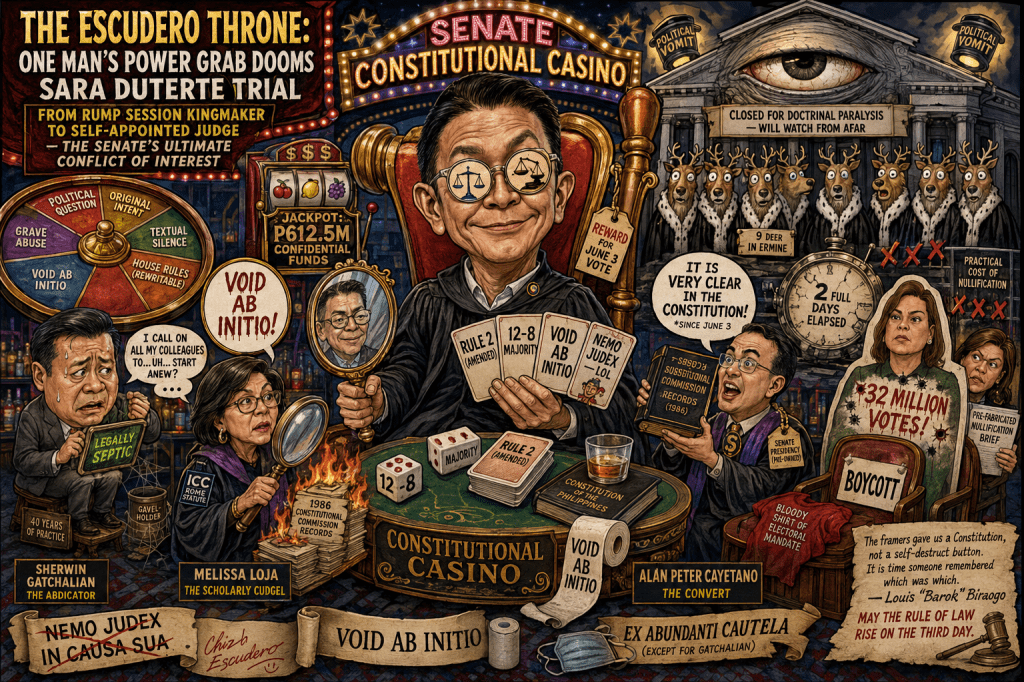
From Rump Session Kingmaker to Self-Anointed Judge — The Senate’s Ultimate Conflict of Interest
By Louis “Barok” C. Biraogo | July 8, 2026
WELCOME, mga ka-kweba, to the grandest burlesque in Philippine political theater. Forget the Vice President on trial—the real spectacle is watching the Senate of the Republic transform itself from a chamber of sober deliberation into a constitutional casino, where the house rules are rewritten mid-game, the dealer is also a player, and the only guarantee is that the loser will scream “void ab initio” into every microphone within a five-kilometer radius. The impeachment trial of Sara Duterte is no longer about P612.5 million in confidential funds or alleged assassination threats. It has metastasized into a referendum on whether a 12-8 majority can weaponize a by-law into a bazooka and blow a constitutional hole through four decades of institutional practice.
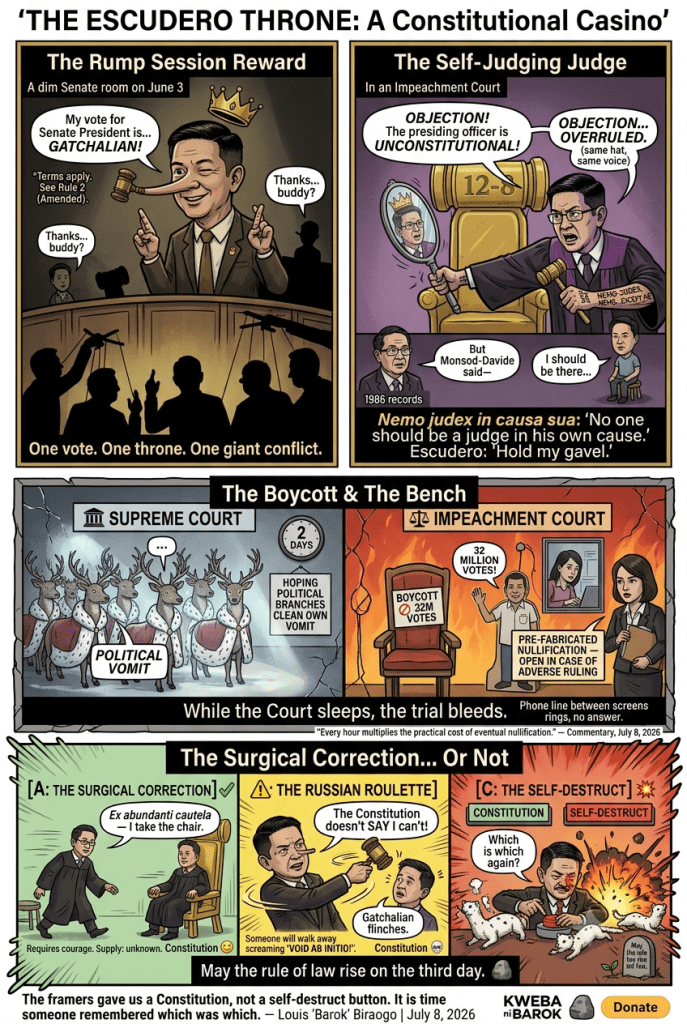
The Presiding Officer’s Throne and the Nemo Judex Problem
At the center of this slow-motion disaster sits one Francis “Chiz” Escudero, the newly elected presiding officer of the impeachment court, elevated to that perch by a Senate rule amendment adopted in the same June 3 “rump session” that toppled the previous Senate President, Alan Peter Cayetano. Let us state this plainly: the man who supplied the decisive vote in the leadership coup was rewarded with a gavel and a custom-made throne. He then ruled, from that very throne, on an objection to his own authority to sit there—a delicious violation of nemo judex in causa sua (no one should be a judge in his own cause) that would make first-year law students weep into their codals. Escudero is either the Senate’s most qualified impeachment proceduralist or its most brazen political chameleon, cloaking an ambition-driven power grab in a black robe and an expression of studied neutrality.
The Loja Thesis: Original Intent Versus Textual Silence
The legal challenge comes from Melissa Loja, an international law scholar wielding the 1986 Constitutional Commission records like a prosecutorial cudgel. Her argument is elegant in its simplicity: the framers, through the famous Monsod-Davide exchange of July 28, 1986, understood the Senate President to preside over all impeachment trials except the President’s. Davide withdrew his proposed amendment making that explicit only because Monsod assured him it was already “understood.” For Loja, the Senate’s amended Rule 2—allowing election of an alternate presiding officer—is not an exercise of rule-making power under Article XI, Section 3(8) of the 1987 Constitution of the Republic of the Philippines (1987 Constitution) but a frontal assault on implicit constitutional design. Any ruling Escudero makes is, in her formulation, void ab initio.
Loja deserves credit for dragging the deliberations out of dusty archives and into the public square. Her methodology is the same one the Supreme Court itself used in Francisco v. House of Representatives and, fatefully, in the 2025 decision that nullified Duterte’s first impeachment.
But let us be viciously honest about her vulnerabilities. A single exchange between two commissioners, however illuminating, is not the same as the ratified text of the Constitution. Loja is an international law specialist criticizing a domestic constitutional proceeding—the intellectual equivalent of a maritime law expert performing open-heart surgery. And her void ab initio maximalism glosses over a genuinely difficult question: does a defect in presiding-officer designation truly extinguish the Senate’s plenary subject-matter jurisdiction over impeachment, a power Article XI, Section 3(6) of the 1987 Constitution grants exclusively and unconditionally?
Her critics will also note, with raised eyebrows, that her previous public commentary has been sympathetic to the Duterte camp’s position on International Criminal Court (ICC) jurisdiction. Is she an impartial oracle of constitutional truth, or the highbrow legal voice of a sophisticated dilatory strategy? The answer is probably both.
The Senate Majority’s House of Cards
But if Loja’s thesis has cracks, the Senate majority’s counter-argument is a house of cards built on a fault line. The textualist defense—“the Constitution doesn’t say the Senate President shall preside”—is a confession dressed as an argument. The Constitution doesn’t say a lot of things. It doesn’t say the impeachment court can’t elect a reality TV host as presiding officer either, but the framers’ recorded understanding of their own work product ought to carry more weight than the silence-as-permission sophistry of a transient majority. The Senate’s citation of Santiago v. Guingona and the political question doctrine is even more pathetic—a doctrinal shield raised by the same institution that, in Francisco, was told in no uncertain terms that impeachment procedures are reviewable for grave abuse of discretion. The Court has already policed the boundaries of this process once. The Senate majority is betting their entire verdict on the proposition that it won’t do so again.
The Supreme Court’s Doctrinal Paralysis
Which brings us to the institutionally incomprehensible passivity of the Supreme Court itself. As of this writing, the High Tribunal has allowed two full trial days to elapse without a temporary restraining order (TRO), without a status quo ante order, without even a sternly worded statement that it’s watching. This is not judicial restraint. This is doctrinal paralysis. Every hour the trial proceeds under Escudero’s gavel multiplies the practical cost of eventual nullification. The Court seems to be hoping—praying, perhaps—that the political branches will clean up their own constitutional vomit so the judiciary doesn’t have to stain its ermine. But the Senate has demonstrated zero inclination toward self-correction, and the Court’s silence is functionally indistinguishable from endorsement. If the trial concludes under a constitutionally infirm presiding officer, the losing side—whether it’s Duterte or the House prosecution—will spend the next decade litigating the nullity question. A verdict rendered by a questionably-constituted tribunal is a political hand grenade, not a resolution.
The Supporting Cast Deepens the Farce
The cast of supporting characters only deepens the farce. Senate President Sherwin Gatchalian, the man who should be wielding the gavel under 40 years of unbroken institutional practice and the framers’ clear understanding, has abdicated. His demurral to Escudero can be read one of two ways: either he is a principled institutionalist respecting the Senate’s amended rules, or he is a risk-averse tactician who knows his own claim to the presidency—born of the same June 3 rump session still under Supreme Court challenge—is legally septic, and he has outsourced the constitutional exposure to his colleague. Alan Peter Cayetano and his bloc, meanwhile, have undergone an almost religious conversion to originalist constitutionalism that is as convenient as it is vociferous. Their argument is legally sound, but their credibility is strained by the fact that they were playing the same game of Senate musical chairs less than two months ago. Principle and self-interest have merged into an indistinguishable gray sludge.
The Respondent’s Strategic Martyrdom
And what of the respondent herself? Vice President Duterte has adopted the posture of a martyr-in-waiting, boycotting the trial physically while her lawyers litigate furiously in the Supreme Court. She waves the bloody shirt of 32 million votes, framing the entire proceeding as a political ouster rather than a legal reckoning. Yet her legal team’s laser focus on the presiding-officer question—a hyper-technical, originalist, process-based objection—reveals the strategy: create a pre-fabricated nullification argument, preserve it meticulously, and deploy it the instant any adverse ruling emerges. Duterte may be many things, but she is not stupid.
The Path to Surgical Correction
The resolution is staring the Senate in the face, and it requires no Supreme Court intervention. Senate President Gatchalian must immediately assume the chair himself, ex abundanti cautela—out of abundant caution—without conceding the constitutional issue. Material rulings made by Escudero should be reconsidered de novo. This would cauterize the wound, protect the verdict from post-hoc nullification, and demonstrate that the Senate understands the difference between a rule and the Constitution.
The Imperative for Judicial Clarity
If the Senate refuses this surgical correction, the Supreme Court must stop acting like a deer in the headlights and issue provisional clarity. The rule of law cannot survive a scenario where a 12-8 majority turns an impeachment trial into a game of constitutional Russian roulette, where the only certainty is that someone will walk away screaming that the chamber was empty.
The framers gave us a Constitution, not a self-destruct button. It is time someone remembered which was which.
May the rule of law rise on the third day. 🪨
Key Citations
A. Legal & Official Sources
- The 1987 Constitution of the Republic of the Philippines. Official Gazette of the Republic of the Philippines, 1987. http://www.officialgazette.gov.ph/constitutions/1987-constitution/.
- Francisco v. House of Representatives. G.R. No. 160261. Supreme Court of the Philippines, 10 Nov. 2003. lawphil.net/jurisprudence/2003/nov2003/gr_160261_2003.html.
- Santiago v. Guingona, Jr. G.R. No. 134577. Supreme Court of the Philippines, 18 Nov. 1998. lawphil.net/judjuris/juri1998/nov1998/gr_134577_1998.html.
- Record of the Constitutional Commission: Proceedings and Debates. Vol. II. Constitutional Commission of 1986, 1986. archive.org/details/record-of-the-constitutional-commission-volume-2.
B. News Reports
- Baroña, Franco Jose C. “Designation of Escudero Violates the Constitution, Law Expert Says.” The Manila Times, 7 July 2026, http://www.manilatimes.net/2026/07/07/news/national/designation-of-escudero-violates-the-constitution-law-expert-says/2379229.
- Baroña, Franco Jose C. “Expert Weighs ICC Hearing Arguments.” The Manila Times, 2 Mar. 2026, http://www.manilatimes.net/2026/03/02/news/national/expert-weighs-icc-hearing-arguments/2290692.
- ₱9 Billion in ‘Savings’? DILG’s Fire Truck Deal Smells Like Smoke

- ₱8B BBM Pork: CCTV for Every Captain’s Kumpare?

- ₱8.9 Billion, 331 Ghost Police Stations: The TIKAS Scandal Explained

- ₱8.4 Billion, 42,000 Barangays, 1 Election: The “Bawat Barangay Makikinabang” Vote-Buying Masterclass

- ₱75 Million Heist: Cops Gone Full Bandit

- ₱6.77B Ghost Haunts Duterte: RTC Dismisses Mans Carpio’s Desperate Plea

- ₱6.77 Billion and Zero Cash: The Sara Duterte SALN Math That Doesn’t Add Up

- ₱6.7-Trillion Temptation: The Great Pork Zombie Revival and the “Collegial” Vote-Buying Circus

- ₱58.53B, Zero Receipts: The LGSF Pork Barrel Nobody Wants to Name
- ₱53 Million Man Tells ₱695-a-Day Workers to Stop Being ‘Mayabang’: The Audacity of BSP’s Remolona

- ₱4.4 Billion and a Witness Who Can’t Explain It: The Duterte Impeachment’s Most Expensive Non-Answer
- ₱3.06 Billion for Evacuation Centers—But Nobody Knows Where They’ll Stand (Or If They’ll Exist)







Leave a Reply