Arrest the Citizen, Spare the Platform: The Cowardly Architecture of HB 9465
By Louis ‘Barok‘ C. Biraogo — July 26, 2026
LET’S begin with the punchline that writes itself.
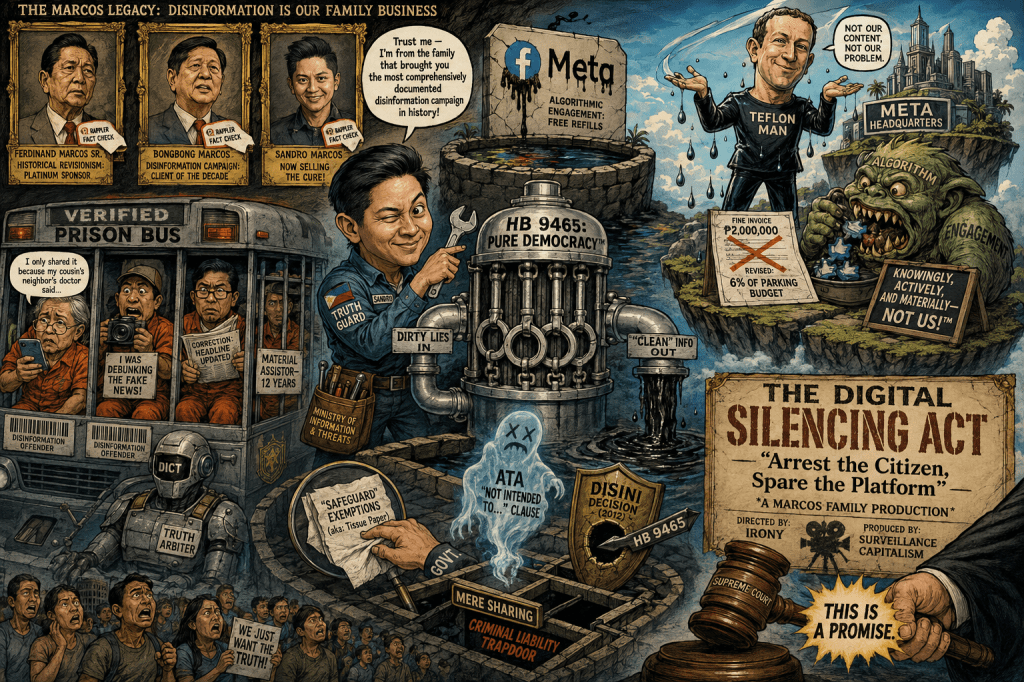
The family whose political resurrection was engineered by the most comprehensively documented disinformation campaign in Philippine history—a campaign so effective it laundered plunder into nostalgia and historical revisionism into a mandate—has now authored a law to criminalize disinformation. Sandro Marcos, House Majority Leader and presidential scion, shepherded House Bill No. 9465 (Digital Media Anti-False Information Act) through the House on a 286-3 vote. The irony is not merely rich; it is obscene. It is a thief installing the burglar alarm and demanding you pay for the subscription.
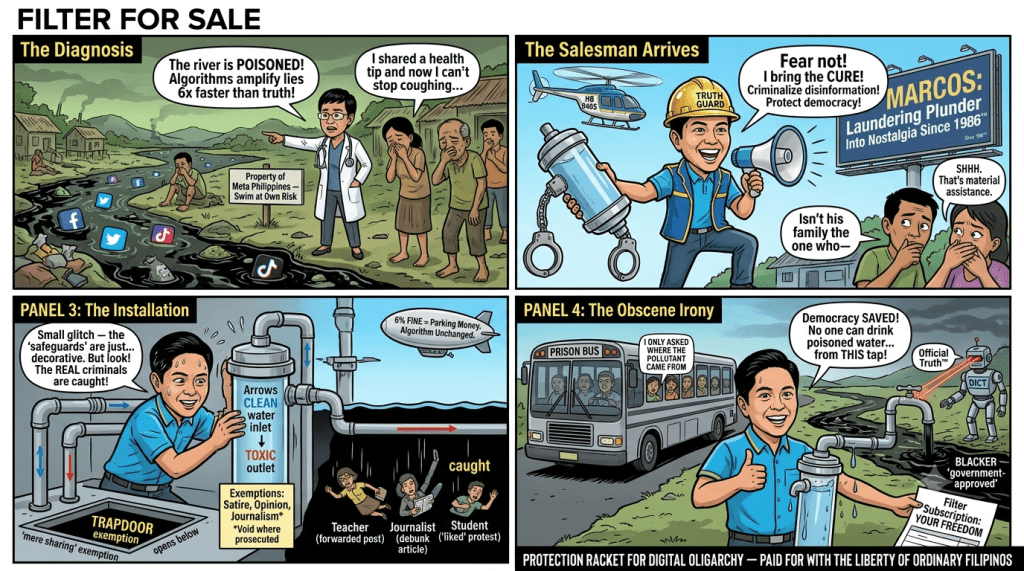
The bill’s proponents would have you believe this is the Philippines finally getting serious about the “polluted river” of online falsehoods—a term Maria Ressa deployed to describe how platform algorithms amplify lies for engagement. The metaphor is apt, but the Marcos remedy is to start arresting people for drinking the water while granting legal immunity to the company that owns the poisoned well.
The Architecture of Cowardice
Here is the bill’s central, unforgivable flaw, a flaw so obvious it must be deliberate: House Bill 9465 flattens the moral and operational distinction between a citizen who shares a misleading post and a state-funded troll farm operator into what civil society groups correctly identify as “functionally the same legal theory.” A retired schoolteacher in Ilocos who forwards a fake medical advisory faces the same six-to-twelve-year prison sentence as a coordinated, foreign-financed influence network. This is not a design defect; it is the design itself.
The bill’s authors will point to their safeguard language—exemptions for satire, political opinion, “mere” sharing, and journalistic inquiry. You must forgive civil society for not being comforted. We have watched this exact movie before, twice, and both times it ended with the Supreme Court having to perform emergency surgery on laws that were sold as “balanced” and “constitutional.” Republic Act No. 11479 (Anti-Terrorism Act of 2020 or ATA) had its own protective “not intended clause,” designed to shield activists and dissenters from prosecution. In Calleja v. Executive Secretary, the Supreme Court struck it down as unconstitutionally vague—a hollow promise that collapsed the moment the state decided it wanted to prosecute. Those “empty words,” as the coalition’s statement describes HB 9465’s exemptions, are not a shield; they are a trapdoor.
Then there is the language borrowed directly from the ATA’s most dangerous provision: criminal liability for those who “materially assist” the dissemination of false information. The ATA’s version penalizes “material support” to terrorists and has been the legal vehicle for subpoenaing human rights defenders and red-tagging activists based on association, not evidence of a crime. Now, transplant that theory of guilt-by-proximity into the world of online speech. An editor who approves a story. A newsroom that embeds a controversial post for the purpose of debunking it. A citizen journalist’s volunteer fixer. All are now “material assistors,” facing a decade in prison, long before any court has determined whether the underlying information was even false—let alone whether they knew it was and intended a specific, “verifiable” public harm.
Prior Restraint, Courtesy of a Government Truth Council
The Senate version, still languishing in a committee whose chairmanship remains conveniently vacant under Senate President Sherwin Gatchalian, goes even further. It empowers a Digital Media Integrity Council—dominated by government agencies—to order content taken down within 48 hours based on its own finding of “sufficient basis.” There is no judicial warrant. There is no prior court hearing. This is a textbook, incontrovertible prior restraint, the kind the Supreme Court eviscerated in Chavez v. Gonzales. In Chavez, the Court found that even an informal government warning to media outlets against airing certain wiretapped conversations was an unconstitutional chilling of speech. Yet here we have a formal, government-dominated body with the power to disappear content from the internet on its own say-so. This is not a close call. This is a constitutional obscenity.
The bill pretends to take on Big Tech. It demands that Very Large Online Platforms—those with over 10% of the population as monthly active users, like Facebook—appoint local representatives, file transparency reports, and disclose their algorithmic recommender systems. Fines can reach up to 6% of their Philippine annual gross revenue. This is the “look-over-there” part of the magic trick. The bill’s platform liability shield is so rigid that a company is protected unless it “knowingly, actively, and materially participated in creating false content.” Meta does not write the propaganda; it sells the micro-targeting tools that let troll armies do it with ruthless efficiency. It builds the engagement-hungry algorithm that makes outrage and lies travel six times faster than truth. The bill declares all of that—the actual engine of the disinformation economy—a giant legal safe harbor. Fining a platform millions of pesos for systemic failures while the small-time user it radicalized faces twelve years in a Philippine jail is not accountability; it is a protection racket for the digital oligarchy, paid for with the liberty of ordinary Filipinos.
The Legal Boomerang
The bill’s defenders claim it has learned from the past, citing the House version’s stricter “actual knowledge and specific intent” standard compared to the Senate’s dangerously low “reasonable belief” bar. They note the express exemption for “mere” liking and sharing. This is a clever editing job done on a fundamentally corrupt document. The Disini v. Secretary of Justice decision, which surgically removed the worst parts of Republic Act No. 10175 (Cybercrime Prevention Act of 2012), held that online libel liability attaches only to the original author—not to those who simply receive, like, or comment on a post. HB 9465’s “exemption” for sharing is not a gift; it is an attempt to codify a backdoor around Disini, placing the burden on the accused citizen to prove beyond a reasonable doubt that they lacked knowledge and intent. In the Philippine justice system, burden of proof is a weapon. The mere act of defending oneself against a disinformation charge—with its six-to-twelve-year sentence hanging in the air—will bankrupt and silence critics long before any conviction.
The heaviest penalties are reserved for “media personalities.” Let that sink in. The people most capable of investigating and debunking state-sponsored falsehoods—investigative journalists—are designated as the most culpable criminals under this law. It is a strategic, surgical strike at the only independent check on the government’s power to define “official truth.” Justin Daduya of Sigla Research Center stated the obvious danger that this government should not be the “arbiter of truth,” yet that is precisely the power this bill vests in the executive.
My call is not for inaction against disinformation. The pollution is real. The solution, however, lies not in punishing the consumer or the small-voiced critic but in dismantling the factories. Follow the civil society coalition’s blueprint: split this monstrous bill into a narrow security law targeting coordinated inauthentic behavior and troll farm financing, a genuine platform accountability act that regulates algorithmic amplification rather than content, and a fully-funded, independent media literacy program. Strip out every provision that sends individuals to prison for speech.My call is not for inaction against disinformation. The pollution is real. The solution, however, lies not in punishing the consumer or the small-voiced critic but in dismantling the factories. Follow the civil society coalition’s blueprint: split this monstrous bill into a narrow security law targeting coordinated inauthentic behavior and troll farm financing, a genuine platform accountability act that regulates algorithmic amplification rather than content, and a fully-funded, independent media literacy program. Strip out every provision that sends individuals to prison for speech. The Senate must kill this bill. Not amend it. Kill it. The man who poisoned the well now offers you a filter—and a prison cell if you complain about the taste. That is not governance. That is a hostage situation dressed up as legislation. The only dignified response is refusal. For the youth, for the truth, and for a democracy that deserves far better than this shabby, authoritarian pantomime, the answer must be a defiant, evidence-based, and resounding no.
My call is not for inaction against disinformation. The pollution is real. The solution, however, lies not in punishing the consumer or the small-voiced critic but in dismantling the factories. Follow the civil society coalition’s blueprint: split this monstrous bill into a narrow security law targeting coordinated inauthentic behavior and troll farm financing, a genuine platform accountability act that regulates algorithmic amplification rather than content, and a fully-funded, independent media literacy program. Strip out every provision that sends individuals to prison for speech. The Senate must kill this bill. Not amend it. Kill it. The man who poisoned the well now offers you a filter—and a prison cell if you complain about the taste. That is not governance. That is a hostage situation dressed up as legislation. The only dignified response is refusal. For the youth, for the truth, and for a democracy that deserves far better than this shabby, authoritarian pantomime, the answer must be a defiant, evidence-based, and resounding no.
Key Citations
A. Legal & Official Sources
- Republic Act No. 11479. An Act to Prevent, Prohibit and Penalize Terrorism, Thereby Repealing Republic Act No. 9372, Otherwise Known as the “Human Security Act of 2007.” 3 July 2020. Supreme Court E-Library, elibrary.judiciary.gov.ph/thebookshelf/showdocs/2/92597.
- Republic Act No. 10175. An Act Defining Cybercrime, Providing for the Prevention, Investigation, Suppression and the Imposition of Penalties Therefor and for Other Purposes. 2012, lawphil.net/statutes/repacts/ra2012/ra_10175_2012.html.
- Calleja v. Executive Secretary. G.R. No. 252578, 7 Dec. 2021, lawphil.net/judjuris/juri2021/dec2021/gr_252578_2021.html.
- Chavez v. Gonzales. G.R. No. 168338, 15 Feb. 2008, lawphil.net/judjuris/juri2008/feb2008/gr_168338_2008.html.
- Disini v. Secretary of Justice. G.R. No. 203335, 11 Feb. 2014, lawphil.net/judjuris/juri2014/feb2014/gr_203335_2014.html.
B. News Reports
- “House approves anti-disinformation bill on final reading.” Philippine News Agency, 3 June 2026, http://www.pna.gov.ph/articles/1276527.
- De Leon, Dwight. “Sandro Marcos’ anti-disinfo bill is revised but fears linger.” Rappler, 29 May 2026, http://www.rappler.com/philippines/sandro-marcos-anti-disinformation-bill-revised-censorship-fears-linger/.
- Chi, Cristina. “Advocates call to junk Marcos anti-disinfo bill with echoes of past laws.” The Philippine Star, 25 July 2026, http://www.philstar.com/headlines/2026/07/25/2544629/media-rights-groups-urge-congress-junk-marcos-anti-disinfo-bill.
- Ressa, Maria. “We’re All Being Manipulated the Same Way.” The Atlantic, 6 Apr. 2022, http://www.theatlantic.com/ideas/archive/2022/04/maria-ressa-disinformation-manipulation/629483/.

- ₱8B BBM Pork: CCTV for Every Captain’s Kumpare?
- ₱8.9 Billion, 331 Ghost Police Stations: The TIKAS Scandal Explained

- ₱8.4 Billion, 42,000 Barangays, 1 Election: The “Bawat Barangay Makikinabang” Vote-Buying Masterclass

- ₱75 Million Heist: Cops Gone Full Bandit

- ₱6.77B Ghost Haunts Duterte: RTC Dismisses Mans Carpio’s Desperate Plea
- ₱6.77 Billion and Zero Cash: The Sara Duterte SALN Math That Doesn’t Add Up
- ₱6.7-Trillion Temptation: The Great Pork Zombie Revival and the “Collegial” Vote-Buying Circus

- ₱58.53B, Zero Receipts: The LGSF Pork Barrel Nobody Wants to Name
- ₱53 Million Man Tells ₱695-a-Day Workers to Stop Being ‘Mayabang’: The Audacity of BSP’s Remolona
- ₱3.06 Billion for Evacuation Centers—But Nobody Knows Where They’ll Stand (Or If They’ll Exist)
- ₱10B Ghost in New Clark City: Matibag’s Haunted Séance for Cayetano

- ₱1.9 Billion for 382 Units and a Rooftop Pool: Poverty Solved, Next Problem Please




Leave a comment