The Art of Winning by Losing: A Masterclass in Prosecutorial Spin
By Louis ‘Barok‘ C. Biraogo — July 27, 2026
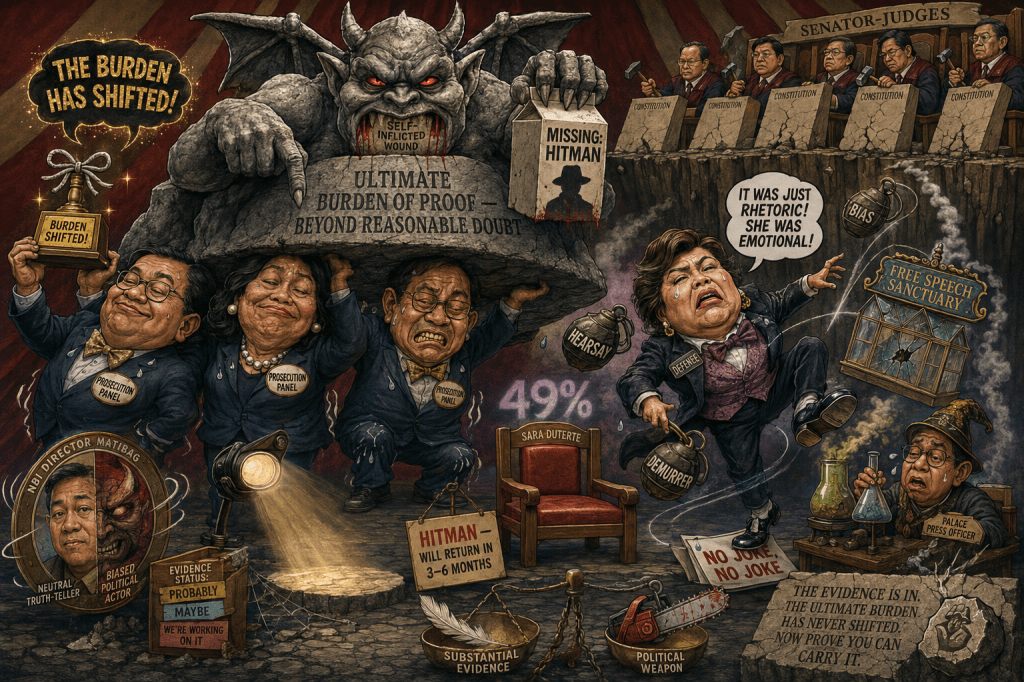
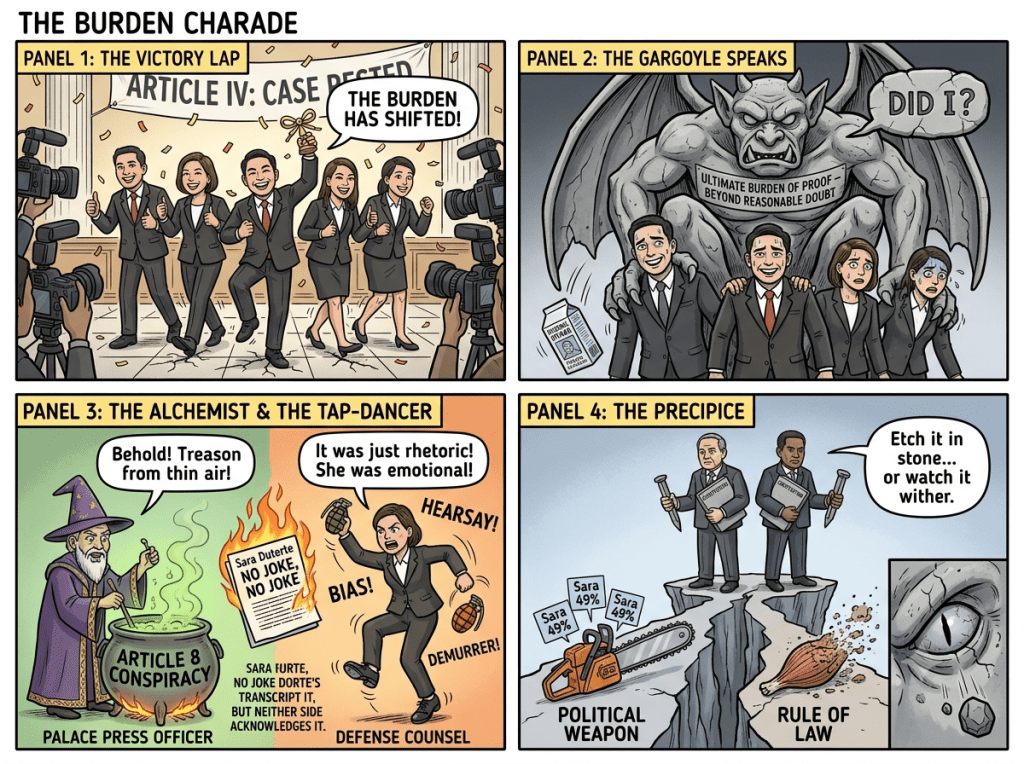
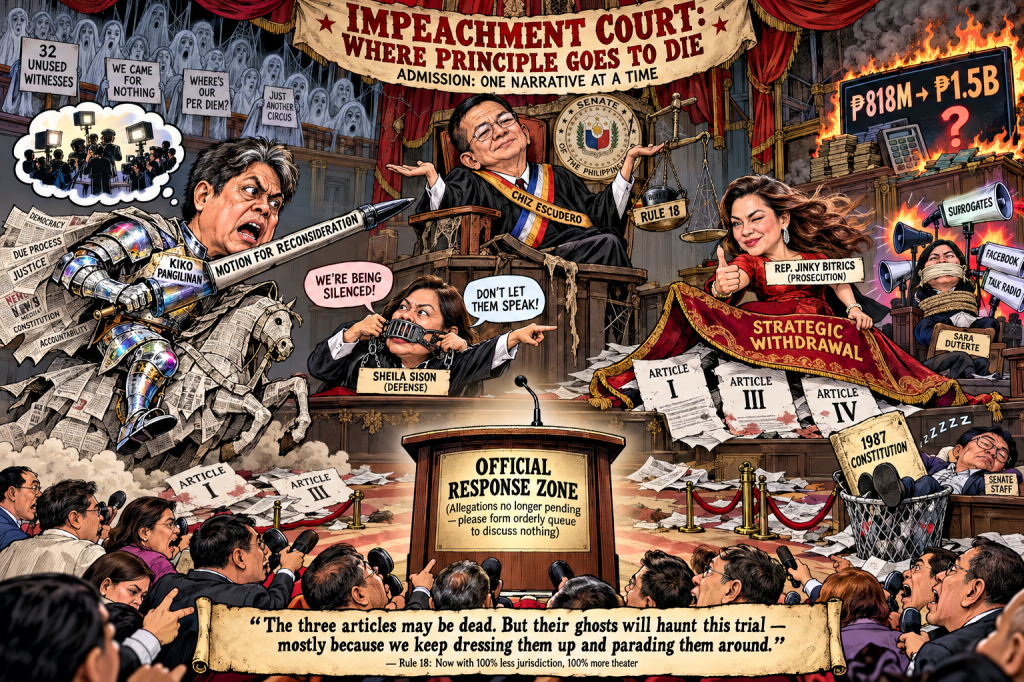
THE House prosecution panel, having rested its case on Article IV—the grave threats charge accusing the Vice President of arranging an assassination plot against the President, First Lady, and former Speaker—strutted before the cameras like conquering heroes. “The burden has shifted!” they crowed, as if they had just pulled off a masterstroke of constitutional jiu-jitsu rather than stating a procedural banality any first-year law student could recite in their sleep.
Let us be surgically precise, because someone in that chamber must be.
Yes, Representative Barbers, the evidentiary burden—the tactical duty to produce counter-evidence or risk an adverse finding on the existing record—has indeed shifted. Congratulations. You have successfully tied your shoelaces. But the ultimate burden of proof? The prosecution’s solemn constitutional obligation to prove every essential element by the requisite quantum? That beast never moves. It sits on your shoulders like a gargoyle, and from where I am sitting, your knees are buckling under its weight.
The Gargoyle That Never Budges
The Supreme Court could not have been clearer in voiding the first impeachment complaint against this Vice President. In Sara Z. Duterte v. House of Representatives (G.R. No. 278353, July 25, 2025), the High Court declared that “the constitutional presumption of innocence is demanded by the due process clause… which protects the accused from conviction except upon proof beyond reasonable doubt of every fact necessary to constitute the crime charged.” The prosecution’s own admission—extracted under cross-examination by defense counsel Mark Vinluan—that its evidence does not “100 percent” establish that Duterte actually hired an assassin, is not a minor concession. It is a self-inflicted wound, bleeding out in full view of the senator-judges. You cannot hang a Vice President on “probably,” “maybe,” and “give us three to six more months to find the hitman.”
And yet, the Palace Press Officer spins this as a “conspiracy” theory, recasting a conditional, if grotesque, outburst as a meeting of the minds under Article 8 of Act No. 3815 (Revised Penal Code). This is rhetorical alchemy of the most desperate sort—an attempt to conjure the gravity of treason from the vapor of an Article 282 grave threats charge. The prosecution wants the senator-judges to smell brimstone without ever producing the devil.
Rhetoric, Rage, and the Free-Speech Sanctuary
This brings us to the defense, whose legal strategy is a contradictory cocktail of righteous indignation and procedural tap-dancing.
The defense argues, with some force, that even if Duterte’s November 23 rant was repugnant, it does not clear the constitutional high bar. They invoke Chavez v. Gonzales and the clear-and-present-danger test, framing the Vice President as an aggrieved political dissident whose hyperbolic speech, however shocking, is protected. They want you to believe this was mere rhetoric, a flash of anger from a woman watching her chief of staff, Zuleika Lopez, face a threatened transfer to the Correctional Institution for Women.
This argument is legally precise but politically tone-deaf. A “true threat”—a statement a reasonable listener would interpret as a serious expression of intent to harm—falls outside the free speech sanctuary. The “No joke, no joke” refrain, the specific naming of targets, the earlier musings about beheading the President: this pattern is a prosecutorial gift. The emotional distress of the moment may explain the outburst; it does not, as a matter of law, excuse it. The defense risks arguing context so aggressively that they implicitly admit the actus reus, hoping senator-judges will find a lack of mens rea in the tears of a detained staffer.
But the defense knows something the prosecution is praying the senators forget: this is not a criminal trial for grave threats. It is an impeachment for “other high crimes” and “betrayal of public trust.” And on that score, the defense has lit a fire under the prosecution’s feet. Citing Gonzales III v. Office of the President, they argue that the catch-all must be interpreted by the ejusdem generis canon—the conduct must approach the paradigm offenses of treason, bribery, and graft in seriousness. Is an unconsummated, conditional threat of murder, without a single peso changing hands or a single overt act toward an actual killing, truly in the same moral and legal universe? Or are we witnessing the weaponization of impeachment to eliminate a political rival who leads every 2028 presidential survey?
Substantial Evidence or Political Chainsaw?
This is the heart of the matter, and both sides are playing the senators for fools.
The prosecution is peddling a “substantial evidence” standard as if removal and perpetual disqualification from office were an administrative matter, like revoking a cockfighting permit. They hide behind the ambiguity of the Corona trial, hoping no one notices that every senator-judge’s conscience is legally free—and constitutionally obligated—to demand the highest standard of proof when the penalty is political death. The defense, meanwhile, hurls procedural grenades. They challenge the authentication of recordings, attack the credibility of National Bureau of Investigation (NBI) Director Melvin Matibag by highlighting his spouse’s role in endorsing the impeachment resolution, and threaten demurrers to evidence. This is the legal equivalent of slashing tires to win a race.
And let us talk about Director Matibag, a witness who has become a controversy. The prosecution presents him as a neutral, institutional truth-teller. The defense paints him as a biased actor entangled in a web of political connections. The truth is likely both, and neither camp looks clean. The prosecution’s star witness is a man whose investigation is, by his own estimate, months from completion. The defense’s cross-examination on bias is legitimate advocacy, but it also reeks of an attempt to try the NBI rather than the Vice President.
Etch It in Stone or Watch It Wither
So here we stand, senator-judges, at a precipice. You are not merely deciding a case. You are etching into the stone of this Republic the definitive meaning of constitutional accountability. You hold in your hands the power to prove that no one—not the daughter of a former president facing the International Criminal Court (ICC), not the front-runner for the highest office—is above the law. Or you can prove, definitively and for generations, that impeachment in the Philippines is a political chainsaw, deployed not for justice but for the pruning of electoral rivals.
The prosecution demands you ignore their missing assassin. The defense demands you ignore the Vice President’s own chilling words. I demand something far more dangerous to both sides: that you act as a true court. Apply the Constitution alone. Reject evidence that is hearsay, conjecture, or political propaganda. Respect due process, not as a delaying tactic, but as the bedrock of a civilized state. Then vote openly, by the two-thirds standard, and let your conscience—not your poll numbers—decide whether this act is genuinely an impeachable betrayal of public trust.
The rule of law is not a phrase to be trotted out on Constitution Day. It is a muscle that atrophies through disuse. Strengthen it. Or watch it wither, while the rest of us write the obituary of this Republic’s democratic institutions.
The evidence is in. The ultimate burden has never shifted. Now prove you can carry it. 🪨
Key Citations
A. Legal & Official Sources
- The 1987 Constitution of the Republic of the Philippines. Official Gazette of the Republic of the Philippines, 1987, http://www.officialgazette.gov.ph/constitutions/1987-constitution/.
- Act No. 3815. An Act Revising the Penal Code and Other Penal Laws (Revised Penal Code). 1930, lawphil.net/statutes/acts/act1930/act_3815_1930.html.
- Sara Z. Duterte v. House of Representatives. G.R. No. 278353. Supreme Court of the Philippines, 25 July 2025, lawphil.net/judjuris/juri2025/jul2025/gr_278353_2025.html.
- Francisco Chavez v. Raul M. Gonzales. G.R. No. 168338. Supreme Court of the Philippines, 15 Feb. 2008, lawphil.net/judjuris/juri2008/feb2008/gr_168338_2008.html.
- Emilio A. Gonzales III v. Office of the President. G.R. No. 196231. Supreme Court of the Philippines, 28 Jan. 2014, lawphil.net/judjuris/juri2014/jan2014/gr_196231_2014.html.
B. News Reports
- Danio, James Daniel. “Prosecution Says Burden Shifts to VP Sara Defense.” The Manila Times, 25 July 2026, http://www.manilatimes.net/2026/07/25/news/national/prosecution-says-burden-shifts-to-vp-sara-defense/2391328.
- Esguerra, Darryl John. “Palace: VP Threat vs. PBBM Not Hypothetical, ‘No Joke’ Means No Joke.” Philippine News Agency, 9 July 2026, https://www.pna.gov.ph/articles/1279064.
- “Ang Hirap Maging Mahirap”: The PAO Scandal That Proves Government Contempt Is Nothing New
- “Far-Off” My Axx: Malacañang’s Claire Castro Drowns in Her Own Legal Gaslighting
- “Forthwith” to Farce: How the Senate is Killing Impeachment—And Why Enrile’s Right (Even If You Can’t Trust Him)
- “HINDI AKO NAG-RESIGN!”

- “I Know Nothing”: Baste Duterte’s Amnesia Defense Meets ₱33M in GenCorp Contracts

- “I’m calling you from my new Globe SIM. Send load!”

- “Mahiya Naman Kayo!” Marcos’ Anti-Corruption Vow Faces a Flood of Doubt

- “Manageable” Debt, Unmanageable Lies: DBM’s ₱21 Trillion Fairy Tale

- “Meow, I’m calling you from my new Globe SIM!”

- “Natrabaho”: One Word, One Ombudsman, and a Judiciary on Trial
- “No Special Jail for Crooks!” Boying Remulla Slams VIP Perks for Flood Scammers

- “Philippine-Controlled” or Yankee Gas Station? The Davao Fuel Depot Farce Exposed






Leave a Reply