
Cash Advances, Zero Accountability: Manila’s Billion-Peso Plunder Unmasked
By Louis ‘Barok‘ C. Biraogo — July 3, 2026
YOU have to hand it to them. It takes a special kind of audacity—the kind that can only be cultivated in the marbled halls of a city government where Commission on Audit (COA) circulars are apparently treated as gentle suggestions—to withdraw P300 million in cash advances in a single day and call it a “job order.” That is not a transaction. That is a heist wearing a poorly-fitted clerical robe, mumbling prayers it doesn’t believe in.
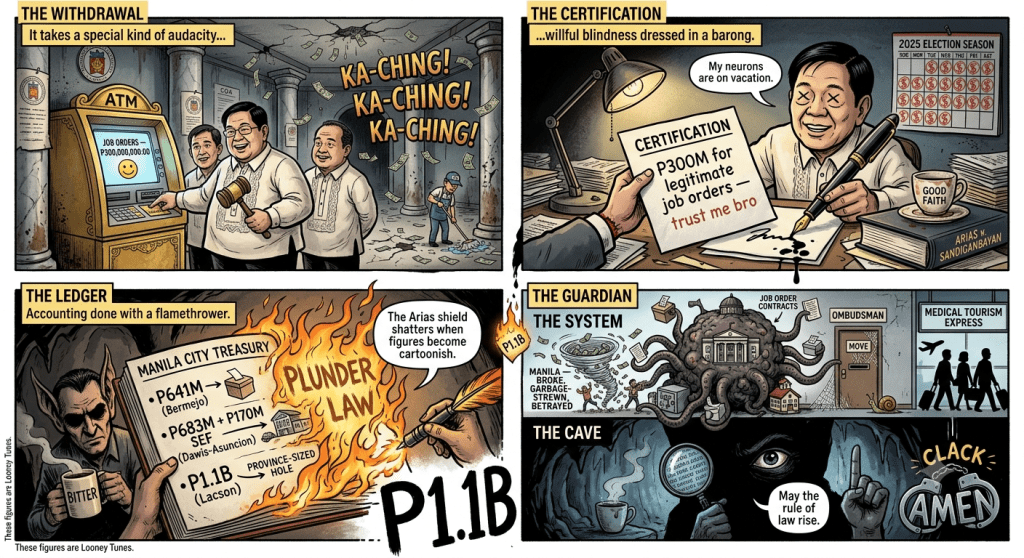
In a story that keeps spilling out like the leaky plumbing of Manila City Hall itself, Mayor Isko Moreno has finally named names. And what names they are: Jocelyn “Joy” Dawis-Asuncion, former Assistant City Administrator. Marlon Lacson, former Secretary to the Mayor. Fernan Bermejo, former Public Employment Service Office (PESO) manager. The triumvirate of fiscal apocalypse. Collectively, they allegedly presided over what can only be described as a fire sale of the city’s treasury—P641 million here, P1.1 billion there, P319.3 million somewhere else—figures that swirl and blur like the accounting was done with a flamethrower.
Isko wants them arrested. Let’s talk about why any Sandiganbayan justice with a functioning conscience should already be reaching for a pen.
Act I: The Cast of Characters and the Art of the Cash Advance
Let us begin with the sheer, breathtaking scale. The dossier compiled by this cave-dwelling scribe reveals a financial crime scene so littered with zeros it resembles a mathematical fever dream. During the 2025 election campaign period—because of course that’s when it happened—21 city officials allegedly withdrew P2.1 billion in cash advances. But our three protagonists distinguished themselves with operatic flair.
Bermejo, the PESO manager, allegedly coursed P641 million through job orders, those wonderfully elastic budgetary instruments that can mean anything from actual street-sweepers to—if Moreno’s allegations hold—a convenient vote-buying slush fund. Dawis-Asuncion, the assistant city administrator, allegedly added another P683 million to her personal cash advance collection, plus a neat P170 million diversion from the Special Education Fund (SEF) to pay Government Service Insurance System (GSIS) premiums and loan amortizations. That’s right: she allegedly stole from schoolchildren to pay the government’s own insurance bills. The circularity is almost philosophical. And Lacson? The former secretary to the mayor allegedly tops the leaderboard with P1.1 billion in cash advances, a figure so large it exceeds the annual budget of some Philippine provinces.
Their defense attorneys will predictably dust off the Arias v. Sandiganbayan playbook—the venerable Supreme Court doctrine that a head of office who relies in good faith on subordinate certifications cannot be automatically liable for conspiracy. But let us be savage in our preemptive rebuttal: Arias protects good-faith reliance, not willful blindness dressed in a barong. When your subordinate “certifies” that P300 million in a single day is for legitimate job orders, and you sign off without a single neuron firing in suspicion, that is not good faith. That is gross inexcusable negligence—one of the three distinct modes of committing a Section 3(e) violation under Republic Act No. 3019 (Anti-Graft and Corrupt Practices Act), as the Court clarified in Fonacier v. Sandiganbayan. The Arias shield shatters the moment the figures become cartoonish. And these figures are Looney Tunes.
Act II: The People’s Hypothetical Conviction
Allow your cave-dwelling correspondent to don the robes of a Sandiganbayan prosecutor, because the path to conviction is so well-lit it practically comes with runway markings.
We begin with the king of anti-corruption statutes: Republic Act No. 7080 (Plunder Law), as amended and as upheld by the Supreme Court in Estrada v. Sandiganbayan—the controlling precedent that killed every constitutional challenge to this statute. Plunder requires four elements, and the dossier ticks each one like a macabre checklist.
One: A public officer. Dawis-Asuncion, Lacson, and Bermejo all occupied positions of public trust with Salary Grades comfortably above 27, placing them squarely within Sandiganbayan jurisdiction under Republic Act No. 8249 (An Act Further Defining the Jurisdiction of the Sandiganbayan).
Two: Amassed, accumulated, or acquired ill-gotten wealth. The aggregate is the kill shot. Whether the final figure is P319.3 million (the Umeda complaint), P641 million (Moreno’s SOCA), or a consolidated total breaching P1 billion, we are so far past the P50-million plunder threshold that the threshold itself has become a rounding error. The Estrada Court emphasized that the law targets the “amassing” of wealth, not necessarily the personal pocketing of every centavo. If the conspiracy directed public funds into a criminal enterprise—say, a vote-buying operation disguised as job orders—that is amassing ill-gotten wealth for a corrupt purpose.
Three: Through a combination or series of overt or criminal acts. This is where the predicate crimes stack like dominos. First, we have Malversation under Article 217 of the Revised Penal Code (RPC). The dossier is damning: Acting City Accountant Jonathan Galorio demanded liquidation. No proper accounting was produced. Under Article 217, failure of a public officer to produce public funds upon demand by a duly authorized officer is prima facie evidence that the missing funds were put to personal use. The Supreme Court in People v. Soliva (2026) could not have been clearer: a shortage plus an inability to explain equals criminal conviction. Partial repayment does not erase liability; the crime is consummated upon failure to account after demand.
But wait, the hypothetical defense whispers. What if the funds were not pocketed but simply diverted? What if Dawis-Asuncion really did use the SEF millions to pay GSIS premiums—a different public purpose? Congratulations, counsel, you have just admitted your client to Technical Malversation under Article 220 of the RPC. The funds were lawfully in her custody for one purpose (education) and were applied to another (insurance premiums). That is still a crime, punishable by imprisonment and a fine of up to 100% of the sum misapplied. And here is the plunder masterstroke: technical malversation is itself a predicate overt act under Section 1(d) of RA 7080. A “combination or series” does not require that every act be personal theft. It requires a pattern of criminality in the handling of public funds. The pattern here is a Jackson Pollock of illegality.
We are not done. The Umeda complaint adds Falsification of Public Documents under Article 171 of the RPC. And looming over all of it is Section 3(e) of RA 3019, the anti-graft catch-all for causing undue injury to the government through manifest partiality, evident bad faith, or gross inexcusable negligence. The Fonacier doctrine means prosecutors need only prove one of those three modes. I would argue all three are present, dripping from the evidence like overripe fruit.
Four: The aggregate amount is at least P50 million. Again, we are in the billions. The Estrada Court upheld this threshold against vagueness challenges. There is nothing vague about P1.1 billion.
The evidence is not testimonial rumor; it is documentary. COA Notices of Disallowance are the prosecution’s nuclear arsenal. Once final, they constitute prima facie evidence of irregularity and create civil liability independent of any criminal conviction. The Landbank withdrawal records, the obligation requests, the job-order headcounts—this is a paper trail paved in gold. The presumption of innocence, enshrined in Article III, Section 14(2) of the 1987 Constitution of the Republic of the Philippines, is a shield, not a blindfold. And the evidence here, viewed at the preliminary investigation stage, screams probable cause with the subtlety of a foghorn.
Act III: The Systemic Cancer and the Call to the Guillotine
Now we must zoom out, because Manila City Hall is not an isolated tumor. It is a biopsy sample from a body politic riddled with metastatic corruption. This scandal is the purest distillation of a disease we have tolerated for decades: the weaponization of “job orders,” the cynical exploitation of election-season urgency, and the institutionalized pillaging of local government coffers as a de facto campaign finance system. The spike from 8,309 to 9,830 job orders as the 2025 elections approached is not a coincidence; it is a confession written in payroll form.
This is the system that the Republic Act No. 6713 (The Code of Conduct and Ethical Standards for Public Officials and Employees) was supposed to prevent. Section 4(a) declares that “public office is a public trust.” Section 4(c) commands officials to “lead modest lives.” Tell me, what is modest about a P300-million cash advance in a single day? These provisions have been reduced to decorative calligraphy on office walls while the actual governance is conducted in shadow ledgers and Landbank withdrawal slips.
And so, to the Office of the Ombudsman, we issue this demand: Move. Move with the urgency that P1.1 billion in questioned funds demands. Consolidate these complaints—the SEF diversion, the PESO/KASAMA misuse, the general cash advances—into a single, devastating plunder information. The dossier is already written; the Umeda and Galorio complaints are sworn and corroborated by career civil servants who have broken the code of silence. The time for preliminary investigation theater is over. File the Information. Let the Sandiganbayan issue those warrants of arrest that Isko Moreno is “hoping” for. And for the love of the rule of law, do not let this case drown in the procedural quicksand of inordinate delay. The respondents will inevitably invoke Cagang v. Sandiganbayan, which shifted the burden to the prosecution to justify delay. Preempt them. Be swift, be precise, be terrifying in your competence.
To the Sandiganbayan: When that Information lands on your docket, find probable cause with the independent judicial eye that the Constitution demands, but do not flinch from what the documentary evidence screams. Issue Hold Departure Orders immediately—we have seen too many plunder defendants discover urgent medical tourism.
And to the accused—Dawis-Asuncion, Lacson, Bermejo—enjoy the presumption of innocence while it lasts. The Constitution guarantees it, and this cave-dweller respects it. But the Constitution also guarantees the people’s right to an honest government. When your counter-affidavits land, they had better contain more than an Arias rehash and a whiff of political persecution. Show us the liquidation papers. Show us the legitimate job orders. Show us that P1.1 billion went anywhere other than the maw of a political machine.
We will wait. But the cave is cold, the coffee is bitter, and our patience is measured in Sandiganbayan docket numbers—which is to say, nearly exhausted.
The rule of law is not a suggestion. It is not a press release. It is not a campaign slogan for a former presidential aspirant rebuilding his brand. It is the difference between a functioning democracy and a hollowed-out shell where elections are bought with job-order contracts and the treasury is treated as a family ATM. For the sake of Manila—broke, garbage-strewn, betrayed Manila—let this be the case that finally, definitively, proves that the cave-dwellers are watching, the prosecutors are serious, and the era of P300-million-a-day habits is over.
May the rule of law rise. And may it bring handcuffs.
— Barok
Key Citations
A. Legal & Official Sources
- The 1987 Constitution of the Republic of the Philippines. Official Gazette of the Republic of the Philippines, 1987, http://www.officialgazette.gov.ph/constitutions/1987-constitution/.
- Republic Act No. 3019. Anti-Graft and Corrupt Practices Act. Official Gazette of the Republic of the Philippines, 17 Aug. 1960, http://www.officialgazette.gov.ph/1960/08/17/republic-act-no-3019/.
- Republic Act No. 7080. An Act Defining and Penalizing the Crime of Plunder. 12 July 1991. Lawphil, lawphil.net/statutes/repacts/ra1991/ra_7080_1991.html.
- Republic Act No. 8249. An Act Further Defining the Jurisdiction of the Sandiganbayan, Amending for the Purpose Presidential Decree No. 1606, as Amended, and for Other Purposes. 5 Feb. 1997. Lawphil, lawphil.net/statutes/repacts/ra1997/ra_8249_1997.html.
- Republic Act No. 6713. An Act Establishing a Code of Conduct and Ethical Standards for Public Officials and Employees. 20 Feb. 1989. Lawphil, lawphil.net/statutes/repacts/ra1989/ra_6713_1989.html.
- Act No. 3815. The Revised Penal Code of the Philippines. Official Gazette of the Republic of the Philippines, 8 Dec. 1930, http://www.officialgazette.gov.ph/1930/12/08/act-no-3815-s-1930/.
- Arias v. Sandiganbayan, G.R. Nos. 81563 & 82512, 19 Dec. 1989. Lawphil, lawphil.net/judjuris/juri1989/dec1989/gr_81563_1989.html.
- Fonacier v. Sandiganbayan, G.R. No. L-50691, 5 Dec. 1994. Lawphil, lawphil.net/judjuris/juri1994/dec1994/gr_l_50691_1994.html.
- Estrada v. Sandiganbayan, G.R. No. 148560, 19 Nov. 2001. Lawphil, lawphil.net/judjuris/juri2001/nov2001/gr_148560_2001.html.
- People v. Soliva, G.R. No. 268309, 26 Mar. 2026. Supreme Court of the Philippines, sc.judiciary.gov.ph/?p=162579.
- Cagang v. Sandiganbayan, G.R. No. 206438, 31 July 2018. Lawphil, lawphil.net/judjuris/juri2018/jul2018/gr_206438_2018.html.
B. News Reports
- Ronquillo, Andrew “Isko Seeks Arrest of Ex-City Officials.” Philstar.com, 2 July 2026, http://www.philstar.com/nation/2026/07/02/2539227/isko-seeks-arrest-ex-city-officials.

- “Ang Hirap Maging Mahirap”: The PAO Scandal That Proves Government Contempt Is Nothing New

- “Far-Off” My Axx: Malacañang’s Claire Castro Drowns in Her Own Legal Gaslighting
- “Forthwith” to Farce: How the Senate is Killing Impeachment—And Why Enrile’s Right (Even If You Can’t Trust Him)

- “HINDI AKO NAG-RESIGN!”

- “I Know Nothing”: Baste Duterte’s Amnesia Defense Meets ₱33M in GenCorp Contracts

- “I’m calling you from my new Globe SIM. Send load!”

- “Mahiya Naman Kayo!” Marcos’ Anti-Corruption Vow Faces a Flood of Doubt

- “Manageable” Debt, Unmanageable Lies: DBM’s ₱21 Trillion Fairy Tale
- “Meow, I’m calling you from my new Globe SIM!”

- “Natrabaho”: One Word, One Ombudsman, and a Judiciary on Trial
- “No Special Jail for Crooks!” Boying Remulla Slams VIP Perks for Flood Scammers

- “Philippine-Controlled” or Yankee Gas Station? The Davao Fuel Depot Farce Exposed








Leave a Reply