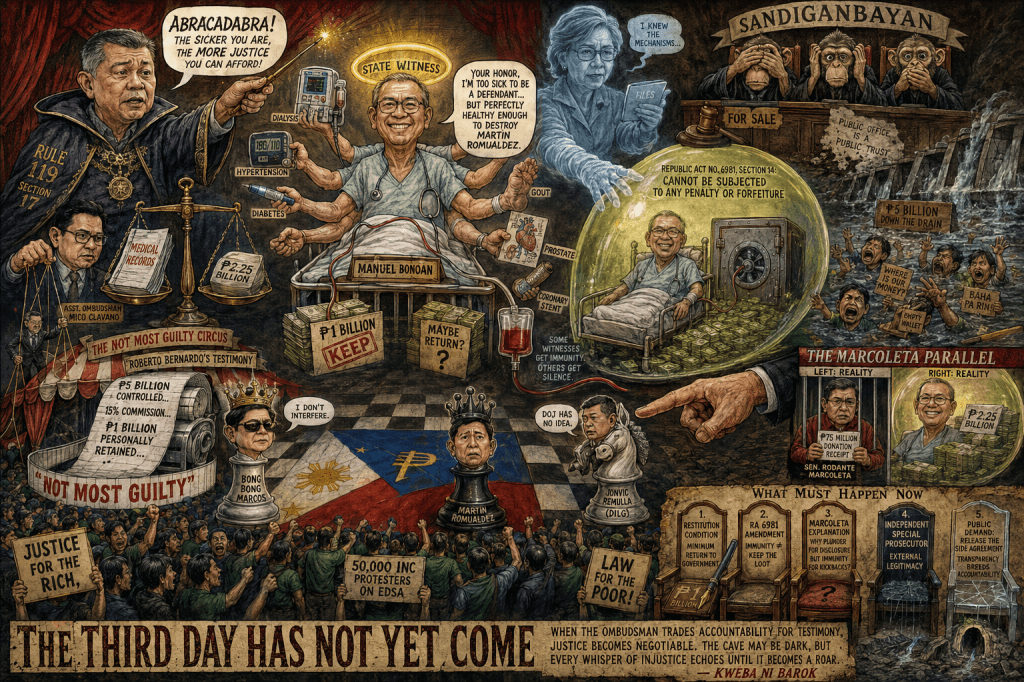
When the Ombudsman Trades Accountability for Testimony, Justice Becomes Negotiable
By Louis ‘Barok‘ C. Biraogo — July 2, 2026
WELCOME to the Philippines, where flood control projects drown in kickbacks, Cabinet secretaries discover their consciences at age 80 with Stage IV renal disease, and the Office of the Ombudsman performs legal alchemy—transforming accused plunderers into state witnesses with a wave of the prosecutorial wand.
Let us be clear: Former Department of Public Works and Highways (DPWH) Secretary Manuel Bonoan, who allegedly controlled ₱5 billion annually in project allocations, allegedly pocketed 15% commissions worth ₱2.25 billion, and by Senator Panfilo Lacson’s conservative estimate personally retained at least ₱1 billion, is being offered immunity. Not a plea bargain. Immunity. The kind where you walk away, keep your billions, and the State thanks you for your cooperation.
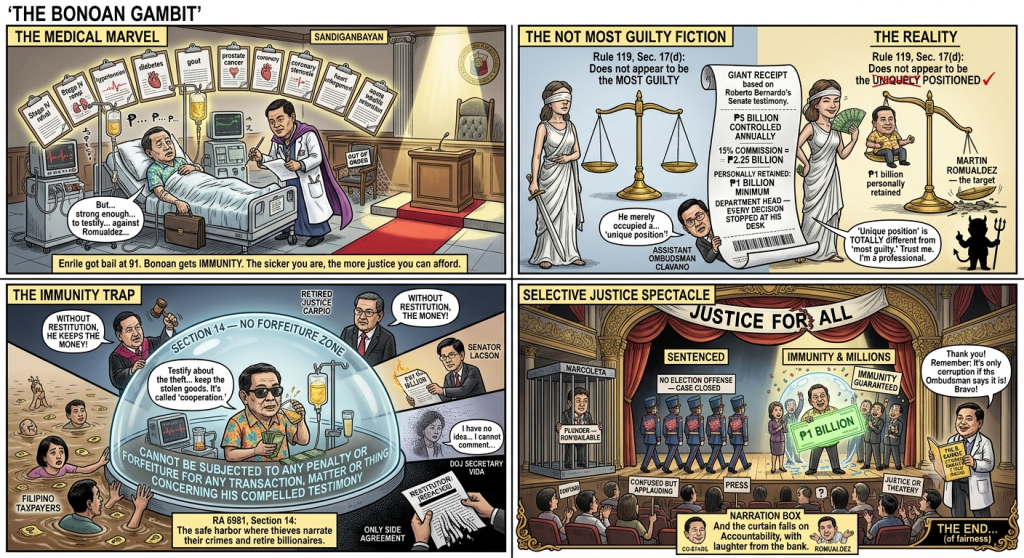
The Medical Marvel Defense
Ombudsman Jesus Crispin Remulla explains with apparent sincerity that Bonoan’s “various medical issues” require perpetuating his testimony “as soon as possible.” Translation: This man is too sick to stand trial but perfectly healthy to deliver testimony convicting Martin Romualdez.
What medical science is this? Stage IV chronic renal disease, hypertension, diabetes, gouty arthritis, prostate cancer, coronary artery disease with stenosis, and heart enlargement—a veritable buffet of terminal conditions—render him incapable of sitting in a defendant’s chair yet entirely capable of days of grueling cross-examination. The Sandiganbayan, apparently, is more hazardous than the witness stand.
This is the Enrile v. Sandiganbayan (G.R. No. 213847, 18 August 2015) doctrine on steroids. Enrile secured humanitarian bail at 91 but still faced trial. Bonoan faces no trial at all—his discharge under Rule 119, Section 17 of the Rules of Court operates as an acquittal. The sicker you are, the more justice you can afford.
The “Not Most Guilty” Fiction
Rule 119, Section 17(d) could not be clearer: the discharged accused “does not appear to be the most guilty.” Not “slightly less guilty than the target.” Not the most guilty.
Yet Roberto Bernardo’s Senate testimony describes Bonoan controlling ₱5 billion annually, receiving 15% commissions, and retaining at least ₱1 billion personally. He was the department head—the man at whose desk every major decision stopped.
Assistant Ombudsman Mico Clavano counters that Bonoan merely occupied a “unique position” to build the case against Romualdez. But presence at the crime scene doesn’t reduce culpability; it makes one an eyewitness and participant—precisely whom the rule excludes.
The Supreme Court in Jimenez v. People (G.R. No. 209195, 17 September 2014) held that “most guilty” requires examining the “degree of participation.” A principal by direct participation—controlling money, approving projects, receiving commissions—cannot become less guilty because someone else conceived the scheme. If Romualdez was architect, Bonoan was general contractor, allegedly pocketing billions along the way.
The Immunity Trap: Section 14 as License to Keep Loot
Here lies the darkest corner: Republic Act No. 6981 (Witness Protection, Security and Benefit Act), Section 14, provides that a compelled witness “cannot be subjected to any penalty or forfeiture for any transaction, matter or thing concerning his compelled testimony.”
Read carefully: cannot be subjected to any forfeiture. Not merely “cannot be imprisoned.” Cannot lose the money.
Retired Justice Antonio Carpio’s warning is surgically precise: “Without the agreement to return the malversed amount, Bonoan can keep the public funds after he testifies.” He is reading the statute. Section 14 arguably immunizes not only Bonoan’s person but his property. Testify about receiving kickbacks, and the testimony shields the kickbacks themselves.
This is the logical endpoint of a poorly drafted immunity statute—a safe harbor for stolen wealth provided the thief narrates the theft. Lacson’s ₱1-billion restitution demand fills a gaping statutory hole. Without an explicit, enforceable restitution agreement, Bonoan could testify, secure acquittal, and retire to well-funded medical care, billions intact.
The Ombudsman has disclosed no restitution figure. DOJ Secretary Fredderick Vida’s “I have no idea, I cannot comment” reads like institutional distancing from a deal even government lawyers find questionable.
The Selective Justice Spectacle
No analysis is complete without examining this gambit’s dark twin: the plunder prosecution of Senator Rodante Marcoleta for undeclared campaign contributions.
Marcoleta admitted receiving ₱75 million in donations. The Commission on Elections (COMELEC) voted 6-0 to terminate investigation, finding no election offense. Yet the Ombudsman proceeds with non-bailable plunder—requiring proof that undeclared contributions without connection to any official act constitute the “combination or series” of criminal acts Republic Act No. 7080 (Plunder Law) demands.
Meanwhile, Bonoan—credibly alleged to have controlled billions in kickbacks—receives immunity.
Legally, these are different cases with different elements. Politically, this looks like selective prosecution in judicial robes. The equal-protection standard is deliberately high (People v. Dela Piedra, G.R. No. 121777, 24 January 2001), requiring intentional discrimination. But the public is not a court. The public sees a Duterte-aligned senator facing plunder for disclosure violations while a Marcos appointee receives immunity for allegedly running the largest infrastructure kickback scheme in recent history.
The Iglesia ni Cristo’s unprecedented EDSA mobilization—up to 50,000 members—reflects growing perception that prosecutorial discretion has become discrimination, that the Marcos-Duterte war is fought with criminal informations rather than campaign speeches.
The Triangle: Family, Power, and Prosecutorial Prerogative
Martin Romualdez is President Marcos’s first cousin—and a potential rival to succeed him in 2028. The Ombudsman prosecuting Romualdez, Jesus Crispin Remulla, is the brother of DILG Secretary Juanito Victor “Jonvic” Remulla, a Marcos appointee. Caught between these overlapping loyalties, the Palace publicly claims non-interference while quietly backing Senator Lacson’s demand that Bonoan return ₱1 billion before receiving immunity.
This is three-dimensional chess. Targeting Romualdez demonstrates even presidential family faces accountability. Offering Bonoan immunity secures testimony. Prosecuting Marcoleta signals Duterte allies won’t escape. The Palace gets anti-corruption optics without accountability for either deal.
But this is chess played with real lives, real billions, and real institutional credibility. When prosecutorial decisions appear calibrated to political convenience, public trust erodes further—in a country where “justice for the rich, law for the poor” is lived reality.
The Cabral Ghost
No critique is complete without acknowledging DPWH Undersecretary Maria Teresa “Tess” Cabral, who died by suicide in December 2025—another potential witness, another insider who knew the mechanisms. Her death removes corroboration and raises uncomfortable questions about pressure on witnesses. Her absence makes Bonoan’s testimony both more necessary and more suspect.
What Must Happen Now
- First, the Sandiganbayan must condition discharge on explicit, enforceable restitution specifying minimum return to government. Not required by statute text, but required by equity and the constitutional mandate (Article XI, Section 1 of the 1987 Constitution of the Republic of the Philippines) that public office is a public trust.
- Second, Congress must amend RA 6981 Section 14 to provide that immunity from forfeiture does not extend to property obtained through the criminal transaction testified about, unless restitution is made. Current language creates perverse incentives: testify and keep proceeds. This is legislative malpractice decades in the making.
- Third, the Ombudsman must publicly explain the Marcoleta disparity. Prosecutorial discretion is not a license for mystery. Why plunder for campaign disclosure but immunity for infrastructure kickbacks?
- Fourth, an independent special prosecutor should review both cases. Given Marcos-Romualdez-Remulla entanglements, external legitimacy is essential.
- Fifth, the public must demand release of the “side agreement.” Carpio is right: transparency breeds accountability; secrecy breeds suspicion.
Conclusion: The Third Day Has Not Yet Come
The Bonoan arrangement may prove a prosecutorial masterstroke unlocking convictions against untouchables. Or it may prove the moment accountability became officially negotiable for those with connections, information, or convenient illnesses.
The Sandiganbayan Fifth Division holds the gavel. Will it demand satisfaction of all Rule 119 requirements, including “not most guilty”? Will it condition discharge on restitution? Or will it defer to prosecutorial discretion, allowing a man allegedly enriched by billions to walk free, wealth intact, for pointing fingers?
The answer tells us whether the rule of law is a living principle or a corpse awaiting resurrection that never comes.
Kweba ni Barok watches, documents, and demands the accountability the powerful deny the powerless. The cave may be dark, but every whisper of injustice echoes until it becomes a roar. 🪨
Key Citations
A. Legal & Official Sources
- The 1987 Constitution of the Republic of the Philippines. 2 Feb. 1987. Official Gazette of the Republic of the Philippines. https://www.officialgazette.gov.ph/constitutions/1987-constitution/.
- Republic Act No. 6981. An Act Providing for a Witness Protection, Security and Benefit Program and for Other Purposes. 24 Apr. 1991. Lawphil Project. https://lawphil.net/statutes/repacts/ra1991/ra_6981_1991.html.
- Republic Act No. 7080. An Act Defining and Penalizing the Crime of Plunder. 12 July 1991. Lawphil Project. https://lawphil.net/statutes/repacts/ra1991/ra_7080_1991.html.
- Rules of Court. Rule 119, Section 17 (Revised Rules of Criminal Procedure). Lawphil Project. https://lawphil.net/courts/rules/rc_110-127_crim.html.
- Enrile v. Sandiganbayan. G.R. No. 213847. Supreme Court of the Philippines, 18 Aug. 2015. Lawphil Project. https://lawphil.net/judjuris/juri2015/aug2015/gr_213847_2015.html.
- Jimenez v. People. G.R. No. 209195. Supreme Court of the Philippines, 17 Sept. 2014. Lawphil Project. https://lawphil.net/judjuris/juri2014/sep2014/gr_209195_2014.html.
- People v. Dela Piedra. G.R. No. 121777. Supreme Court of the Philippines, 24 Jan. 2001. Lawphil Project. https://lawphil.net/judjuris/juri2001/jan2001/gr_121777_2001.html.
B. News Reports
- Villeza, Mark Ernest. “‘Bonoan to pin down Martin? He must return P1 billion.’” Philstar.com, 1 July 2026, http://www.philstar.com/headlines/2026/07/01/2538994/bonoan-pin-down-martin-he-must-return-p1-billion.
- Villeza, Mark Ernest. “Bonoan Accepted as State Witness.” Philstar.com, 30 June 2026, http://www.philstar.com/headlines/2026/06/30/2538738/bonoan-accepted-state-witness.
- “ Lacson: Ex-DPWH Chief Bonoan Has a Lot to Reveal, but Should Also Make Restitution.” Manila Bulletin, 30 June 2026 or 1 July 2026 update, mb.com.ph/2026/06/30/lacson-ex-dpwh-chief-bonoan-has-a-lot-to-reveal-but-should-also-make-restitution.
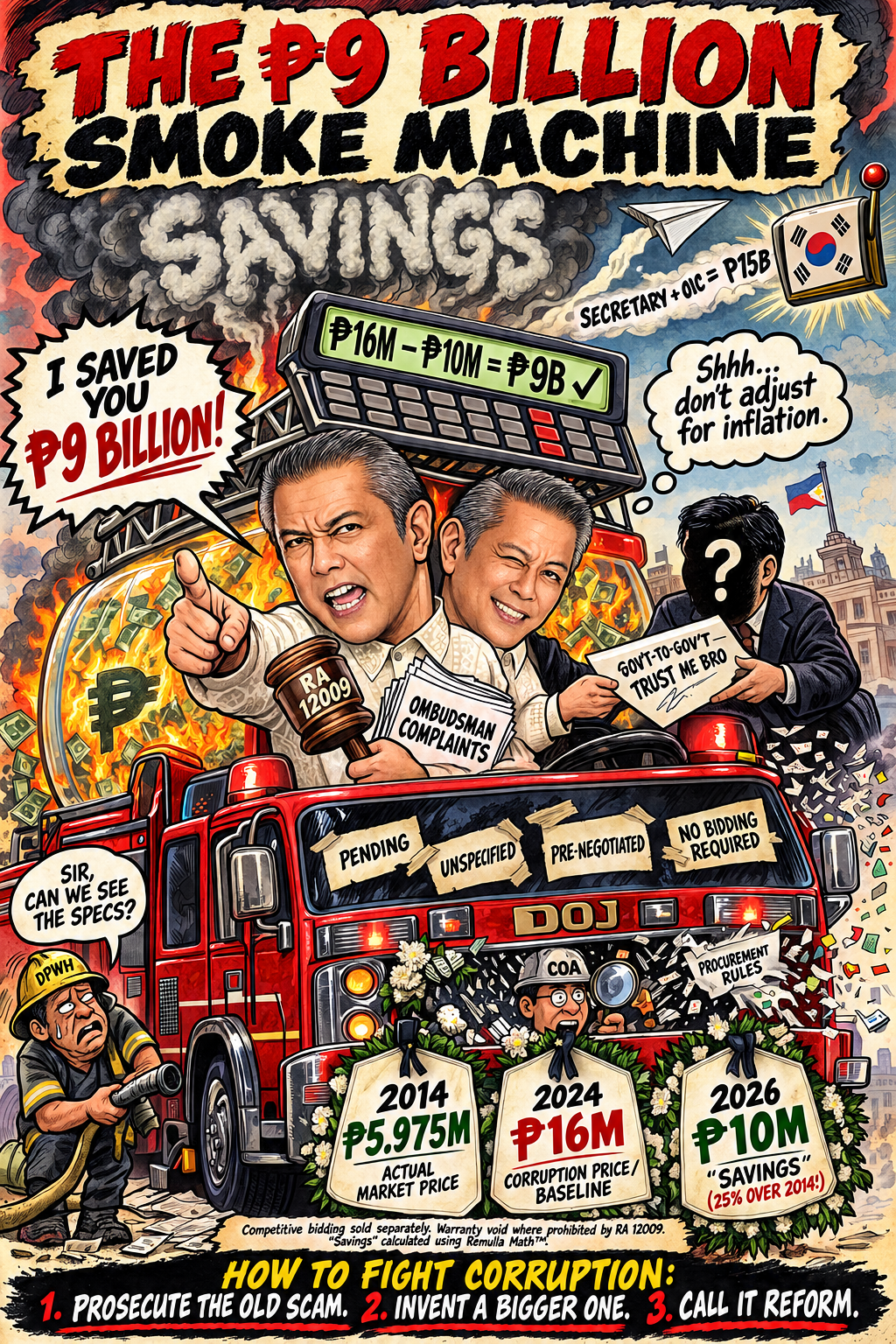
- ₱9 Billion in ‘Savings’? DILG’s Fire Truck Deal Smells Like Smoke

- ₱8B BBM Pork: CCTV for Every Captain’s Kumpare?
- ₱8.9 Billion, 331 Ghost Police Stations: The TIKAS Scandal Explained

- ₱8.4 Billion, 42,000 Barangays, 1 Election: The “Bawat Barangay Makikinabang” Vote-Buying Masterclass

- ₱75 Million Heist: Cops Gone Full Bandit

- ₱6.77B Ghost Haunts Duterte: RTC Dismisses Mans Carpio’s Desperate Plea
- ₱6.77 Billion and Zero Cash: The Sara Duterte SALN Math That Doesn’t Add Up

- ₱6.7-Trillion Temptation: The Great Pork Zombie Revival and the “Collegial” Vote-Buying Circus

- ₱58.53B, Zero Receipts: The LGSF Pork Barrel Nobody Wants to Name
- ₱53 Million Man Tells ₱695-a-Day Workers to Stop Being ‘Mayabang’: The Audacity of BSP’s Remolona
- ₱4.4 Billion and a Witness Who Can’t Explain It: The Duterte Impeachment’s Most Expensive Non-Answer
- ₱3.06 Billion for Evacuation Centers—But Nobody Knows Where They’ll Stand (Or If They’ll Exist)





Leave a Reply