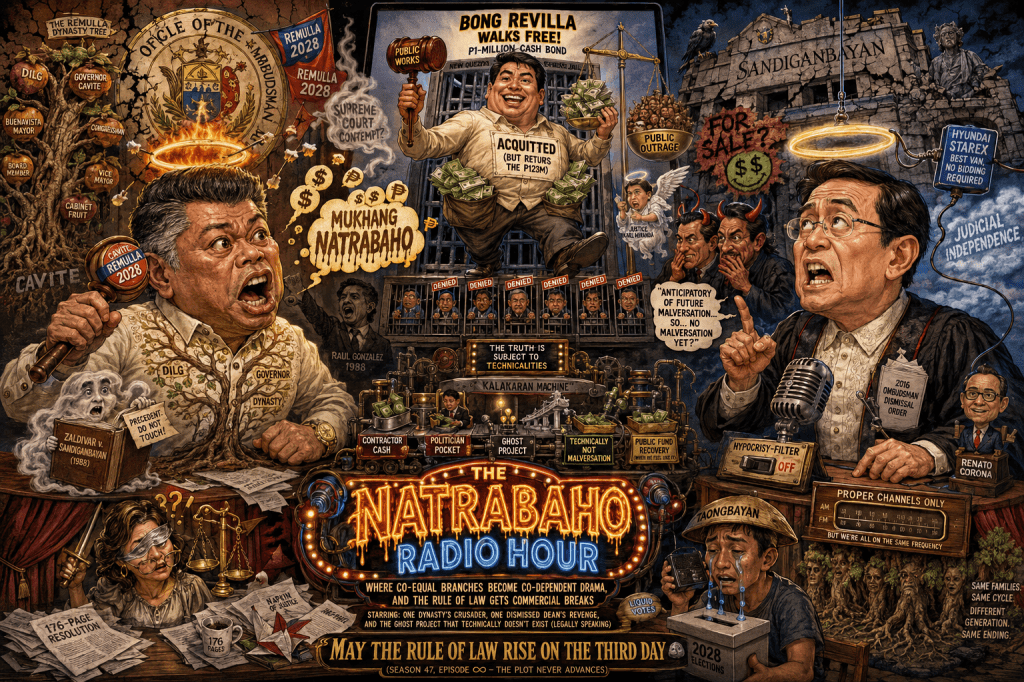
A Bail Grant, a Radio Rant, and the Dynasty That Dared to Cry Corruption
By Louis ‘Barok‘ C. Biraogo — August 10, 2026
IN THE cavernous halls of Philippine justice, where the blindfold on Lady Justice is often rumored to be slightly askew, a spectacular public duel has erupted. It’s not a subtle exchange of legal memoranda, but a radio war—a clash of titans shouting past each other in the coliseum of public opinion, while the very institutional channels designed for this fight gather dust.
The combatants: Ombudsman Jesus Crispin “Boying” Remulla and former law dean Judd Roy. The casus belli: the Sandiganbayan’s 2-1 decision granting former Senator Bong Revilla bail in a ₱92.8-million ghost flood-control project case. The constitutional architecture they are rattling is the 1987 Constitution of the Republic of the Philippines (1987 Constitution)’s deliberate firewall: an independent anti-corruption prosecutor under Article XI and an independent judiciary under Article VIII, each a watchdog meant to guard the republic, now locked in a snarling match over a single bail ruling. Neither the appellate process to correct legal errors, nor the Judicial Integrity Board to probe judicial conduct, was activated. Instead, we got a radio drama, and here’s the uncomfortable truth: neither lead actor is entirely wrong.

The Bail That Feels Like a Sanctuary
Let’s grant his frustration a fair autopsy before we declare his response a legal homicide. His anger tracks a pathology in Philippine jurisprudence that is as real as it is infuriating. The “strong evidence of guilt” standard for denying bail in non-bailable offenses has, in high-profile cases, morphed from a rigorous judicial test into a seemingly insurmountable peak. The Sandiganbayan’s 176-page resolution, penned by Justice Fritz Bryn Delos Santos, is a masterclass in this metaphysical standard. The majority surgically dismantled the prosecution’s evidence, dismissing testimony about advance kickbacks from contractors as merely “anticipatory of future malversation.” In their exacting logic, cash in a bag given in a parking lot was not yet a public fund, and the complex crime of malversation through falsification hadn’t fully crystallized. It’s a legal reasoning so pristine, so clinically detached from the kalakaran (systemic practice) it examined, that it risks mistaking the forest for the meticulously examined trees. Chairperson Karl Miranda’s blistering dissent saw the same evidence and found a “strong” case, viewing the alleged kickback not as an isolated prelude but as the very engine of the ghost project. The uncomfortable result, perfectly calibrated for public outrage, is a 2-1 vote granting bail exclusively to the most powerful accused, while his lower-level co-accused remain detained. It’s the recurring pattern that drives anti-corruption advocates to despair: a fortress of legal technicality that feels, to the public, indistinguishable from a sanctuary.
The Halo That Fits a Little Too Snugly
Enter Judd Roy, stage left, to deliver a stern constitutional lecture. His argument is unassailable in its orthodoxy: a public official with the megaphone of the state must not deploy the language of criminality against a co-equal branch without proof, especially when a motion for reconsideration on the very ruling is still pending. The casual remark “mukhang natrabaho”—a phrase that in Filipino political argot doesn’t mean clever lawyering but explicitly connotes bribery—falls far short of a responsible prosecutor’s standard. Roy is legally correct. But when the legal acolyte becomes the story, we must interrogate the moral architecture of his crusade. Is this the pure voice of an institutionalist, or the perfectly timed redemption arc of a man with a score to settle? Roy’s righteous demand that Remulla use “proper channels” instead of radio is, let us note with a satirical chuckle, a demand he delivered on the very same medium. More delightfully for conspiracy theorists, Roy is a man with a past. This stalwart defender of judicial sanctity was, in 2016, unceremoniously dismissed from service by the very Office of the Ombudsman he now seeks to discipline, for a procurement anomaly. He was also a defense lawyer for the late impeached Chief Justice Renato Corona. Is his sudden, radio-borne passion for judicial independence a matter of high constitutional principle, or the most elegant act of institutional payback a former law dean could orchestrate? The halo fits a little too snugly.
When the Anti-Corruption Crusader Comes from a Dynasty
But if Roy’s halo is askew, Ombudsman Remulla’s has been flung into a raging bonfire of political optics. His original sin was not anger, but method—the gravitational pull of his words toward the black hole of the Supreme Court’s ruling in Zaldivar v. Sandiganbayan and Gonzalez (G.R. Nos. 79690-707 & 80578, October 7, 1988). In that 1988 precedent, the Supreme Court indefinitely suspended the sitting Tanodbayan, Raul Gonzalez, for contempt and gross misconduct after he publicly accused the Court of favoring the “rich and influential.” The parallel is spine-chillingly precise: a sitting Ombudsman, frustrated by a ruling, publicly insinuating improper influence on the bench over a pending case. Remulla, a veteran lawyer, knows this. His choice to say “mukhang natrabaho” on national radio was either a stunning ignorance of legal history, which is unlikely, or a calculated political gambit. This brings us to the delicate and unavoidable question of political economy. The man leveling the charge of elite capture is not just a prosecutor; he is a prominent member of the Remulla dynasty. His brother serves as Department of the Interior and Local Government (DILG) Secretary. His son is the Governor of Cavite. The national anti-corruption crusader is simultaneously the brother of a key Cabinet member and a fixture of a political clan that has dominated Cavite for decades. This structural reality does not, in itself, negate his critique of the Sandiganbayan. But it does demand a higher standard of circumspection. When an Ombudsman embedded in such a family publicly casts aspersions on the integrity of a co-equal branch, the public is entitled to ask whether the zeal is purely institutional or whether there are broader, unspoken dynamics at play. The challenge for Remulla is not to deny his context—which is impossible—but to demonstrate through precise legal action, not radio rhetoric, that his office operates independently of it. The public must not be left wondering whether a crusade against corruption has, however inadvertently, become entangled with the gravitational pull of a political family’s long-term trajectory. The veiled suggestion that the retiring Chief Justice’s “legacy” hinges on a dialogue with the Ombudsman, however sincerely intended, only deepens that uncomfortable question.
Rule of Law or Dynastic Telenovela?
So where does this burlesque leave the rule of law? Teetering on the edge of an abyss, with all actors demanding we watch them, not the void. The path to de-escalation is clear and must be demanded without flinching. The Ombudsman must sheathe his radio sword and fight his war where it belongs: in the courtroom, armed with his motion for reconsideration, not with slanderous innuendo. The Sandiganbayan must not mistake judicial restraint for institutional timidity. Its dignified “no offense taken” response is a noble posture, but it must now honestly and transparently confront the substantive questions raised by Justice Miranda’s dissent, not hide behind procedural finality.
The call here is not for a winner in a radio war. It is a call for the supremacy of the rule of law above fleeting power and dynastic ambition. We demand full transparency and unflinching accountability—for plunderers in the Senate, yes, but also for prosecutors who must wield accusations with surgical precision, not a megaphone. We demand equal justice not calibrated by the defendant’s last name or the prosecutor’s bloodline. We call for democratic institutions strong enough to serve the nation, not the political tantrums of the few who temporarily inhabit them. We call for a public service that puts the people first, not family brands. And we call for hope—for a generation of young Filipinos who must one day look at this mess and believe that justice is a right, not a punchline in a political dynasty’s long-running telenovela.
May the rule of law rise on the third day. 🪨
Key Citations
A. Legal & Official Sources
- The 1987 Constitution of the Republic of the Philippines. Official Gazette of the Republic of the Philippines, 1987, http://www.officialgazette.gov.ph/constitutions/1987-constitution/.
- Article VIII, The 1987 Constitution of the Republic of the Philippines. Official Gazette of the Republic of the Philippines, http://www.officialgazette.gov.ph/constitutions/the-1987-constitution-of-the-republic-of-the-philippines/the-1987-constitution-of-the-republic-of-the-philippines-article-viii/.
- Article XI, The 1987 Constitution of the Republic of the Philippines. Official Gazette of the Republic of the Philippines, http://www.officialgazette.gov.ph/constitutions/the-1987-constitution-of-the-republic-of-the-philippines/the-1987-constitution-of-the-republic-of-the-philippines-article-xi/.
- Zaldivar v. Sandiganbayan, G.R. Nos. L-79690-707 & L-80578, 7 Oct. 1988, lawphil.net/judjuris/juri1988/oct1988/gr_l-79690_1988.html.
- Sandiganbayan. Official Website, sb.judiciary.gov.ph/.
- Office of the Ombudsman. Official Website, http://www.ombudsman.gov.ph/.
- Department of the Interior and Local Government. Official Website, dilg.gov.ph/.
- Sandiganbayan Third Division. People of the Philippines v. Ramon Bautista “Bong” Revilla, Jr., et al., E-SB-26-CRM-0002. Resolution, 31 July 2026, sb.judiciary.gov.ph/wp-content/uploads/2026/07/Resolutions/Res_Crim_E-SB-26-CRM-0002_People%20vs.%20Ramon%20Bautista%20Bong%20Revilla,%20Jr.,%20et%20al_07-31-26.pdf.
B. News Reports
- Recuenco, Aaron. “Ex-Law Dean Calls Out Remulla for Statement vs Sandiganbayan Justices over Revilla Bail.” Manila Bulletin, 4 Aug. 2026, mb.com.ph/2026/08/04/ex-law-dean-calls-out-remulla-for-statement-vs-sandiganbayan-justices-over-revilla-bail.
- Panti, Llanesca T. “Bong Revilla granted bail in P92.8-M flood control malversation case.” GMA News Online, GMA Network, 31 July 2026, http://www.gmanetwork.com/news/topstories/nation/996877/bong-revilla-flood-control-malversation-case/story/.
- “Ombudsman Remulla on Bong Revilla bail grant: We expected this to happen.” GMA News Online, GMA Network, 1 Aug. 2026, http://www.gmanetwork.com/news/topstories/nation/996992/ombudsman-remulla-on-bong-revilla-bail-grant-we-expected-this-to-happen/story/.
- “Lawyer asks: Did the Ombudsman insinuate that Sandiganbayan is corrupt?” Inquirer.net, 5 Aug. 2026, newsinfo.inquirer.net/2277636/lawyer-asks-did-the-ombudsman-insinuate-that-sandiganbayan-is-corrupt.
- “PLM officials, ex-Corona lawyer, dismissed from service.” Rappler, 1 Mar. 2016, http://www.rappler.com/philippines/124205-pamantasan-officials-ex-corona-lawyer-dismissed-service/.
- Bolledo, Jairo. “Revilla’s P1-M Bail: What ‘Weak Evidence’ Bought Him.” Rappler, 1 Aug. 2026, http://www.rappler.com/philippines/explanation-sandiganbayan-decision-bong-revilla-bail-malversation-case/.
- ₱8B BBM Pork: CCTV for Every Captain’s Kumpare?

- ₱8.9 Billion, 331 Ghost Police Stations: The TIKAS Scandal Explained

- ₱8.4 Billion, 42,000 Barangays, 1 Election: The “Bawat Barangay Makikinabang” Vote-Buying Masterclass

- ₱75 Million Heist: Cops Gone Full Bandit

- ₱6.77B Ghost Haunts Duterte: RTC Dismisses Mans Carpio’s Desperate Plea
- ₱6.77 Billion and Zero Cash: The Sara Duterte SALN Math That Doesn’t Add Up

- ₱6.7-Trillion Temptation: The Great Pork Zombie Revival and the “Collegial” Vote-Buying Circus

- ₱58.53B, Zero Receipts: The LGSF Pork Barrel Nobody Wants to Name
- ₱53 Million Man Tells ₱695-a-Day Workers to Stop Being ‘Mayabang’: The Audacity of BSP’s Remolona

- ₱4.4 Billion and a Witness Who Can’t Explain It: The Duterte Impeachment’s Most Expensive Non-Answer
- ₱3.06 Billion for Evacuation Centers—But Nobody Knows Where They’ll Stand (Or If They’ll Exist)
- ₱16 Billion, 280 Accounts, 8 Helicopters: Boying Remulla’s Case Against the Yaps Is Not a Drill





Leave a Reply