
Where Public Office Is Just the Family Business with Better Parking
By Louis ‘Barok‘ C. Biraogo — August 9, 2026
LET us begin with a sacrament of Philippine democracy: a congressman, sworn to serve the people, allegedly signing government contracts payable to himself. Not metaphorically. Literally.
Rep. Noel “Bong” Rivera of Tarlac’s 3rd District—85 percent re-election victor, barangay-captain-made-good, Nationalist People’s Coalition (NPC) stalwart—now stands indicted on nine counts of graft under Section 3(h) of Republic Act No. 3019 (Anti-Graft and Corrupt Practices Act). Nine Informations filed across six Sandiganbayan divisions. The charge is not complex: while serving as congressman, Rivera allegedly remained majority stockholder, CEO, and General Manager of Tarlac 3-G Construction and Development Corporation—a firm that, during his incumbency, saw its Department of Public Works and Highways (DPWH) contract haul double to ₱358.7 million in 2023 alone. His signature reportedly adorns the very contracts his company won. One hand raised for the oath, the other extended for the check.
Ombudsman Jesus Crispin Remulla, in a press-conference flourish, branded Rivera a “congtractor.” The portmanteau is vulgar, prosecutorial, and absolutely precise. It signals an institutional recognition—belated, perhaps cosmetic, but welcome nonetheless—that the House of Representatives has become a franchising operation where legislative seats function as procurement licenses.
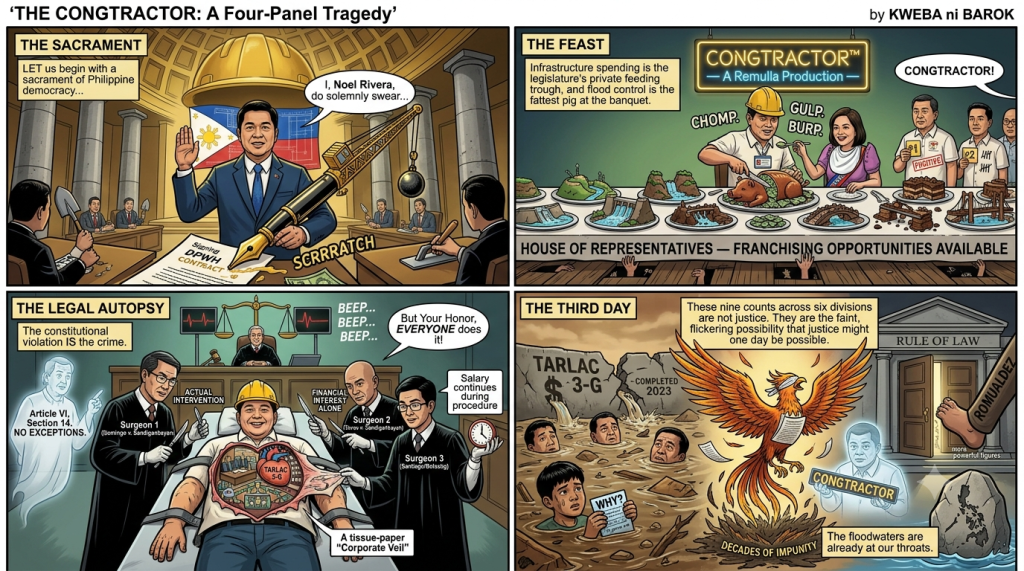
The 90-day suspension spectacle: Salary ON, representation OFF. This is what electing a construction firm to Congress looks like.
The Legal Autopsy: Dissecting the Living Congtractor
The 1987 Constitution of the Republic of the Philippines (1987 Constitution), in Article VI, Section 14, could not be plainer: “Neither shall he, directly or indirectly, be interested financially in any contract with, or in any franchise or special privilege granted by, the Government… during his term of office.” No exceptions. No thresholds. No de minimis defense for a little family business on the side.
The Supreme Court’s Domingo v. Sandiganbayan framework establishes that Section 3(h) of RA 3019 creates two independent paths to guilt. The first requires proof of actual intervention—signing contracts, influencing awards. The second, and far more damning, is triggered simply by holding a financial interest prohibited by the Constitution. The prosecution need not prove Rivera lifted a finger to secure the contracts. His ownership stake, standing alone during his term, completes the offense. The constitutional violation is the crime.
Rivera’s 54.84 percent stake in Tarlac 3-G is not in dispute. His wife Evelyn—Vice Mayor of Concepcion, naturally—holds most of the rest. Together, they form a closed loop of political and economic power: husband legislates and oversees, wife governs locally, the family corporation collects government checks. Under Teves v. Sandiganbayan, delegating management to a spouse without actual divestment is no defense. The corporate veil is tissue paper.
Rivera also stands accused of failing to comply with Republic Act No. 6713 (Code of Conduct and Ethical Standards for Public Officials and Employees), which mandates divestment within sixty days of assuming office. He did not divest. He did not resign. He kept signing.
The Defense’s Gambit—and Why It Fails Spectacularly
Rivera’s counsel will inevitably invoke the Floirendo ghost: the argument that a literal reading of Section 3(h) would criminalize every legislator holding shares in any company that wins any government contract. This is not a defense against conviction; it is a confession about Congress. The Ombudsman itself, in the Floirendo resolution, acknowledged that constitutional text is sweeping—and then filed the case anyway, noting its duty is to enforce the law as written. If the law is too broad, let Congress amend it. But Congress does not want to amend it. Congress is the beneficiary.
The selective-prosecution card will also be played. Only eight lawmakers were referred by the defunct Independent Commission for Infrastructure (ICI), out of thirteen summoned. The ICI leaked commissioners, lacked contempt power, and conducted hearings in executive sessions. The Makabayan bloc called it “empty anti-corruption rhetoric.” Fair enough. But the Ombudsman’s preliminary investigation was independent, and the Informations now filed are its own. Selective prosecution requires proof of intentional discrimination—a standard Philippine jurisprudence has set punishingly high. Rivera is not being singled out; he is being processed in a queue.
The Congtractor Roster: A Who’s Who of Infrastructure Predators
And what a queue it is. Zaldy Co of Ako Bicol, now a fugitive, sits at the scandal’s plunder-track center. James “Jojo” Ang Jr. of Uswag Ilonggo already faces fourteen graft counts. Jernie Nisay, Augustina Pancho, Joseph Lara, Francisco Matugas—names that read less like a legislative directory than a contractors’ association board meeting. The ICI, for all its flaws, documented what Filipinos have known for decades: infrastructure spending is the legislature’s private feeding trough, and flood control is the fattest pig at the banquet.
Let us speak plainly about flood control. These are not abstract appropriations. These are projects meant to prevent communities from submerging, children from drowning, families from losing everything. When a “congtractor” delivers substandard flood-control infrastructure—and the pattern of doubled contract values coinciding with Rivera’s election suggests profit motive eclipsing public safety—the corruption is not victimless. The victims are wet, dead, and forgotten.
The 90-Day Suspension Spectacle: Salary On, Representation Off
Under Section 13 of RA 3019 and the Santiago v. Sandiganbayan doctrine, the Sandiganbayan must suspend Rivera pendente lite once it finds the Informations facially valid. This is ministerial, not discretionary. The suspension will last up to ninety days across all counts, per Bolastig v. Sandiganbayan. Rivera will collect his salary—Section 13 does not stop pay—but Tarlac’s 3rd District will temporarily lose its voting representative. Constituents, already burdened with potentially shoddy infrastructure, will now be politically disenfranchised. This is the cost of electing a construction firm to Congress.
The Ombudsman’s Burden: Branding Is Not Accountability
Remulla deserves no standing ovation. He inherited a scandal, inherited a defunct commission’s referrals, and is now filing charges that any competent prosecutor would have filed. His “congtractor” coinage is clever branding, but branding does not equal accountability. The real test is whether his office can clear cases faster than public trust evaporates, and whether the plunder-track cases against more powerful figures—Romualdez among them—see the same prosecutorial vigor. The Rivera case is low-hanging fruit; the constitutionally prohibited interest is documented, the signatures are on the contracts, the beneficial ownership is undisputed. If the Ombudsman cannot win this, the entire anti-corruption apparatus is theater.
A Demand, Not a Suggestion: Prosecute the Dynasty Machine
Prosecute Noel Rivera. Prosecute his wife if the evidence supports conspiracy. Prosecute every name on the ICI referral list. File plunder charges where contract values exceed the ₱50 million threshold—₱2.3 billion across 72 projects is not a clerical error. End the cycle of impunity where legislators treat the national treasury as a family business line of credit.
Hold the political dynasties accountable. The Riveras of Tarlac, the Yaps who back them, the Cojuangco network that birthed the NPC—these are not aberrations but architecture. The “congtractor” system is how dynasties fund elections, reward loyalists, and perpetuate power.
Strengthen democratic institutions so they serve the nation, not a cartel. Demand full transparency in procurement—electronic bidding, real-time disclosure, an end to the negotiated darkness where contracts are awarded to the congressman’s own company and nobody notices until the floods come.
The Third Day: Will the Rule of Law Rise from the Rubble?
The people of Tarlac’s 3rd District—and every district represented by a “congtractor”—deserve representatives who build communities, not personal fortunes. They deserve infrastructure that withstands typhoons, not contracts that dissolve into family bank accounts.
The rule of law must rise on the third day—after decades buried under the rubble of congressional self-dealing, entombed by the fiction that legislators can simultaneously serve the public and invoice it. This case, this filing, these nine counts across six divisions, are not justice. They are the faint, flickering possibility that justice might one day be possible.
For the youth of this land, who will inherit whatever is left after the feast, hope is not a sentiment. It is a demand: that the era of the “congtractor” end in a Sandiganbayan courtroom, not in the next electoral cycle where the same names appear on ballots and the same firms appear on bid awards. May the rule of law rise indeed. The floodwaters are already at our throats. 🪨
Key Citations
A. Legal & Official Sources
- The 1987 Constitution of the Republic of the Philippines. Official Gazette of the Republic of the Philippines, 1987, http://www.officialgazette.gov.ph/constitutions/1987-constitution/.
- Republic Act No. 3019. Anti-Graft and Corrupt Practices Act. 1960, lawphil.net/statutes/repacts/ra1960/ra_3019_1960.html.
- Republic Act No. 6713. An Act Establishing a Code of Conduct and Ethical Standards for Public Officials and Employees. 1989, lawphil.net/statutes/repacts/ra1989/ra_6713_1989.html.
- Domingo v. Sandiganbayan. G.R. No. 109376, Supreme Court of the Philippines, 20 Jan. 2000, lawphil.net/judjuris/juri2000/jan2000/gr_109376_2000.html.
- Teves v. Sandiganbayan. G.R. No. 154182, Supreme Court of the Philippines, 17 Dec. 2004, lawphil.net/judjuris/juri2004/dec2004/gr_154182_2004.html.
- Santiago v. Sandiganbayan. G.R. No. 128055, Supreme Court of the Philippines, 18 Apr. 2001, lawphil.net/judjuris/juri2001/apr2001/gr_128055_2001.html.
- Bolastig v. Sandiganbayan. G.R. No. 110503, Supreme Court of the Philippines, 4 Aug. 1994, lawphil.net/judjuris/juri1994/aug1994/gr_110503_1994.html.
B. News Reports
- Mendoza, J. E. “Tarlac Rep. Noel Rivera Faces 9 Counts of Graft in Sandiganbayan.” Inquirer.net, 8 Aug. 2026, newsinfo.inquirer.net/2279988/tarlac-rep-noel-rivera-faces-9-counts-of-graft-in-sandiganbayan.
- Nonato, Vince F. “Floirendo Raps a ‘Cause for Concern’ for Solons with Businesses?” Inquirer.net, 22 Sept. 2017, newsinfo.inquirer.net/932329/floirendo-raps-a-cause-for-concern-for-solons-with-businesses.
- ₱8B BBM Pork: CCTV for Every Captain’s Kumpare?
- ₱8.9 Billion, 331 Ghost Police Stations: The TIKAS Scandal Explained

- ₱8.4 Billion, 42,000 Barangays, 1 Election: The “Bawat Barangay Makikinabang” Vote-Buying Masterclass
- ₱75 Million Heist: Cops Gone Full Bandit

- ₱6.77B Ghost Haunts Duterte: RTC Dismisses Mans Carpio’s Desperate Plea
- ₱6.77 Billion and Zero Cash: The Sara Duterte SALN Math That Doesn’t Add Up

- ₱6.7-Trillion Temptation: The Great Pork Zombie Revival and the “Collegial” Vote-Buying Circus

- ₱58.53B, Zero Receipts: The LGSF Pork Barrel Nobody Wants to Name
- ₱53 Million Man Tells ₱695-a-Day Workers to Stop Being ‘Mayabang’: The Audacity of BSP’s Remolona
- ₱4.4 Billion and a Witness Who Can’t Explain It: The Duterte Impeachment’s Most Expensive Non-Answer
- ₱3.06 Billion for Evacuation Centers—But Nobody Knows Where They’ll Stand (Or If They’ll Exist)
- ₱16 Billion, 280 Accounts, 8 Helicopters: Boying Remulla’s Case Against the Yaps Is Not a Drill





Leave a Reply