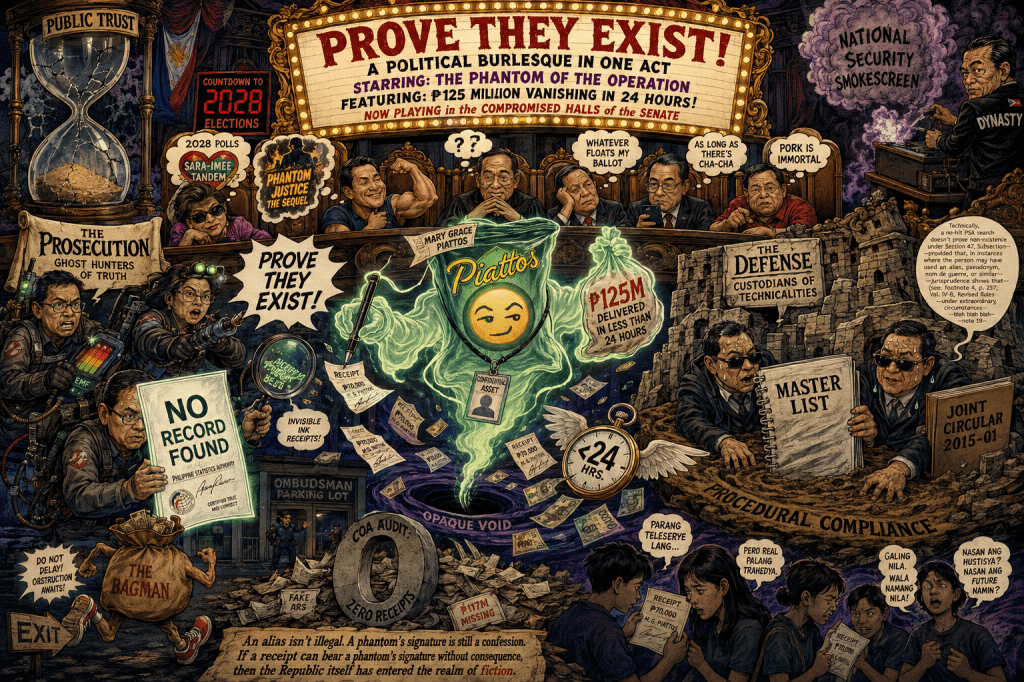
An alias isn’t illegal. A phantom’s signature is still a confession.
By Louis ‘Barok‘ C.
Biraogo — August 9, 2026
THE stage is set, mga ka-kweba, for a political burlesque masquerading as a high constitutional drama. The impeachment trial of Vice President Sara Duterte is not merely a legal proceeding; it is a Rorschach test for the nation’s soul, and the inkblot is a receipt signed by a specter named “Mary Grace Piattos.” The prosecution, in a stroke of narrative genius, has issued a dare that echoes through the hallowed, yet deeply compromised, halls of the Senate: “Prove they’re real.”
But this is more than a ghost hunt. We must dissect this farrago of fiscal anarchy using the cold steel of jurisprudence, not just the hot air of political spin.
The Core Legal Tension: A Tapestry of Fraud or the Cloak of Secrecy?
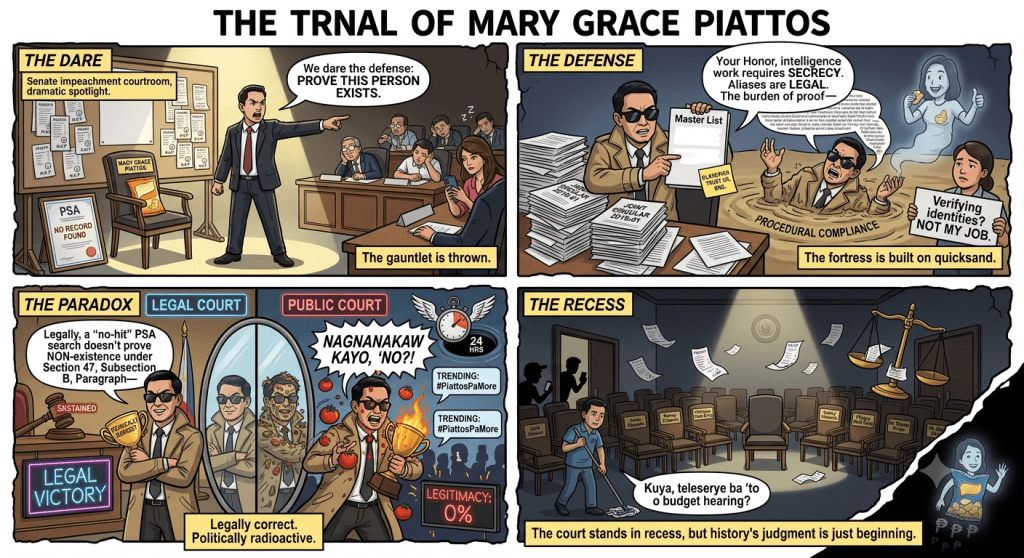
The prosecution’s apex argument is masterful, moving beyond a single funny alias to a grand, infernal mosaic of systemic rot. They are not just asking if “Kokoy Villamin” exists; they are painting a picture where ₱125 million of public funds vanished “in less than 24 hours,” via a bagman, into an opaque void. This is their Article XI, Section 1 “public trust” uppercut. The Commission on Audit (COA) auditor’s revelation of “zero receipts or sales invoices” and the failure of Colonel Lachica’s certification to show any “meritorious information” are the evidentiary cornerstones. As the Supreme Court held in Gonzales III v. Office of the President, betrayal of public trust is a catch-all for acts that render an officer unfit. The prosecution is methodically weaving a pattern that screams not just gross inexcusable negligence under Republic Act No. 3013 (RA 3013), but a conscious, systematic circumvention of Presidential Decree No. 1445 (PD 1445)’s mandate that every single centavo be properly documented. The bagman’s sprint to the Ombudsman parking lot isn’t an anomaly; it’s the evidence of the crime.
The defense’s sanctuary, however, is the legally sacrosanct but politically radioactive principle of operational security. Their strongest card is this: intelligence work is not a grocery run. It requires aliases, code names, and the dark art of plausible deniability. The COA-DBM-DILG-GCG-DND Joint Circular No. 2015-01 (Joint Circular 2015-01) is their shield; it doesn’t demand a driver’s license from an informant. But this fortress is a house of cards in a hurricane. The argument crumbles if there was no internal, sealed master list cross-referencing the alias “Mary Grace Piattos” to a real, flesh-and-blood asset. Relying on COA’s initial acceptance of documents is a sanctuary built on quicksand; procedural compliance does not a truthful document make, and good faith reliance on a subordinate is not an absolute defense, as jurisprudence from Arias v. Sandiganbayan clearly delineates. The defense’s silence on this master list is a scream that drowns out their procedural whispers.
The “Prove They Exist” Gambit: Substance Over Form
This brings us to the prosecution’s defining strategic gambit, a trap so elegantly simple it deserves applause in a theater of the absurd. “Prove these individuals exist” is not a legal demand rooted in a technical reading of a COA circular—auditor Rodelio Wamil already neutered that by admitting verification of identities isn’t his job. This is a gauntlet thrown directly at the senator-judges’ conscience. It bypasses the legalese and asks the visceral, common-sense question that defines betrayal of public trust. The prosecution is brilliantly weaponizing the Philippine Statistics Authority (PSA)’s “no record found” certification, understanding that its true power is not in being conclusive proof, but in shifting the narrative burden.
The paradox is lethal: the more the defense lawyeringly explains that a “no-hit” PSA search doesn’t prove non-existence, the more they sound like they are harboring phantoms. The technicality is legally sound, but politically suicidal. The senators sitting as judges, especially those like Imee Marcos and Robin Padilla, whose impartiality was justly skewered by the Palace, will not be legally compelled to demand a birth certificate. They will, however, be politically compelled to answer one question to themselves: “Do I believe a person named Mary Grace Piattos received government funds for a legitimate intelligence operation?” The prosecution is betting the answer is a resounding, internal “no,” turning the constitutional principle of accountability into a gut-check on credibility, and rendering the defense’s legal footnotes utterly irrelevant.
The Fatal Paradox: The Toxic Fragrance of Legal Correctness
This lays bare the final, cruel paradox. The defense’s entire case may be legally sustainable. They can die on the hill of procedural technicality, clutching the secrecy clause of the Joint Circular like a holy relic. They can argue, correctly, that the burden of proving fraud beyond the applicable quantum of evidence rests on the prosecution and has not been met. They are legally correct. And it is here, in their moment of technical triumph, that they risk losing everything. In the court of public opinion, and therefore in the minds of senators facing an electorate in 2028, the appearance of deception is a capital crime. The public does not distinguish between a lie and a legal maneuver that smells like one. The sheer absurdity of the “Piattos” phenomenon has become an unindictable co-conspirator for the prosecution. The defense’s sound legal argument has been doused in the pungent perfume of ridicule. They can win every legal skirmish and still lose the war for legitimacy, a toxic outcome that perfectly clarifies the difference between law and justice.
A Charge to the Court, and a Prayer for the Republic
So now I turn to you, the robed, the robe-resistant, and the brazenly conflicted, with a plea dressed in scorn: You are not shadow counsel for the accused, nor a cheering squad for the prosecution. The oath you took is not a decorative ribbon on a judicial robe some of you so arrogantly refuse to wear. The “quantum of evidence” standard from Corona v. Senate is your guide, not the polling numbers for a Sara-Imee tandem in 2028. Uphold impartiality, for the credibility of a nation’s last check on power hangs in the balance. Decide not for a faction, but for a public good that is gasping for air.
This trial must be a watershed. We call for the supremacy of the rule of law, not the rule of dynastic convenience. We demand full transparency, not the performative kind that hides behind a smokescreen of “national security.” The youth of this land deserve a future where their government’s accounting is less fictional than a teleserye script.
Therefore, my concrete recommendations are these: Amend COA Joint Circular 2015-01 immediately. It must require a sealed, court-verifiable master list of all aliases used in confidential operations, bridging the chasm between necessary secrecy and constitutional accountability. Define “meritorious information” with objective, post-operational metrics, not just a general’s autograph. Let this trial not just judge a person, but reform a system. For if a receipt can bear a phantom’s signature without consequence, then the Republic itself has entered the realm of fiction. The court stands in recess, but history’s judgment is just beginning.
Key Citations
A. Legal & Official Sources
- The 1987 Constitution of the Republic of the Philippines. Official Gazette of the Republic of the Philippines / Lawphil Project, 1987, lawphil.net/consti/cons1987.html.
- Republic Act No. 3013. An Act Granting the Gapan Electric Corporation a Franchise for an Electric Light, Heat and Power System in the Municipalities of Gapan and San Isidro, Province of Nueva Ecija. 1960, lawphil.net/statutes/repacts/ra1960/ra_3013_1960.html.
- Presidential Decree No. 1445. Ordaining and Instituting a Government Auditing Code of the Philippines. 11 June 1978, lawphil.net/statutes/presdecs/pd1978/pd_1445_1978.html.
- COA-DBM-DILG-GCG-DND Joint Circular No. 2015-01. Guidelines on the Entitlement, Release, Use, Reporting and Audit of Confidential and/or Intelligence Funds. 8 January 2015, dilg.gov.ph/PDF_File/issuances/joint_circulars/dilg-joincircular-201534_eb60b107fa.pdf.
- Gonzales III v. Office of the President. G.R. No. 196231, 28 January 2014, lawphil.net/judjuris/juri2014/jan2014/gr_196231_2014.html.
- Arias v. Sandiganbayan. G.R. No. 81563, 19 December 1989, lawphil.net/judjuris/juri1989/dec1989/gr_81563_1989.html.
- Corona v. Senate of the Philippines. G.R. No. 200242, 17 July 2012, lawphil.net/judjuris/juri2012/jul2012/gr_200242_2012.html.
B. News Reports
- Cabalza, Dexter and Dexter, Gabriel. “Prosecutors Dare Defense: Prove Names on Secret Fund Docs Are Real.” INQUIRER.net, 7 Aug. 2026, newsinfo.inquirer.net/2279312/prosecutors-dare-defense-prove-names-on-secret-fund-docs-are-real.
- ₱8B BBM Pork: CCTV for Every Captain’s Kumpare?

- ₱8.9 Billion, 331 Ghost Police Stations: The TIKAS Scandal Explained

- ₱8.4 Billion, 42,000 Barangays, 1 Election: The “Bawat Barangay Makikinabang” Vote-Buying Masterclass

- ₱75 Million Heist: Cops Gone Full Bandit

- ₱6.77B Ghost Haunts Duterte: RTC Dismisses Mans Carpio’s Desperate Plea
- ₱6.77 Billion and Zero Cash: The Sara Duterte SALN Math That Doesn’t Add Up

- ₱6.7-Trillion Temptation: The Great Pork Zombie Revival and the “Collegial” Vote-Buying Circus

- ₱58.53B, Zero Receipts: The LGSF Pork Barrel Nobody Wants to Name

- ₱53 Million Man Tells ₱695-a-Day Workers to Stop Being ‘Mayabang’: The Audacity of BSP’s Remolona
- ₱4.4 Billion and a Witness Who Can’t Explain It: The Duterte Impeachment’s Most Expensive Non-Answer
- ₱3.06 Billion for Evacuation Centers—But Nobody Knows Where They’ll Stand (Or If They’ll Exist)
- ₱16 Billion, 280 Accounts, 8 Helicopters: Boying Remulla’s Case Against the Yaps Is Not a Drill






Leave a comment