
Featuring the Gonzales Family Business Model: Public Office Up Front, Private Profit Out Back
By Louis “Barok” C. Biraogo — August 8, 2026
Concrete Confessions: When Flood Walls File Their Own Charge Sheet
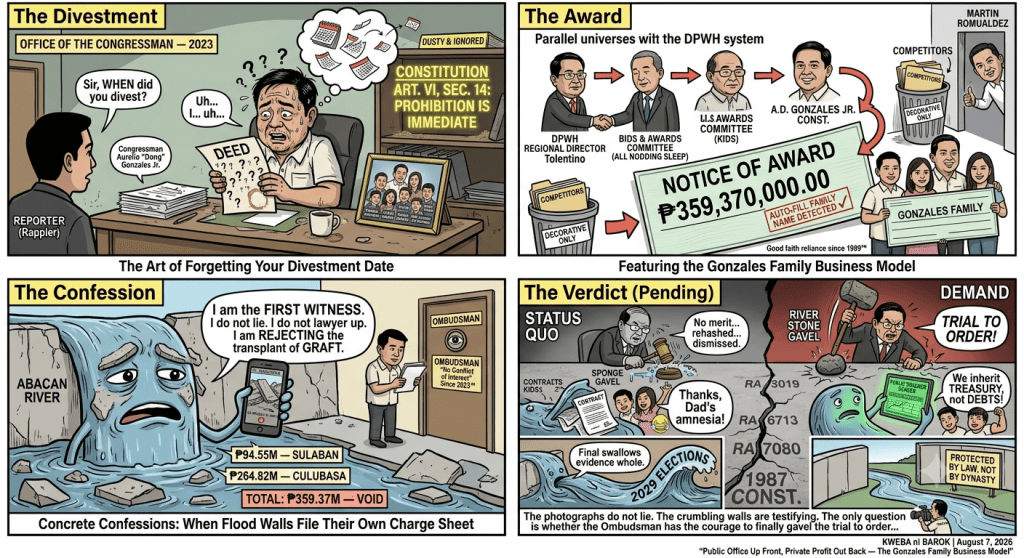
The photographs are the first witnesses. They do not lie, equivocate, or lawyer up. Dated July 30, 2026, they show the Abacan River’s flood control structures—completed barely three years ago at a cost of ₱359.37 million—already in their death throes: concrete skin sloughing off into the current, embankments collapsed as if hit by an artillery shell, and the tell-tale scars of frantic, unexplained repairs. The river, it seems, is rejecting a transplant of graft. This is the crime scene that Barangay Captain Terence Sampang Napao has now, for the second time, laid at the doorstep of the Office of the Ombudsman. But this is not a mere construction failure. This is a monument to a constitutional crime, a family business, and the systemic rot that has turned the Philippine Congress into a contractor’s guild.
The Cong-Tractor’s Convenient Amnesia
Let us call this what it is: a textbook case of the “cong-tractor” phenomenon, and its central character is former House Senior Deputy Speaker Aurelio “Dong” Gonzales Jr. The narrative the Gonzales camp wants you to believe is a simple one of a man who has divested from a family firm, A.D. Gonzales Jr. Construction & Trading Co. Inc., which just so happens to win hundreds of millions in government contracts in his own district while he sits in Congress. In a masterstroke of public relations, Gonzales told Rappler he couldn’t specify when he gave up control. You can almost hear the nervous cough. This isn’t a defense; it’s a confession with a missing timestamp. The 1987 Constitution of the Republic of the Philippines (1987 Constitution), in Article VI, Section 14, does not entertain amnesia. It erects an absolute, flat prohibition against a legislator being “directly or indirectly… interested financially in any contract with… the Government… during his term of office.” Not “divest when convenient.” Not “transfer shares to your children named Aurelio.” Not “explain it away later.” The prohibition is immediate and the violation is per se. Every day that Gonzales cannot produce a legally-sound, dated divestment document that precedes February 2023—when the Notices of Award for the Suclaban and Culubasa projects were signed—is a day he is presumptively in violation of the supreme law of the land.
Dynasty by Design: The Family Firm That Builds—and Breaks
Let us trace the money, a river of cash flowing parallel to the Abacan River. The ₱94.55 million for Contract ID 23C00048 and the ₱264.82 million for 23C00049 did not materialize from thin air. They were dredged from the national treasury and poured into the corporate vessel of A.D. Gonzales Jr. Construction, an entity where the good congressman’s children—Alyssa Michaela (now the sitting Representative), Aurelio Brenz (now the City of San Fernando Vice Mayor), Aurelio III, and Aurelio Micheline—serve as the officers and controlling stockholders. This is not a family business; it is a family conspiracy, a corporate alter-ego for a political dynasty. The legal framework to prosecute this is not merely adequate; it is an arsenal. Republic Act No. 3019 (Anti-Graft and Corrupt Practices Act), Sec. 3[h] criminalizes a public officer having a pecuniary interest in a contract he intervenes in. Republic Act No. 6713 (Code of Conduct and Ethical Standards for Public Officials and Employees) demands divestment within sixty days. And looming over all of this is Republic Act No. 7080 (Plunder Law), which defines the crime as amassing ill-gotten wealth of at least ₱50 million through a “combination or series of overt or criminal acts.” The eroding walls and the dynastic boardroom are the corpus delicti of a conspiracy to raid the public treasury, with the ₱359.37 million tag as the entry ticket to a reclusion perpetua charge.
The Porous Firewall and the Dusty Cycle of Impunity
The Gonzales family’s legal firewall will rely on the Supreme Court’s holding in Macapagal-Arroyo v. People, which demands proof that private co-conspirators knowingly participated in a plunderous scheme, not just a family business. It’s a fair, if ultimately porous, defense given the brazenness of the structure. But the more immediate threat to accountability is a far older and more cynical weapon: the Cycle of Impunity. Napao first filed a plunder complaint in September 2023 over ₱611 million in other Abacan River projects. The Ombudsman at the time, perhaps suffering from a constitutional allergy, found “no conflict of interest.” The case was dismissed. The system’s immune response had worked perfectly: identify the pathogen, isolate it, and expel it with a ministerial finding of “lack of merit.” This is the rhythm of the racket: scandal, dismissal, a cooling-off period, and then a new round of contracts. The only reason we are here again is that the ground literally gave way beneath the first complaint’s dismissal, and Napao, a political rival of the Gonzales-aligned faction in Mexico, Pampanga, was persistent—or vengeful—enough to return with a geotagged camera.
Legislative Protection Racket: Purest Form
This cycle is not a bug in the Philippine political operating system; it is a core feature. The Gonzales affair looks like a provincial franchise of the national flood-control scandal that has already engulfed former Speaker Martin Romualdez. It is the legislative protection racket in its purest form. Congressmen, endowed with the power of the purse, insert themselves into the execution of the budget, identifying projects for executive agencies like the Department of Public Works and Highways (DPWH) to implement, and then those agencies just happen to award the contracts to firms that bear the names of those congressmen’s children. The DPWH officials—in this case, former Regional Director Roseller Tolentino and the entire Bids and Awards Committee, now named as respondents—are not independent actors. They are the essential facilitators, the bureaucratic middlemen who certify the accomplishment reports and sign off on the ghost projects. They will hide behind the Arias v. Sandiganbayan defense, claiming they relied in good faith on their subordinates’ certifications. It is a legal joke so old it has dust on it; the doctrine of good faith reliance cannot apply when you are the direct decision-maker on the award, not a distant superior.
Breaking the Dynasty’s Spine—or Waiting for the River to Swallow the Evidence
This is the structural sickness that demands structural reform. The demand is not merely for the immediate, unflinching prosecution of the Gonzaleses and their DPWH co-conspirators. That is the minimum. The true call is to break the spine of political dynasties that have transformed public office into a family heirloom encrusted with stolen gold. The failure to pass a genuine Anti-Political Dynasty law has made the Gonzales model a replicable, rational business decision. The post-Carpio-Morales v. Binay abandonment of the condonation doctrine closed one escape hatch, but the house remains full of them. The supreme arrogance of this case is that two of the named respondents—Alyssa Michaela and Aurelio Brenz—are now themselves sitting elective officials, their positions a living monument to the spoils of the alleged crimes.
Yet, in the wreckage of collapsing flood walls, there is the faint architecture of hope. The new Ombudsman, Jesus Crispin Remulla, has publicly named Gonzales as a subject of a parallel, motu proprio conflict-of-interest investigation, even before Napao’s latest filing. This suggests the institutional antibodies may finally be activating. The immediate call for reform is to empower this process, consolidate the citizen’s evidence with the state’s probe, and demonstrate that this crackdown is not a settling of scores within the crumbling Romualdez political machine but a genuine, systemic purge.
We must demand that the rule of law rise not on the third day, but today. We must demand a real-time, publicly accessible tracker for every legislator-linked contractor, a scorching light to disinfect this entire process. This is the fight for the supremacy of law over the codified greed of a dynasty, for genuine public service over life-threatening infrastructure. This is the fight for a future where the youth inherit a nation’s treasury, not its debts, and where a river in Pampanga does not have to file its own plunder case just to survive. The photographs do not lie. The crumbling walls are testifying. The only question is whether the Ombudsman has the courage to finally gavel the trial to order, or simply dismiss this as another “rehashed” complaint, waiting for the river to swallow the evidence whole.
Key Citations
A. Legal & Official Sources
- The 1987 Constitution of the Republic of the Philippines. Official Gazette of the Republic of the Philippines, 1987, http://www.officialgazette.gov.ph/constitutions/1987-constitution/.
- Republic Act No. 3019. Anti-Graft and Corrupt Practices Act. 1960, lawphil.net/statutes/repacts/ra1960/ra_3019_1960.html.
- Republic Act No. 6713. An Act Establishing a Code of Conduct and Ethical Standards for Public Officials and Employees. 1989, lawphil.net/statutes/repacts/ra1989/ra_6713_1989.html.
- Republic Act No. 7080. An Act Defining and Penalizing the Crime of Plunder. 1991, http://www.lawphil.net/statutes/repacts/ra1991/ra_7080_1991.html.
- Macapagal-Arroyo v. People. G.R. No. 220598, 19 July 2016, lawphil.net/judjuris/juri2016/jul2016/gr_220598_2016.html.
- Arias v. Sandiganbayan. G.R. No. 81563, 19 Dec. 1989, lawphil.net/judjuris/juri1989/dec1989/gr_81563_1989.html.
- Carpio-Morales v. Court of Appeals (Binay). G.R. Nos. 217126-27, 10 Nov. 2015, lawphil.net/judjuris/juri2015/nov2015/gr_217126_2015.html.
B. News Reports
- “When Dong Gonzales was Pampanga rep, his children bagged P900M in DPWH deals.” Rappler, 31 Aug. 2025, http://www.rappler.com/newsbreak/in-depth/aurelio-dong-gonzales-family-firm-bagged-millions-flood-control-deals-pampanga/.

- “Ang Hirap Maging Mahirap”: The PAO Scandal That Proves Government Contempt Is Nothing New

- “Far-Off” My Axx: Malacañang’s Claire Castro Drowns in Her Own Legal Gaslighting
- “Forthwith” to Farce: How the Senate is Killing Impeachment—And Why Enrile’s Right (Even If You Can’t Trust Him)
- “HINDI AKO NAG-RESIGN!”

- “I Know Nothing”: Baste Duterte’s Amnesia Defense Meets ₱33M in GenCorp Contracts

- “I’m calling you from my new Globe SIM. Send load!”

- “Mahiya Naman Kayo!” Marcos’ Anti-Corruption Vow Faces a Flood of Doubt

- “Manageable” Debt, Unmanageable Lies: DBM’s ₱21 Trillion Fairy Tale

- “Meow, I’m calling you from my new Globe SIM!”

- “Natrabaho”: One Word, One Ombudsman, and a Judiciary on Trial

- “No Special Jail for Crooks!” Boying Remulla Slams VIP Perks for Flood Scammers

- “Philippine-Controlled” or Yankee Gas Station? The Davao Fuel Depot Farce Exposed






Leave a comment