
The Law Says Discretion; The Evidence Says Predilection. The Republic Says: Wake Me When the Sandiganbayan Weighs In
By Louis ‘Barok‘ C. Biraogo — August 8, 2026
THE Ombudsman’s six-month preventive suspension of Insurance Commissioner Reynaldo Regalado is not a morality play. It is a mirror. It reflects the precise moment Philippine administrative law dies—not with a bang, but with the quiet scratch of a pen approving a third consortium into a captive market of mandatory public utility vehicle (PUV) insurance. The legal question is deceptively simple: did Commissioner Regalado merely exercise his discretion, or did he sell it? The answer lies not in the Manila Regional Trial Court (RTC)’s validation of Circular Letter 2025-17, but in the sewer where discretion meets self-dealing.
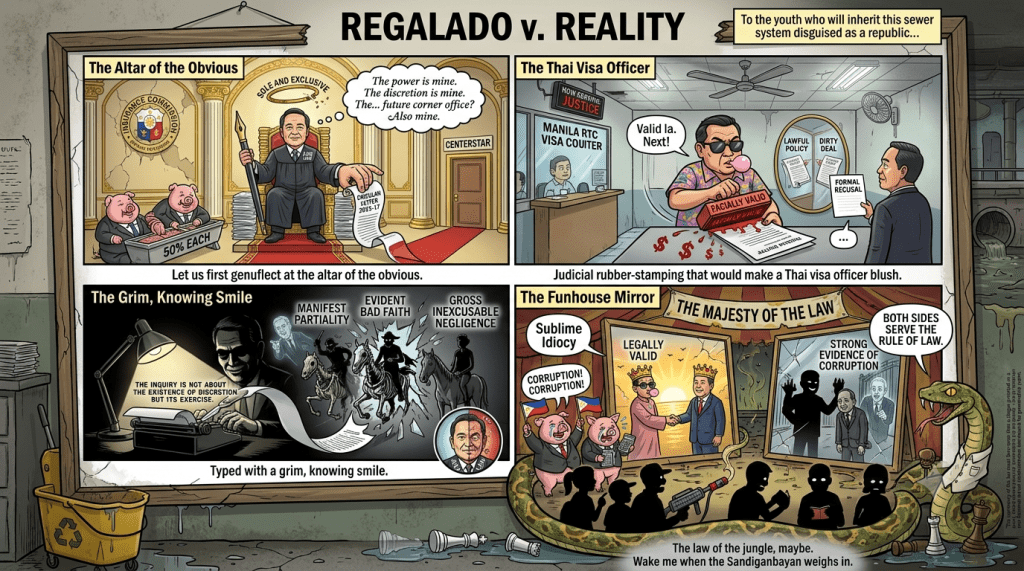
The Central Fault Line: Lawful Power, Dirty Hands
Let us first genuflect at the altar of the obvious. Regalado possessed unambiguous statutory authority under Section 437 of Republic Act No. 10607 (Amended Insurance Code) to issue CL 2025-17, shattering the old SCCI-PAMI duopoly, and to accredit Centerstar Management and Insurance Agency. The Manila RTC Branch 180, in an act of judicial rubber-stamping that would make a Thai visa officer blush, upheld the facial validity of both the circular and the accreditation. For Regalado’s defenders, this is the end of the conversation. For anyone with a functioning understanding of Philippine anti-graft law, it is barely the opening statement.
The Ombudsman’s order, a document I suspect was typed with a grim, knowing smile, cuts through this sophistry with surgical precision. The inquiry is not about the existence of discretion, but its exercise. The Ruling validates a policy; it is absolutely silent on whether the policymaker was on the take. The Supreme Court in Albert v. Sandiganbayan defined the three horsemen of Section 3(e) of Republic Act No. 3019 (Anti-Graft and Corrupt Practices Act) as manifest partiality, evident bad faith, and gross inexcusable negligence. They are disjunctive; one is enough. The anatomy of this deal reeks of the first two. A regulator who gives a lucrative, no-bid government-mandated market share to an entity linked to the law firm where he remains listed as “Senior Counsel (on leave)” has not just blurred the line between public duty and private loyalty—he has erased it, drawn a cartoon on the blank space, and sold the cartoon to the highest bidder. The delicate legal fiction of being “on leave” does not sever the institutional loyalty or the future expectation of a corner office. It is a conflict of interest so brazen it violates not only Section 3(h) of RA 3019 but the stark prohibitions of Republic Act No. 6713 (Code of Conduct and Ethical Standards for Public Officials and Employees) on financial or material interest in transactions requiring one’s approval. The RTC may have blessed the rule, but the Ombudsman is investigating whether the rulemaker’s hand was guided by a former partner’s purse.
The Four Horsemen of the Regulatory Apocalypse
The Regalado scandal is not a freak accident; it is a predictable crash at the intersection of four structural pathologies that make the Philippine bureaucracy a buffet for the well-connected.
First, the toxic concentration of power. The Insurance Commissioner’s authority, per Department Order 2018-020, is “sole and exclusive” over accreditation—a setup so breathtakingly vulnerable to capture it is less a grant of authority and more a betrayal of public trust, designating a single point of failure for an entire industry.
Second, the captive market as a corruption magnet. The Passenger Personal Accident Insurance (PPAI) program is a guaranteed, multi-billion-peso trough created by government fiat. It compels every PUV operator to buy a product from a cartel that, until Regalado’s pen intervened, was a cozy duopoly. This is not a free market; it is a hunting preserve, and the only question is which hunters hold the license.
Third, the weaponized complaint. Let’s not be naive. SCCI and its eleven co-complainant insurers are not whistleblowers on a crusade for ethical purity. They are incumbent oligopolists who saw their guaranteed share of the carcass shrink from fifty to thirty-three percent. Their anti-graft complaint is a brilliant piece of legal jiujitsu, deploying the heavy weaponry of RA 3019 to achieve what a failed RTC petition could not: the elimination of a competitor. By shouting “Corruption!”, these corporate titans have draped their commercial self-interest in the Philippine flag, and the Ombudsman has obligingly become their artillery.
Fourth, the manufactured legal chaos. We now have the sublime idiocy of simultaneous proceedings: an RTC declares the accreditation legally valid, while the Ombudsman finds strong evidence that the same accreditation was a corrupt act. This is not the majesty of the law; it is a legal funhouse mirror, designed by a system that allows civil and administrative tracks to proceed in parallel, producing the kind of contradictory rulings that make the rule of law a global laughingstock.
The Chessboard of Vipers: Strategic Moves and Their Icy Meaning
Six questions now hang over this rotting edifice, each signaling a different species of doom.
- The Certiorari Gambit: If Regalado challenges the suspension under Rule 65, citing the disproportionality doctrine in Garcia v. Mojica, he frames this as a constitutional check on Ombudsman power. If he fights on the facts, he is a cornered man pleading innocence.
- The Palace’s Pawn: Malacañang’s choice of an OIC will speak volumes. A technocratic placeholder signals a wait-and-see approach; a political operator signals Regalado is finished; inaction signals terminal dysfunction.
- The Phantom Recusal: The entire edifice of the defense crumbles if Regalado cannot produce a single piece of paper—a memo, an email—proving he formally recused himself from AAQ Law-linked matters. The silence here is not just deafening; it is a confession.
- The Criminal Fork: A referral of RA 3019 counts to the Sandiganbayan transforms this from a six-month vacation without pay into the prospect of imprisonment and perpetual disqualification from public office. That is the nuclear option, and its use will signal whether the Ombudsman is truly hunting or just firing warning shots.
- The Accreditation Wildcard: If Centerstar’s accreditation survives untouched regardless of Regalado’s personal fate, this affair is revealed not as a quest for justice but as a personal vendetta—a human sacrifice to appease the gods of the duopoly while the market structure remains conveniently unchanged.
- Finally, the Narrative Counter-Attack: Regalado’s camp is already leaking that SCCI’s own compliance history and motives will face forensic scrutiny. Watch as this transforms from a simple corruption case into a muddy he-said-she-said corporate warfare, where the public interest is the first and final casualty.
A Tattered Flag and a Call to Arms
To the youth who will inherit this sewer system disguised as a republic, look at this scandal and see your future being stolen in real-time. The cure is not a new Commissioner. The cure is a scalpel to the four pathologies themselves: shatter the single-point regulatory power into a multi-member commission; subject mandatory insurance schemes to genuine, open competitive bidding; penalize the weaponized anti-graft complaint with the same ferocity as the initial crime; and fix the judicial system so it does not produce parallel, contradictory truths. The supreme irony is that both SCCI and Regalado likely believe they serve the rule of law—when in truth, they both serve only the law of the jungle, where the most cunning beast wins. Let genuine public service and a radical pro-people transparency burn this jungle down. The supremacy of the law must be more than a slogan printed on a dusty frame in a government office; it must be a flamethrower in the hands of citizens who refuse to be governed by vipers.
Key Citations
A. Legal & Official Sources
- Republic Act No. 10607. An Act Strengthening the Insurance Industry, Further Amending Presidential Decree No. 612, Otherwise Known as “The Insurance Code,” as Amended. 2013, http://www.officialgazette.gov.ph/2013/08/15/republic-act-no-10607/.
- Republic Act No. 3019. Anti-Graft and Corrupt Practices Act. 1960, lawphil.net/statutes/repacts/ra1960/ra_3019_1960.html.
- Republic Act No. 6713. An Act Establishing a Code of Conduct and Ethical Standards for Public Officials and Employees. 1989, lawphil.net/statutes/repacts/ra1989/ra_6713_1989.html.
- Albert v. Sandiganbayan. G.R. No. 164015, 26 Feb. 2009, lawphil.net/judjuris/juri2009/feb2009/gr_164015_2009.html.
- Garcia v. Mojica. G.R. No. 139043, 10 Sept. 1999, lawphil.net/judjuris/juri1999/sep1999/gr_139043_1999.html.
- Department Order No. 2018-020. Revised Guidelines on Mandatory Insurance Policies for Motor Vehicles and Personal Passenger Accident Insurance for Public Utility Vehicles. 29 Aug. 2018, elibrary.judiciary.gov.ph/thebookshelf/showdocs/10/91263.
- Insurance Commission Circular Letter No. 2025-17. Revised Framework for Passenger Personal Accident Insurance (PPAI) Program for Public Utility Vehicles. 2025, http://www.insurance.gov.ph/wp-content/uploads/2025/09/IC-Circular-Letter-No.-2025-17_Revised-Framework-for-Passenger-Personal-Accident-Insurance-PPAI-Program-for-Public-Utility-Vehicles.pdf.
B. News Reports
- “Premium Penalty: Insurance Chief Suspended Over ‘Irregular’ PUV Insurance Deal.” Politiko, 4 Aug. 2026, politiko.com.ph/2026/08/04/premium-penalty-insurance-chief-suspended-over-irregular-puv-insurance-deal/politiko-lokal/.



Leave a Reply