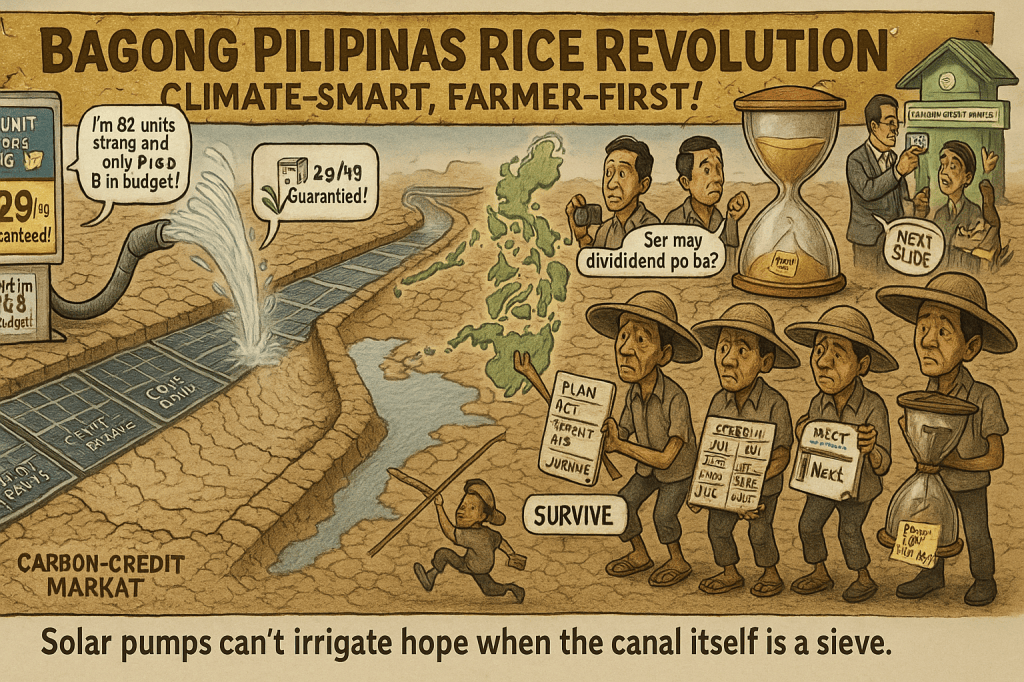
Four pumps a day, zero audits a year: Inside NIA’s procurement speedrun
By Louis ‘Barok’ C. Biraogo — October 10, 2026
THE Marcos administration wants you to believe that 10,000 solar-powered irrigation sites by 2030 will solve Philippine agriculture’s problems. They’ve deployed Acting Executive Secretary Ralph Recto to sell this vision with the kind of breathless optimism usually reserved for tech startups and crypto scams. “Every peso farmers save on diesel can instead be used for seeds, fertilizer, equipment,” he said, as if the entire agrarian crisis could be solved by a well-timed ribbon-cutting.
It’s a beautiful story. Solar panels gleam in the tropical sun. Farmers smile as water flows freely. The ghost of diesel past fades into the mist. The only problem? The government’s own audit reports, NIA’s admission of corruption, and a Kalinga controversy involving a solar pump sitting inside a private ranch suggest this beautiful story might have a less photogenic ending—one where taxpayers foot the bill, farmers get shafted, and Chinese solar panels become the newest chapter in the Philippines’ long-running tragedy of good intentions meeting catastrophic execution.
Welcome to the Solar Pump Irrigation Project (SPIP) industrial complex. Bring your waders.

Spoiler: Not water. Marcos’ solar irrigation “legacy” is a climate scam built on Chinese panels, ghost projects, and NIA’s own corruption admission. Do the math they hope you won’t. 🧮🔥
The Arithmetic They Hope You Won’t Do
Let’s start with the headline numbers, because they’re doing a lot of work here. The government wants to expand from 4,036 sites to 10,000. That’s 5,964 new installations. Over four years, that’s roughly 1,491 sites per year, or 124 per month, or four solar irrigation projects completed every single day.
The Philippine government. Completing four infrastructure projects every day. For four years straight.
This is the same government whose National Irrigation Administration (NIA) has been flagged by the Commission on Audit (COA) for awarding P16.75 billion in contracts to unqualified contractors in 2024 alone, in violation of Republic Act No. 9184 (Government Procurement Reform Act). This is the same agency whose top official literally admitted to corruption before the Senate Blue Ribbon Committee in 2023. This is the same NIA that has a documented, decades-long pattern of project delays so chronic that Congress has repeatedly launched investigations into hundreds of flagged irrigation projects.
But sure. Four solar pumps a day. No problem.
The government also claims the program will benefit two million farmers and irrigate 100,000 additional hectares. That works out to about 0.05 hectares per farmer—roughly 500 square meters, or the size of a modest suburban lot. If that math seems off, it’s because it almost certainly is. The government is likely counting existing beneficiaries, double-counting farmers across multiple sites, and conflating “located within a service area” with “actually receiving water.” NIA’s own 2026 planning materials acknowledge the need to avoid “overlap and double counting,” which is bureaucrat-speak for “we know these numbers are fudged”.
The Kalinga Problem: Where Your Tax Peso Goes to Die
Let’s talk about the Santor Rizal Solar Pump Irrigation Project in Kalinga. This is the one where an advocacy group, Save Kalinga Inc., asked a rather inconvenient question: Why is a taxpayer-funded irrigation facility sitting inside a private ranch?
Contract ID CW-KALINGA-24-2023. Funded under the Comprehensive Agrarian Reform Program–Irrigation Component of Republic Act No. 6657 (Comprehensive Agrarian Reform Law of 1988). Intended to irrigate 72 hectares and benefit 60 farmers. Implemented by NIA-Cordillera. And located, according to the advocacy group, inside a fenced private property in Andarayan, Santor, Rizal.
The group wants to know:
- Are there legal documents—easement, usufruct, deed of donation—guaranteeing that the government and farmers retain access?
- Are the 60 listed “beneficiaries” actually registered agrarian reform beneficiaries?
- Is there a Memorandum of Agreement with the landowner?
- Why hasn’t the list of beneficiaries and actual irrigation coverage been publicly posted?
These are excellent questions. NIA has, as of this writing, apparently not answered them.
The legal principle at stake is elementary. Presidential Decree No. 1445 (Government Auditing Code of the Philippines), Section 4, provides that government funds and property must be used solely for public purposes. A solar irrigation system built inside a private ranch, without documented public access guarantees, fails that test on its face. If the landowner can wake up one morning and lock the gate, the entire public investment becomes a subsidy to a private individual—exactly the kind of arrangement that the Comprehensive Agrarian Reform Program was designed to prevent.
The Kalinga case is not an isolated anomaly. It’s a preview. When you scale from 4,000 to 10,000 sites at breakneck speed, with an agency that has a documented procurement problem and a corruption admission from its own chief, you get more Kalingas. You get more sites selected because a local politician wanted a project in his district. You get more private land arrangements that fail to protect the public interest. You get more “beneficiaries” who turn out to be relatives of the contractor.
The Abra Failure: A Solar Pump That Died
If you want to know what happens when solar irrigation meets Philippine reality, look at Abra.
A government agricultural study of a solar irrigation installation in the province found a negative Net Present Value of ₱1.44 million, a benefit-cost ratio of 0.13, and a projected payback period of 17.53 years. The system was damaged by Typhoon Egay, remained unrepaired during the study period, and served fewer farmers and hectares than originally planned.
Let that sink in. A benefit-cost ratio of 0.13 means that for every peso invested, the government got back 13 centavos in benefits. You’d get a better return burying the money in a jar in the NIA backyard.
The Abra case is not an argument against solar irrigation. It’s an argument against solar irrigation without rigorous feasibility studies, without climate-resilient engineering, and without post-construction maintenance plans. And here’s the kicker: NIA’s own 2025 audit report admits that “damages to canal, facilities and solar-powered pumps resulting from typhoons, floods, erosions and other fortuitous events” have “adversely affected the delivery and distribution of irrigation water” across multiple systems.
The government is selling solar irrigation as a climate resilience measure. But solar panels are not typhoon-proof. They are, in fact, quite vulnerable to flying debris, flooding, and saltwater intrusion. The same storms that make irrigation more necessary can also destroy the infrastructure designed to provide it. Building solar pumps without typhoon-rated mounting structures, flood-safe electrical systems, and disaster insurance is not climate adaptation. It’s climate gambling.
The China Dependency: Your “Green” Program Has a Red Supply Chain
Here’s the geopolitical irony that Recto conveniently omitted from his press release: 98 percent of the Philippines’ solar panel imports come from China. In 2025 alone, the country imported approximately $483 million worth of solar panels, virtually all from the People’s Republic. The Philippine Solar and Storage Energy Alliance (PSSEA) has explicitly warned that “China is our primary source of solar modules, mounting structures, inverters, batteries, and other balance-of-system components. It provides the lifeline of the solar business”.
So the Marcos administration’s plan to achieve “net-zero energy use in irrigation” depends almost entirely on a country with which the Philippines has an active territorial dispute, a history of weaponizing trade, and a demonstrated willingness to restrict exports when geopolitical interests demand it.
This is not a hypothetical risk. Executive Order No. 110 (Declaring a State of National Energy Emergency), declaring a national energy emergency after Strait of Hormuz closures, exposed the Philippines’ import dependency vulnerabilities. If Sino-Philippine tensions escalate—and PSSEA has specifically warned that they could—solar irrigation expansion could face supply chain disruptions, price spikes, and technology transfer limitations.
The government is building a program marketed as “energy security” on a foundation of energy dependency. Every solar panel installed in a Philippine rice field is a small monument to Chinese manufacturing dominance. This is not patriotism. It’s outsourcing with extra steps.
NIA’s Procurement: The Corruption Is Structural, Not Incidental
Let’s be blunt: NIA has a corruption problem. This is not Barok being uncharitable. This is the Commission on Audit, the Senate Blue Ribbon Committee, and NIA’s own leadership saying so.
In August 2023, Acting NIA Chief Eduardo Guillen admitted under oath before the Senate that there was “certain corruption” in the agency. His exact words: “Yes po. Kaya inaayos natin iyong sistema.” Translation: “Yes, that’s why we’re fixing the system.”
In 2024, COA flagged NIA for awarding 292 infrastructure contracts worth P16.749 billion that were “not compliant with pertinent provisions of Republic Act No. 9184”—the Government Procurement Reform Act. These weren’t minor paperwork errors. The audit report specifically cites contracts awarded to contractors who did not meet qualification requirements.
The historical pattern is even more damning. In 2014, 53 NIA officials were charged over ₱66 million in anomalous projects. In 2020, Congress launched multiple investigations into 299 irrigation projects flagged by COA. The agency has a documented, decades-long pattern of delays, cost overruns, and procurement irregularities.
Now the government wants to give this same agency P16.75 billion-scale procurement authority to install 6,000 more solar systems across the country, at a pace of four per day, with minimal independent oversight.
What could possibly go wrong?
Here’s what:
- Ghost projects (solar installations that exist only on paper).
- Overpriced equipment (panels bought at double market rate, with the difference going somewhere).
- Substandard components (cheap Chinese inverters that fail within two years).
- Politically selected sites (a congressman’s cousin gets a solar pump, a farmer’s cooperative gets nothing).
- Maintenance neglect (panels installed, then forgotten, then covered in dust and bird droppings).
The government’s answer to these concerns is to point to NIA’s newly created “Review and Inspectorate Group for SPIPs,” established in April 2026. But the creation of an inspectorate is an admission that inspection is necessary—which raises the question of why it took until 2026 to create one, and whether an inspectorate staffed by the same agency that needs inspecting can be trusted to inspect itself.
The Water Problem: Solar Pumps Can’t Pump Water That Isn’t There
Here’s the conceptual flaw at the heart of the SPIP expansion: solar panels solve the energy problem, not the water problem.
If the river is dry, the aquifer is depleted, or the reservoir is empty, a solar pump is just an expensive piece of equipment sitting in a field. The government’s press materials frame solar irrigation as a drought-resilience measure, but drought resilience requires water, not just energy. And the Philippines is currently experiencing a strong El Niño, with the Philippine Atmospheric, Geophysical and Astronomical Services Administration (PAGASA) warning of below-normal rainfall and extended dry spells.
Worse, cheap solar pumping can actually accelerate water depletion. When diesel is expensive, farmers pump less. When solar makes pumping essentially free, farmers pump more. Without groundwater regulation, solar irrigation becomes a subsidy for over-extraction—a technological fix that accelerates the resource crisis it claims to address.
Presidential Decree No. 1067 (Water Code of the Philippines) declares that all waters belong to the State and subjects their use to regulation. But does NIA conduct water-resource assessments before approving each SPIP? Does it monitor groundwater levels? Does it enforce extraction limits? The audit reports suggest the answer is: not adequately.
NIA’s own 2025 audit report cites “budgetary limitations for rehabilitation and repair” and notes that “limited budget allocation for Feasibility Studies and Detailed Engineering” is a “significant constraint”. In plain English: the agency doesn’t have enough money to properly study whether these projects will work before building them. It’s building first and asking questions later.
The “AI Monitoring” Gimmick: Tech Theater for the TikTok Age
And then there’s the AI component. Recto says NIA is developing an “AI-based monitoring system” using “real-time data on water availability, soil conditions and irrigation requirements”. In Bukidnon, “AI-assisted irrigation scheduling” has been tested using satellite data and soil-moisture monitoring.
This sounds impressive. It also sounds like a procurement trap waiting to happen.
Government projects do not become more efficient simply because the contract includes the words “AI,” “satellite,” and “dashboard.” The proper test is whether the AI reduces water consumption or increases yield enough to justify its incremental cost. If the AI system costs ₱5 million per site and saves ₱500,000 in water, it’s not innovation—it’s decoration.
There’s also the cybersecurity dimension. If NIA’s AI monitoring systems use Chinese-made sensors, communications equipment, or software platforms, the agency is creating potential vulnerabilities in critical water infrastructure. The Philippines already halted a “Safe City Project” due to Huawei security concerns. Solar irrigation monitoring systems raise similar questions.
The AI component may be genuinely useful. Or it may be a way to inflate contract values, justify sole-source procurement, and create the appearance of technological sophistication without delivering measurable benefits. Given NIA’s procurement history, the burden of proof should be on the agency to demonstrate that AI is worth the cost.
The Bottom Line: Expand, But Audit First
Solar-powered irrigation is not a bad idea. In appropriate conditions—adequate water source, proper site selection, climate-resilient engineering, transparent procurement—it can reduce farmer costs, lower emissions, and improve irrigation access. The technology works.
But the government’s plan to scale from 4,036 to 10,000 sites by 2030 is not a technical plan. It’s a political target dressed up as policy. The number “10,000” was chosen because it sounds impressive, not because anyone has demonstrated that 10,000 sites are feasible, sustainable, or economically justified.
The Kalinga controversy, the Abra failure, NIA’s procurement violations, the China dependency, and the water sustainability concerns are not reasons to abandon solar irrigation. They are reasons to slow down, audit rigorously, and build accountability before scale.
The government’s own audit reports already contain the evidence of what happens when NIA builds fast and checks later. Farmers in Abra got a solar pump that didn’t work. Farmers in Kalinga may have gotten a solar pump they can’t access. Taxpayers got a ₱16.75 billion procurement scandal.
The Marcos administration wants a legacy. It wants 10,000 gleaming solar panels across the countryside, proof of its commitment to farmers, food security, and climate resilience. But legacy is not measured in installations. It is measured in water delivered, hectares irrigated, pesos saved, and trust earned.
Right now, the evidence suggests the administration is building a monument to good intentions and poor execution. Before we celebrate the 10,000th solar pump, we should ask a simpler question: Does the first one actually work?
The answer, in Kalinga, in Abra, and in COA’s audit reports, is not encouraging.
Louis ‘Barok’ C. Biraogo writes the Kweba ni Barok blog. He has been described as “suspicious of government press releases” and “the kind of person who reads audit reports for fun.” He stands by both characterizations.
Key Citations
A. Legal & Official Sources
- Republic Act No. 9184. An Act Providing for the Modernization, Standardization and Regulation of the Procurement Activities of the Government and for Other Purposes (Government Procurement Reform Act). Official Gazette of the Republic of the Philippines, 10 Jan. 2003, http://www.officialgazette.gov.ph/2003/01/10/republic-act-no-9184/.
- Republic Act No. 6657. An Act Instituting a Comprehensive Agrarian Reform Program to Promote Social Justice and Industrialization, Providing the Mechanism for Its Implementation, and for Other Purposes (Comprehensive Agrarian Reform Law of 1988). Official Gazette of the Republic of the Philippines, 10 June 1988, http://www.officialgazette.gov.ph/1988/06/10/republic-act-no-6657/.
- Presidential Decree No. 1445. Ordaining and Instituting a Government Auditing Code of the Philippines. Official Gazette of the Republic of the Philippines, 11 June 1978, http://www.officialgazette.gov.ph/1978/06/11/presidential-decree-no-1445-s-1978/.
- Presidential Decree No. 1067. A Decree Instituting a Water Code, Thereby Revising and Consolidating the Laws Governing the Ownership, Appropriation, Utilization, Exploitation, Development, Conservation and Protection of Water Resources (Water Code of the Philippines). Lawphil Project, 31 Dec. 1976, lawphil.net/statutes/presdecs/pd1976/pd_1067_1976.html.
- Executive Order No. 110. Declaring a State of National Energy Emergency and Authorizing the Unified Package for Livelihoods, Industry, Food, and Transport. Official Gazette of the Republic of the Philippines, 24 Mar. 2026, http://www.officialgazette.gov.ph/2026/03/24/executive-order-no-110-s-2026/.
B. News Reports
- Bordey, Hana. “NIA Acting Chief ‘Admits’ Corruption in Agency.” GMA News Online, GMA Network, 24 Aug. 2023, http://www.gmanetwork.com/news/topstories/nation/879922/nia-acting-chief-admits-corruption-in-agency/story/.
- “COA Flags P16.7B in NIA Projects Possibly Awarded to Unqualified Contractors.” Rappler, 30 Jan. 2026, http://www.rappler.com/philippines/coa-flags-nia-projects-awarded-unqualified-contractors/.
- “Advocacy Group Seeks Explanation on Kalinga Solar Pump Project.” Daily Tribune, 3 Mar. 2026, tribune.net.ph/2026/03/03/advocacy-group-seeks-explanation-on-kalinga-solar-pump-project.
- “Philippines Now China’s 2nd Biggest Market for Solar Panels.” The Philippine Star, 29 May 2026, http://www.philstar.com/business/2026/05/29/2531211/philippines-now-chinas-2nd-biggest-market-solar-panels.
- Department of Agriculture, Adaptation and Mitigation Initiative in Agriculture. Towards Climate-Resilient and Sustainable Agriculture: Targeting and Prioritization for the Adaptation and Mitigation Initiative in Agriculture (AMIA) in Abra Province. 2024, amia.da.gov.ph/wp-content/uploads/2024/04/Towards-Climate-Resilient-and-Sustainable-Agriculture_Targeting-and-Prioritization-for-the-Adaptation-and-Mitigation-Initiative-in-Agriculture-AMIA-in-Abra-Province.pdf.

- ₱8B BBM Pork: CCTV for Every Captain’s Kumpare?

- ₱8.9 Billion, 331 Ghost Police Stations: The TIKAS Scandal Explained

- ₱8.4 Billion, 42,000 Barangays, 1 Election: The “Bawat Barangay Makikinabang” Vote-Buying Masterclass

- ₱75 Million Heist: Cops Gone Full Bandit

- ₱6.77B Ghost Haunts Duterte: RTC Dismisses Mans Carpio’s Desperate Plea
- ₱6.77 Billion and Zero Cash: The Sara Duterte SALN Math That Doesn’t Add Up

- ₱6.7-Trillion Temptation: The Great Pork Zombie Revival and the “Collegial” Vote-Buying Circus

- ₱58.53B, Zero Receipts: The LGSF Pork Barrel Nobody Wants to Name
- ₱53 Million Man Tells ₱695-a-Day Workers to Stop Being ‘Mayabang’: The Audacity of BSP’s Remolona
- ₱4.4 Billion and a Witness Who Can’t Explain It: The Duterte Impeachment’s Most Expensive Non-Answer
- ₱3.06 Billion for Evacuation Centers—But Nobody Knows Where They’ll Stand (Or If They’ll Exist)
- ₱16 Billion, 280 Accounts, 8 Helicopters: Boying Remulla’s Case Against the Yaps Is Not a Drill









Leave a Reply