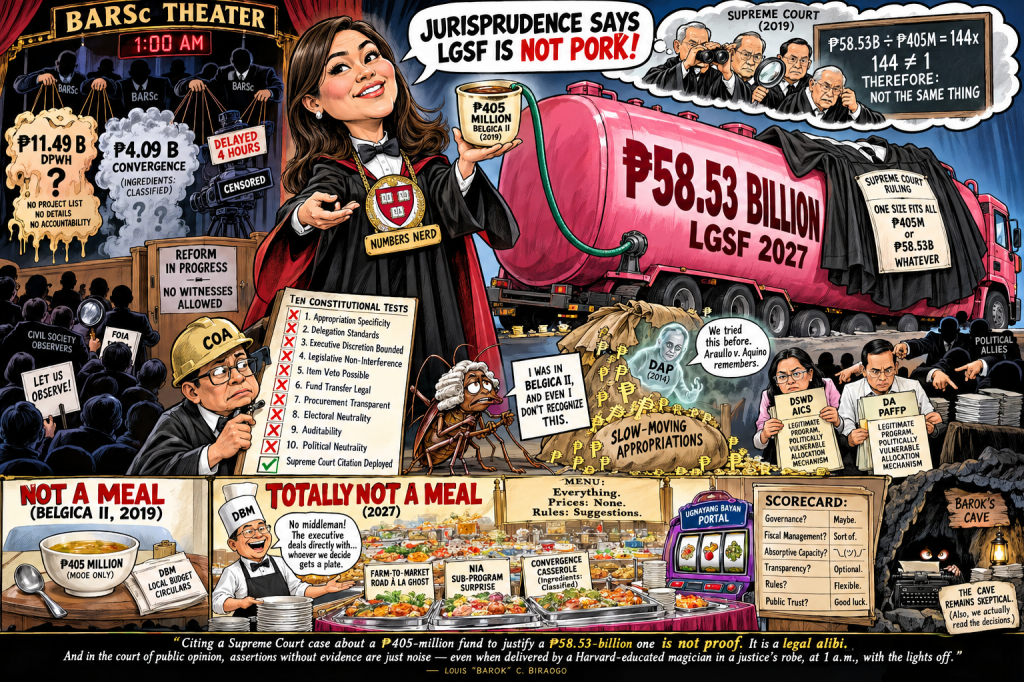
How a ₱405-Million Supreme Court Case Became the Alibi for a ₱58.53-Billion Fund
By Louis ‘Barok’ C. Biraogo — October 9, 2026
WELCOME back to the cave, where we do the dirty work of reading Supreme Court decisions so you don’t have to—and where we occasionally find that the people who write the budget have read exactly enough of them to be dangerous.
This week’s comedy: Rep. Mikaela Angela Suansing, the Harvard-educated, self-described “numbers nerd” who chairs the House Committee on Appropriations, has declared—with the confident finality of someone who has never had to explain a variation order to the Commission on Audit (COA)—that there is “no pork” in the proposed ₱7.2-trillion 2027 national budget.
Not even the ₱58.53-billion Local Government Support Fund (LGSF), which she helpfully notes has been blessed by the Supreme Court. The Department of Budget and Management (DBM) said so. The jurisprudence said so. Case closed. Move along, nothing to see here except, you know, ₱98.86 billion in “red-flagged” amendments that budget watchdogs have been screaming about since roughly the moment the Budget Amendments Review Subcommittee (BARSc) doors closed and the livestream went dark.
Let’s examine this legal defense with the analytical rigor it deserves—which is to say, let’s hold it up to the light and watch the cockroaches scatter.
The Belgica Sleight-of-Hand
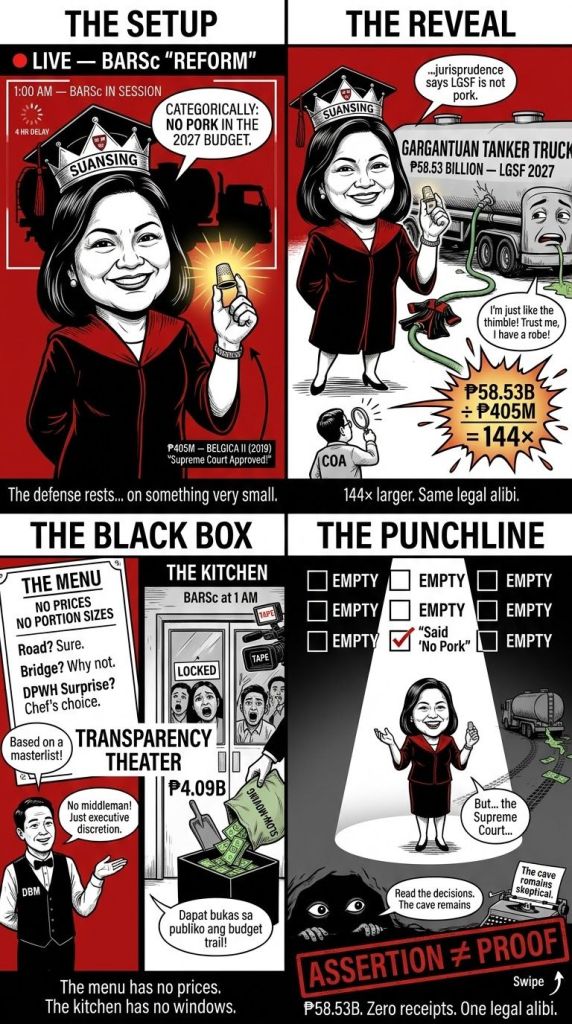
Suansing’s defense rests on a straightforward proposition: The Supreme Court already said the LGSF is constitutional, so it cannot be pork.
This is what we in the cave call a “non sequitur with a robe on.”
Here’s what the Supreme Court actually held in Belgica v. Executive Secretary, G.R. No. 210503 (the 2019 sequel, not the 2013 blockbuster that killed the Priority Development Assistance Fund). The Court examined the 2014 LGSF—a ₱405-million fund, less than one percent of the 2027 version—and found that it satisfied two tests: the “completeness test” (the law sets forth the policy to be executed) and the “sufficient standard test” (the law provides adequate guidelines to prevent the executive’s discretion from “running riot”).
The Court’s reasoning was specific: the 2014 LGSF had a specified amount (₱405 million), was limited to Maintenance and Other Operating Expenses, and was subject to DBM Local Budget Circulars that identified the specific programs and projects for which the fund could be used.
Now here’s the part Suansing’s legal team hopes you won’t notice: ₱405 million is not ₱58.53 billion. The 2027 LGSF is 144 times larger than the fund the Supreme Court actually examined. That’s not a rounding error. That’s not a “distinction without a difference.” That’s the difference between a garden hose and the Hoover Dam.
The Court in Belgica II did not hold that any LGSF, regardless of size, structure, or allocation mechanism, is forever immune from pork-barrel scrutiny. It held that that particular fund, as structured under that particular General Appropriations Act (GAA), with those particular DBM guidelines, passed constitutional muster. The constitutional question is fact-specific. It asks whether this appropriation, in this budget, with these guidelines, sufficiently constrains executive discretion.
Suansing’s assertion—“jurisprudence says LGSF is not pork”—is the legal equivalent of saying “the Supreme Court said a bowl of soup is not a meal, therefore this buffet is also not a meal.” It conflates a narrow holding with a categorical immunity.
The Operational Reality: Who Actually Determines Who Gets What?
Here’s where the constitutional analysis gets interesting—and where Suansing’s defense starts to smell like something that died in the Department of Public Works and Highways (DPWH) warehouse.
The DBM has issued a statement assuring the public that LGSF requests will be submitted directly by Local Government Units (LGUs) through the “Ugnayang Bayan Portal,” evaluated via a “scorecard” considering governance, fiscal management, and absorptive capacity. No middleman. No political intermediaries. The executive deals directly with local chief executives.
This sounds lovely. It also sounds exactly like what the DBM would say, because the DBM’s job is to make executive discretion sound technocratic and apolitical.
The actual constitutional question, as the Supreme Court framed it in Belgica v. Ochoa, Jr., G.R. No. 208566 (Belgica I) (the 2013 case), is whether legislators participate in post-enactment budget execution—whether they can identify projects, dictate beneficiaries, or direct releases after the GAA is passed. If the DBM’s process truly operates as described, with objective criteria and no legislative involvement in project selection, the constitutional case for the LGSF is substantially stronger.
But here’s the catch: we don’t know if it operates as described. The DBM’s scorecard criteria—governance, fiscal management, absorptive capacity—are broad enough to accommodate almost any outcome. “Necessity of the proposed assistance” and “equitable distribution among LGUs” are not the same as transparent, formula-driven allocation. Former Finance Undersecretary Cielo Magno made exactly this point last August: Congress needs to establish “clear framework and parameters” for LGSF allocation, rather than leaving it to executive discretion.
Suansing’s response? The DBM evaluates requests based on a “menu” approved by Congress. The menu includes almost everything. Caloocan Rep. Edgar Erice noted during plenary deliberations that this “menu” approach allows the executive to fund almost any project it wants, including DPWH projects that should arguably go through the regular infrastructure budget process.
A menu with no prices and no rules about who gets to order is not a constraint. It’s a suggestion.
The BARSc Follies: Transparency Theater
Let’s talk about the process, because process is where constitutional law meets political reality.
Suansing came into the Appropriations chairmanship promising reform. She would abolish the “small committee.” She would open the bicameral conference committee to public viewing. She would let civil society organizations participate meaningfully.
What actually happened? The Budget Amendments Review Subcommittee (BARSc)—the rebranded small committee—met at 1 a.m., with reporters ushered out of the room, CSOs barred from on-site monitoring, and the livestream delayed by four hours. By the time anyone could watch, the deed was done: ₱11.49 billion inserted into the DPWH budget, including ₱4.09 billion for a “Convergence and Special Support Program” that the People’s Budget Coalition (PBC) flagged as “the exact lines where the last few years’ ghost projects, and political or pet insertions lived”.
Public finance expert Zy-za Nadine Suzara put it bluntly: “They call it reform, according to House Appropriations chairperson Mika Suansing. Good grief. It is simply another name for the ‘small committee.’”
The House’s defense is that BARSc is institutionally different—it includes members from the minority and party-list coalitions, unlike the old small committee. But an institution that meets at 1 a.m. with the doors locked is not transparent merely because the roster is more diverse. Transparency is about access, not composition.
The ₱4.09-Billion Question
Here’s a specific number that deserves specific scrutiny.
The BARSc approved a ₱4.09-billion increase to the LGSF. Where does the money come from? Suansing has reportedly said it would be sourced from “slow-moving” or underutilized appropriations.
This is where I’d like to invoke the spirit of Araullo v. Aquino III, G.R. No. 209287—the 2014 case that struck down the Disbursement Acceleration Program (DAP) for, among other things, treating unobligated funds as “savings” before the fiscal year ended and cross-border transfers that bypassed Congress’s power of the purse.
Under Article VI, Section 25(5) of the 1987 Constitution, no law may authorize transfers of appropriations except for the narrowly defined augmentation authority. The Supreme Court in Araullo made clear that the executive cannot simply declare funds “savings” and move them around as it pleases.
So when Suansing says the ₱4.09 billion comes from “slow-moving” appropriations, the public is entitled to ask: Which agency? Which program? Which original appropriation? Was it actually savings, or merely an unspent balance? What statutory authority permits the movement?
These are not rhetorical questions. They are the difference between a legitimate augmentation and a constitutional violation. And they are the questions that the BARSc’s 1 a.m. session did not answer.
The “85% Red Flag” Problem
The People’s Budget Coalition has flagged ₱98.86 billion out of ₱116.32 billion in amendments—85 percent—as “questionable”. Rep. Tinio reportedly characterized ₱77.86 billion as “pork-type.”
Suansing’s defenders will say these are advocacy classifications, not judicial findings. And they’re right. “Red flag” is not a legal term of art. It does not mean “illegal.” It means “this deserves scrutiny.”
But here’s the problem: Suansing is not offering any counter-analysis. She is not saying “here is why the PBC’s numbers are wrong.” She is not providing project-level data to show that the flagged items are legitimate. She is not publishing the BARSc minutes so that independent analysts can verify her claims.
She is saying “no pork” and citing a Supreme Court case that examined a fund 144 times smaller than the one she’s defending.
That is not a rebuttal. That is an assertion. And in the court of public opinion, assertions without evidence are just noise.
The AICS and PAFFP Defenses: Legitimate Programs, Political Vulnerabilities
Let me be fair to Suansing on two points.
First, AICS. The Assistance to Individuals in Crisis Situations (AICS) program is not inherently a patronage mechanism. Department of Social Welfare and Development (DSWD) data shows it serves millions of Filipinos—more than 4.2 million clients and ₱27.9 billion released in the first half of 2026 alone. Medical assistance, cash relief, funeral aid—these are real needs, and the program meets them.
But DSWD itself has acknowledged that referrals from legislators occur, with social workers retaining formal assessment authority. The distinction between “politician informs constituent about assistance” and “politician determines who receives assistance” is constitutionally critical. If the referral becomes the functional eligibility criterion, AICS transforms from social protection into political patronage with a DSWD logo.
Second, agricultural assistance. The Presidential Assistance to Farmers and Fisherfolk (PAFFP) has a legitimate policy foundation: fuel price volatility, fertilizer costs, climate risks, food security. An argument for maintaining agricultural shock-response capacity is economically defensible.
But the word “Presidential” in the program’s name is not accidental. It brands the assistance as emanating from the President, not from the government as a whole. That branding creates political advantage, even without explicit electoral inducement. The cleanest safeguard would be database-driven, formula-based eligibility—Registry System for Basic Sectors in Agriculture (RSBSA) and BoatR registration rather than political networks.
Suansing’s defense of these programs is substantively stronger than her LGSF defense. But she is still defending the existence of the programs, not the allocation mechanisms that critics are actually questioning.
The Ten Tests That Matter
Instead of asking “Is the LGSF pork?”—a question that can be argued indefinitely because “pork” has no single legal definition—here are the ten questions that actually determine whether the 2027 budget passes constitutional muster:
- Appropriation specificity: Does the GAA identify the amount and purpose with sufficient precision?
- Delegation: Does the GAA provide adequate standards for executive implementation?
- Executive discretion: Can the implementing agency choose among objectively defined eligible recipients?
- Legislative non-interference: Can individual legislators identify or alter projects after enactment?
- Item veto: Can the President meaningfully exercise the constitutional item veto?
- Fund transfer: Were augmentations made consistently with Article VI, Section 25 of the 1987 Constitution?
- Procurement: Are projects subject to the transparency and public monitoring requirements of Republic Act No. 12009 (New Government Procurement Act)?
- Electoral neutrality: Is assistance distributed without electoral inducement?
- Auditability: Can the Commission on Audit (COA) and the public trace the entire peso?
- Political neutrality: Does implementation comply with Republic Act No. 6713 (Code of Conduct and Ethical Standards for Public Officials and Employees)’s prohibition on officials acting as “dispensers of undue patronage”?
Suansing has answered none of these questions with project-level data. She has answered them with a Supreme Court citation.
The Bottom Line
Suansing’s legal argument is not frivolous. The Supreme Court did uphold the LGSF. The DBM does have guidelines. The House does have constitutional authority to amend the budget.
But her categorical formulation—“there is no pork”—goes further than the jurisprudence warrants. The Court did not hold that every LGSF is immune from scrutiny. It did not hold that size is irrelevant. It did not hold that a fund that functions as political patronage is constitutional merely because it bears the LGSF label.
The constitutional test is operational, not nominal. It asks who controls project selection, what criteria govern allocation, whether legislators participate after enactment, whether executive discretion is genuinely bounded, and whether the complete budget-to-project-to-payment trail is publicly auditable.
On those questions, the 2027 budget is a black box. The BARSc met at 1 a.m. The livestream went dark. The ₱4.09-billion augmentation has no public sourcing trail. The ₱11.49-billion DPWH insertion has no project list. The ₱58.53-billion LGSF has no published allocation formula.
The Supreme Court in Belgica II warned that budget mechanisms can evolve and that recurring appropriation controversies are capable of repetition. It anticipated exactly this scenario: a fund that is legally defensible in isolation but politically vulnerable in operation.
Suansing’s “no pork” declaration will not be tested by her statement, the LGSF label, or even the 2019 ruling. It will be tested by the publicly traceable behavior of every peso after the 2027 GAA becomes law.
Until then, the burden of proof is on her. And citing a Supreme Court case about a ₱405-million fund to justify a ₱58.53-billion one is not proof. It is a legal alibi.
The cave remains skeptical.
Key Citations
A. Legal & Official Sources
- The 1987 Constitution of the Republic of the Philippines. Official Gazette of the Republic of the Philippines, 1987, https://www.officialgazette.gov.ph/constitutions/1987-constitution/.
- Belgica v. Ochoa, Jr., G.R. No. 208566, 19 Nov. 2013. Lawphil, https://lawphil.net/judjuris/juri2013/nov2013/gr_208566_2013.html.
- Belgica v. Executive Secretary, G.R. No. 210503, 8 Oct. 2019. Lawphil, https://lawphil.net/judjuris/gr_210503_2019.html.
- Araullo v. Aquino III, G.R. No. 209287, 1 July 2014. Lawphil, https://lawphil.net/judjuris/juri2014/jul2014/gr_209287_2014.html.
- Republic Act No. 6713. An Act Establishing a Code of Conduct and Ethical Standards for Public Officials and Employees. Official Gazette of the Republic of the Philippines, 20 Feb. 1989, https://www.officialgazette.gov.ph/1989/02/20/republic-act-no-06713/.
- Republic Act No. 12009. An Act Revising Republic Act No. 9184, Otherwise Known as the Government Procurement Reform Act, and for Other Purposes (New Government Procurement Act). Lawphil, 20 July 2024, https://lawphil.net/statutes/repacts/ra2024/ra_12009_2024.html.
B. News Reports
- Lalu, Gabriel Pabico. “Suansing Maintains: No Pork in Proposed 2027 Budget.” INQUIRER.net, 2 Oct. 2026, https://newsinfo.inquirer.net/2315946/suansing-maintains-no-pork-in-proposed-2027-budget.
- “P116.32B Dagdag-Pondo, Inirekomenda sa 2027 Budget.” Remate Online, 3 Oct. 2026, https://remate.ph/p116-32b-dagdag-pondo-inirekomenda-sa-2027-budget/.
- “House Subpanel OKs Additional P4.09M for Next Year’s LGSF.” Philippine Daily Inquirer, 1 Oct. 2026, https://newsinfo.inquirer.net/2315522/house-subpanel-oks-additional-p4-09m-for-next-years-lgsf/.
- “LGSF Umakyat sa P62.62B, Kinuwestiyon ni Tinio.” NewsKo, 2 Oct. 2026, https://newsko.com.ph/2026/10/02/lgsf-umakyat-sa-p62-62b-kinuwestiyon-ni-tinio/.
- “Prof. Magno: Kongreso, Dapat Maglatag ng Malinaw na Framework sa LGSF.” 105.9 True FM, YouTube, 20 Aug. 2026, https://www.youtube.com/watch?v=kLJXF86_Ly0.
- Department of Social Welfare and Development. “Over 4.2M Clients Nationwide Avail of DSWD’s AICS in 1st Sem of 2026.” DSWD, 16 July 2026, https://www.dswd.gov.ph/over-4-2m-clients-nationwide-avail-of-dswds-aics-in-1st-sem-of-2026/.
- Begas, Billy. “House Panel Allots More Budget for Key Social Aid Programs.” Bilyonaryo News Channel, 2 Oct. 2026, https://bnc.bilyonaryo.com/house-panel-allots-more-budget-for-key-social-aid-programs/news/.

- ₱8B BBM Pork: CCTV for Every Captain’s Kumpare?

- ₱8.9 Billion, 331 Ghost Police Stations: The TIKAS Scandal Explained

- ₱8.4 Billion, 42,000 Barangays, 1 Election: The “Bawat Barangay Makikinabang” Vote-Buying Masterclass

- ₱75 Million Heist: Cops Gone Full Bandit

- ₱6.77B Ghost Haunts Duterte: RTC Dismisses Mans Carpio’s Desperate Plea

- ₱6.77 Billion and Zero Cash: The Sara Duterte SALN Math That Doesn’t Add Up

- ₱6.7-Trillion Temptation: The Great Pork Zombie Revival and the “Collegial” Vote-Buying Circus

- ₱58.53B, Zero Receipts: The LGSF Pork Barrel Nobody Wants to Name
- ₱53 Million Man Tells ₱695-a-Day Workers to Stop Being ‘Mayabang’: The Audacity of BSP’s Remolona

- ₱4.4 Billion and a Witness Who Can’t Explain It: The Duterte Impeachment’s Most Expensive Non-Answer
- ₱3.06 Billion for Evacuation Centers—But Nobody Knows Where They’ll Stand (Or If They’ll Exist)
- ₱16 Billion, 280 Accounts, 8 Helicopters: Boying Remulla’s Case Against the Yaps Is Not a Drill







Leave a comment