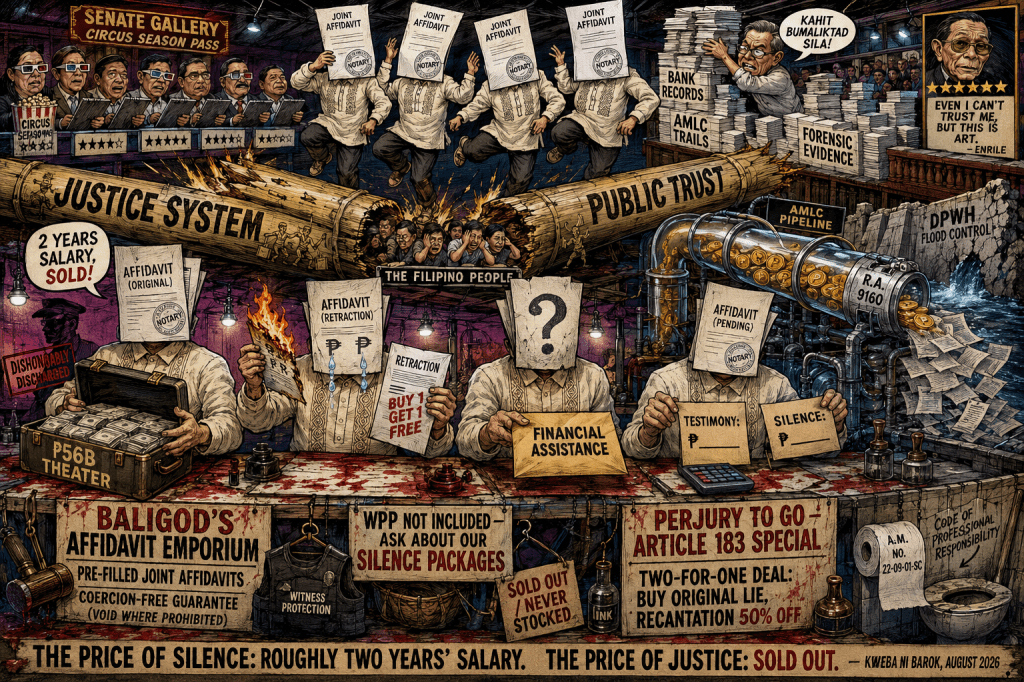
The Going Rate for Truth, the Cost of Silence, and Why Senate Hearings Are Just Post-Purchase Reviews.
By Louis ‘Barok‘ C. Biraogo — August 7, 2026
They have withdrawn their faces from public view—the only honest withdrawal they have made throughout this entire sordid affair.
The Predictable Pirouette of the Faceless Four
Four men who once styled themselves as courageous whistleblowers—former bodyguards of ex-Ako Bicol party-list Rep. Zaldy Co, some allegedly ex-Marines—have now executed the most predictable pirouette in Philippine jurisprudence: the dramatic recantation. Faces shrouded, voices trembling about “threats to our lives,” they have gifted GMA News with notarized affidavits and video evidence of their latest performance. The script, this time, is that they were coerced. Promised financial assistance. Pressured by the Ombudsman to sign pre-prepared documents. They just want to “live quietly,” they say.
How exquisitely, disgustingly Filipino. We have witnessed this choreography before—the affidavit, the press conference, the recantation, the disappearance. It is the Tinikling of the damned, and we the public are the bamboo poles, being clapped together while the powerful dance between our legs.
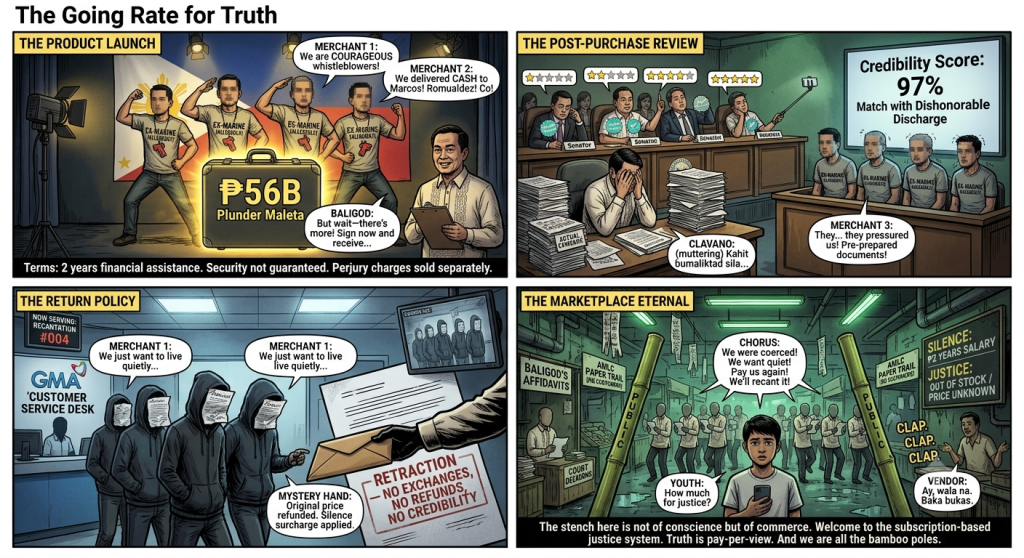
Vendors of Sworn Testimony, Not Witnesses
Let us be surgically precise about why this recantation is not merely worthless—it is self-destroying. The four men have confessed to a crime in the act of trying to escape one. By their own admission, their original February 2026 joint affidavit implicating President Ferdinand Marcos Jr., former Speaker Martin Romualdez, and Zaldy Co in the delivery of maleta-sized cash payoffs from the ₱56-billion flood control scandal was executed in exchange for a promise. “There was a promise made. For financial assistance, for instance. They said we can afford not to work for two years,” one of them told GMA News.
Pause and let that sit in your throat like bile. These men are not saying they were mistaken. They are not saying they were confused. They are admitting, on national television, that they sold their sworn testimony for money. They were not witnesses; they were vendors. And the goods they peddled were lies dressed as truth.
Perjury’s No-Escape Clause
The logical consequence is lethal to their credibility in either direction. Under Article 183 of Act No. 3815 (Revised Penal Code), perjury is the willful and deliberate assertion of falsehood on a material matter under oath. By their own narrative, either their original affidavit or this new recantation constitutes perjury. There is no escape hatch. A witness who boasts of having sold one version of the truth has impeached his own soul, not merely his testimony. As the Supreme Court held in People v. Domantay (G.R. No. 130562), recantations are “looked upon with disfavor and are generally rejected on the ground that a testimony solemnly given in court should not be easily vacated by the mere expediency of a subsequent recantation.” And in People v. Ballabare (G.R. No. 108871), the Court warned that retractions are “exceedingly unreliable” because they can be “easily obtained from witnesses, typically through intimidation or monetary consideration.”
The stench here is not of conscience but of commerce. The four men now face their own perjury and cyberlibel exposure from the Department of Justice (DOJ)’s July 2026 resolution. Recantation is not an act of moral awakening; it is a strategic retreat from the gallows of their own making. And who, pray tell, is paying them now? The original affidavit, by their account, had a sponsor. Does this one not? Or are we to believe that the second transaction, the one that buys silence rather than noise, was conducted out of pure, altruistic devotion to truth?
Damaged Goods Before the Flip
But let us not make the mistake of romanticizing the original testimony either. The Philippine Navy has confirmed that four of the original 18 “ex-bodyguards” were never Marines, and most were dishonorably discharged. The DOJ itself recommended perjury and cyberlibel charges against Baligod and his entire troupe. Assistant Ombudsman Mico Clavano IV publicly noted that their initial joint affidavit failed “even an initial evaluation” due to credibility issues. These men were damaged goods long before they recanted. The tragedy is not that the prosecution’s star witnesses flipped—it is that the prosecution, at least initially, relied on stars so dim they could barely be seen.
This is the abyss into which Philippine anti-corruption efforts perpetually fall: we build plunder cases on the testimony of mercenaries, and then we act surprised when the opposing side hires them away. The ₱56-billion plunder threshold under Republic Act No. 7080 (Anti-Plunder Act), as upheld in Estrada v. Sandiganbayan (G.R. No. 148560), requires evidence that can withstand the Sandiganbayan’s exacting scrutiny. Cash-in-a-suitcase testimony from anonymous, self-confessed liars is not evidence—it is theater.
Build on Paper, Not on Liars
Assistant Ombudsman Clavano, to his credit, appears to understand this. Since July 2, 2026, he has been singing the same wise hymn: the case “will still stand on independently gathered evidence kahit bumaliktad sila (even if they flip).” This is the right instinct. The Ombudsman’s strategic course must now pivot decisively and ruthlessly toward four imperatives.
- Secure the documentary and forensic evidence that cannot be bribed, threatened, or recanted. Bank records do not forget. AMLC freeze orders on Forbes Park properties tied to shell entities do not develop crises of conscience. The Supreme Court has long held in People v. Ubina (97 Phil. 515) that physical and documentary evidence carries a weight that no recanting mouth can erase.
- Deepen cooperation with the Anti-Money Laundering Council (AMLC) under Republic Act No. 9160 (Anti-Money Laundering Act of 2001). The ₱56 billion did not evaporate; it flowed through financial institutions that leave trails a thousand times more eloquent than any bodyguard’s trembling affidavit. Follow the money, not the maleta theater.
- Formally investigate the financial inducement behind both affidavits under Presidential Decree No. 1829 (Penalizing Obstruction of Apprehension and Prosecution of Criminal Offenders), which penalizes acts that obstruct, impede, or frustrate the apprehension and prosecution of criminal offenders, including making untruthful statements to mislead investigators. Someone financed the original lies. Someone is financing the recantation. Find them. Charge them.
- Immediately close the structural gap that allowed this circus: the conspicuous absence of formal Witness Protection Program (WPP) coverage under Republic Act No. 6981 (Witness Protection, Security and Benefit Act). DOJ-side witnesses in the same flood control scandal—former Department of Public Works and Highways (DPWH) Undersecretaries and contractors—received provisional WPP admission. The Co bodyguards did not. They were left to be traded as commodities in an unregulated marketplace of sworn statements because the state failed to provide the transparent, accountable channel that R.A. 6981 was explicitly designed to create.
The Rot Is Institutional
This is not a legal technicality. This is a systemic rot. We have created a subscription-based justice system where truth is a pay-per-view event, and our senators, ever the dutiful theater critics, convene to review the latest season with the wide-eyed innocence of virgins at a burlesque. The Code of Professional Responsibility and Accountability (A.M. No. 22-09-01-SC) strictly prohibits lawyers from fabricating evidence or suborning perjury, yet someone drafted both the uniform original joint affidavit and the new recantation documents. Where is the Integrated Bar of the Philippines (IBP)? Where is the Supreme Court’s disciplinary apparatus?
To the remaining witnesses who have not yet sold their souls: tell the truth—consistent, precise, unvarnished. Never guess. Never omit. Never recant for a reward. Your loyalty belongs to the Republic and the rule of law, not to the highest bidder.
To the Ombudsman: build your case on paper, not on liars. To the AMLC: trace every peso. To Congress: summon these four faceless merchants and demand to know who paid them, when, and how much.
And to the Filipino youth inheriting this broken theater of a justice system: demand better. The price of silence, it turns out, is roughly two years’ salary. The price of justice, we are still waiting to find out.
— Kweba ni Barok
Key Citations
A. Legal & Official Sources
- Act No. 3815. The Revised Penal Code. 1930, lawphil.net/statutes/acts/act1930/act_3815_1930b.html.
- People v. Domantay. G.R. No. 130612. Supreme Court of the Philippines, 11 May 1999, lawphil.net/judjuris/juri1999/may1999/gr_130612_1999.html.
- People v. Ballabare. G.R. No. 108871. Supreme Court of the Philippines, 19 Nov. 1996, lawphil.net/judjuris/juri1996/nov1996/gr_108871_1996.html.
- Republic Act No. 7080. An Act Defining and Penalizing the Crime of Plunder. 12 July 1991, http://www.lawphil.net/statutes/repacts/ra1991/ra_7080_1991.html.
- Estrada v. Sandiganbayan. G.R. No. 148560. Supreme Court of the Philippines, 19 Nov. 2001, lawphil.net/judjuris/juri2001/nov2001/gr_148560_2001.html.
- People v. Ubina. 97 Phil. 515. Supreme Court of the Philippines, lawphil.net/judjuris/juri1955/aug1955/gr_l-6969_1955.html.
- Republic Act No. 9160. An Act Defining the Crime of Money Laundering, Providing Penalties Therefor and for Other Purposes (Anti-Money Laundering Act of 2001). 29 Sept. 2001, lawphil.net/statutes/repacts/ra2001/ra_9160_2001.html.
- Presidential Decree No. 1829. Penalizing Obstruction of Apprehension and Prosecution of Criminal Offenders. 16 Jan. 1981, lawphil.net/statutes/presdecs/pd1981/pd_1829_1981.html.
- Republic Act No. 6981. An Act Providing for a Witness Protection, Security and Benefit Program and for Other Purposes. 24 Apr. 1991, lawphil.net/statutes/repacts/ra1991/ra_6981_1991.html.
- Code of Professional Responsibility and Accountability. A.M. No. 22-09-01-SC. Supreme Court of the Philippines, 11 Apr. 2023, sc.judiciary.gov.ph/wp-content/uploads/2023/05/22-09-01-SC-FINAL.pdf.
B. News Reports
- Umali, Mariz. “4 Ex-Bodyguards Recant Statements vs. Marcos, Romualdez, Co.” GMA News Online, GMA Network, 6 Aug. 2026, http://www.gmanetwork.com/news/topstories/nation/997635/4-ex-bodyguards-recant-statements-vs-marcos-romualdez-co/story/.
- “Ang Hirap Maging Mahirap”: The PAO Scandal That Proves Government Contempt Is Nothing New
- “Far-Off” My Axx: Malacañang’s Claire Castro Drowns in Her Own Legal Gaslighting
- “Forthwith” to Farce: How the Senate is Killing Impeachment—And Why Enrile’s Right (Even If You Can’t Trust Him)

- “HINDI AKO NAG-RESIGN!”

- “I Know Nothing”: Baste Duterte’s Amnesia Defense Meets ₱33M in GenCorp Contracts

- “I’m calling you from my new Globe SIM. Send load!”

- “Mahiya Naman Kayo!” Marcos’ Anti-Corruption Vow Faces a Flood of Doubt

- “Manageable” Debt, Unmanageable Lies: DBM’s ₱21 Trillion Fairy Tale

- “Meow, I’m calling you from my new Globe SIM!”

- “Natrabaho”: One Word, One Ombudsman, and a Judiciary on Trial
- “No Special Jail for Crooks!” Boying Remulla Slams VIP Perks for Flood Scammers

- “Philippine-Controlled” or Yankee Gas Station? The Davao Fuel Depot Farce Exposed





Leave a Reply