
The Legal Autopsy of a Political Dynasty’s Very Bad, Horrible, Indefensible Lakefront Project
By Louis ‘Barok‘ C. Biraogo — August 10, 2026
MGA, ka-kweba, ladies and gentlemen of the viewing public, gather around the slab. What we have before us is not a mere scandal. It is a masterclass in institutional decay, a symphony of avarice conducted by the tone-deaf, and a criminal enterprise so brazen its perpetrators apparently couldn’t be bothered to find a real slope before billing the government for “slope protection.”
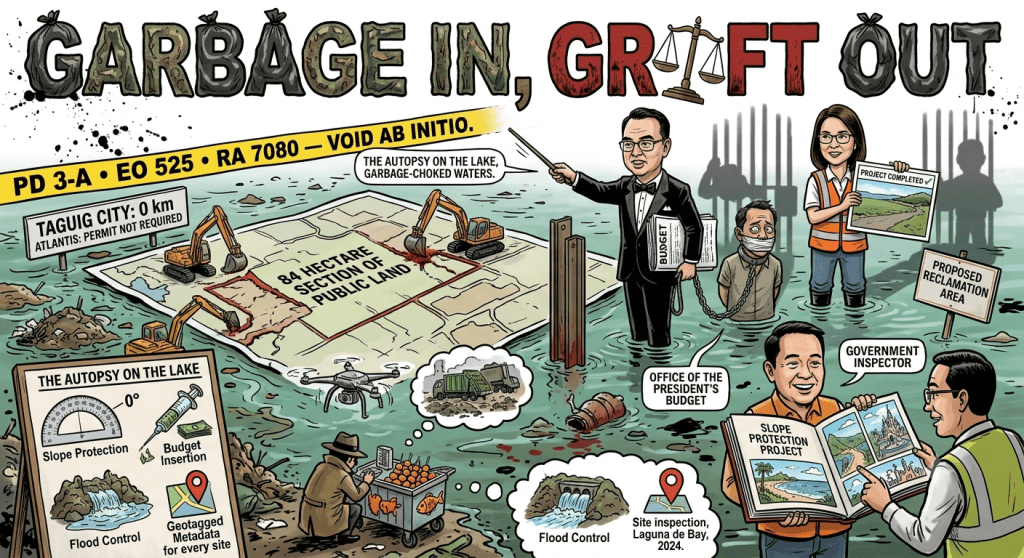
The facts, as alleged, are almost too on-the-nose for a satire: 84 hectares of Laguna de Bay—an area larger than 80 football pitches—allegedly reclaimed without a single permit. Thirty-two “flood control” projects that controlled no floods, protected no slopes, and existed primarily as line items in a budget that sibling senators Alan Peter and Pia Cayetano stuffed with a combined P11.49 billion. Sheet piles driven into open water. Garbage diverted from sanitary landfills and dumped into the lake as fill. Contractors billing the government using photographs of completely different projects located kilometers away—the construction equivalent of submitting someone else’s vacation photos as your wedding album.
And the pièce de résistance? Philippine Reclamation Authority (PRA) officials reduced to launching drones while pretending to buy street food, because conducting regulatory oversight in the Cayetanos’ backyard requires the tradecraft of a Cold War spy. Let that image sear itself into your consciousness: the agency legally mandated to oversee reclamation, fleeing from shadowy tails like something out of a John le Carré novel, just to document a crime in progress.
If this were fiction, publishers would reject the manuscript for being too implausible.
THE LEGAL FRAMEWORK: WHY THIS ISN’T A SCANDAL—IT’S A CRIME SCENE
Let us begin where all proper legal autopsies begin: with the law, that inconvenient thing that applies even to political dynasties.
The reclamation question is, legally speaking, not even a question. Presidential Decree No. 3-A (PD 3-A), a statute so clear it practically screams from the page, provides that any reclamation made without proper authorization “shall be forfeited to the State without need of judicial action.” Not after a hearing. Not pending appeal. Without need of judicial action. The PRA, under Executive Order No. 525 (EO 525) and its own Administrative Order No. 2007-2 (AO 2007-2), is the sole coordinating authority for reclamation, and it expressly states that no local government unit (LGU)—not Taguig, not Makati, not the fabled lost city of Atlantis—can approve reclamation on its own.
The Supreme Court’s ruling in Chavez v. Public Estates Authority drives the final nail into this particular coffin. Foreshore and submerged lands are inalienable public domain. Reclaiming them without authorization is not merely irregular; it is void ab initio—void from the beginning, a legal nullity, a thing that never was. Any title derived from such illegal reclamation is a fantastical fiction, a piece of paper worth less than the garbage used as fill. The state’s right to seize this land is legally unassailable. The only question is why it hasn’t already done so.
But wait, cries the imaginary defense attorney. What about the Laguna Lake Development Authority (LLDA)? Under Republic Act No. 4850 (RA 4850), as amended, doesn’t it have concurrent jurisdiction? Indeed it does—and that makes it worse for the reclamation’s proponents, not better. The LLDA’s clearance requirement is an additional regulatory hurdle, not a substitute for PRA oversight. The reclamation allegedly cleared neither. It is, in the immortal words of every parent who has ever caught a child with a hand in the cookie jar, doubly unauthorized.
THE GHOST PROJECT CONUNDRUM: WHEN “SLOPE PROTECTION” MEANS “OPEN WATER”
Now we wade into the murky, garbage-filled waters of the ghost projects themselves. Senator Lacson’s rhetorical question—”What is your slope protection if there is no slope because you put it in the water?”—is not merely a sick burn delivered on a radio show. It is a devastating legal argument dressed in colloquial clothing.
The criminal framework here is Plunder, capital “P,” under Republic Act No. 7080 (RA 7080). The P11.49 billion in combined budget insertions shatters the P50 million threshold like a wrecking ball through wet tissue paper. The 32 contracts constitute the necessary “combination or series” of overt criminal acts. And the recycled photographs? Those are the smoking gun that doesn’t just smoke—it belches flame, sings arias, and demands an encore.
But here, dear readers, is where we must momentarily temper our righteous indignation with prosecutorial rigor. The Supreme Court’s Estrada v. Sandiganbayan doctrine demands proof of a specific chain: appropriation, influence, procurement manipulation, fraudulent implementation, and—crucially—ill-gotten wealth flowing back to a public officer. A P6.79 billion insertion by Senator Alan Peter Cayetano is a political obscenity, but it is not, standing alone, a criminal conviction. The Arias defense—the doctrine that public officials may reasonably rely on subordinates, drawn from Arias v. Sandiganbayan—is a legitimate shield for a legislator who merely funded a project. It becomes a paper umbrella in a typhoon only when prosecutors prove that the legislator knew the project was a ghost, directed its fraudulent implementation, or received a kickback.
This is why the PRA “budget hostage” allegation is potentially the most legally significant claim in the entire saga. If Lacson can prove that Senator Alan Peter Cayetano held the Office of the President’s budget captive to pressure a regulatory agency into suspending its investigation, that transforms the narrative from “legislator funds questionable project” to “public officer obstructs justice to protect a criminal enterprise.” That is not a political spat. That is a predicate act.
As for Senator Pia Cayetano’s P4.7 billion insertion, the criminal case is, at present, materially weaker. Budgetary association is not criminal participation. Without evidence of operational knowledge or receipt of benefits, the legal distinction between her position and her brother’s must be maintained, however politically inconvenient that may be.
THE INSTITUTIONAL AUTOPSY: WHO KILLED OVERSIGHT?
The institutions charged with preventing this farce did not merely fail. They were, if the allegations are true, actively subverted.
The PRA, the very agency tasked with regulating reclamation, had its officials followed and harassed. One resorted to a family outing as cover for drone surveillance. This is not regulatory oversight. This is guerrilla documentation of a crime in progress by a state that has lost control of its territory.
The Senate Blue Ribbon Committee, the great white shark of congressional oversight, is currently swimming in circles with a self-inhibited chairman and a political knife fight over leadership. Senator Tulfo’s voluntary inhibition, following allegations that he himself was named by supposed “bagmen,” is either an act of ethical hygiene or a tactical retreat dressed in noble robes. The proposed subcommittee under Senator Pangilinan is a workable fix, but let us not pretend it is anything other than a salvage operation on a vessel already taking on water.
And then there is the Ombudsman, to whom evidence has been delivered and who has agreed with Senate leadership to “solely handle” the investigation. Let me be crystalline: the Ombudsman is the constitutionally proper venue for determining criminal guilt. The Senate, per Bengzon v. Senate Blue Ribbon Committee, cannot become a de facto criminal court. But the Senate’s constitutional oversight function—its power to investigate systemic failures and craft remedial legislation—must not be surrendered in a backroom deal with the very political actors under scrutiny.
THE FORENSIC IMPERATIVE: FOLLOW THE GARBAGE, FOLLOW THE MONEY
This scandal will not be solved by radio interviews. It will be solved by forensic accounting and engineering evidence.
Investigators must construct a transaction-by-transaction matrix for every one of those 32 projects. Who proposed it? Who inserted it into the budget? Who procured it? Who certified its completion? Where is the physical evidence of its existence? And where, precisely, did the money go?
The recycled photographs are legally devastating because geotagged metadata provides an objective, falsifiable test of the official narrative. Either the photo shows the project site or it does not. Either the contractor billed for work performed or it did not. Binary questions with binary answers, immune to political spin.
The garbage-as-fill allegation opens an entirely separate front under the Philippine Clean Water Act of 2004 (Republic Act No. 9275) and the Supreme Court’s Mandamus ruling in MMDA v. Concerned Residents of Manila Bay. The government’s environmental duty is affirmative and continuing. If dump trucks diverted to Laguna de Bay turned a sanitary landfill operation into a toxic reclamation project, the responsible parties face liability that extends well beyond the political scandal.
THE VERDICT: WHAT MUST HAPPEN NOW
The PRA must initiate immediate administrative forfeiture proceedings. Not tomorrow. Not pending further study. Immediately. The law provides the cudgel; it is time to swing it.
The Ombudsman must prioritize the plunder investigation, leveraging the two cooperating contractors as entry points into the conspiracy. A financial forensic analysis of the Cayetano family’s assets against their lawful income is not a political hit job. It is standard investigative procedure when billions in public funds are alleged to have vanished into a lake.
The Senate must proceed with the Pangilinan subcommittee and legislate automatic public disclosure of all budget insertions. No more anonymous billions buried in the General Appropriations Act like legislative improvised explosive devices.
The Executive must unconditionally support the PRA. A co-equal branch does not pay ransom to legislators wielding the budget like a shakedown artist.
And to the contractors who submitted recycled photographs and dumped garbage in a lake: your best option, at this juncture, is to cooperate fully and hope the Ombudsman is in a merciful mood. The alternative is a plunder conviction and the cold realization that P11.49 billion buys a very long prison sentence and precisely zero slope protection.
The rule of law is not a suggestion. It is the operating system of a democratic republic. This scandal is a system crash. The reboot begins now, and it begins with documents, not declarations; with engineering measurements, not radio interviews; with bank records, not political posturing.
Let the evidence decide who is lying. And let the prosecution begin.
Key Citations
A. Legal & Official Sources
- Presidential Decree No. 3-A. 11 Jan. 1973. Quoted and applied in Executive Order No. 525, lawphil.net/executive/execord/eo1979/eo_525_1979.html.
- Executive Order No. 525. Designating the Public Estates Authority as the Agency Primarily Responsible for All Reclamation Projects. 14 Feb. 1979, lawphil.net/executive/execord/eo1979/eo_525_1979.html.
- Philippine Reclamation Authority. Administrative Order No. 2007-2: Implementing Rules and Regulations of Executive Order No. 543 Delegating to the Philippine Reclamation Authority the Power to Approve Reclamation Projects. 31 Jan. 2007, elibrary.judiciary.gov.ph/thebookshelf/showdocs/11/44001.
- Chavez v. Public Estates Authority. G.R. No. 133250, 9 July 2002, lawphil.net/judjuris/juri2002/jul2002/gr_133250_2002.html.
- Republic Act No. 4850. An Act Creating the Laguna Lake Development Authority, Prescribing Its Powers, Functions and Duties, Providing Funds Therefor, and for Other Purposes. 18 July 1966, lawphil.net/statutes/repacts/ra1966/ra_4850_1966.html.
- Republic Act No. 7080. An Act Defining and Penalizing the Crime of Plunder. 12 July 1991, http://www.lawphil.net/statutes/repacts/ra1991/ra_7080_1991.html.
- Estrada v. Sandiganbayan. G.R. No. 148560, 19 Nov. 2001, lawphil.net/judjuris/juri2001/nov2001/gr_148560_2001.html.
- Arias v. Sandiganbayan. G.R. Nos. 81563 & 82512, 19 Dec. 1989, lawphil.net/judjuris/juri1989/dec1989/gr_81563_1989.html.
- Bengzon v. Senate Blue Ribbon Committee. G.R. No. 89914, 20 Nov. 1991, lawphil.net/judjuris/juri1991/nov1991/gr_89914_1991.html.
- Republic Act No. 9275. An Act Providing for a Comprehensive Water Quality Management and for Other Purposes (Philippine Clean Water Act of 2004). 22 Mar. 2004, lawphil.net/statutes/repacts/ra2004/ra_9275_2004.html.
- Metropolitan Manila Development Authority v. Concerned Residents of Manila Bay. G.R. Nos. 171947-48, 18 Dec. 2008, lawphil.net/judjuris/juri2008/dec2008/gr_171947_2008.html.
B. News Reports
- Servallos, Neil Jayson. “Ping: PRA to Seize Illegally Reclaimed Areas in Taguig.” The Philippine Star, 10 Aug. 2026, http://www.philstar.com/headlines/2026/08/10/2548222/ping-pra-seize-illegally-reclaimed-areas-taguig.

- “Ang Hirap Maging Mahirap”: The PAO Scandal That Proves Government Contempt Is Nothing New

- “Far-Off” My Axx: Malacañang’s Claire Castro Drowns in Her Own Legal Gaslighting
- “Forthwith” to Farce: How the Senate is Killing Impeachment—And Why Enrile’s Right (Even If You Can’t Trust Him)

- “HINDI AKO NAG-RESIGN!”

- “I Know Nothing”: Baste Duterte’s Amnesia Defense Meets ₱33M in GenCorp Contracts

- “I’m calling you from my new Globe SIM. Send load!”

- “Mahiya Naman Kayo!” Marcos’ Anti-Corruption Vow Faces a Flood of Doubt

- “Manageable” Debt, Unmanageable Lies: DBM’s ₱21 Trillion Fairy Tale

- “Meow, I’m calling you from my new Globe SIM!”

- “Natrabaho”: One Word, One Ombudsman, and a Judiciary on Trial

- “No Special Jail for Crooks!” Boying Remulla Slams VIP Perks for Flood Scammers

- “Philippine-Controlled” or Yankee Gas Station? The Davao Fuel Depot Farce Exposed









Leave a Reply