Drainage Optional, Outrage Mandatory: Inside the Dizon School of Governance
By Louis ‘Barok‘ C. Biraogo — August 11, 2026
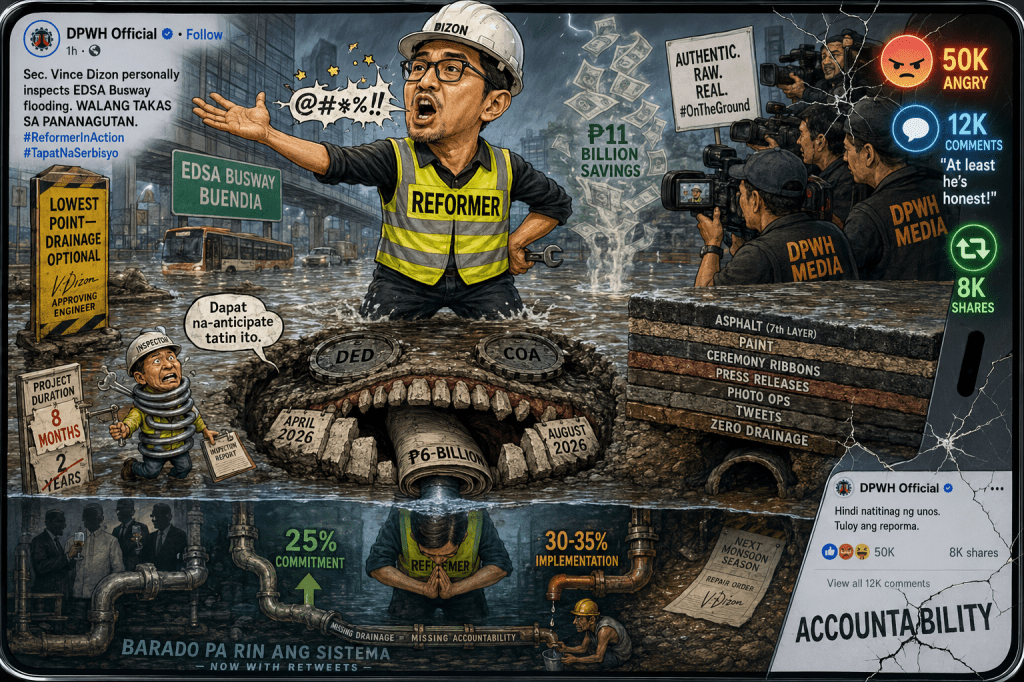
THE water pooling on EDSA didn’t just expose a pothole. It exposed the architecture of a national con. On the night of August 8, 2026, Public Works Secretary Vince Dizon stood in that stagnant pool, cursed into a camera his own department was rolling, and performed the most exquisite act of political jiu-jitsu the Marcos administration has yet produced: he weaponized his own failure. He baptized a design debacle in profanity and emerged, dripping, as the public’s avenger rather than the project’s sponsor. The footage went viral. The questions went unanswered. The water remained.
This is not a story about a pothole. It is a story about a P6-billion flagship project, delivered two months ahead of schedule, that somehow forgot to include a drainage outlet at its own documented lowest elevation point—a hydrological inevitability any first-year engineering student would flag. That it wasn’t caught, and that the official charged with delivering the project discovered the defect on camera as if stumbling upon a crime scene, is either a confession of staggering incompetence or something considerably darker.
I. The Anatomy of a Failure
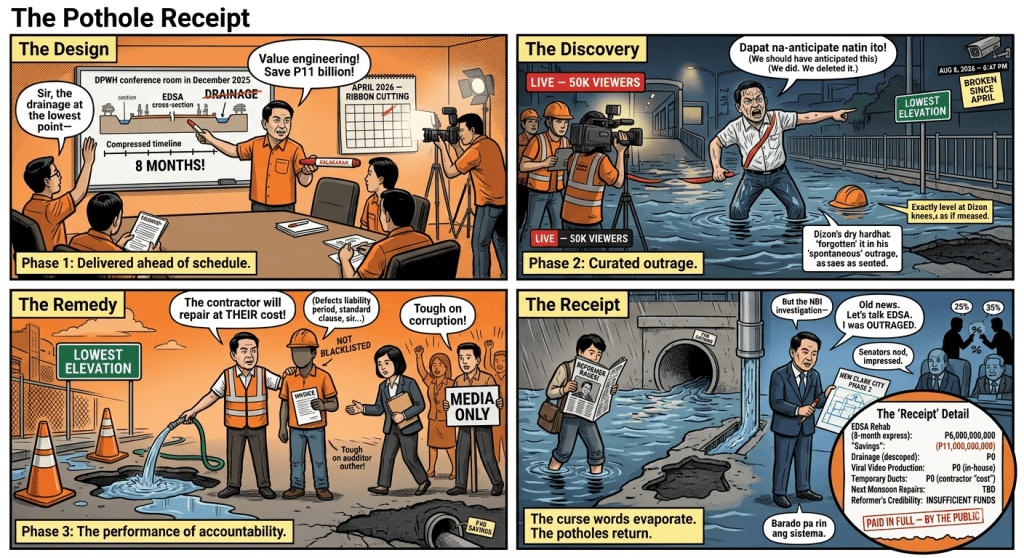
Begin with the engineering, because the engineering is where the lies are most easily counted. Dizon’s own on-camera diagnosis is damning: the EDSA busway near Buendia is the corridor’s lowest point, all water drains toward it, and no median drainage was installed. “Dapat na-anticipate natin ito,” he said. We should have anticipated this. Indeed. The question is why his department didn’t.
Under standard design-bid-build procurement, Department of Public Works and Highways (DPWH) engineers prepare and approve the Detailed Engineering Design (DED) before bidding. The contractor builds to that design. If the DED omitted median drainage at a documented low point, the failure originated inside DPWH, not at the contractor’s mixing plant. Either way, the department Dizon leads signed off on a road that would inevitably flood. The profanity, however authentic, is a confession made admissible against interest.
Now layer in the procurement. The original rehabilitation was a two-year, P17-billion project. Under Dizon, it was compressed into an eight-month, P6-billion sprint. The “savings” of P11 billion were trumpeted as reformist efficiency. But value engineering has a dark twin called descoping, and drainage works are the classic victim—invisible once paved over, their absence undetectable until the first monsoon. No ribbon-cutting ceremony ever featured a drainage culvert. The political incentive to cut precisely what cannot be seen is not brown-envelope corruption. It is career-advancement corruption. It produces the same potholes.
Phase 1 was completed in April 2026. By August, it was riddled with potholes. Under Republic Act 9184, the Government Procurement Reform Act, the Defects Liability Period runs one year from completion. The contractor is legally obligated to repair at its own cost—precisely the remedy Dizon ordered on camera, presenting a standard contractual clause as a hard-won concession. He did not blacklist the contractor. He did not invoke Section 62.2.3.2 of the Government Procurement Reform Act (RA 9184) to attribute structural defects. He did not refer the matter to Commission on Audit (COA). He installed temporary ducts and performed righteous anger. The theater was impeccable. The substance hit no one.
II. Cursing at Symptoms, Protecting Architects: The Dizon Method
Vince Dizon is not a cartoon villain. He is a competent public servant with a record of delivering complex projects, appointed in September 2025 with an explicit mandate to clean house after the Bonoan-era ghost projects. He arrived promising a “full organizational sweep” and lifetime bans for errant contractors. That reformer biography is precisely what makes the EDSA pothole so analytically treacherous.
Reformist credentials are the most effective shield against accountability. When a known corrupt official fails, we demand his head. When a known reformer fails, we demand his explanation—and are too often satisfied with the sincerity of its delivery. Dizon’s profanity-laced video is the apotheosis of this dynamic. Released by DPWH’s own social media team, framed as transparency, it preempted every investigative question with emotional authenticity. Who dares demand an audit when the Secretary is already as outraged as the public? The performance of accountability, executed skillfully, can foreclose the substance of it entirely.
Yet a reformer who presides over a design failure this elementary cannot escape his own position. Dizon possessed every authority to prevent this: mandate heavy-duty standards, require independent testing, enforce multi-year warranties, deploy inspectors with stop-work authority, withhold final acceptance until compliance was verified. One courageous checkmark at any critical decision point would have stopped the scandal. He chose none. He chose substandard specifications, compressed timelines that squeezed out oversight, premature opening without proper inspection, calculated deflection toward the contractor, and deception wrapped in candor’s aesthetic.
And he chose all this while carrying unresolved legal exposure from his BCDA tenure: the New Clark City sports complex, originally P8.51 billion and escalated to P11 billion, whose bidding documentation the NBI had reopened just weeks before the EDSA video. Dizon took a leave of absence in July 2026 to address that scrutiny. He returned to find a camera-ready pothole. The timing is either extraordinarily unlucky or extraordinarily convenient. The official deciding how aggressively to pursue EDSA accountability is simultaneously under active investigative interest for a structurally similar deal. That is not an allegation of guilt. It is a disqualifying structural conflict.
III. The Kalakaran Calculus
The EDSA pothole lands amid a Sandiganbayan trial calendar built around a documented “kalakaran”—a system where DPWH district engineers collected a percentage of every project’s budget before construction began. State witnesses testified that “commitment” rates reached 25% by 2025, with only 30-35% of a project’s nominal budget reaching physical implementation.
No public evidence ties the EDSA contract to that scheme. But the parallel transforms a drainage omission from engineering error into governance emergency. If a quarter of every public works budget is siphoned before a shovel breaks ground, the natural question for any prematurely failing project is whether its costing was subjected to meaningfully different scrutiny. The P17-billion-to-P6-billion scope reduction Dizon advertised as savings could be read as the delta between what was appropriated and what was actually intended for delivery—always calibrated to accommodate commissions. The missing median drainage, in that reading, is not an oversight. It is the arithmetic of the kalakaran made physical.
COA has constitutional authority to conduct a value-for-money audit. It can examine whether drainage works were costed and then dropped, or never costed at all. That Dizon has not voluntarily invited such an audit—that he has instead offered temporary ducts and a contractor-funded patch—is the silence that drowns out the profanity.
IV. The Reckoning
The daily commuter does not need a Cabinet secretary’s performance of righteous fury. The daily commuter needs a road that understands gravity. An audit, not a viral video.
I call for Secretary Vince Dizon’s immediate resignation. Not because he is corrupt—Philippine courts take longer to resolve a case than DPWH takes to build a road that disintegrates—but because he has structurally failed at the mission for which he was anointed: to break the kalakaran, not direct its Broadway adaptation. His unresolved legal exposure from the New Clark City deal makes his continued tenure an active liability. A reformer who cannot submit to the same scrutiny he demands of others is not a reformer. He is a bottleneck in a hard hat, cursing at the plumbing while gripping the wrench behind his back.
I call for transparency—not the curated variety released by a communications team that knew exactly how many retweets a well-timed profanity would harvest, but the documentary kind: published Detailed Engineering Designs, itemized cost breakdowns, inspection reports. Show us who signed off on a lowest point without an outlet. Show us the P11 billion in “savings” in sufficient detail that we can verify anything was saved at all, or merely deferred into next monsoon’s repair budget. Let COA in. Let sunlight perform the disinfection that profanity, however emphatically delivered, structurally cannot.
I call for the strengthening of democratic institutions so they serve the nation, not the network of contractors and bureaucrats who have perfected the dark art of converting public necessity into private opportunity while training the public to mistake volume for virtue. Every reformer faces the Dizon Paradox: build accountability structures that outlast your tenure, or perform accountability in ways that enhance your political viability. The pothole is the receipt proving which choice was made.
To the youth inheriting these roads and the debts incurred to build them: the system can be broken. But not by officials who curse at symptoms while protecting architects. It will be broken by citizens who demand audits with the ferocity of a Secretary’s expletive and the tenacity of a COA fraud examiner on their third cup of coffee.
The curse words will evaporate. The potholes will return. Unless COA opens a file tonight. Unless the DED is published tomorrow. Unless the contractor faces blacklisting, not just a photo opportunity. Unless the public demands the paper trail that transforms the theater of accountability into its architecture.
Barado pa rin ang sistema. But a clogged system clears not with profanity—but with pressure.
May the rule of law rise on the third day. 🪨
— Barok
Key Citations
A. News Articles
- “Dizon curses over potholes at newly rehabilitated Edsa in Makati.” Inquirer.net, 10 Aug. 2026, https://newsinfo.inquirer.net/2281019/dizon-curses-over-potholes-at-newly-rehabilitated-edsa-in-makati.
- “Dizon blows top over fresh EDSA potholes.” The Manila Times, 10 Aug. 2026, https://www.manilatimes.net/2026/08/10/news/dizon-blows-top-over-fresh-edsa-potholes/2401701.
- “Dizon: Edsa rehab to start on Dec. 24, to be finished in 8 months.” Inquirer.net, 17 Dec. 2025, https://newsinfo.inquirer.net/2155853/dizon-edsa-rehab-to-start-in-dec-24-to-be-finished-for-8-months.
- “DPWH nears completion of Edsa phase 1 rehab.” Inquirer.net, 6 Apr. 2026, https://newsinfo.inquirer.net/2207809/dpwh-completes-phase-1-of-edsa-rehab-works.
- “Dizon replaces Bonoan; ‘sweep’ of DPWH ordered.” Inquirer.net, 1 Sept. 2025, https://newsinfo.inquirer.net/2102701/dizon-replaces-bonoan-sweep-of-dpwh-ordered.
- “Dizon on SEAG projects: My conscience is clear.” Philstar.com, 21 July 2026, https://www.philstar.com/headlines/2026/07/21/2543552/dizon-seag-projects-my-conscience-clear.
- “Sandiganbayan Justice Miranda: Bong Revilla ‘indispensable’ in alleged flood control fund misuse.” GMA News Online, 1 Aug. 2026, https://www.gmanetwork.com/news/topstories/nation/997023/sandiganbayan-justice-miranda-bong-revilla-indispensable-in-alleged-flood-control-fund-misuse/story/.
- “Deal to construct P13-B gov’t complex, sports hub at New Clark City questioned.” Inquirer.net, 2 Dec. 2019, https://newsinfo.inquirer.net/1196800/deal-to-construct-p13-b-govt-at-new-clark-city-questioned.
B. Official Documents & Websites
- Republic Act No. 9184. Lawphil, https://lawphil.net/statutes/repacts/ra2003/ra_9184_2003.html.
- Commission on Audit. Official Website, https://www.coa.gov.ph/.
- Department of Public Works and Highways. Official Website, https://www.dpwh.gov.ph/.
- ₱8B BBM Pork: CCTV for Every Captain’s Kumpare?

- ₱8.9 Billion, 331 Ghost Police Stations: The TIKAS Scandal Explained

- ₱8.4 Billion, 42,000 Barangays, 1 Election: The “Bawat Barangay Makikinabang” Vote-Buying Masterclass

- ₱75 Million Heist: Cops Gone Full Bandit

- ₱6.77B Ghost Haunts Duterte: RTC Dismisses Mans Carpio’s Desperate Plea
- ₱6.77 Billion and Zero Cash: The Sara Duterte SALN Math That Doesn’t Add Up

- ₱6.7-Trillion Temptation: The Great Pork Zombie Revival and the “Collegial” Vote-Buying Circus

- ₱58.53B, Zero Receipts: The LGSF Pork Barrel Nobody Wants to Name
- ₱53 Million Man Tells ₱695-a-Day Workers to Stop Being ‘Mayabang’: The Audacity of BSP’s Remolona

- ₱4.4 Billion and a Witness Who Can’t Explain It: The Duterte Impeachment’s Most Expensive Non-Answer
- ₱3.06 Billion for Evacuation Centers—But Nobody Knows Where They’ll Stand (Or If They’ll Exist)
- ₱16 Billion, 280 Accounts, 8 Helicopters: Boying Remulla’s Case Against the Yaps Is Not a Drill







Leave a Reply