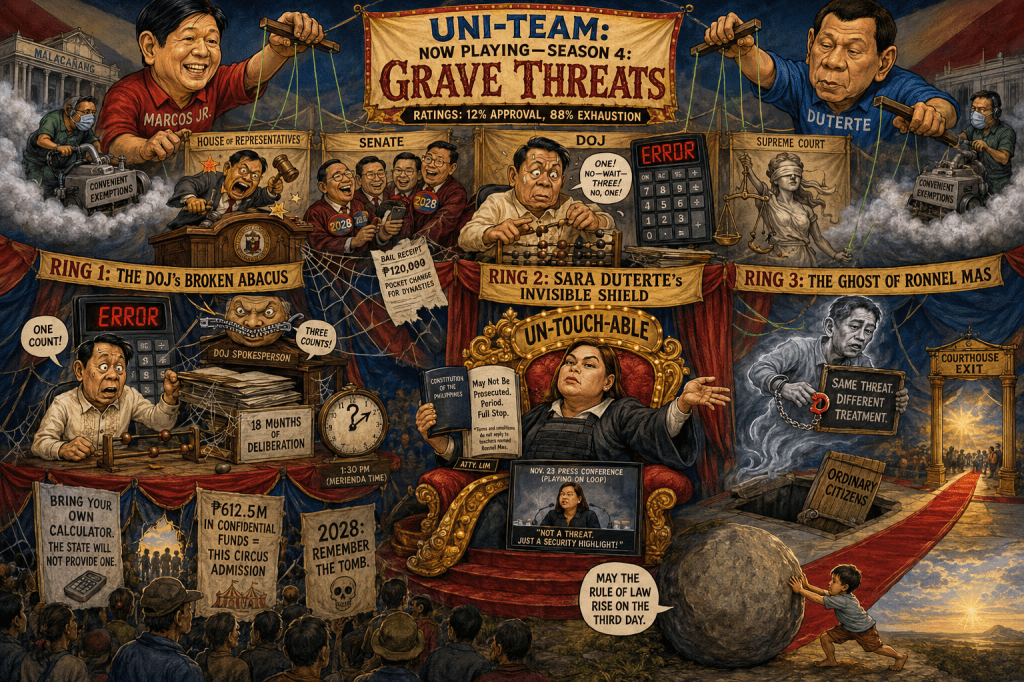
Because Nothing Says “Rule of Law” Like Filing Charges You Can’t Count and Claiming Immunity That Doesn’t Exist
By Louis ‘Barok‘ C. Biraogo — August 12, 2026
LET us begin with the numbers, because apparently the Department of Justice (DOJ) cannot.
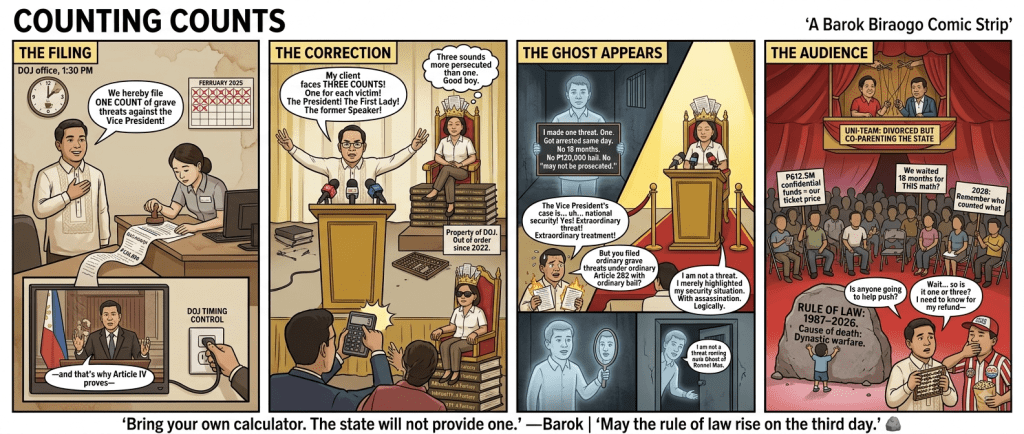
On August 11, 2026, at approximately 1:30 in the afternoon — a time presumably chosen so everyone could still make their merienda — the DOJ filed what its own spokesperson described as one count of grave threats against Vice President Sara Duterte. Bail: ₱120,000. Pocket change for a dynasty.
But across town, Duterte’s counsel, Atty. Paul Lawrence Lim, was telling anyone who would listen that his client was facing three counts. One for each alleged victim: the President, the First Lady, the former Speaker.
How is it possible that the chief prosecutorial arm of the Republic cannot tell us, with a straight face, how many crimes it has just charged the sitting Vice President with? Is it one? Is it three? Did the DOJ’s abacus break? Was there a buy-one-get-two-free promotion on grave threats?
This is not a clerical error. This is a Rorschach test. The DOJ wants “one count” because it sounds routine, ministerial, nothing to see here. The Duterte camp wants “three counts” because it sounds like persecution. Neither side has any incentive to clarify, and so the Filipino people are left to guess how many crimes our Vice President is actually accused of committing.
Welcome to the Marcos-Duterte political war. Bring your own calculator. The state will not provide one.
The Pure Law: Who’s Right?
Let us strip away the theater and examine the pure law. On the pure law, the DOJ commands the stronger position. This is not a close call.
Article XI, Section 3(7) of the 1987 Constitution of the Republic of the Philippines (1987 Constitution) tells us that a party convicted in impeachment “shall nevertheless be liable and subject to prosecution, trial, and punishment according to law.” Read that again: nevertheless liable. The Constitution itself contemplates impeachment and criminal prosecution as separate tracks, running on parallel rails. Impeachment removes; criminal law punishes. Different functions, different standards of proof, different consequences.
Then there is Estrada v. Desierto, where the Supreme Court rejected — flatly, unequivocally — the argument that a public officer must first be convicted in impeachment before facing criminal prosecution. The Court saw the perverse incentive clearly: such a rule would place an impeached-but-not-yet-convicted official in a better position than an ordinary citizen. The Constitution does not create super-citizens. It creates accountable ones.
And then there is the immunity question, which is not really a question at all. Presidential immunity from suit during incumbency has never — not once, not in any Supreme Court decision — been extended to the Vice President. Fr. Joaquin Bernas, a framer of the Constitution, said so explicitly. Every constitutional law textbook says so.
And yet Atty. Lim stands before the cameras and declares that his client “may not be prosecuted.” This is advocacy, not analysis. It is a press release dressed up as a legal argument.
But — and this is where Barok earns his reputation for fairness — a sliver of genuine doctrinal unsettlement deserves to be taken seriously. Estrada v. Desierto involved an impeachment court that had already become functus officio. The Supreme Court did not decide what happens when impeachment is ongoing, when senator-judges are still hearing evidence on the very same conduct, when two constitutional processes grind forward simultaneously on identical facts.
That sequencing question is genuinely open. It is untested. It is serious. Atty. Lim could have said: “The propriety of prosecuting a sitting Vice President while an impeachment trial is actively underway raises profound separation-of-powers concerns that the Supreme Court has not yet squarely addressed.” That would have been true and defensible.
Instead, he said she “may not be prosecuted.” Period. Full stop. This is the difference between lawyering and public relations.
The DOJ’s Self-Inflicted Wounds
But if the Duterte camp overclaims the law, the DOJ undermines its own institutional credibility through sloppiness and indiscipline.
Start with the count discrepancy. When you are filing criminal charges against the second-highest official in the land, in the middle of an impeachment trial, with the entire nation watching, you do not fumble the question of how many crimes you are actually charging. This is an unforced error of the first order.
Then there is the “mastermind” problem. More than a year before charges were filed, a senior DOJ official stood before the cameras and branded Duterte a “self-confessed mastermind” of an assassination plot — while the preliminary investigation was still pending, before probable cause had been formally found. This is a high-ranking prosecutor, bound by the Code of Professional Responsibility and Accountability (CPRA),, publicly prejudging the guilt of a person entitled to the constitutional presumption of innocence. The Duterte camp has a genuine process-fairness complaint here, and it is considerably stronger than their impeachable-officer argument.
And the timing. Eighteen months. That is how long the National Bureau of Investigation (NBI)’s complaint sat in the DOJ’s inbox — February 2025 to August 2026 — for a case whose core evidence is a video recording both sides agree exists. And then, what a coincidence: the charges are filed exactly two weeks after House prosecutors rested their evidence-in-chief on Article IV of the impeachment complaint, precisely when the Senate trial’s burden shifted to the defense.
Maybe it was diligence. Maybe the filing was calibrated for maximum political effect, a prosecutorial exclamation point timed to remind senator-judges that Article IV is serious enough to warrant an actual criminal case. The public record does not let us settle this definitively, and that irreducible ambiguity is itself the indictment.
The Ronnel Mas Ghost
And then there is the ghost in the room. His name is Ronnel Mas. Public schoolteacher. Allegedly made a threat against a public figure. He was taken into custody. He did not get eighteen months of deliberation. He did not get a carefully worded press statement about the presumption of innocence. He got arrested.
The Duterte camp has raised this comparison, and it is rhetorically devastating not because it is legally precise — the facts differ — but because it forces a question the administration cannot answer cleanly: Why does a teacher face immediate consequences while a Vice President gets the full red-carpet treatment?
Malacañang’s response has been to argue that Duterte’s case is a “national security” matter. But the DOJ didn’t file a national security charge. It filed an ordinary grave threats complaint under Article 282 of Act No. 3815 (Revised Penal Code), with the standard cybercrime enhancement, with bail at ₱120,000. You cannot have it both ways, Malacañang. Either this is an extraordinary threat requiring extraordinary treatment, or it is an ordinary crime proceeding through ordinary channels. Pick one.
The Bigger Cancer: Dynastic Warfare as Governance
But let us zoom out, because this case is not really about Article 282. It is about two dynasties that have decided the state is their personal battleground, and the rest of us are just spectators.
Cast your mind back to 2022. The UniTeam. Marcos and Duterte, together, promising unity. It was a political marriage of convenience, and like most marriages of convenience, it collapsed the moment convenience was no longer mutual. The confidential funds controversy. The “toxic” relationship. The imagined beheading. The International Criminal Court (ICC) arrest of Rodrigo Duterte, which the Marcos administration facilitated and then tried to distance itself from. The first impeachment, voided by the Supreme Court. The second impeachment, now grinding through the Senate. And now, the criminal case.
This is not governance. This is a telenovela with a body count.
Both dynasties have weaponized every institution they can reach. The House, where impeachment complaints are fast-tracked or slow-walked depending on whose ally holds the gavel. The DOJ, where probable cause findings appear to coincide conveniently with the Senate trial calendar. The Senate itself, where senator-judges calculate their votes based not on evidence but on 2028 electoral prospects. Every agency, every constitutional body has been reduced to a piece on someone’s chessboard.
And all the while, the Filipino people — the ones without dynastic surnames, who cannot afford ₱120,000 bail, who wait in line at public hospitals and send their children to overcrowded schools — are told to pick a side. To cheer for Team Marcos or Team Duterte as if this were a basketball game, as if the erosion of every democratic institution were just entertainment.
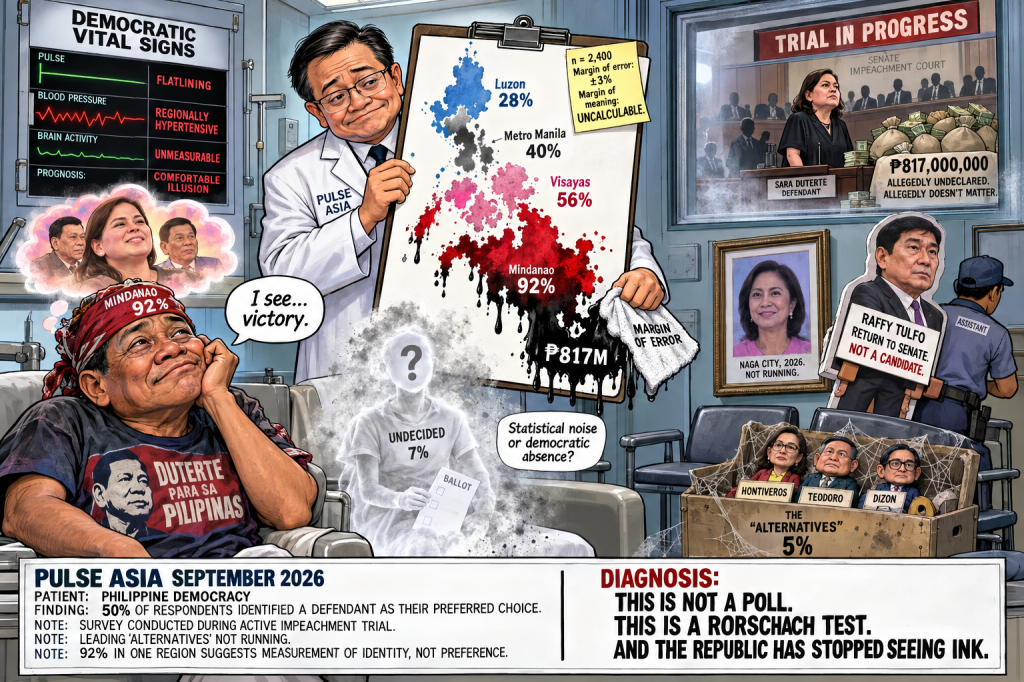
The rule of law has been beaten so badly it needs an ICU bed. Separation of powers collapses the moment a filing deadline can be weaponized to influence a Senate vote. The P612.5 million in confidential funds that started this whole chain of events remains largely unaccounted for, shrouded in the convenient fog of “national security” exemptions, while both camps point fingers and auditors drown in paper.
This is the toxic legacy of the Marcos-Duterte war: the systematic, multi-generational dismantling of every institution that stands between the Filipino people and the unfiltered exercise of raw dynastic power.
The youth of this land are watching. They are watching a Vice President claim she cannot be prosecuted because her title shields her from the law. They are watching a DOJ that cannot count to three. They are watching their future being auctioned to the highest dynastic bidder.
What Is to Be Done?
To the DOJ: Clarify, immediately, how many counts you have actually filed. Publish the Informations. Impose a gag rule on your officials. No more “mastermind” statements. You are prosecutors, not pundits. Act like it.
To the Duterte camp: Raise your jurisdictional objections. Pursue your certiorari petition. The sequencing question deserves to be settled. But stop telling the public the Vice President “may not be prosecuted.” That is not what the law says. Address the substance of the November 23 recording. The Filipino people deserve an answer that does not sound like a press release.
To the Senate impeachment court: Explicitly reaffirm that the criminal filing has no bearing on your proceedings. Your verdict must be based on the evidence before you, not on the executive branch’s charging calendar.
To the Supreme Court: Take the case when it comes. Estrada v. Desierto left a gap. Fill it. Tell the nation whether an ongoing impeachment trial bars, stays, or has no effect on a parallel criminal prosecution. Do not hide behind ripeness doctrines. This is your moment to strengthen the rule of law.
To the Marcos and Duterte camps: Compete fairly. Respect the Constitution. Prioritize national interest over dynastic gain. Speak truthfully. Accept institutional outcomes. The country you are burning down for the sake of 2028 is the same country your children will inherit.
To the Filipino people: Do not let them make you choose between two dynasties. The choice is false. The future belongs to you. Demand transparency. Demand accountability. And in 2028, remember who spent 2026 treating the Constitution like a suggestion and the rule of law like an obstacle.
Coda: The Stone
Philippine democracy, in this August of 2026, looks a great deal like a corpse. Beaten by dynastic warfare. Starved of institutional integrity. The stone is very large. The tomb is very dark.
But stones have been rolled away before. The rule of law has a stubborn habit of resurrecting when it is least expected, when the cynics have written the obituaries, when the powerful have convinced themselves they are beyond its reach.
The question is not whether the stone will move. The question is who will push it. The courts? The Senate? The people? Or will we all stand around the tomb, arguing about how many counts are on the charge sheet, while the dynasties dance on the grave of our democracy?
May the rule of law rise on the third day. 🪨
— Barok
Key Citations
A. Legal & Official Sources
- The 1987 Constitution of the Republic of the Philippines. Official Gazette of the Republic of the Philippines, 1987, http://www.officialgazette.gov.ph/constitutions/1987-constitution/.
- Article XI of the 1987 Constitution of the Republic of the Philippines. Official Gazette of the Republic of the Philippines, http://www.officialgazette.gov.ph/constitutions/the-1987-constitution-of-the-republic-of-the-philippines/the-1987-constitution-of-the-republic-of-the-philippines-article-xi/.
- Estrada v. Desierto. G.R. Nos. 146710-15, Supreme Court of the Philippines, 2 Mar. 2001, lawphil.net/judjuris/juri2001/mar2001/gr_146710_2001.html.
- Act No. 3815. The Revised Penal Code. 8 Dec. 1930, lawphil.net/statutes/acts/act1930/act_3815_1930.html.
- A.M. No. 22-09-01-SC. Code of Professional Responsibility and Accountability. Supreme Court of the Philippines, 11 Apr. 2023, sc.judiciary.gov.ph/22-09-01-sc-code-of-professional-responsibility-and-accountability/.
B. News Reports
- Bolledo, Jairo. “Grave threats case filed vs Sara Duterte over assassination remarks.” Rappler, 11 Aug. 2026, http://www.rappler.com/philippines/sara-duterte-grave-threats-case-assassination-remarks-marcos-filed/.
- “DOJ files grave threats vs. Sara Duterte.” GMA News Online, GMA Network, 11 Aug. 2026, http://www.gmanetwork.com/news/topstories/nation/998144/doj-grave-threats-sara-duterte/story/.
- “Prosecutors: VP’s threat mirrors teacher’s over Duterte bounty.” Inquirer.net, 13 July 2026, newsinfo.inquirer.net/2262982/prosecutors-vps-threat-mirrors-teachers-arrest-over-duterte-bounty.
- “Ang Hirap Maging Mahirap”: The PAO Scandal That Proves Government Contempt Is Nothing New

- “Far-Off” My Axx: Malacañang’s Claire Castro Drowns in Her Own Legal Gaslighting
- “Forthwith” to Farce: How the Senate is Killing Impeachment—And Why Enrile’s Right (Even If You Can’t Trust Him)

- “HINDI AKO NAG-RESIGN!”

- “I Know Nothing”: Baste Duterte’s Amnesia Defense Meets ₱33M in GenCorp Contracts

- “I’m calling you from my new Globe SIM. Send load!”

- “Mahiya Naman Kayo!” Marcos’ Anti-Corruption Vow Faces a Flood of Doubt

- “Manageable” Debt, Unmanageable Lies: DBM’s ₱21 Trillion Fairy Tale

- “Meow, I’m calling you from my new Globe SIM!”

- “Natrabaho”: One Word, One Ombudsman, and a Judiciary on Trial

- “No Special Jail for Crooks!” Boying Remulla Slams VIP Perks for Flood Scammers

- “Philippine-Controlled” or Yankee Gas Station? The Davao Fuel Depot Farce Exposed







Leave a Reply